
中央经济工作会议

Search documents
结合实际,领会做好新形势下经济工作的规律性认识——论学习贯彻中央经济工作会议精神
Ren Min Ri Bao· 2025-12-15 01:37
Core Viewpoint - The article emphasizes the importance of understanding and applying economic laws as a key experience for governance, highlighting five essential principles for economic work during the 14th Five-Year Plan period, which are aimed at achieving effective economic and social development in the new context [1][4]. Group 1: Economic Potential and Policy Support - Fully tapping into economic potential involves leveraging advantages such as a complete industrial system and a large market scale to convert potential into driving force [2]. - The necessity of combining policy support with reform and innovation is underscored, aiming to address both old problems and new challenges while enhancing the macroeconomic governance system [3][4]. - The implementation of proactive macro policies is crucial, focusing on enhancing the foresight, targeting, and coordination of policies to stabilize and improve economic performance [4]. Group 2: Reform and Innovation - The article discusses the importance of reform measures that have been effective in releasing market vitality, such as the establishment of a unified national market and the introduction of new laws to support the private economy [3]. - It highlights the need for comprehensive policy measures to address intertwined cyclical, structural, and institutional issues in the economy, advocating for a balance between macro policy adjustments and deepening reforms [3][4]. - Specific tasks for reform and innovation are outlined, including fostering new growth drivers and enhancing the dynamism of high-quality development [4]. Group 3: Strategic Importance of the 14th Five-Year Plan - The 14th Five-Year Plan period is identified as a critical time for laying the foundation for socialist modernization and achieving significant breakthroughs in strategic tasks related to Chinese-style modernization [4]. - The article stresses that understanding the "five musts" and applying them in practice will lead to a good start for the 14th Five-Year Plan, enhancing the country's resilience, competitiveness, and sustainable development [4].
【申万宏源策略】周度研究成果(12.8-12.14)
申万宏源研究· 2025-12-15 01:18
Group 1: Macro Environment and Market Outlook - The macro environment for A-shares has "returned" since late November, but the upward space remains limited, with concerns about the capital expenditure decline of US tech giants in 2026 and pressure on the AI industry chain [7] - The Central Economic Work Conference emphasizes internal strengthening to cope with external challenges, indicating limited short-term expectations for A-share style characteristics [7] - The mid-term judgment remains a "two-stage bull market," with the current phase (Bull Market 1.0) at a high level and a potential Bull Market 2.0 expected in the second half of 2026, driven by various positive factors [8] Group 2: Industry Valuation and Comparison - As of December 12, 2025, the valuation metrics for major indices are as follows: - CSI All Share (excluding ST) PE at 21x, PB at 1.8x, at historical percentiles of 77% and 39% - SSE 50 PE at 11.7x, PB at 1.3x, at historical percentiles of 62% and 40% - CSI 300 PE at 13.9x, PB at 1.4x, at historical percentiles of 61% and 31% - CSI 500 PE at 32.7x, PB at 2.2x, at historical percentiles of 61% and 45% - ChiNext Index PE at 40.7x, PB at 5.2x, at historical percentiles of 35% and 59% [11][12] - Industries with PE valuations above the 85th percentile include real estate, retail, and IT services, while the healthcare sector is below the 15th percentile for both PE and PB [11] Group 3: Global Asset Allocation - The US Federal Reserve announced a 25 basis point rate cut, bringing the target range for the federal funds rate to 3.50%-3.75%, indicating a complex policy signal that has led to mixed movements in global equities and commodities [14] - The focus on achieving reasonable growth was reiterated in the December 2025 Political Bureau meeting, emphasizing the need for proactive fiscal and moderate monetary policies [15][16]


新起点、新动能、新机遇——国际人士瞩目中央经济工作会议为世界注入确定性
Jing Ji Ri Bao· 2025-12-14 22:30
Core Viewpoint - The recent Central Economic Work Conference in Beijing has set the direction for China's economy, aiming to provide stability and opportunities for the global economy amidst uncertainties [1][2]. Economic Outlook - The conference highlighted that the main economic and social development goals for 2025 will be successfully completed, marking a strong start for the new "15th Five-Year Plan" [2]. - International organizations have raised China's economic growth forecasts for 2025 by 0.4, 0.2, 0.1, and 0.1 percentage points respectively, reflecting growing confidence in China's economic resilience [3]. Policy Focus - The conference emphasized the need to fully tap into economic potential, combining policy support with reform and innovation, and focusing on both material and human investment [3]. - Key tasks for the upcoming year include innovation-driven development, expanding domestic demand, and enhancing the quality of life for citizens [4][9]. New Growth Drivers - The conference underscored the importance of innovation and the establishment of international technology innovation centers in major regions like Beijing, Shanghai, and the Guangdong-Hong Kong-Macau Greater Bay Area [7]. - A strong domestic market is identified as a strategic foundation for modernization, with specific actions to boost consumption and stabilize investment [9]. Global Cooperation - The launch of the Hainan Free Trade Port is a significant step towards high-level opening up and promoting an open world economy [10]. - The conference outlined eight key tasks for the next year, with a strong emphasis on expanding international cooperation and optimizing free trade zones [10][11]. Market Potential - China's expanding market access in various sectors, including finance, automotive, and digital services, is creating a more predictable and transparent environment for foreign investment [11]. - The growth of e-commerce and logistics in China is facilitating easier access for international products, enhancing opportunities for global businesses [11][12].
市政府召开第174次常务会议:传达学习贯彻中央经济工作会议精神,研究部署加快培育发展开源鸿蒙生态、建设全球性国际邮政快递枢纽、食品药品安全等工作
Chang Jiang Ri Bao· 2025-12-14 06:34
Core Insights - The meeting emphasized the importance of implementing the spirit of the Central Economic Work Conference and related meetings, focusing on economic and social development for the upcoming year [2] Group 1: Economic Development Strategies - The government aims to stimulate domestic demand, promote consumption and investment, and ensure a positive interaction between supply and demand [2] - There is a commitment to integrate and serve the national unified market, fostering innovation and deepening the integration of technology and industry [2] - The plan includes the development of a modern industrial cluster known as "965" and the promotion of new productive forces tailored to local conditions [2] Group 2: Infrastructure and Logistics - The meeting highlighted the need to leverage Wuhan's advantages as a comprehensive transportation hub to develop a global international postal and express delivery hub [3] - The strategy includes the coordinated development of Tianhe Airport and Huahu Airport as dual hubs for international air cargo and passenger transport [3] Group 3: Food and Drug Safety - There is a strong emphasis on implementing stringent safety regulations across the food and drug supply chain, enhancing collaborative efforts, and improving smart regulatory efficiency [3] - The initiative aims to establish a comprehensive traceability system for food and drugs to ensure public safety [3] Group 4: Environmental Management - The meeting called for the establishment of a non-site regulatory enforcement system focused on automatic monitoring of pollution sources to enhance ecological governance [3]
2025年中央经济工作会议学习心得:挖掘潜能,苦练内功
Changjiang Securities· 2025-12-13 09:15
Group 1: Economic Policy Directions - The meeting proposed five new "musts," which are an iteration of last year's five "musts," reflecting a deeper understanding of economic work[16] - Fiscal policy continues to be described as "more proactive," focusing on improving fiscal revenue, maintaining debt intensity, and optimizing expenditure structure[18] - Monetary policy remains "appropriately loose," with an emphasis on policy effectiveness, balancing between broad money supply and credit[22] Group 2: Key Economic Tasks - Expanding domestic demand remains the top priority, with expectations for a "rural and urban resident income increase plan" and efforts to stabilize investment[24] - Risk prevention in key areas, particularly in real estate, focuses on stabilizing housing prices and improving supply-demand dynamics, with "deepening housing fund system reform" as a major highlight for next year[28]
农业银行尾盘暴拉,再现股民神预测,发生了什么?
Xin Lang Cai Jing· 2025-12-12 14:21
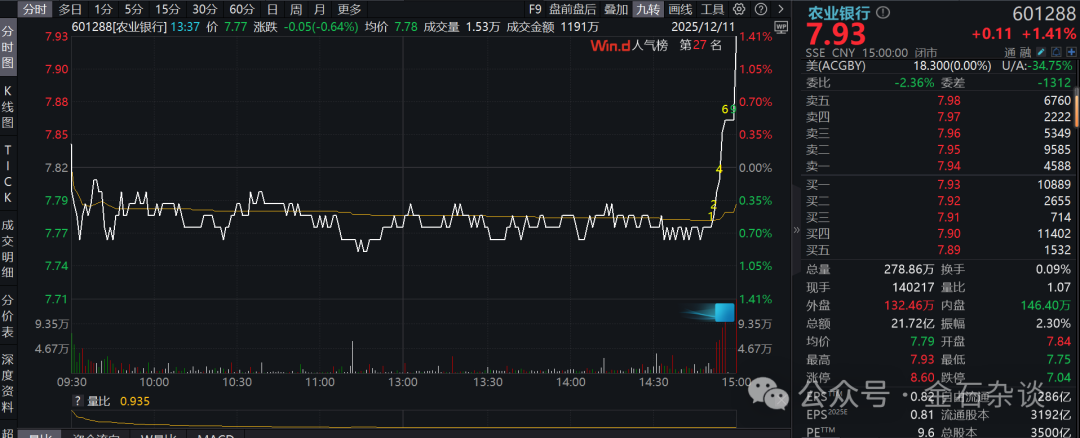
Core Viewpoint - Agricultural Bank experienced a significant surge in stock price during the last 10 minutes of trading on December 11, rising from a decline of 0.7% to an increase of 1.41%, with 100 million yuan entering the market in that short period [1][14]. Group 1: Market Reactions - Investors humorously speculated on the reasons behind Agricultural Bank's surge, suggesting it might be due to extraordinary events like discovering lithium mines or plans for space expansion [3][16]. - Many investors were curious about the identity of the entities driving the price increase, with some suggesting it could be a balancing tool for indices or mysterious funds supporting the market [3][16]. Group 2: Broader Market Trends - The surge was not limited to Agricultural Bank; other major banks, insurance stocks, and even liquor stocks also saw price increases, indicating a broader market trend [6][10]. - Industrial and Commercial Bank also rose from a decline of 0.76% during the same period, reflecting a general recovery among financial institutions [6][18]. Group 3: Index Adjustments and Speculations - There was speculation that the price movements were related to upcoming index adjustments, but analysts indicated that the adjustments would not take effect until December 12, making this unlikely [9][24]. - Analysts proposed three potential reasons for the price surge: institutional investors reacting to the upcoming Central Economic Work Conference, mysterious funds supporting the market, and a shift of funds from small-cap to large-cap stocks due to new quantitative regulations [13][26].

山东省委常委会召开扩大会议,传达学习中央经济工作会议精神
Xin Lang Cai Jing· 2025-12-12 14:19
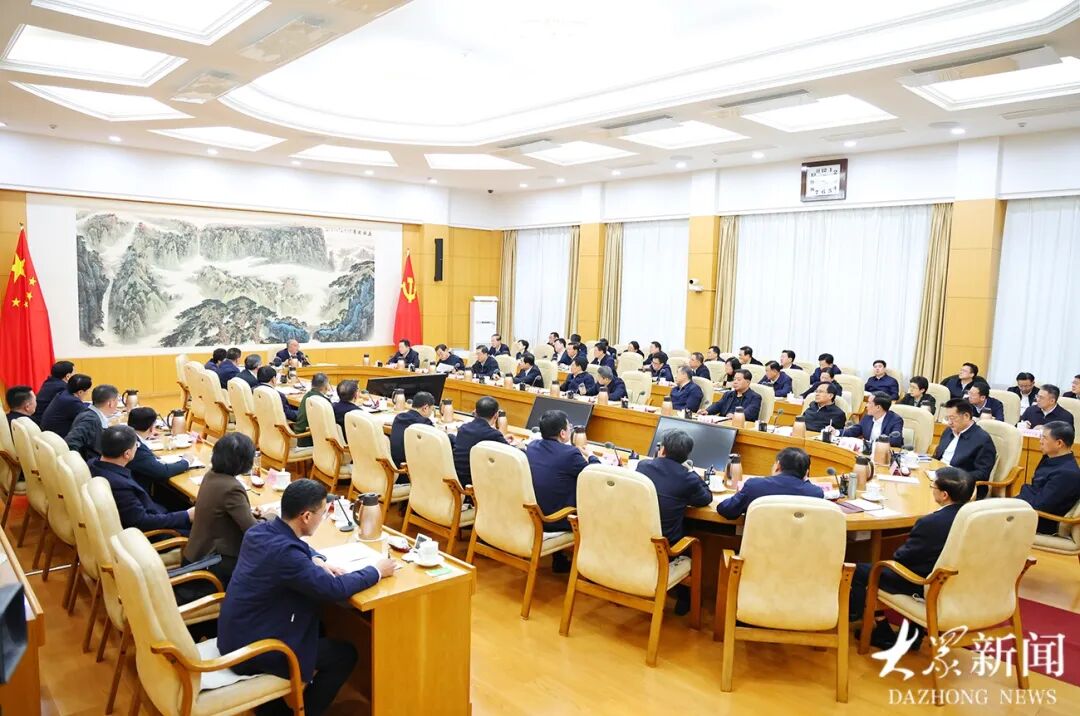
省委常委会扩大会议传达学习中央经济工作会议精神 坚定扛牢经济大省挑大梁责任担当 努力为全国大局多作贡献 (来源:山东工商联) (来源:山东工商联) 省委常委会扩大会议传达学习中央经济工作会议精神 坚定扛牢经济大省挑大梁责任担当 努力为全国大局多作贡献 12月12日,省委常委会召开扩大会议,传达学习习近平总书记在中央经济工作会议上的重要讲话和李强总理总结讲话,研究我省贯彻落实意见。 12月12日,省委常委会召开扩大会议,传达学习习近平总书记在中央经济工作会议上的重要讲话和李强总理总结讲话,研究我省贯彻落实意见。 省委书记林武主持会议并讲话。 会议指出,这次中央经济工作会议,是在"十四五"即将圆满收官、"十五五"即将开启的重要历史节点上,召开的一次十分重要的会议,对于我们坚定信 心、奋发有为,实现"十五五"良好开局具有重大而深远的意义。习近平总书记的重要讲话,全面总结成绩,深入分析形势,科学谋划目标,系统部署任 务,深刻阐述了一系列事关经济社会发展的重大理论和实践问题,丰富和发展了习近平经济思想,为我们做好工作提供了根本遵循。李强总理就贯彻落实 习近平总书记重要讲话精神、做好明年经济工作提出要求,具有很强的针对性 ...
近三次中央经济工作会议政策要点梳理:2025年中央经济工作会议政策要点梳理-20251212
Guo Tou Qi Huo· 2025-12-12 13:16
免责声明 本研究报告由国投期货有限公司撰写,研究报告中所提供的信息仅供参考。报告根据国际和行业通行的准则,以合 法渠道获得这些信息,尽可能保证可靠、准确和完整,但并不保证报告所述信息的准确性和完整性。本报告不能作 为投资研究决策的依据,不能作为道义的、责任的和法律的依据或者凭证,无论是否已经明示或者暗示。国投期货 有限公司将随时补充、更正和修订有关信息,但不保证及时发布。对于本报告所提供信息所导致的任何直接的或者 间接的投资盈亏后果不承担任何责任。 都泓佳 Z0017641 黄恬 Z0021089 表:近三次中央经济工作会议政策要点梳理 | 2025中央经济工作会议 | 2024中央经济工作会议 | 2023中央经济工作会议 | 经济社会发展主要目标将顺利完成。 | | | | | | --- | --- | --- | --- | --- | --- | --- | --- | | 我国经济顶压前行、向新向优发展, | 现代化产业体系建设持续推进,改革 | 经济社会发展主要目标任务即将顺利完 | 开放迈出新步伐,重点领域风险化解 | | | | | | 成。当前外部环境变化带来的不利影响 | 取得积极进展, ...
进出口银行党委传达学习中央经济工作会议精神
Xin Lang Cai Jing· 2025-12-12 12:17
来源:进出口银行 12月12日,进出口银行在京召开党委(扩大)会议,传达学习中央经济工作会议精神,按照全国金融系 统工作会议的要求,研究部署贯彻落实举措。党委书记、董事长陈怀宇主持会议并讲话,其他党委成员 出席会议。 会议认为,习近平总书记在中央经济工作会议上的重要讲话思想深邃、内涵丰富,站在强国建设、民族 复兴的战略高度,深刻洞察国内国际形势,对做好经济工作的规律性认识不断深化,对"十五五"开局之 年经济工作的战略部署指向明确,是马克思主义政治经济学中国化的最新成果,为开创中国式现代化新 局面提供了根本遵循。 会议指出,今年是"十四五"规划收官之年,以习近平同志为核心的党中央团结带领全党全国各族人民迎 难而上、奋力拼搏,推动中国经济巨轮无惧风雨、破浪前行,展现强大韧性和活力。全行上下要深刻领 会今年和"十四五"时期我国经济社会发展取得的巨大成就,深刻领悟"两个确立"的决定性意义,增 强"四个意识"、坚定"四个自信"、做到"两个维护"。 会议要求,要把学习贯彻中央经济工作会议精神作为当前和今后一个时期的重大政治任务,准确把握经 济工作面临的形势和主要目标任务,紧紧围绕金融工作主线,找准进出口银行工作的结合点和 ...