
价格倒挂

Search documents
汽车流通业危机四伏,超半数经销商赔本赚吆喝
Zhong Guo Qi Che Bao Wang· 2025-09-01 01:24
Core Insights - The automotive distribution industry in China is facing significant challenges, with only 30% of dealers meeting sales targets and over 50% experiencing losses [3][4][8] - Despite a 10.8% year-on-year increase in passenger car sales to 10.9 million units, the profitability of dealers has deteriorated, indicating a troubling trend in the automotive market [3][4] Dealer Satisfaction and Performance - Overall dealer satisfaction has dropped from 79.6 to 64.7, primarily due to increased operational pressures and a significant rise in price inversion, which erodes profit margins [4][5] - Only 30.3% of dealers achieved their sales targets, with 29% of dealers falling below a 70% target completion rate [5][8] Financial Performance and Profitability - The loss ratio among dealers has risen to 52.6%, with only 29.9% reporting profits, marking a further decline in dealer viability compared to the previous year [8][11] - New energy independent brand dealers show better financial health, with a profit ratio of 42.9%, compared to 25.6% for traditional fuel vehicle dealers [8][9] Revenue Streams and Margins - The gross margin contributions from new car sales, after-sales, and financial insurance are -22.3%, 63.8%, and 36.2% respectively, indicating a severe loss in new car sales [9][10] - New energy independent brand dealers have a gross margin contribution of 16.8% from new car sales, showcasing a more favorable performance compared to traditional brands [9] Price Inversion and Dealer Concerns - A staggering 74.4% of dealers are experiencing price inversion, with 43.6% facing a price inversion exceeding 15%, which poses a serious risk to their financial stability [11] - Dealers are calling for manufacturers to set more reasonable sales targets and pricing strategies to alleviate the pressure caused by price inversion [10][11] Future Outlook - Dealers anticipate a slight growth or stability in the market for the second half of 2025, but the optimism is less than that observed at the end of 2024, with 49% expecting an increase in annual sales [11]


白酒强势反攻涨超2%,形势看似一片大好,背后真相真有这么简单?
Sou Hu Cai Jing· 2025-08-30 02:06
Core Viewpoint - The white liquor sector has shown a remarkable upward trend, with the index rising over 2%, driven by significant stock performances from companies like Jinhui Liquor and Shede Liquor, despite underlying inventory pressures that equate to 3 to 6 months of sales [1][2][4]. Market Performance - On August 29, the white liquor stocks surged, with the Tonghuashun white liquor index surpassing a 2% increase. Jinhui Liquor led with over a 6% rise, while Shede Liquor and Gujing Gongjiu followed with increases of over 4% [2]. - Major brands like Guizhou Moutai also demonstrated resilience, with a 1.36% increase, maintaining a strong position above the 1,000 yuan mark [2]. Fund Movements - Central Huijin, representing the "national team," significantly increased its holdings in the white liquor ETF by 121 million shares in the first half of the year, raising its total to 581 million shares, making it the third-largest holder of this ETF [4]. - The overall market performance in August saw the Tonghuashun white liquor index accumulate a rise of over 13% [4]. Valuation and Policy Support - The current price-to-earnings (PE) ratio for the white liquor sector stands at 19.83, marking a near ten-year low, with individual companies like Guizhou Moutai at a dynamic PE of 24 and Wuliangye at 17, both below historical averages, indicating significant valuation appeal [6]. - Recent government policies aimed at stimulating consumption and addressing unreasonable restrictions on the liquor industry have provided positive signals for the market [6]. Fundamental Improvements and Seasonal Recovery - There are signs of marginal improvement in the fundamentals, particularly with the recovery of banquet and gift consumption since late July, especially in the sub-300 yuan price range [7]. - The upcoming Mid-Autumn Festival and National Day are expected to catalyze demand, enhancing sales momentum [7]. Changing Fund Preferences and Shareholder Returns - Fund preferences are shifting as leading liquor companies increase dividend rates and implement stock buybacks, with dividend yields for major firms exceeding 3.5%, appealing to long-term investors seeking stable returns [10]. Ongoing Challenges - Despite positive market signals, underlying issues such as weak consumer spending persist, with a reported 2.1% year-on-year growth in per capita consumption expenditure in Q1 2025, impacting sales, particularly in high-end products [11]. - Inventory levels remain a significant challenge, with some mainstream brands holding stock equivalent to 3 to 6 months of normal sales, and production figures showing a 5.8% decline year-on-year [11]. - Price discrepancies continue, with major products like Wuliangye's mainstream offerings trading at 12.5% below factory prices, affecting profit margins for distributors [12]. Institutional Perspectives and Future Outlook - Market consensus among institutions shows a belief in a gradual recovery for the white liquor industry, with improved sales and pricing indicators suggesting potential for recovery [13]. - If sales data during the Mid-Autumn Festival exceeds expectations, the mid-range liquor segment may experience a rebound [15]. - Long-term prospects remain strong due to the robust business models of leading companies, although economic stabilization and inventory reduction will take time to materialize [15].



市场价近腰斩后,茅台1935新品告别千元档
Guo Ji Jin Rong Bao· 2025-08-25 13:00
Core Viewpoint - The launch of Moutai 1935 has garnered significant attention in the industry, but the pre-sale performance is disappointing, indicating potential challenges for the product's market acceptance [1][4]. Group 1: Product Launch and Pricing - Moutai 1935 was officially launched for pre-sale on major platforms like JD, Tmall, and Douyin, with a price set at 998 yuan per bottle [1]. - The original suggested retail price for Moutai 1935 was 1188 yuan, but the actual market price has significantly dropped, with offline stores selling it for around 700 yuan and online platforms offering it between 600-700 yuan [6][9]. - The product's packaging has been upgraded, but the quality of the liquor remains unchanged, aiming to stimulate consumer interest [4]. Group 2: Sales Performance - Despite the initial hype, pre-sale numbers are low, with only 1 reservation on JD and 10 sales on Douyin as of the report [1]. - The wholesale price for Moutai 1935 is reported at 680 yuan, leading to minimal profit margins for distributors, as retail prices are only slightly higher [9]. Group 3: Market Context and Competition - Moutai 1935 is seen as a competitor to Wuliangye, but it has struggled with price discrepancies, leading to a market price that has fallen below the thousand yuan mark [6][7]. - The revenue for the sauce-flavored liquor segment, which includes Moutai 1935, has shown a significant slowdown, with a growth rate of only 4.69% compared to previous years where it was above 25% [9].

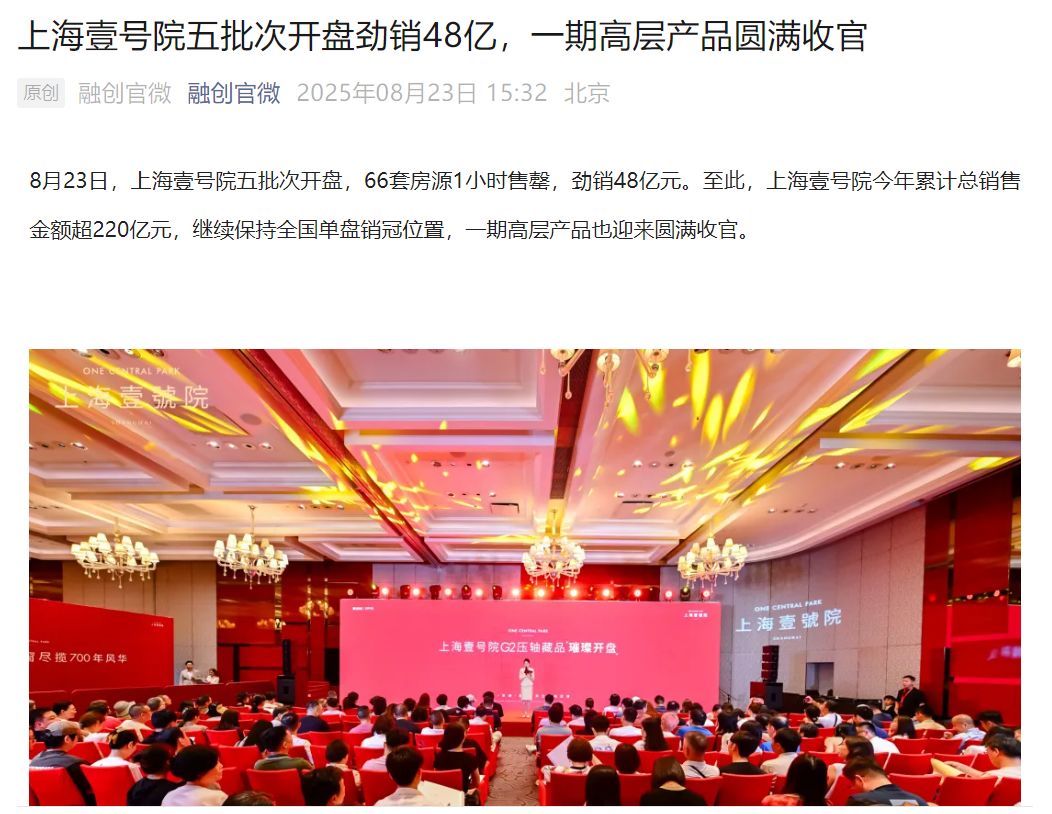
48亿元 1小时售罄!上海一豪宅新房周末刷屏 单价近20万元/平方米
Mei Ri Jing Ji Xin Wen· 2025-08-24 03:42
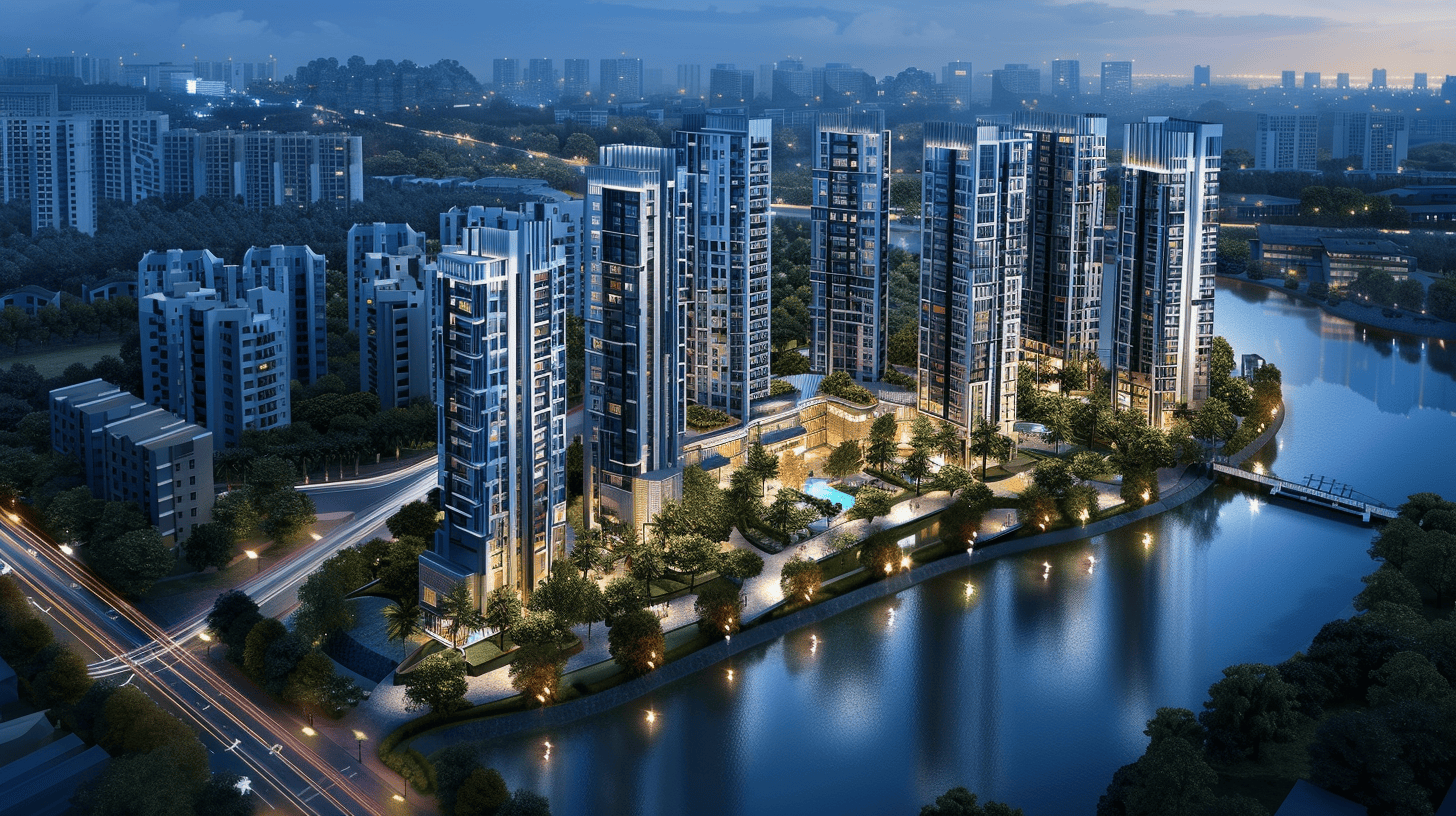
Core Viewpoint - Shanghai Yihao Courtyard continues to dominate the luxury real estate market, achieving significant sales figures and maintaining its position as the top-selling single project in the country [1][4]. Sales Performance - On August 23, 66 units were sold out within one hour, generating sales of 4.8 billion yuan, bringing the total sales for the year to over 22 billion yuan [1]. - Since its initial launch in August 2024, the project has had five sales events, accumulating a total sales amount of approximately 24 billion yuan [4]. - The average selling price has increased from approximately 17,000 yuan per square meter at launch to about 19,800 yuan per square meter in the latest batch, with an average total price of around 73 million yuan per unit [4]. Market Dynamics - The high demand for luxury properties in Shanghai is attributed to the price gap between new developments and existing second-hand properties, which still command higher prices [4]. - The luxury housing market is experiencing a shift in buyer focus towards core urban areas, driven by the potential for property appreciation [5]. - The overall performance of the Shanghai real estate market is influenced by the release of quality projects and the ongoing demand for improved housing options [5]. Price Trends - In July, new residential property prices in first-tier cities decreased by 1.1% year-on-year, with Shanghai being the only city to see an increase of 6.1% year-on-year [6]. - Month-on-month, first-tier cities saw a 0.2% decline in new residential property prices, with Shanghai experiencing a 0.3% increase [6].
上海豪宅日光,单价近20万!
证券时报· 2025-08-23 15:08
Group 1 - The core viewpoint of the articles highlights the strong performance of the luxury real estate market in Shanghai, with significant sales figures and price increases observed in recent months [1][2] - Shanghai's Yihao Courtyard project has achieved a cumulative sales amount exceeding 22 billion yuan this year, with the latest batch of 66 units selling out quickly [1] - The average price of the latest batch of units is approximately 19.8 million yuan per square meter, reflecting a year-on-year increase from the initial average price of 17 million yuan per square meter [1] Group 2 - In the broader context, the National Bureau of Statistics reported that among 70 major cities, only 6 saw new home prices rise month-on-month, indicating a trend of price differentiation across cities [2] - Shanghai's new home prices increased by 0.3%, contrasting with a slight decline in first-tier cities, showcasing the resilience of the luxury market [2] - Analysts attribute the strong performance in Shanghai's real estate market to sustained demand for quality projects and the release of improvement-driven housing needs [2]
超50%亏损,70%未完成销售目标!汽车经销商生存状况进一步恶化
Hua Xia Shi Bao· 2025-08-22 00:39
Core Insights - The report from the China Automobile Dealers Association indicates that the survival rate of automotive dealers is declining, with a loss ratio of 52.6% in the first half of 2025, marking a new high in nearly eight years [3][4] - Only 30.3% of dealers met their sales targets, highlighting significant challenges in the market [9] Financial Performance - The loss ratio among automotive dealers has increased, with 52.6% reporting losses, 17.5% breaking even, and 29.9% making profits [3][4] - New car gross profit contribution is at -22.3%, while after-sales and financial insurance contributions are 63.8% and 36.2% respectively [5][6] Market Conditions - The automotive market is experiencing intense competition, leading to a reliance on price cuts to boost sales, resulting in a situation where sales increase does not translate to revenue growth [4] - 74.4% of dealers are facing price inversion issues, with 43.6% experiencing price inversions exceeding 15% [7][8] Dealer Satisfaction - Dealer satisfaction with manufacturers has dropped to a score of 64.7, the lowest in 14 years, due to price inversions and reduced rewards for meeting sales targets [8] - The average gross profit margin (GP1) for dealers is around -16%, indicating that most dealers cannot achieve profitability through car sales alone [7][8] Inventory and Sales Pressure - The inventory warning index for dealers rose to 56.6 in June 2025, indicating ongoing pressure on cash flow and inventory management [8] - A significant portion of dealers (29%) failed to meet 70% of their sales targets, reflecting the broader challenges in the automotive market [9]

经销商对车企满意度创近14年来最低
Mei Ri Jing Ji Xin Wen· 2025-08-20 12:47
Core Insights - The satisfaction score of automotive dealers towards manufacturers has significantly decreased, reaching the lowest level in nearly 14 years due to multiple operational pressures and increased price inversion [1] Group 1: Price Inversion Issues - Over 74.4% of automotive dealers experienced varying degrees of price inversion, with nearly half facing price inversions exceeding 15% [2] - Severe price inversion has severely impacted dealers' liquidity, leading to increased financial pressure and reduced inventory tolerance [2] - Only 30.3% of dealers met their sales targets, with 29.0% of dealers achieving less than 70% of their targets [2] Group 2: Profitability and Market Conditions - The proportion of dealers reporting losses rose to 52.6%, while only 29.9% reported profits [3] - Independent dealers of new energy vehicles performed better than traditional fuel vehicle dealers, with profit rates of 42.9% compared to 25.6% for traditional brands [3] - The market is characterized by intense competition, with manufacturers and dealers resorting to price cuts to boost sales, resulting in a situation where sales increase does not translate to revenue or profit growth [3] Group 3: Rebate Policy Concerns - Dealers have expressed concerns over complex rebate policies, particularly the high proportion of ambiguous rebates that complicate accurate calculations [4] - The rebate cycle is predominantly 2-3 months, with some manufacturers extending it beyond 3 months, leading to dissatisfaction among dealers [4] - The industry calls for simplified rebate policies, advocating for a single monthly assessment and the elimination of restrictions on rebate usage [4] Group 4: Future Outlook - Dealers' expectations for overall trends in 2025 indicate slight growth or stability, with only 49% anticipating an increase in annual sales, a decline from previous expectations [4]
深圳二手房连续三周成交增长,单周录得1265套,低总价房源占比升至29.1%
Sou Hu Cai Jing· 2025-08-20 07:52
Core Insights - The Shenzhen second-hand housing market showed a positive recovery trend in August, with a recorded 1,265 transactions in the 33rd week, representing a 4.0% week-on-week increase, marking three consecutive weeks of growth [1] - The transaction structure indicates a shift in buyer preferences, with popular areas being Longgang Central City, Nanshan Qianhai, and Longgang Shuangcheng, recording 49, 43, and 41 transactions respectively [3] - The market is witnessing a significant interest in second-hand homes, particularly those priced below 3 million yuan, which accounted for 29.1% of transactions, up 2.5 percentage points from July [3][4] Market Activity - Data from multiple real estate platforms indicate increased market activity, with a 47% year-on-year rise in second-hand residential contracts from August 1 to 17 [3] - The Beike Research Institute reported a 26.3% increase in second-hand home transactions in the last week, with viewings also rising by 16% [3] - The total number of effective second-hand housing listings in Shenzhen was 76,399 as of August 18, showing a slight decrease of 92 listings from the previous week, indicating a potential improvement in supply-demand dynamics [4] Buyer Preferences - There is a growing interest in "new second-hand" homes, typically 5 to 10 years old, due to their price advantages and the absence of waiting for handover [4] - The price drop in many recently launched second-hand housing projects has created a "price inversion" phenomenon, making them more attractive compared to new homes [4] - The market continues to exhibit a trend of "price for volume," but prices for new second-hand homes have shown signs of recovery, reflecting differentiated performance among various property types [4]
52.6%经销商亏损,43.6%陷价格倒挂,新能源盈利率42.9%
Sou Hu Cai Jing· 2025-08-20 06:23
Group 1 - The core issue facing automotive dealers in China is highlighted by a survey indicating that 52.6% of dealers are experiencing financial losses as of the first half of 2025, with only 29.9% reporting profits [1] - Only 30.3% of dealers achieved their sales targets for the first half of the year, with 29.0% of dealers completing less than 70% of their targets [3] - Luxury brand dealers performed better in meeting sales targets compared to joint venture and independent brand dealers, with a higher proportion of joint venture dealers failing to meet their targets [3] Group 2 - A significant 74.4% of dealers are facing price inversion issues, with 43.6% experiencing price drops exceeding 15%, leading to severe cash flow challenges [4] - The strategy of "exchanging price for volume" has resulted in a situation where sales increase does not correspond to revenue or profit growth, with new car sales contributing a negative gross margin of -22.3% [4] - The gross margin contributions from after-sales services and financial insurance are 63.8% and 36.2%, respectively, indicating a reliance on these services for profitability [4] Group 3 - There is a notable divergence in the performance of new energy independent brand dealers versus traditional fuel vehicle dealers, with 42.9% of new energy dealers reporting profits compared to only 25.6% of traditional dealers [5] - New energy dealers show positive gross margin contributions across all business segments, while traditional fuel vehicle dealers report a negative gross margin contribution of -29.1% from new car sales [5] - The rapid growth in demand for new energy vehicles is reflected in a cumulative retail volume of 5.468 million units in the first half of 2025, marking a year-on-year increase of 33.3% [5]

降价换销量,生存状况进一步恶化!超50%汽车经销商亏损
Di Yi Cai Jing· 2025-08-19 22:18
Group 1 - The domestic automotive consumption has shown a mild recovery in the first half of the year, driven by vehicle scrappage and replacement policies, but fierce market competition has led to price cuts by manufacturers and dealers, worsening the survival conditions for dealers [1] - As of August 18, 2025, the loss ratio among automotive dealers has risen to 52.6%, with only 29.9% reporting profits, indicating a challenging environment for dealers [1] - Only 30.3% of dealers met their sales targets in the first half of the year, with 29% of dealers achieving less than 70% of their targets [1] Group 2 - New car sales losses are the biggest challenge for dealers, with 74.4% of dealers experiencing some degree of price inversion, and 43.6% facing price inversions exceeding 15% [1] - The after-sales segment remains the largest contributor to dealers' gross profit, with new car, after-sales, and financial insurance gross profit contributions reported at -22.3%, 63.8%, and 36.2% respectively [1] Group 3 - Independent dealers of new energy brands are performing better than traditional fuel vehicle brands, with profit ratios of 42.9% for new energy dealers compared to 25.6% for traditional fuel dealers [2] - Many 4S stores are shifting to new energy brands, with some luxury brand dealers also transitioning, indicating a strategic shift in the market [2] - The liquidity issues faced by automotive dealers need urgent attention, particularly for traditional fuel brand dealers suffering from severe losses due to price inversions [2] Group 4 - A joint statement from four major associations in the Yangtze River Delta highlighted four prominent issues in the industry, including imbalanced target setting by manufacturers and a distorted rebate system [3] - The rebate cycle from manufacturers to dealers is primarily between 2 to 3 months, with some exceeding 3 months, complicating the financial planning for dealers [3] - Only a few manufacturers provide full cash rebates to dealers, with many using a mix of cash and vehicle purchase credits, leading to difficulties in calculating actual rebates [3]