
国际货币体系

Search documents
美元霸权会在数字货币浪潮中落幕吗?
Sou Hu Cai Jing· 2025-10-04 12:38
Core Viewpoint - The dominance of the US dollar in the international financial system is being challenged by the rise of digital currencies, raising questions about whether digital currencies can ultimately replace the dollar's supremacy [1][5][12] Group 1: Historical Context of Dollar Dominance - The US dollar's dominance was established post-World War II, supported by the Bretton Woods system, which linked the dollar to gold and other currencies to the dollar [3] - Despite the collapse of the Bretton Woods system in the 1970s, the dollar maintained its central role in international trade and finance, bolstered by the US's control over global commodity pricing, particularly oil [3] Group 2: Rise of Digital Currencies - The emergence of decentralized digital currencies like Bitcoin represents a significant shift in the financial landscape, challenging traditional currency concepts with features such as decentralization, anonymity, and immutability [5] - Central Bank Digital Currencies (CBDCs) are being explored by various countries, combining the advantages of digital currencies with the stability of traditional currencies, potentially enhancing payment efficiency and reducing transaction costs [5] Group 3: Potential Challenges to Dollar Supremacy - Digital currencies could theoretically disrupt the dollar's monopoly in the international monetary system, especially if more countries and businesses adopt them for international trade settlements [7] - The speed and cost advantages of digital currencies in cross-border payments present an attractive alternative to traditional banking methods, which rely heavily on the dollar [7] Group 4: Obstacles to Digital Currency Adoption - The entrenched position of the dollar is supported by the US's strong economic, political, and military power, along with the liquidity and stability of its financial markets [8] - The digital currency market faces significant challenges, including price volatility, lack of effective regulation, and risks associated with illicit activities [8] - The promotion and application of CBDCs encounter hurdles such as inconsistent technical standards and incomplete legal frameworks [8] Group 5: Geopolitical and Economic Constraints - The US dollar's dominance is not just an economic issue but also a tool for the US to maintain its global hegemony, leading to potential resistance against the rise of digital currencies [10] - International cooperation on digital currency development is complicated by varying national interests and strategies, creating challenges for global coordination [10] Group 6: Future Outlook - The rise of digital currencies presents both opportunities and challenges for the international monetary system, but the foundation of dollar dominance remains strong [12] - A coexistence of digital currencies and the dollar in the international financial system is likely, with both competing and complementing each other [12]


稳定币的代币特征及其对国际货币体系的影响
Sou Hu Cai Jing· 2025-10-03 15:38
Core Viewpoint - The rapid development of stablecoins, while enhancing cross-border payment efficiency and reducing costs, reveals limitations in their monetary functions, indicating a potential short-term impact on dollarization trends and a long-term inability to disrupt the multi-polar development of the international monetary system [1][2][3]. Group 1: Development of Stablecoins - The emergence of distributed ledger technology has provided the technical foundation for stablecoins, leading to a significant increase in their market size, with an annual growth rate exceeding 100% since 2020 [3][4]. - As of June 2025, the stablecoin market is projected to exceed $250 billion, with on-chain transaction volumes reaching approximately $7 trillion in 2024, accounting for 0.4% of global SWIFT settlement volumes [3][4]. - Stablecoins are increasingly utilized in various sectors, including decentralized finance (DeFi) and virtual economies, serving as a core collateral and payment method [6][8]. Group 2: Characteristics and Limitations of Stablecoins - Stablecoins primarily function as a digital representation of fiat currencies, lacking the essential characteristics of traditional money, such as single currency status, elasticity, and integrity [9][10]. - They exhibit significant scene dependency, primarily functioning within the digital asset ecosystem, and face regulatory challenges in mainstream economic transactions [14][15]. - The stability of stablecoins is relative and relies on market trust rather than institutional guarantees, making them vulnerable to price fluctuations and market sentiment [16][17]. Group 3: Impact on International Monetary System - In the short term, stablecoins may reinforce dollarization trends, particularly in small economies where they serve as a bridge between local currencies and the dollar [18][19]. - The long-term evolution of the international monetary system is expected to remain multi-polar, with stablecoins unlikely to fulfill the roles of a global currency due to inherent structural deficiencies [21][22]. - The introduction of stablecoins may intensify competition among major international currencies, accelerating the evolution of the global monetary landscape [24]. Group 4: Recommendations for China - China should expedite the establishment of a regulatory framework for stablecoins, ensuring compliance and mitigating risks associated with their use [26][27]. - The development of offshore RMB stablecoins is essential to create controllable international payment channels, leveraging Hong Kong's financial infrastructure [28][29]. - Strengthening the collaboration between stablecoins and the digital RMB can enhance the global presence of the RMB in payment systems [29][30]. - Deepening the opening of the bond market will provide more options for stablecoin collateral, supporting the internationalization of the RMB [30][31].
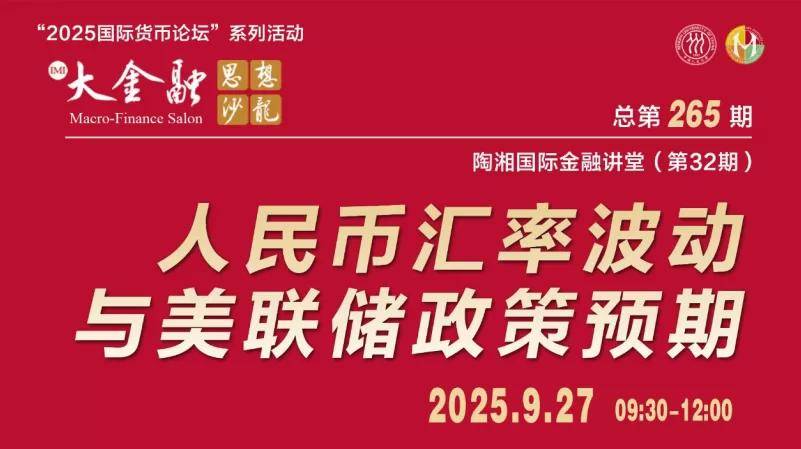
大金融思想沙龙总第265期:人民币汇率波动与美联储政策预期
Sou Hu Cai Jing· 2025-09-29 01:03
Core Insights - The conference focused on the theme "Fluctuations of the RMB Exchange Rate and Expectations of Federal Reserve Policies" [1] - Key speakers included Guan Tao, Chief Economist at Zhongyin Securities, and other experts discussing the implications of U.S. monetary policy on the RMB [1][3] Group 1: RMB Exchange Rate Outlook - The RMB is expected to appreciate against the USD by 2025 due to various factors, including a decline in the USD index by 9.5% in the first nine months of 2023 and improvements in the Chinese economy [3][4] - Factors supporting the RMB include the Federal Reserve's interest rate cuts, a weakened USD credibility, and positive economic indicators from China [3][4] - The current RMB exchange rate is not significantly deviating from its equilibrium, with no substantial appreciation pressure observed [4] Group 2: Federal Reserve Policy Impact - The Federal Reserve began a rate-cutting cycle in September 2023, which is expected to influence global liquidity and capital flows, benefiting emerging markets including China [6] - The Fed's monetary policy is primarily driven by domestic inflation and employment levels, which may lead to further weakening of the USD [6] - The anticipated slowdown in U.S. capital inflows in Q4 2023 could impact international capital confidence in USD assets, affecting the RMB exchange rate [6] Group 3: International Monetary System Challenges - The international monetary system faces challenges from geopolitical tensions, the rise of credit currencies, and the need for reform in response to technological advancements [8] - Future reforms may include promoting a more stable monetary system, enhancing cross-border payment efficiency, and exploring the role of sovereign currencies [8] - The U.S. Federal Reserve's policies are ultimately aimed at maximizing U.S. interests, balancing domestic and global economic considerations [8]


高盛闪辉:以扩大离岸市场探索人民币国际化道路
Di Yi Cai Jing· 2025-09-18 03:24
Core Viewpoint - The article emphasizes the potential for the internationalization of the Renminbi (RMB) as China continues to develop its economy and expand its offshore market while maintaining stability in its onshore market [1][10]. Group 1: Economic Context - Since 2000, China's GDP share in global GDP has increased from 6% to 19%, marking a 13 percentage point rise [1]. - China has surpassed the U.S. to become the largest contributor to global goods trade, accounting for 33% of global manufacturing value added [1]. - The RMB's share in global financial activities and official reserves remains low at around 2%, despite China's significant role in the global economy [1][7]. Group 2: Geopolitical Factors - The geopolitical landscape has shifted post-2022 with the Russia-Ukraine conflict, increasing the willingness of emerging market central banks to diversify their assets, potentially opening doors for RMB internationalization [2]. Group 3: Determinants of Reserve Currency - Key factors influencing the choice of reserve currency include inertia, economic scale, financial market depth, currency creditworthiness, and increasingly, geopolitical considerations [3][4]. - The inertia of reserve currencies suggests that changes in reserve composition occur slowly, with adjustments typically under 10% in a single year [3]. - Economic scale is a crucial determinant, where an increase in GDP share can lead to a disproportionate rise in reserve currency share once a critical threshold is reached [4]. Group 4: Insights from Historical Currency Transitions - Historical transitions of dominant currencies, such as the shift from the British Pound to the U.S. Dollar, illustrate that becoming a dominant currency is a lengthy process [5][6]. - Policy actions and economic conditions significantly influence the rise and fall of currency internationalization [6]. Group 5: RMB Internationalization Strategy - The RMB's internationalization may focus on expanding the offshore market while keeping the onshore market relatively stable, given the larger scale of the onshore market [8][10]. - The RMB's role in foreign direct investment (FDI) is expected to grow, particularly in light of China's ongoing trade surpluses and competitive manufacturing sector [9]. - The Chinese government is actively working to reduce reliance on the U.S. Dollar, developing cross-border payment systems and promoting RMB-denominated commodity trading [9][10].

申银万国期货早间策略-20250917
Shen Yin Wan Guo Qi Huo· 2025-09-17 06:14
Report Investment Rating - Not mentioned in the report Core View - The September market trend is more volatile compared to July and August, entering a high-level consolidation phase after a continuous rise. In the long run, China's capital market is at the beginning of a strategic allocation period. The CSI 500 and CSI 1000 indices, which have more technology growth components, are more offensive with large fluctuations but may bring higher returns. The SSE 50 and CSI 300 indices, which have more dividend blue-chip components, are more defensive with small fluctuations and relatively weak price elasticity [2] Summary by Directory 1. Stock Index Futures Market - **IF Contracts**: The previous day's closing prices for IF contracts showed declines, with decreases ranging from -0.11% to -0.25%. The trading volume and open interest had different changes, with open interest increasing in some contracts and decreasing in others [1] - **IH Contracts**: The prices of IH contracts also declined, with decreases ranging from -0.24% to -0.34%. The trading volume and open interest changed, with open interest showing a mixed pattern of increase and decrease [1] - **IC Contracts**: The prices of IC contracts increased, with increases ranging from 0.55% to 0.65%. The trading volume and open interest had different changes, with open interest generally increasing [1] - **IM Contracts**: The prices of IM contracts decreased, with decreases ranging from -0.44% to -0.72%. The trading volume and open interest changed, with open interest showing a mixed pattern of increase and decrease [1] - **Inter - month Spreads**: The inter - month spreads of different contracts had different changes compared to the previous values [1] 2. Stock Index Spot Market - **Major Indexes**: The CSI 300 index increased by 0.24%, the SSE 50 index decreased by -0.15%, the CSI 500 index decreased by -0.10%, and the CSI 1000 index decreased by -0.24%. Other major domestic and overseas indexes also had different degrees of increase or decrease [1] - **Industry Indexes**: Different industries in the CSI 300 index had different price changes, with some industries rising and some falling [1] 3. Futures - Spot Basis - The basis of different contracts relative to their corresponding spot indexes had different values and changes compared to the previous two - day values [1] 4. Other Domestic and Overseas Indexes - Domestic and overseas major indexes, such as the Shanghai Composite Index, Shenzhen Component Index, and overseas indexes like the Hang Seng Index, Nikkei 225, etc., had different degrees of increase or decrease [1] 5. Macro Information - The Ministry of Commerce and other nine departments issued policies to expand service consumption, including 19 measures in five aspects, and proposed to build pilot cities for new consumption formats [2] - Trump said he would talk to Chinese leaders, and the Chinese Foreign Ministry spokesperson had no specific information to provide [2] - The central bank governor pointed out that the international monetary system may evolve towards a pattern of co - existence, competition, and mutual restraint of several sovereign currencies [2] - The so - called "cancellation of the overseas individual housing purchase limit in China" is a misreading, and the policy only optimizes the review process [2] 6. Industry Information - A ±800 kV UHV DC transmission project from Southeast Tibet to the Guangdong - Hong Kong - Macao Greater Bay Area started construction, with a total investment of about 53.2 billion yuan and over 150 billion yuan in supporting power base investment [2] - Guangdong Province issued an action plan to empower the toy industry with AI, aiming for a scale - above - designated - size toy industry revenue of 100 billion yuan and an AI toy penetration rate of over 30% by 2027 [2] - Suzhou released an "AI +" urban action plan, aiming to gather over 3000 AI enterprises by the end of 2026, with an average annual growth rate of over 20% in the core scale of the intelligent economy industry [2] - The China Real Estate Association's direct - sales platform for commercial housing was officially launched, with 15 initial signing units [2] - The world's first AI Agent trading market, MuleRun, was officially launched [2]
中国人民银行行长潘功胜在《求是》杂志发表文章表示:积极发挥大国引领作用 务实开展全球金融治理与合作
Shang Hai Zheng Quan Bao· 2025-09-16 18:32
Core Viewpoint - The article emphasizes the need for reform in global financial governance, focusing on the international monetary system, cross-border payment systems, global financial stability, and governance of international financial organizations [1][3][4] Group 1: International Monetary System - The article discusses the direction for a new round of international monetary system reform, highlighting the need to reduce over-reliance on a single sovereign currency and its negative impacts, promoting healthy competition among a few strong sovereign currencies [1] - It suggests that the future international monetary system may evolve towards a coexistence of a few sovereign currencies that compete and balance each other [1] Group 2: Cross-Border Payment Systems - The article reviews the improvement of the global cross-border payment system, noting that traditional systems face increasing challenges, leading to a global call for enhancements [1] - It states that the cross-border payment system is developing towards greater efficiency, security, inclusiveness, and diversity, with a trend expected to continue [1] - The article highlights the establishment of a multi-channel, widely covered RMB cross-border payment clearing network in China over the past decade [1] Group 3: Global Financial Stability - The article outlines the strengthening of financial regulatory rules post-global financial crisis, emphasizing the importance of a multi-layered financial safety net [3] - It mentions that China has signed bilateral currency swap agreements with over 30 countries and regions, contributing to the global financial safety net [3] - The article notes that China has actively participated in the formulation and implementation of international financial regulatory standards, being one of the few economies to fully implement Basel III [3] Group 4: Governance of International Financial Organizations - The article points out that the current shareholding structure of the International Monetary Fund (IMF) does not reflect the relative positions of member countries in the global economy [4] - It stresses the urgency of adjusting the shareholding ratios to enhance the legitimacy and representation of the IMF [4] - The article calls for major international financial organizations to strengthen their economic and financial oversight functions and to coordinate macroeconomic policies to maintain stability in the international financial system [4]
中金缪延亮:美元陷阱的形成与突破——读埃斯瓦尔·S. 普拉萨德《美元陷阱》
中金点睛· 2025-09-14 23:35
Core Viewpoint - The article discusses the sustainability of the dollar system and the so-called "dollar trap," emphasizing that while the dollar's dominance is being questioned, there are currently no viable alternatives to replace it [2][22]. Group 1: Formation of the "Dollar Trap" - The "dollar trap" is supported by three pillars: the necessity for emerging economies to hold foreign reserves, the unique status of U.S. Treasury bonds as a safe haven, and the lack of alternative safe assets [2][3][12]. - Emerging markets have accumulated significant foreign reserves, with their share rising from 37.5% to 67.2% between 2000 and 2013, driven by the need for self-insurance and currency stability [3][4]. Group 2: Characteristics of the "Dollar Trap" - Emerging countries voluntarily enter the "dollar trap" by accumulating dollar reserves to pursue export-led growth, but they face continuous devaluation risks [18]. - The "dollar trap" leads to significant potential losses for countries holding U.S. debt, as their currencies appreciate against the dollar, and U.S. inflation erodes the real purchasing power of dollar assets [19][20]. Group 3: Current Changes in the "Dollar Trap" - Since 2015, emerging markets have shown improved financial stability and reduced the necessity to accumulate foreign reserves, indicating a shift in their economic models [24]. - The credibility of U.S. Treasury bonds as a safe asset is weakening due to deteriorating economic fundamentals and fiscal discipline in the U.S., raising concerns about the sustainability of U.S. debt [26][27]. - The TINA (There Is No Alternative) framework is being challenged as emerging markets explore alternatives to the dollar, including the yuan, gold, and bitcoin [29][30].

薛鹤翔:美国外汇期货的前世今生
Sou Hu Cai Jing· 2025-09-12 05:21
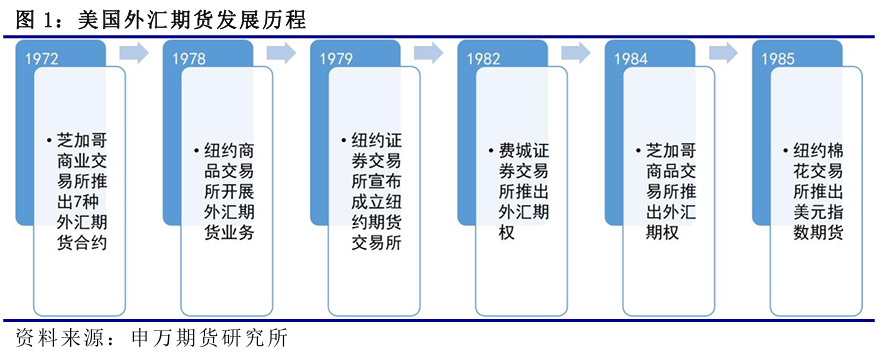
Background of Forex Futures - Forex futures originated in the 1970s, driven by the significant changes in the international monetary system, particularly the collapse of the Bretton Woods system [4][5] - The Bretton Woods system established fixed exchange rates between currencies and the US dollar, which was pegged to gold, minimizing foreign exchange risk [4] - The collapse of this system in 1973 and the subsequent Jamaica Agreement in 1976 allowed countries to choose their exchange rate systems freely, increasing foreign exchange risk and the demand for risk management [4][5] Development of Forex Futures in the US - The Chicago Mercantile Exchange (CME) launched the first forex futures contracts in May 1972, marking the establishment of the forex futures market [6] - The market expanded rapidly after the Jamaica Agreement, with other exchanges like NYMEX and NYFE entering the forex futures business [6] - By 1982, standardized forex options were introduced, further diversifying the forex derivatives market [6][7] Current State of Forex Futures in the US - The CME is the primary market for forex futures and options in the US, continuously introducing new forex derivatives to meet diverse investor needs [2][10] - In 2024, the CME's average daily trading volume reached 26.5 million contracts, a 9% increase from 2023, with forex products averaging 1.03 million contracts daily, an 8% year-on-year growth [14] - The most traded forex futures in 2024 included the Euro (258,000 contracts), Japanese Yen (192,000 contracts), and British Pound (120,000 contracts) [14] Trends in Forex Futures Development - There is an increasing demand for forex derivatives due to heightened market volatility and the need for effective risk management [16] - Emerging market currency derivatives are expected to see significant growth as economies develop and trade volumes increase, particularly in regions like Latin America [16]

赵建:从黄金美元、债务美元到美元稳定币——国际货币体系的百年大变局
Sou Hu Cai Jing· 2025-08-11 09:33
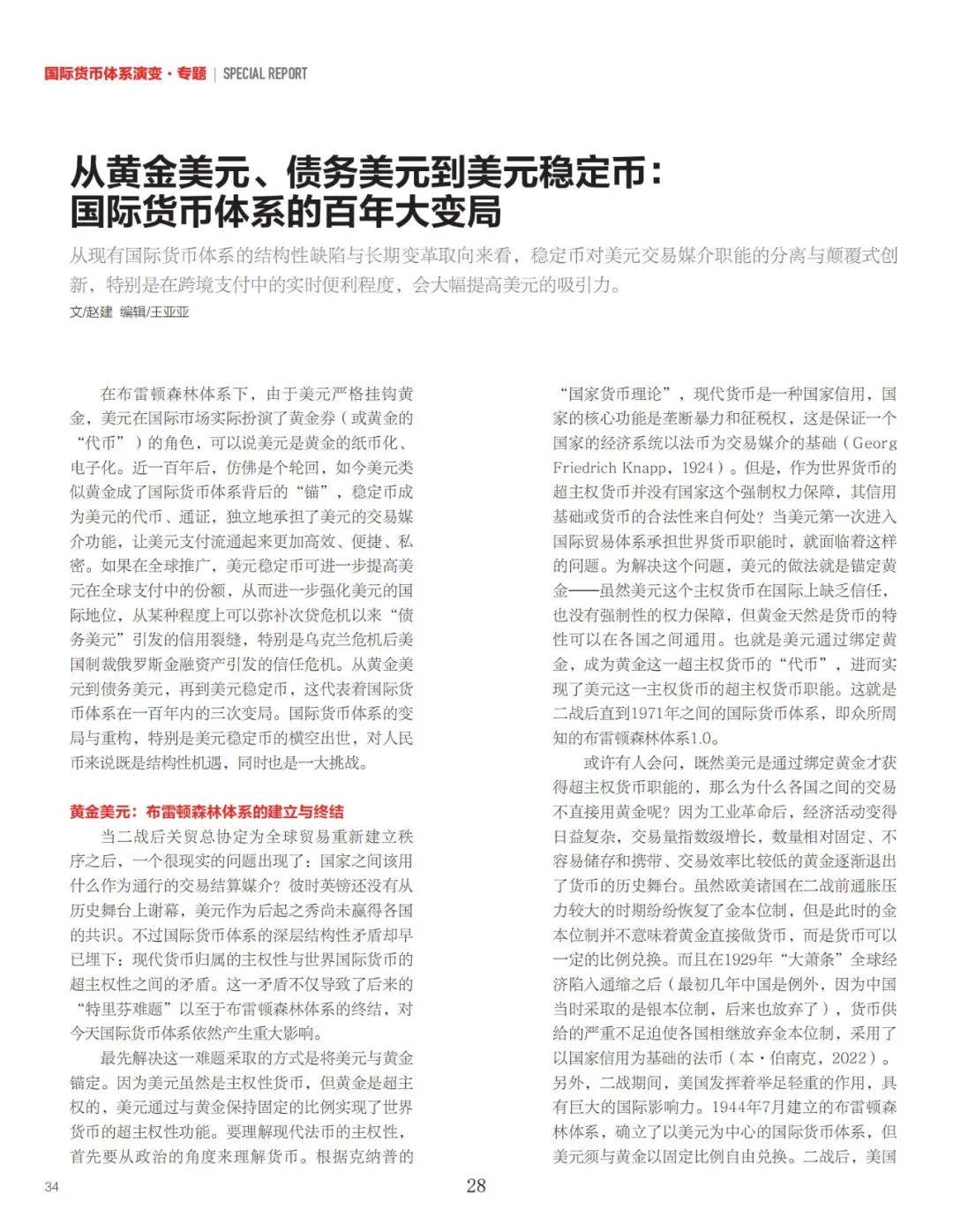
Group 1: Core Views - The article discusses the structural flaws of the current international monetary system and the transformative potential of stablecoins, particularly in enhancing the efficiency of dollar transactions in cross-border payments [4][18][19] - It outlines the historical evolution of the international monetary system, highlighting three significant phases: the "golden dollar" era under the Bretton Woods system, the "debt dollar" phase driven by debt expansion, and the emergence of "dollar stablecoins" as a technological innovation [4][10][18] Group 2: Golden Dollar: Establishment and Termination of the Bretton Woods System - The Bretton Woods system established the dollar's peg to gold, allowing it to function as a global trade and reserve currency, but this system faced inherent contradictions leading to its collapse [5][9] - The "Triffin Dilemma" emerged as a critical issue, where the demand for dollars in international trade outpaced the growth of gold reserves, ultimately resulting in the suspension of dollar convertibility to gold in 1971 [9][12] Group 3: Debt Dollar: Modern Credit Currency Era and Its Flaws - The transition to a "debt dollar" system marked a shift where the dollar was no longer tied to gold, leading to a reliance on debt for currency creation, which has resulted in significant global financial implications [10][12] - The article identifies three phases of the debt dollar system, including the rise of global dollar loans, the debt explosion post-2008 financial crisis, and the surge in U.S. government debt during the COVID-19 pandemic [15][17] Group 4: Dollar Stablecoins: Technological Innovation and Future of the International Monetary System - Stablecoins are positioned as a solution to enhance the efficiency of dollar transactions, potentially restoring confidence in the dollar amidst concerns over its debt issues and geopolitical tensions [19][20] - The article emphasizes the rapid growth of stablecoin transactions, which reached $27.6 trillion in 2024, surpassing the combined transaction volumes of Visa and Mastercard, although most of this volume is still tied to crypto assets [21] - It discusses the theoretical and technical foundations of stablecoins, including their ability to separate the functions of currency, and the underlying technologies that support their operation [20][21]
国际货币体系专题(一):百年浮沉,彰往察来
HUAXI Securities· 2025-08-10 15:32
Group 1: Historical Evolution of the International Monetary System - The international monetary system has evolved through three major phases since 1870: the Gold Standard, the Bretton Woods System, and the Jamaica System[1] - The Gold Standard operated on a government commitment to maintain currency value through gold reserves, while the Bretton Woods System was a quasi-gold standard based on the unique economic position of the United States[2] - The Jamaica System represents a loose and flexible choice under economic diversification, affirming the current state of a multi-currency system[3] Group 2: Monetary Discipline and Current Challenges - The transition from the Gold Standard to the Bretton Woods System and then to the Jamaica System reflects a gradual loosening of monetary discipline, allowing for more flexible monetary policies[4] - In the 21st century, major economies like Japan, the U.S., and the Eurozone have implemented aggressive quantitative easing near zero interest rates, undermining confidence in these reserve currencies[5] - Emerging economies are increasing their gold reserves, indicating a paradox where the freedom from gold constraints leads to a heightened desire for gold reserves[6] Group 3: Capital Flows and Regulatory Needs - International capital flows have grown significantly, revealing the weaknesses of existing monetary systems, with capital acting as a powerful force that can destabilize these systems[7] - The Jamaica System's characteristics of freedom and diversity allow international capital to attack weaker economic regions, necessitating capital control measures to prevent financial crises in emerging markets[8] Group 4: Future of the Monetary System - The future restructuring of the international monetary system will depend on shifts in global economic and trade centers, influenced by technological advancements and industrial competitiveness[9] - The current monetary system faces challenges from structural imbalances among major economies, which could lead to financial crises and increased protectionism, particularly from the U.S.[10]