多元化发展

Search documents
盈趣科技(002925.SZ):暂未有进入半导体行业的计划
Ge Long Hui· 2025-12-03 00:36
Group 1 - The core viewpoint of the article is that Yingqu Technology (002925.SZ) is investing in Moore Threads to expand its business scope and enhance competitiveness in related fields, while currently having no plans to enter the semiconductor industry [1] Group 2 - The investment in Moore Threads is based on strategic layout and diversification considerations [1] - The collaboration aims to further broaden the company's business areas [1] - The company emphasizes its focus on enhancing competitiveness in relevant sectors through this investment [1]

盈趣科技:暂未有进入半导体行业的计划
Ge Long Hui· 2025-12-03 00:32
Group 1 - The core viewpoint of the article is that Yingqu Technology (002925.SZ) is investing in Moore Threads to expand its business scope and enhance competitiveness in related fields, while currently having no plans to enter the semiconductor industry [1] Group 2 - The investment in Moore Threads is based on strategic layout and diversification considerations [1] - The collaboration aims to further broaden the company's business areas [1] - The company emphasizes its focus on enhancing competitiveness in relevant sectors through this investment [1]
峨眉山A(000888)首次覆盖报告:金顶索道改造提质增能 乐山机场助力客流增长
Xin Lang Cai Jing· 2025-12-03 00:29
金顶索道改造推动运力跃升,核心资产价值再强化。索道业务是公司营收与利润提升的核心驱动力, 2023–2024 年毛利率持续高于80%,收入占比约40%,经营韧性强。金顶索道设计运力将从约1200人/小 时提升至 3200 人/小时,运力增幅约167%。高峰排队将明显缓解,游客在金顶停留时间增加,有望提 升索道、门票及衍生消费转化效率。 乐山机场通航在即,助力游客增长。截至2025 年2 月,乐山机场航站楼等主体工程已完工,预计2025 年年底前具备通航基本条件。乐山机场通航后,将衔接现有高速公路网,构建" 航空+高速"直达主要 景区的联运大通道。乐山机场的设计年吞吐量为260 万人次,有望促进峨眉山旅游客流扩展。 差异化票价政策见效,市场潜力仍有较大挖掘空间。以24 年数据为例,横向对比中,峨眉山客流量为 467.22 万人次,低于 普陀山(1230万人次)、九华山(1050 万人次) 和 五台山(690 万人次),但旅 游总收入高于九华山,2024 年峨眉山旅游总收入为 10.13 亿元,而九华山的收入为 7.64 亿元。峨眉山 具备较强的单位游客价值转化能力,未来有望通过交通改善和产品升级进一步挖掘市场潜 ...

合百集团20251126
2025-11-26 14:15
Summary of HeBai Group's Conference Call Company Overview - **Company**: HeBai Group - **Date**: October 2025 Key Points Industry Performance - **Real Estate**: Revenue for the first three quarters of 2025 decreased by over 50% [2][5] - **Appliance Business**: Despite stable performance in the first half due to subsidy policies, profits are expected to decline slightly for the year [2][5] - **Agricultural Products**: Revenue increased by 16.8% year-on-year, but net profit declined due to the cultivation period of the Feixi Logistics Park, putting pressure on overall profitability [2][5] - **Supermarket Sales**: In October 2025, supermarket sales grew by 27% to 350 million yuan, while department store sales saw a slight increase of 0.5% after previous declines [2][6] - **Overall Sales**: Appliance sales dropped by 50% year-on-year, while agricultural product sales rose by 13% to 550 million yuan [2][6] Financial Metrics - **Gross Margin**: - Supermarket: Approximately 14%, down 0.5 percentage points year-on-year [14] - Department Store: Approximately 12.5%, down 0.7 percentage points year-on-year [14] - Appliance: 7.4%, slightly up by 0.1 percentage points [14] - **Net Profit**: - Supermarket net profit fell from over 30 million yuan last year to less than 10 million yuan this year [14] - Department store net profit around 12 million yuan, with appliance net profit at approximately 1 million yuan [14] Strategic Initiatives - **Store Adjustments**: Plans to gradually adjust stores from 2026 to 2028, with significant sales and customer flow increases reported in adjusted stores [4][18] - **Private Label Development**: Nearly 500 private label products, with a 90% year-on-year increase in product count, but sales contribution remains below 2% [9][10] - **Supply Chain Optimization**: Direct procurement in Hefei region increased to over 70%, with plans to expand into fresh vegetables and fruits [10][12] Investment and Expansion - **Investment in Emerging Industries**: HeBai Group invested 900 million yuan in the Hefei Guosheng Capital Equity Investment Fund, focusing on semiconductors, new energy, and biomedicine [20][21] - **Store Expansion Plans**: Closed 35 stores this year but plans to open 10 new supermarkets, focusing on stabilizing the central Anhui region [7][13] Market Challenges - **Intense Competition**: The market in Anhui, especially Hefei, is nearing saturation with new entrants, leading to fierce competition in community shopping centers [15] - **Impact of Subsidy Policies**: The shift to a lottery system for appliance subsidies has led to a significant drop in sales since mid-July 2025 [24][25] Future Outlook - **Profit Margin Improvement**: Expected improvements in profit margins through store adjustments and supply chain enhancements [16][18] - **Marketing Strategies for 2026**: Preparing differentiated marketing strategies for the upcoming Spring Festival to maximize consumer opportunities [26] Additional Notes - **New Chairman Appointment**: The appointment of a new chairman is pending, with expectations for a decision by the end of 2025 [22] - **Tax Refund Stores**: Five stores in Anhui are part of the tax refund pilot, with potential for increased transactions if policies are streamlined [11]

思特威:公司对自身生产经营充满信心
Zheng Quan Ri Bao Wang· 2025-11-26 13:49
证券日报网讯思特威11月26日在互动平台回答投资者提问时表示,公司坚持"智慧安防+智能手机+汽车 电子"三足鼎立发展方向的同时,夯实多元业务战略,通过持续的技术创新和多元化产品布局实现全面 发展,公司对自身生产经营充满信心。 ...

格力电器股东大会董明珠已“少说话”,回应渠道变革等
Sou Hu Cai Jing· 2025-11-26 02:41
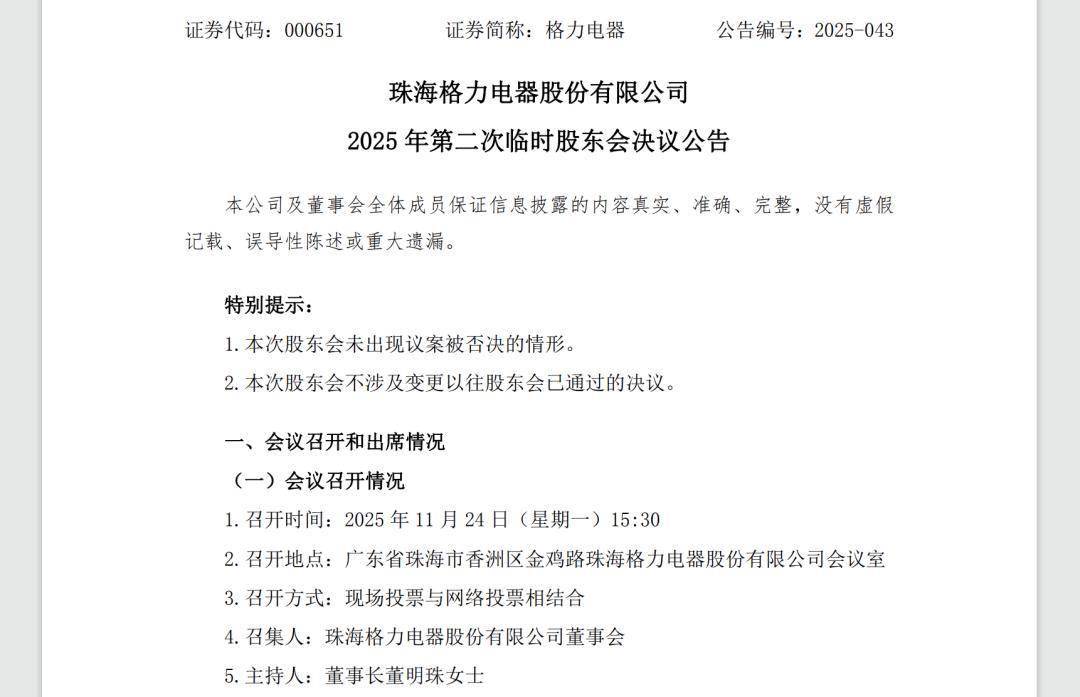
Group 1 - Gree Electric held its second extraordinary shareholders' meeting for 2025 on November 24, with only about 70 shareholders attending, indicating a relatively low turnout compared to previous meetings [1] - Chairman Dong Mingzhu emphasized the meeting as a gathering of "friends" rather than just a shareholders' meeting, reflecting a more personal approach [1] - Sales Director Lu Luqun reported that since the launch of the Dong Mingzhu Health Home in February, over 1,000 stores have been established, with a shift in sales ratio from 70:30 to a more balanced 1:1 between air conditioning and non-air conditioning products [1] Group 2 - Dong Mingzhu addressed the debate on whether Gree should focus solely on air conditioning, stating that success lies in concentration rather than mere specialization or diversification [2] - Gree Electric's Q3 2025 report showed revenue of 39.855 billion yuan, a year-on-year decline of 15.09%, and a net profit of 7.049 billion yuan, down 9.92% [2] - The company plans to distribute a cash dividend of 10 yuan per 10 shares to all shareholders, totaling 5.585 billion yuan, as part of its mid-year profit distribution plan [2]


汽车厂家瞄准天空和家庭
Zhong Guo Zhi Liang Xin Wen Wang· 2025-11-20 03:35
Core Viewpoint - The automotive industry is shifting its focus from traditional vehicles to innovative technologies such as flying cars and humanoid robots, indicating a transformation towards a broader concept of mobility and smart living [1][4][12] Group 1: Industry Trends - Major Chinese automotive companies like XPeng, Changan, and GAC Group are increasingly interested in flying cars and humanoid robots, showcasing their technological advancements at events like the Guangzhou International Auto Show [2][4] - The annual sales of passenger vehicles in China have stabilized, prompting companies to explore new avenues beyond traditional car manufacturing to sustain growth and profitability [4][5] Group 2: Technological Advancements - The core competencies of "new energy" vehicles, such as advanced driver assistance systems and high-performance batteries, are being leveraged to develop flying cars and humanoid robots, creating a synergistic effect [5][6][8] - Chinese companies are leading in AI technology for automotive applications, which can be directly applied to flying vehicles and robots, enhancing their capabilities in perception, decision-making, and control [6][8] Group 3: Market Opportunities - The transition to flying cars and humanoid robots is seen as a way for automotive companies to escape the limitations of traditional vehicle manufacturing and create new value in smart mobility [4][11] - The introduction of flying cars is expected to alleviate ground traffic congestion and reduce commuting times, while humanoid robots may become essential household items, especially in aging societies [11][12] Group 4: Consumer Experience - Automotive companies are not just manufacturing vehicles but are evolving into providers of AI-driven mobility solutions, enhancing consumer experiences through innovative products that integrate into daily life [8][12] - The development of new vehicle types and technologies is aimed at meeting diverse consumer needs, thereby expanding market segments and strengthening brand influence [8][11]

受困“捕鱼” 姚记科技押宝短剧
Bei Jing Shang Bao· 2025-11-19 15:41
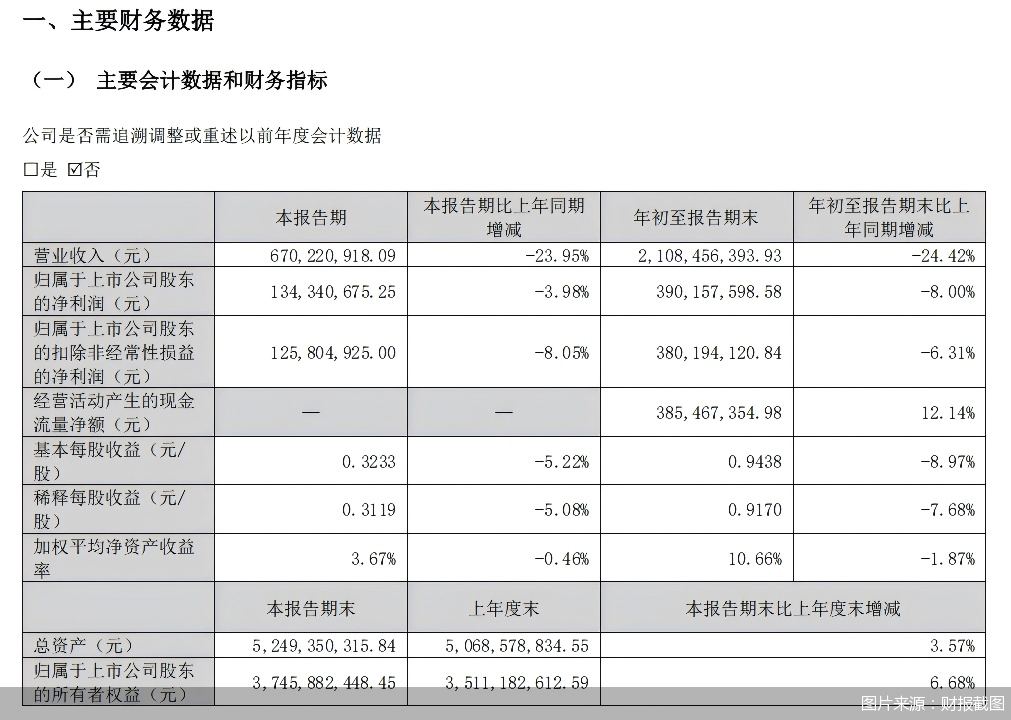
Core Viewpoint - The company is facing significant challenges in its performance, with a notable decline in revenue and net profit, while also undergoing management changes. The gaming and digital marketing sectors are under pressure, prompting the company to seek new growth opportunities through short video and short drama initiatives [1][2][3]. Financial Performance - In the third quarter of this year, the company's revenue was 6.7 billion, a year-on-year decrease of 23.95%, and the net profit attributable to the parent company was 1.34 billion, down 3.98% [2]. - For the first three quarters of this year, the total revenue was 21.08 billion, reflecting a 24.42% decline compared to the previous year, with a net profit of 3.9 billion, down 8% [2]. - The company's gaming revenue from 2019 to 2023 was 10.18 billion, 12.14 billion, 12.22 billion, 12.02 billion, and 12.26 billion respectively, indicating a relatively stable performance despite recent challenges [2][3]. Gaming Business Challenges - The gaming sector, particularly the fishing game segment, is facing intense competition and a saturation of user traffic, which could hinder user retention if product iterations are insufficient [3]. - The company has launched new games like "Fishing New Era" but is still primarily reliant on its fishing game series, which may limit its growth potential [3]. Digital Marketing Sector - The digital marketing business has experienced unstable gross margins, with figures from 2020 to 2024 showing 9.56%, 6.92%, 4.74%, 5.46%, and 7.76% respectively [4]. - The company’s bargaining power is perceived to be weak due to a fixed customer structure primarily consisting of large companies, compounded by increased competition in the digital marketing space [4]. New Growth Initiatives - The company is exploring new growth avenues through short video and short drama production, leveraging its experience in digital marketing to create a full industry chain ecosystem [6][7]. - The Shanghai International Short Video Center, established in late 2020, focuses on short video and short drama production, with over 200 indoor scenes completed [6]. Management Changes - Following the resignation of Liang Meifeng, the company appointed Ji Wenjun as a non-independent director, indicating a shift in management amidst ongoing performance challenges [1][2].

金杯汽车(600609.SH):拟合计投资1.58亿元取得中拓科技52.00%的股权
Ge Long Hui A P P· 2025-11-19 12:49
Core Viewpoint - The company Jinbei Automobile (600609.SH) plans to invest in Zhongtuo Technology to strengthen its supply chain, optimize customer structure, expand revenue scale, and enhance business synergy and diversification [1] Group 1: Investment Details - The investment in Zhongtuo Technology is based on an enterprise valuation of 215 million yuan, with a final transaction value of 215 million yuan agreed upon after negotiations [1] - The company will invest 89.58 million yuan in cash to subscribe to an increase in Zhongtuo Technology's registered capital of 25 million yuan, resulting in a 29.41% equity stake [1] - Following the capital increase, the company will acquire an additional 22.59% equity stake for 68.80 million yuan, leading to a total ownership of 52% in Zhongtuo Technology [1] Group 2: Zhongtuo Technology Overview - Zhongtuo Technology is a high-tech enterprise engaged in the research, production, and sales of automotive components, with manufacturing bases in Changchun, Chengdu, and Tianjin, and a service center in Foshan [2] - The company supplies parts to major automotive manufacturers including Hongqi, Volkswagen/Audi, BMW, Toyota, and others, and has become a first-tier supplier for Li Auto [2] - Prior to the investment, Zhongtuo Technology's equity was pledged due to bank loans, but the investment will allow the company to prioritize repaying these loans and release the equity pledge [2]

高管变动、营收下降,卖扑克年入近11亿的姚记科技怎么了
Bei Jing Shang Bao· 2025-11-19 04:47
Core Viewpoint - The company is experiencing significant revenue declines in its core business areas, prompting a leadership change and a search for new growth opportunities through diversification into short video and short drama production [1][2][8]. Financial Performance - In 2024, the company's revenue decreased by 24.04% year-on-year, while the third quarter of 2025 saw a revenue drop of 23.95% [1][2]. - For the third quarter of 2025, the company reported a revenue of 670 million yuan and a net profit attributable to shareholders of 134 million yuan, reflecting a decline of 3.98% [2][3]. - The first three quarters of 2025 showed a total revenue of 2.108 billion yuan, down 24.42% year-on-year, with a net profit of 390 million yuan, down 8.0% [2][3]. Business Segments - The poker business remains stable, but the company is facing challenges in its gaming segment, which has seen a revenue decline of 17.20% to 1.015 billion yuan in 2024 [4][5]. - The gaming segment, which includes products like "Fishing New Era," has been a key growth driver since 2018, but is now facing intense competition and user retention issues [4][5]. - The digital marketing segment has shown unstable gross margins, with rates fluctuating from 9.56% in 2020 to 7.76% in 2024, attributed to a fixed client structure and increased competition [6]. Strategic Initiatives - The company is actively seeking new growth points, particularly through its short video and short drama initiatives, leveraging its existing digital marketing experience [8][9]. - The establishment of the Shanghai International Short Video Center aims to enhance capabilities in short video and drama production, with over 200 indoor scenes completed [8]. - The company plans to integrate short drama marketing with its digital marketing channels to drive traffic, although it faces challenges in content quality and expertise [9].