
新能源汽车市场

Search documents
前7个月我国汽车产销均同比大幅增长
Zheng Quan Ri Bao Zhi Sheng· 2025-08-11 16:39
Core Viewpoint - The Chinese automotive market shows a clear recovery trend, with significant year-on-year growth in production and sales, particularly in the new energy vehicle (NEV) segment, driven by favorable policies and new model launches [1][2][4]. Production and Sales Data - In the first seven months of the year, China's automotive production reached 18.235 million units, and sales totaled 18.269 million units, marking year-on-year increases of 12.7% and 12%, respectively [1]. - In July, production and sales were 2.591 million and 2.593 million units, reflecting year-on-year growth of 13.3% and 14.7%, but a month-on-month decline of 7.3% and 10.7% [1][2]. Passenger Vehicle Market - The passenger vehicle segment saw production and sales of 2.293 million and 2.287 million units in July, with year-on-year increases of 13% and 14.7% [2]. - Chinese brands led the market with July sales of 1.604 million units, a year-on-year increase of 21.3%, raising their market share to 70.1% [2]. Commercial Vehicle Market - The commercial vehicle sector also demonstrated resilience, with July production and sales of 298,000 and 306,000 units, showing year-on-year growth of 16.3% and 14.1% [3]. - Heavy-duty trucks were the main growth driver, with July sales reaching 85,000 units, a year-on-year increase of 45.6% [3]. Export Performance - Automotive exports continued to show positive trends, with July exports reaching 575,000 units, a year-on-year increase of 22.6% [4]. - NEVs significantly contributed to export growth, with July exports of 225,000 units, a year-on-year surge of 120% [4]. Key Enterprises and Market Dynamics - Among the top ten exporting companies, seven reported positive growth in July, with Chery leading at 119,000 units exported, a year-on-year increase of 31.9% [5]. - BYD's exports grew impressively, reaching 81,000 units in July, a year-on-year increase of 160% [5]. Future Outlook - The automotive market is expected to maintain steady growth, supported by government policies and enhanced competitiveness of NEVs, which will play a crucial role in both domestic consumption upgrades and global export expansion [6].

乘联分会:7月乘用车厂商零售、出口、批发和生产均创当月历史新高 新能源出口创出历年各月历史新高
智通财经网· 2025-08-08 08:19
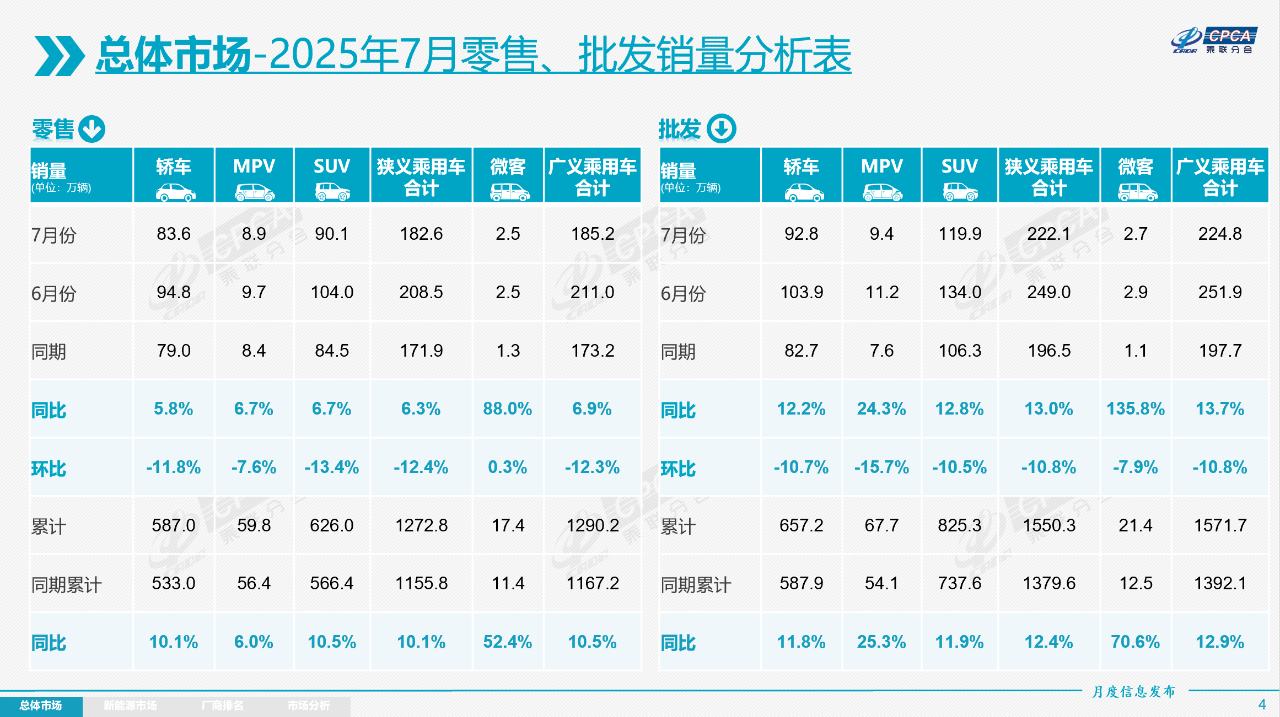
Core Insights - The passenger car market in July 2025 saw record highs in retail, exports, wholesale, and production, with new energy vehicle (NEV) exports reaching an all-time monthly high [1] - Domestic retail of passenger cars from January to July 2025 achieved a cumulative growth of 10.1%, with July's retail growth at 6.3%, indicating a "low-high-flat" trend for the year [1][2] - The price war in the market has moderated, with various hidden incentives emerging, while NEV promotions remained stable at 10.2% in July [1][4] Retail Performance - In July, the national retail of passenger cars reached 1.826 million units, a year-on-year increase of 6.3% but a month-on-month decrease of 12.4% [2][9] - Cumulative retail from January to July 2025 was 12.728 million units, reflecting a 10.1% year-on-year growth [2][9] - The retail penetration rate of NEVs in July rose to 54.0%, supported by policies like tax exemptions for NEVs [2][15] Production and Wholesale - In July, the production of passenger cars was 2.229 million units, a year-on-year increase of 12.1% [7][9] - The wholesale of passenger cars reached 2.221 million units in July, marking a historical high for the month, with a year-on-year growth of 13.0% [9] - NEV production in July was 1.147 million units, up 22.3% year-on-year, while NEV wholesale reached 1.181 million units, a 24.4% increase [10][12] Export Trends - In July, total automobile exports reached 694,000 units, with an export value of $11.837 billion [7] - NEV exports accounted for 44.7% of total exports, with a year-on-year increase of 19 percentage points [7][16] - The export of NEVs in July was 213,000 units, a significant year-on-year growth of 120.4% [16] Market Dynamics - The overall inventory of passenger cars decreased by 90,000 units in July, indicating a proactive inventory reduction by manufacturers [10] - The market for traditional fuel vehicles saw a decline in exports, while NEV exports grew significantly, highlighting a shift in market dynamics [2][7] - The competitive landscape is evolving, with traditional automakers like Geely, Chery, and Great Wall Motors showing improved market shares in the NEV segment [5][18] Brand Performance - In July, domestic brands sold 1.21 million units, achieving a market share of 65.9%, a year-on-year increase of 4 percentage points [5] - The retail share of luxury vehicles decreased to 9.3%, with a year-on-year decline of 3 percentage points [5] - New energy vehicle sales from new entrants accounted for 21.4% of the market, reflecting a growing presence of new players [20]




碳酸锂市场周报:宏观产业利好共振,波动放大谨慎对待-20250725
Rui Da Qi Huo· 2025-07-25 12:11
Group 1: Report Summary - The lithium carbonate market showed a volatile and slightly stronger trend this week, with the main contract up 15.09% and an amplitude of 17.87%, closing at 80,520 yuan/ton [5]. - The fundamentals of lithium carbonate may be in a stage where supply expectations are somewhat repaired, but demand is temporarily weak. Consumption expectations are positive, but price increases due to market sentiment need to be treated with caution [5]. - The recommended strategy is to trade with a light position in a volatile market and control risks by paying attention to trading rhythms [5]. Group 2: Futures and Spot Market Futures Market - Futures prices fluctuated strongly. As of July 25, 2025, the closing price of the main lithium carbonate contract was 80,520 yuan/ton, a week-on-week increase of 10,560 yuan/ton. The near - far month spread was - 1,120 yuan/ton, a week-on-week decrease of 2,380 yuan/ton [11]. Spot Market - Spot prices strengthened. As of July 25, 2025, the average price of battery - grade lithium carbonate was 72,900 yuan/ton, a week-on-week increase of 6,250 yuan/ton. The basis of the main contract was - 7,620 yuan/ton, a week-on-week decrease of 4,310 yuan/ton [15]. Group 3: Upstream Market Lithium Spodumene - The price of lithium spodumene concentrate (6% - 6.5%) increased. As of July 25, 2025, the average price was 740 US dollars/ton, a week-on-week increase of 32 US dollars/ton. The US dollar - RMB spot exchange rate was 7.1547, a week-on-week decrease of 0.35% [19]. Lithium Mica and Phosphorus Lithium Aluminate - The average price of phosphorus lithium aluminate was 7,450 yuan/ton, a week-on-week increase of 1,625 yuan/ton. The average price of lithium mica (Li₂O: 2.0% - 3%) was 2,067 yuan/ton, a week-on-week increase of 286 yuan/ton [24]. Group 4: Industry Supply and Demand Supply Side - In June 2025, the monthly import volume of lithium carbonate was 17,697.62 tons, a decrease of 3,448.16 tons from May, a decline of 16.31% and a year-on-year decline of 9.63%. The monthly export volume was 429.653 tons, an increase of 142.92 tons from May, an increase of 49.84% and a year-on-year decline of 14.28%. - The monthly output was 44,100 tons, an increase of 2,000 tons from May, an increase of 4.75% and a year-on-year increase of 5%. The monthly operating rate was 43%, a month-on-month decline of 5% and a year-on-year decline of 32% [29]. Demand Side Intermediate Products - The average price of lithium hexafluorophosphate was 49,500 yuan/ton, a week-on-week increase of 3,000 yuan/ton. In June 2025, the monthly output of electrolyte was 161,150 tons, an increase of 2,650 tons from May, an increase of 1.67% and a year-on-year increase of 35.25% [32]. - The average price of lithium iron phosphate (power type) was 32,650 yuan/ton, a week-on-week increase of 22,000 yuan/ton. In June 2025, the monthly output of lithium iron phosphate cathode materials was 203,300 tons, a decrease of 6,800 tons from May, a decline of 3.24% and a year-on-year increase of 31.16%. The monthly operating rate was 52% [35]. - In June 2025, the monthly output of ternary materials was 59,000 tons, a decrease of 6,200 tons from May, a decline of 9.51% and a year-on-year increase of 13.46%. The monthly operating rate was 51%. The prices of ternary materials 811, 622, and 523 remained stable this week [39]. - The average price of lithium manganate was 29,000 yuan/ton, a week-on-week increase of 500 yuan/ton. In June 2025, the monthly output of lithium manganate was 10,800 tons, a decrease of 300 tons from May, a decline of 2.7% and a year-on-year increase of 61.19% [44]. - The average price of lithium cobaltate was 222,000 yuan/ton, a week-on-week increase of 2,000 yuan/ton. In June 2025, the monthly output of lithium cobaltate was 12,400 tons, a decrease of 700 tons from May, a decline of 5.34% and a year-on-year increase of 58.97% [47]. Application Products - In June 2025, the penetration rate of new energy vehicles was 44.32%, a month-on-month increase of 0.33% and a year-on-year increase of 9.12%. The monthly output was 1,268,000 vehicles, a month-on-month decrease of 0.16%; the sales volume was 1,329,000 vehicles, a month-on-month increase of 1.68% [49]. - As of June 2025, the cumulative export volume of new energy vehicles was 1.06 million, a year-on-year increase of 75.21% [55]. Group 5: Options Market - It is recommended to construct a long straddle option to bet on increased volatility. The synthetic underlying premium and discount is 0.61, presenting a positive arbitrage opportunity [58].
卖给印度人的Model Y,起步价50万
36氪· 2025-07-17 10:04
Core Viewpoint - Tesla has entered the Indian market after a long wait of nine years, but faces significant challenges due to high pricing and a nascent electric vehicle market in India [4][6][26]. Group 1: Market Entry and Challenges - Tesla opened its first showroom in Mumbai, marking its entry into the Indian market [4]. - The pricing of Tesla vehicles in India is high, with the Model Y starting at approximately 500,000 RMB, making it less attractive to the average Indian consumer [8][11]. - India's electric vehicle market is still in its infancy, with only 4% of total vehicle sales being electric, compared to 40.9% in China [14][15]. Group 2: Economic Context - India's GDP per capita is significantly lower than China's, at $2,696 compared to $13,400, which affects the affordability of electric vehicles [14]. - The charging infrastructure in India is underdeveloped, with only 0.5 charging stations per square kilometer in Delhi, compared to over 42,000 in Shenzhen [15]. Group 3: Supply Chain and Production Issues - Tesla's plans to build a factory in India have been hindered by high import tariffs and a weak local supply chain for critical battery materials like lithium and cobalt [17][18]. - India relies heavily on imports for essential materials, and disruptions in supply chains could severely impact the local electric vehicle industry [19]. Group 4: Strategic Adjustments - Tesla is undergoing leadership changes, with key sales executives leaving, indicating potential shifts in strategy [21][22]. - The company is also introducing lower-priced models to attract a broader customer base [23]. Group 5: Future Outlook - Despite current challenges, the Indian electric vehicle market is projected to grow significantly, with expectations that electric vehicles will account for 30% of total passenger vehicle sales by 2030 [26]. - Tesla's entry into India could potentially reshape the global electric vehicle market, depending on its ability to navigate local challenges and establish a foothold [28][29].

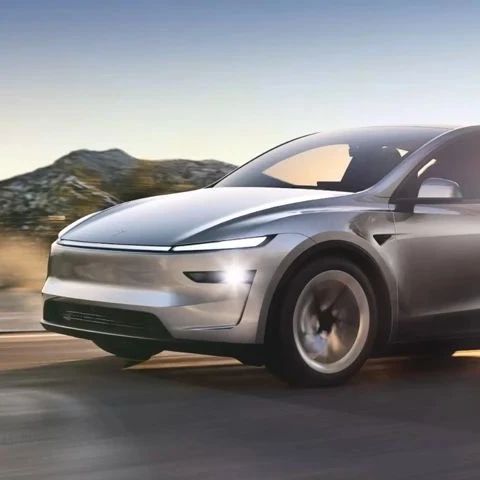
美股盘前,台积电涨超4%,公司Q2净利润激增61%超预期,预计今年销售额将增长约30%;理想汽车涨近7%,理想i8现已开启预订,预计售价35万元-40万元。
news flash· 2025-07-17 08:07
Group 1 - TSMC's stock rose over 4% in pre-market trading, driven by a Q2 net profit surge of 61%, exceeding expectations [1] - TSMC anticipates a sales growth of approximately 30% for the current year [1] Group 2 - Li Auto's stock increased nearly 7%, with the Li i8 now available for pre-order [1] - The expected price range for the Li i8 is between 350,000 to 400,000 yuan [1]


乘联分会:7月1-13日全国乘用车新能源市场零售33.2万辆 同比去年7月同期增长26%
news flash· 2025-07-16 08:48
Group 1 - The core viewpoint of the article highlights the growth in the retail and wholesale of new energy vehicles in China during the first half of July 2023, indicating a strong market performance compared to the previous year [1] - From July 1 to 13, the retail sales of new energy vehicles reached 332,000 units, representing a year-on-year increase of 26% compared to the same period last year, but a decrease of 4% compared to the previous month [1] - The retail penetration rate for new energy vehicles stands at 58.1%, with cumulative retail sales for the year reaching 5.801 million units, reflecting a year-on-year growth of 33% [1] Group 2 - During the same period, the wholesale of new energy vehicles by manufacturers totaled 316,000 units, marking a year-on-year increase of 37% and a month-on-month increase of 1% [1] - The wholesale penetration rate for new energy vehicles is recorded at 56.9%, with cumulative wholesale figures for the year reaching 6.763 million units, which is a year-on-year growth of 37% [1]
半年产销数据出炉,长城汽车为何垫底
Zheng Quan Shi Bao Wang· 2025-07-11 07:33
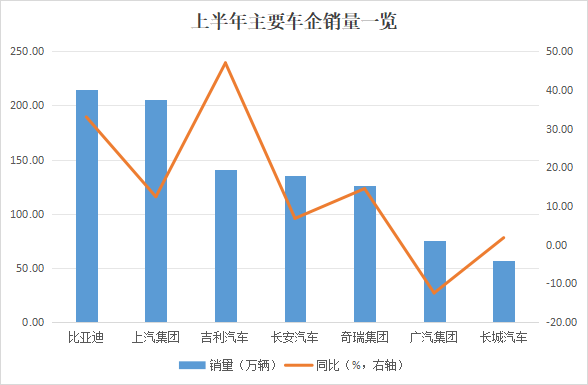
Group 1: Industry Overview - In the first half of the year, domestic automobile production and sales in China exceeded 15 million units, achieving over 10% year-on-year growth [1] - New energy vehicle sales accounted for 44.3% of total automobile sales [1] Group 2: Company Performance - BYD and SAIC Motor both surpassed 2 million units in sales, while Great Wall Motors sold only 569,800 units, ranking last among major automakers [1] - Geely Automotive recorded the highest growth rate at 47% year-on-year, while Great Wall Motors' growth was only 1.81%, significantly below the national average [1] Group 3: Great Wall Motors Specifics - Great Wall Motors' Ora brand saw its sales halved, and the Tank brand sold 103,700 units, down 10.67% year-on-year, a sharp decline from a 99% growth last year [3] - The Tank brand, which is positioned as a high-end off-road vehicle, faces intense competition from new entrants like BYD's Fangchengbao series, which has gained market share due to its cost-performance advantage [3] - Despite weak sales growth, Great Wall Motors increased its marketing expenses by 34.57%, the highest among A-share listed automakers [3] Group 4: Financial Performance - As of July 10, Great Wall Motors' stock price had dropped approximately 17%, contrasting with significant gains for companies like Xpeng Motors and BYD, which saw increases of over 40% [5] - In the first quarter, Great Wall Motors experienced an operating cash outflow of nearly 9 billion yuan, while BYD had an operating cash inflow of 8.58 billion yuan [5] - Great Wall Motors' cash and cash equivalents at the end of the first quarter were 28.6 billion yuan, lower than other major automakers [5] - The company's short-term debt repayment capability is concerning, with a cash to short-term debt ratio of only 0.63, ranking it among the lowest in the A-share market [5]

乘联分会:7月1-6日全国乘用车新能源市场零售13.5万辆 同比增长21%
news flash· 2025-07-10 08:24
Core Insights - The retail sales of new energy vehicles in China's passenger car market reached 135,000 units from July 1 to July 6, representing a year-on-year increase of 21% [1] - However, this figure shows a month-on-month decline of 11% compared to the previous month [1] - The retail penetration rate for new energy vehicles stands at 56.7%, with cumulative retail sales for the year reaching 6.583 million units, a year-on-year growth of 37% [1] Wholesale Data - During the same period, wholesale sales of new energy vehicles by manufacturers totaled 125,000 units, marking a year-on-year increase of 31% [1] - The month-on-month growth for wholesale sales remained flat at 0% compared to the previous month [1] - The wholesale penetration rate for new energy vehicles is recorded at 53.6%, with cumulative wholesale sales for the year amounting to 5.594 million units, reflecting a year-on-year increase of 33% [1]
新势力车企6月份交付量出炉:鸿蒙智行独占鳌头 零跑理想小鹏汽车紧随其后
Zheng Quan Ri Bao Wang· 2025-07-02 12:53
Core Insights - The new energy vehicle market in China is experiencing robust growth and intense competition, with several new players reporting significant sales figures for June [1][2][3] Company Performance - Hongmeng Zhixing achieved a record delivery of 52,700 vehicles in June, marking a historical high for both monthly and daily sales, and leading the new energy vehicle market [2] - Leap Motor delivered 48,000 vehicles in June, a year-on-year increase of over 138%, with cumulative deliveries exceeding 800,000 [2] - Li Auto's deliveries fell to 36,300 units in June, a decrease of 24.1% compared to the same month last year, but plans to accelerate the launch of new electric models in the second half of the year [2] - Xpeng Motors reported a significant increase in deliveries, with 34,600 vehicles delivered in June, a year-on-year growth of 224% [3] - Deep Blue Automotive delivered 29,900 vehicles in June, a year-on-year increase of 79% [4] - Xiaomi Automotive delivered over 25,000 vehicles in June, with a notable order volume for its new SUV model, the Xiaomi YU7 [4] - NIO delivered 24,900 vehicles in June, a year-on-year increase of 17.5% [5] - Zeekr delivered 43,000 vehicles in June, maintaining a delivery volume above 40,000 for four consecutive months [6] Market Trends - The June sales performance was influenced by various factors, including promotional activities during the Dragon Boat Festival and increased family car purchases due to the end of the college entrance examination [1] - The shift in consumer behavior is evident, with a focus on practicality and cost-effectiveness in vehicle purchases [6] - The new energy vehicle market is seeing a reshuffling of delivery rankings, indicating changing dynamics and competition among new players [6]


乘联分会:6月1日—22日全国乘用车市场零售126.9万辆 同比增长24%
news flash· 2025-06-25 08:51
Core Insights - The retail sales of passenger cars in China from June 1 to June 22 reached 1.269 million units, representing a year-on-year increase of 24% [1] - Compared to the same period last month, there was an 8% growth in retail sales [1] - Cumulatively, the retail sales for the year have reached 10.086 million units, showing an 11% year-on-year growth [1] New Energy Vehicle Market - During the same period, retail sales of new energy vehicles amounted to 691,000 units, marking a year-on-year increase of 38% [1] - This represents an 11% growth compared to the previous month [1] - The penetration rate of new energy vehicles in the national market is 54.5%, with cumulative retail sales for the year at 5.049 million units, reflecting a 35% year-on-year increase [1]