消费潜力释放

Search documents
消费潜力持续释放 消费市场实现稳定增长
Yang Shi Wang· 2025-10-21 12:13
Core Insights - The consumer market in China has shown stable growth this year, driven by effective consumption-boosting policies and the expansion of new consumption formats, models, and scenarios [1] Group 1: Retail Performance - The total retail sales of consumer goods in the first three quarters increased by 4.5% year-on-year, which is an acceleration of 1.2 percentage points compared to the same period last year and 1.0 percentage point compared to the entire last year [3] - Service consumption has accelerated, with retail sales in the service sector growing by 5.2% year-on-year in the first three quarters, outpacing the growth of goods retail sales by 0.6 percentage points [3] - Specific service categories such as cultural, sports, and leisure services, communication and information services, and transportation services have all achieved double-digit growth [3] Group 2: Specific Product Categories - The "trade-in" policy has significantly boosted retail sales in related categories, with furniture retail sales increasing by 21.3% year-on-year in the first three quarters [5] - Retail sales of household appliances and audio-visual equipment, as well as cultural and office supplies, grew by 25.3% and 19.9% year-on-year, respectively, showing a marked acceleration compared to the previous year [5] Group 3: Online Consumption - Online retail sales increased by 9.8% year-on-year in the first three quarters, with growth accelerating since May, indicating a strengthening role of online consumption in driving total retail sales [5] Group 4: Economic Contribution - Final consumption expenditure contributed 53.5% to economic growth in the first three quarters, an increase of 9.0 percentage points compared to the entire last year, reinforcing its role as the main engine of economic growth [6]


海鲜“消费地图”拓展的启示
Sou Hu Cai Jing· 2025-10-21 02:08
Group 1 - The core viewpoint emphasizes the importance of logistics and transportation in unlocking the vast market potential of China's economy, particularly in enhancing consumer experiences and expanding consumption [1][2] - The trend of "seafood going rural" is supported by an increasingly sophisticated logistics network, allowing for a significant drop in prices for certain seafood products, thus enhancing consumer access and satisfaction [2][3] - Data indicates a remarkable increase in seafood consumption, with a 185% year-on-year growth in sales of king crabs during the recent holidays, particularly in lower-tier cities [1][2] Group 2 - The concept of "new" consumption is highlighted, with traditional sectors also showing potential for growth through innovation in product offerings and service models, responding to the evolving consumer demand for quality [3] - The development of high-quality aquaculture in inland regions, such as Xinjiang's salmon production, illustrates the shift towards meeting consumer preferences for premium products at competitive prices [3] - The expansion of various consumption sectors, including new energy vehicles and lifestyle economies in rural areas, reflects the resilience and potential of China's economic foundation [3]
锐财经丨经济运行总体平稳稳中有进
Ren Min Ri Bao Hai Wai Ban· 2025-10-21 01:39
Economic Growth - China's GDP grew by 5.2% year-on-year in the first three quarters, ranking among the top major economies [1][2] - The economic increment reached 39,679 billion yuan, an increase of 1,368 billion yuan compared to the previous year [1][2] Employment and Prices - The average urban unemployment rate for the first three quarters was 5.2%, consistent with the first half of the year [4] - The Consumer Price Index (CPI) slightly decreased by 0.1%, while the core CPI, excluding food and energy, rose by 0.6% [4] International Trade - China's foreign trade showed strong resilience, with import and export volumes reaching historical highs, and foreign exchange reserves maintained above 3.3 trillion USD [4][5] - The total value of goods imports and exports increased by 6.0% year-on-year in the third quarter [9] Industrial Development - The proportion of added value from high-tech manufacturing and equipment manufacturing reached 16.7% and 35.9%, respectively [4] - Investment in equipment and tools increased by 14.0% year-on-year, significantly contributing to overall investment growth [6] New Economic Drivers - Industries such as lithium-ion battery manufacturing and electric vehicle production saw substantial growth, with increases of 29.8% and 29.7%, respectively [7] - The production of new energy vehicles and related products also experienced double-digit growth [7] Policy Impact - A series of policies have effectively stabilized the economy and supported long-term development, with consumer spending contributing 53.5% to economic growth [6] - The government has issued 300 billion yuan in special bonds to stimulate consumer demand through programs like "old for new" [6]

海鲜“消费地图”拓展的启示(评论员观察)
Ren Min Ri Bao· 2025-10-20 22:01
Core Insights - The article emphasizes the importance of leveraging China's vast economic landscape to continuously unlock the potential of its large-scale market, with a focus on improving logistics and transportation systems as a key driver for consumption growth [1][2]. Group 1: Consumption Trends - There is a notable shift in consumer behavior, with traditional consumption areas revealing new potential, such as the increased availability and consumption of seafood in inland areas due to improved logistics [1][2]. - Data indicates that during the recent National Day and Mid-Autumn Festival holidays, sales of certain seafood items, like king crabs, surged by 185% year-on-year, particularly in second-tier and lower-tier cities [1][2]. Group 2: Economic Strategies - President Xi Jinping's call to actively expand domestic demand and create more consumption scenarios is highlighted, indicating a strategic focus on meeting the evolving needs of consumers [2][3]. - The article discusses the trend of "seafood going rural," supported by an increasingly efficient logistics network, which has led to significant price reductions for certain seafood items, enhancing consumer access [2][3]. Group 3: Innovation in Consumption - The integration of new technologies and innovative consumption models is crucial for tapping into new growth points, with examples from various cities showcasing how events and new retail formats attract consumers [3]. - Traditional sectors, such as dining, are also evolving with new offerings and experiences that cater to the upgraded consumer demand for quality over quantity [3]. Group 4: Quality and Supply - The article emphasizes the importance of quality in meeting consumer demands, citing examples like the development of high-quality aquaculture in Xinjiang, which is expected to produce over 5,000 tons of salmon by 2024 [3]. - The expansion of the seafood consumption market into central and western regions reflects the broader economic stability and potential within China, aligning with consumer expectations for higher quality living [3][4].
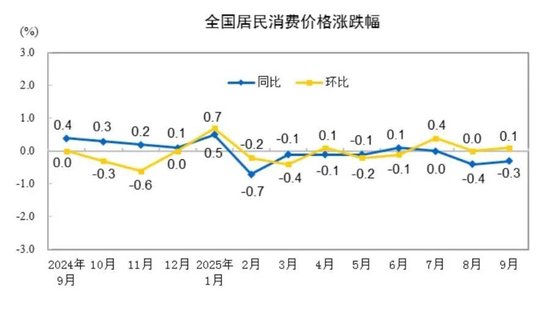
9月份CPI环比上涨0.1% 消费市场运行总体平稳
Ren Min Ri Bao Hai Wai Ban· 2025-10-20 06:13
Group 1: Consumer Price Index (CPI) Insights - In September, the Consumer Price Index (CPI) increased by 0.1% month-on-month but decreased by 0.3% year-on-year, with the core CPI (excluding food and energy) rising by 1.0%, marking the fifth consecutive month of growth [1][2] - Food prices rose by 0.7% month-on-month, contributing approximately 0.13 percentage points to the CPI increase, while clothing prices increased by 0.8% due to seasonal changes [1] - Service prices declined by 0.3%, with significant drops in airfare, hotel accommodation, and tourism prices, collectively impacting the CPI by approximately 0.17 percentage points [1] Group 2: Producer Price Index (PPI) Insights - The Producer Price Index (PPI) remained flat month-on-month and decreased by 2.3% year-on-year, with the decline narrowing by 0.6 percentage points compared to the previous month [2][3] - The PPI's year-on-year decline was influenced by a lower comparison base from the previous year and the positive effects of macroeconomic policies, leading to price stabilization in certain industries [3] - Improvements in supply-demand structures and the impact of international oil price fluctuations contributed to the PPI trends, with coal processing prices rising by 3.8% month-on-month [2][3]
消费市场运行总体平稳
Sou Hu Cai Jing· 2025-10-20 01:16
Group 1 - The consumer price index (CPI) increased by 0.1% month-on-month in September, while year-on-year it decreased by 0.3%, with the core CPI (excluding food and energy) rising by 1.0%, marking the fifth consecutive month of growth [1][2] - Food prices rose by 0.7% month-on-month, contributing approximately 0.13 percentage points to the CPI increase, while clothing prices increased by 0.8% due to seasonal changes [1] - The producer price index (PPI) remained flat month-on-month and decreased by 2.3% year-on-year, with the decline narrowing by 0.6 percentage points compared to the previous month [2][3] Group 2 - The year-on-year decline in CPI of 0.3% was primarily influenced by a negative carryover effect of approximately 0.8 percentage points, while new price changes contributed about 0.5 percentage points [2] - The PPI's month-on-month stability is attributed to improved supply-demand dynamics in certain industries, with coal processing prices rising by 3.8% and coal mining prices increasing by 2.5% [2][3] - The narrowing year-on-year decline in PPI is a result of ongoing macroeconomic policy effects, with some industries experiencing positive price changes due to market competition and structural upgrades [3]
9月PPI同比降幅继续收窄
Zhong Guo Hua Gong Bao· 2025-10-17 03:37
Group 1 - In September, China's Producer Price Index (PPI) remained flat month-on-month and decreased by 2.3% year-on-year, with the decline narrowing by 0.6 percentage points compared to the previous month [1] - The PPI's month-on-month performance showed two main characteristics: first, improvements in supply and demand structures led to price stabilization in certain industries, notably a 3.8% increase in coal processing prices and a 2.5% increase in coal mining and washing prices, both rising for two consecutive months [1] - Second, domestic oil-related industry prices fell due to external factors, with a 2.7% decrease in oil extraction prices, a 1.5% decrease in refined petroleum product manufacturing prices, a 0.6% decrease in organic chemical raw material manufacturing prices, and a 0.2% decrease in chemical fiber manufacturing prices [1] Group 2 - Year-on-year, the effects of macroeconomic policies have become evident, with some industry prices showing positive changes, particularly in coal processing, coal mining and washing, photovoltaic equipment and components manufacturing, and battery manufacturing, where price declines narrowed by 8.3, 3, 2.4, and 0.5 percentage points respectively [2] - The upgrading of industrial structures and the release of consumer potential have contributed to price increases in related industries, such as a 1.2% rise in electronic specialty materials manufacturing prices [2]
9月份核心CPI同比涨幅近19个月以来首次回到1% 部分领域市场供求关系逐步改善
Jing Ji Ri Bao· 2025-10-16 00:27
Core Insights - The consumer price index (CPI) showed a slight increase in September, with a month-on-month rise of 0.1%, marking a shift from the previous month where it was flat. The core CPI, excluding food and energy, rose by 1% year-on-year, the highest increase in 19 months, indicating a recovery in consumer prices [1][2][3] Group 1: CPI Analysis - The year-on-year CPI decreased by 0.3%, but the decline was less severe than the previous month, narrowing by 0.1 percentage points. The drop was primarily due to the "carryover effect" from previous price changes [2] - Food prices fell by 4.4% year-on-year, contributing approximately 0.83 percentage points to the CPI decline. However, the core CPI's increase of 1% reflects a more stable underlying price level [2][3] - The rise in CPI was supported by government policies aimed at boosting consumption, with significant price increases in home appliances and mobile phones [2] Group 2: PPI Analysis - The producer price index (PPI) remained flat month-on-month for two consecutive months, with a year-on-year decline of 2.3%, which is a reduction of 0.6 percentage points from the previous month. This indicates some stabilization in industrial prices [3][4] - Certain industries, such as coal processing and black metal smelting, have shown price increases for two months, reflecting improved supply-demand dynamics [3][4] - The overall decline in PPI is influenced by last year's low comparison base and the positive effects of macroeconomic policies [3] Group 3: Market Dynamics - The construction of a unified national market has led to a reduction in year-on-year price declines across various sectors, with notable improvements in market competition and order [4] - Upgrading industrial structures and releasing consumer potential have contributed to price increases in specific sectors, such as aircraft manufacturing and nutritional food production [4]
部分领域市场供求关系逐步改善
Jing Ji Ri Bao· 2025-10-16 00:07
Group 1 - The consumer price index (CPI) showed a slight increase in September, with a month-on-month rise of 0.1%, marking a shift from the previous month where it was flat [1][2] - The core CPI, excluding food and energy, rose by 1% year-on-year, the highest increase in 19 months, indicating a steady recovery in consumer prices [1][3] - Food prices increased by 0.7% month-on-month, with seasonal price rises observed in fresh vegetables, eggs, fresh fruits, lamb, and beef, while pork and aquatic product prices decreased due to sufficient supply [1][2] Group 2 - The producer price index (PPI) remained flat month-on-month for two consecutive months, with a year-on-year decline of 2.3%, but the rate of decline has narrowed by 0.6 percentage points compared to the previous month [3][4] - Improvements in supply-demand structure have led to price stabilization in certain industries, such as coal processing and black metal smelting, with some prices showing an upward trend [3][4] - The construction of a unified national market has contributed to a reduction in the year-on-year decline of prices in various sectors, with notable improvements in industries like coal mining and photovoltaic equipment manufacturing [4]
9月核心CPI,19个月来涨幅首次回到1%
2 1 Shi Ji Jing Ji Bao Dao· 2025-10-15 23:41
Group 1: CPI Analysis - In September, the national Consumer Price Index (CPI) decreased by 0.3% year-on-year, while it increased by 0.1% month-on-month [1][3][8] - The core CPI, excluding food and energy, rose by 1.0%, marking the first return to a 1% increase in nearly 19 months [6][8] - Food prices fell by 4.4%, contributing significantly to the CPI decline, while non-food prices increased by 0.7% [3][5][7] Group 2: PPI Analysis - The Producer Price Index (PPI) decreased by 2.3% year-on-year in September, with a month-on-month stability [1][8][11] - The decline in PPI was less severe than in previous months, narrowing by 0.6 percentage points compared to the previous month [1][8][11] - The industrial producer purchase prices also saw a year-on-year decrease of 3.1%, with a month-on-month increase of 0.1% [8][11] Group 3: Economic Insights - Economic policies have shown positive effects, leading to a narrowing of price declines in several industries [11][12] - The construction of a unified national market and the optimization of market competition have contributed to the recovery of prices in certain sectors [11][12] - The demand for high-quality and upgraded consumption has led to price increases in specific manufacturing sectors, such as a 14.7% rise in the price of arts and crafts products [12]