
消费金融

Search documents
加大消费重点领域金融支持
Jing Ji Ri Bao· 2026-01-03 22:00
Core Viewpoint - The joint notice issued by the Ministry of Commerce, the People's Bank of China, and the Financial Regulatory Administration aims to enhance financial support for key consumption areas to stimulate domestic demand and consumption [2] Group 1: Support for Consumption - Various departments have implemented targeted measures to boost consumption, integrating financial services with consumer needs through a comprehensive approach involving credit, payment, and derivative services [3] - The notice emphasizes collaboration between financial institutions and key merchants to enhance payment options like installment payments and digital currencies, addressing consumer demand for upgrading products [3] - Consumer finance is recognized as a crucial financial force in stimulating consumption, with its growth providing stable funding for industrial upgrades and encouraging consumers to choose high-quality products [3] Group 2: Innovation in Consumption Scenarios - The notice suggests developing specialized loan products to enhance rural e-commerce and improve payment convenience for inbound consumption [5] - Financial institutions are encouraged to create diverse financial products that cater to new consumption patterns, including green and digital consumption, and to support innovative consumption models [6] - The collaboration with Shanghai Lego Land to promote digital RMB usage exemplifies efforts to create convenient payment environments and enhance consumer experiences [5][6] Group 3: Strengthening Supply and Demand Connection - Financial institutions are urged to optimize their product offerings to better align with consumer needs and support new consumption scenarios [7] - The transition from standardized to personalized financial products is necessary to meet diverse consumer demands, with a focus on tailored solutions for specific consumption scenarios [7] - A collaborative approach among business, finance, and industrial policies is essential to foster a healthy consumer finance market, reducing financing costs and encouraging consumer spending [7]


地方消费贷“红包”来了 成都银行已落地新政
Zheng Quan Ri Bao· 2025-12-30 07:08
Core Viewpoint - The rapid implementation of local consumer loan interest subsidy policies by Chengdu Bank, following the national "Guo Bu" consumer loan initiative, aims to stimulate consumer spending and economic recovery in Sichuan Province [1][2]. Group 1: Policy Implementation - Chengdu Bank released specific implementation details for the consumer loan interest subsidy policy, which is effective from October 1, 2025, to March 31, 2026, covering key consumption periods such as New Year's Day and Spring Festival [1]. - The policy is designed to balance fairness and efficiency, addressing both large consumer needs and smaller purchases like home appliance upgrades [1]. Group 2: Financial Performance - Since 2025, Chengdu Bank has issued a total of 27 billion yuan in consumer loans, reflecting a year-on-year growth of 10.9%, thereby injecting financial resources into the consumer market [1]. - The bank has invested over 11 million yuan in subsidies since 2025, benefiting 1.5 million citizens and directly driving consumption exceeding 1.5 billion yuan [2]. Group 3: Digital Services and Consumer Engagement - Chengdu Bank has developed a cloud-based automotive finance rights platform, creating a fully digital service system for auto financing, and has conducted 24 promotional events since 2023, distributing 660 million yuan in consumer rewards [2]. - The bank collaborates with major platforms like Meituan and JD.com, as well as over 200 local merchants, to create a comprehensive discount matrix that enhances consumer engagement [2]. Group 4: Future Outlook - Chengdu Bank plans to continue focusing on local service and enhancing consumer financial products to contribute to urban economic vitality and promote quality consumption expansion [2].

地方消费贷“红包”能申领了!成都银行已首批落地新政
Xin Lang Cai Jing· 2025-12-29 07:04
Core Insights - The article discusses the implementation of a personal consumption loan interest subsidy policy in Sichuan Province, which aims to stimulate consumer spending by providing financial incentives to borrowers [2][4]. Group 1: Policy Implementation - The Sichuan Provincial Finance Department and other agencies have launched a personal consumption loan interest subsidy policy, effective from October 1 to March 31 of the following year, covering key consumption periods like New Year and Spring Festival [2]. - Eligible personal consumption loans can receive an interest subsidy of 1% per annum, capped at 50% of the loan contract interest rate, with specific limits on the total subsidy amount for borrowers [2][4]. Group 2: Application Process - The application process for the interest subsidy is streamlined, allowing users to complete it in three simple steps via a mobile banking app, enhancing user experience and operational efficiency [3]. - Borrowers must upload consumption vouchers for loans under 50,000 yuan, while loans above this amount require invoice submission, with a clear stipulation that the consumption must occur within Sichuan [3]. Group 3: Consumer Engagement and Financial Services - Chengdu Bank has adopted a multi-faceted approach to enhance consumer financial services, including the rapid implementation of the subsidy policy and the introduction of an intelligent approval system [4][5]. - The bank has invested over 11 million yuan in subsidies, benefiting 1.5 million citizens and driving consumption exceeding 1.5 billion yuan [5]. Group 4: Financial Performance and Stability - Chengdu Bank reported a total asset size of 1.38 trillion yuan as of September 2025, with a loan and advance total of 847.48 billion yuan, reflecting a growth rate of 14.13% year-on-year [6]. - The bank's net profit for the first three quarters of 2025 reached 9.49 billion yuan, with a return on equity (ROE) of 15.2%, indicating strong capital efficiency and profitability [6]. Group 5: Future Outlook - Chengdu Bank plans to continue enhancing its consumer financial products and services, focusing on improving urban economic vitality and promoting quality consumption [7].
八部门:鼓励金融机构在东盟国家探索发展消费金融,支持境内产品出口销售
Sou Hu Cai Jing· 2025-12-24 07:53
Core Viewpoint - The People's Bank of China and eight other departments jointly issued opinions to support the accelerated construction of the Western Land-Sea New Corridor, emphasizing financial support for industrial clusters along the corridor [1] Group 1: Financial Support Initiatives - Financial institutions are encouraged to support pillar, characteristic, strategic emerging industries, and digital industry clusters along the corridor [1] - A comprehensive credit service system based on corridor industrial parks is to be innovated, supporting standardized supply chain finance operations [1] Group 2: Financing Models and Tools - The application of the unified registration and public announcement system for movable property financing by the People's Bank of China will be fully utilized to expand movable property and rights guarantee financing [1] - Various credit models such as accounts receivable, franchise rights, orders, and warehouse receipts financing will be promoted [1] Group 3: International and Commodity Financing - Financial institutions are encouraged to explore consumer finance development in ASEAN countries and support the export sales of domestic products [1] - Conditional regions are supported to conduct futures bonded delivery and standard warehouse receipt pledge financing based on bonded supervision for commodities like crude oil [1]
惠民生,促消费,建行信用卡助力消费经济高质量发展
Xin Lang Cai Jing· 2025-12-24 01:51
Core Viewpoint - The article emphasizes the role of credit cards in boosting and expanding consumption, aligning with the strategic focus on domestic demand expansion as outlined by the Chinese government [1][2]. Group 1: Financial Services and Economic Support - Credit cards are highlighted as essential financial products that connect consumers with merchants, thereby supporting the real economy [1]. - China Construction Bank (CCB) credit cards have driven social consumption exceeding 13 trillion yuan during the 14th Five-Year Plan, with a loan balance surpassing 1 trillion yuan, providing financial support for over 5 million customers in vehicle purchases and over 2.7 million families in housing [1]. Group 2: Policy Support and Consumer Demand - In 2025, favorable policies from the State Council and various ministries are expected to stimulate consumption, providing strong support for economic recovery [2]. - CCB credit cards are focusing on consumer demand in sectors like home appliances and digital products, offering year-round installment payment discounts and 0% interest promotions [2]. Group 3: Large Consumption Areas - CCB credit cards are targeting the automotive and home renovation markets, offering vehicle financing support with loan amounts up to 2 million yuan and terms up to 5 years, including a zero down payment option [3]. - The "CCB Home Renovation Festival" is set to activate the home improvement market with various promotional activities, including significant discounts and rewards [3]. Group 4: Consumer Experience and Brand Building - CCB credit cards are creating a comprehensive "Enjoy Fun" brand activity matrix that integrates travel, food, and shopping, enhancing consumer engagement [4]. - The bank is implementing seasonal themed activities and partnerships with major platforms to boost tourism consumption, providing discounts on travel-related expenses [4]. Group 5: Shopping and Online Engagement - CCB credit cards are launching extensive online and offline shopping promotions, collaborating with major platforms to offer various discounts and rewards throughout the year [5][6]. - During the "66 Festival" in 2025, CCB credit cards distributed 20 billion points to customers, significantly encouraging ongoing consumer spending [6]. Group 6: Consumer Insights and Product Offerings - CCB credit cards are tailored to meet diverse consumer needs, offering specialized benefits for different customer segments, such as moviegoers and car owners [7]. - The bank is upgrading its credit card offerings to enhance payment convenience for domestic and international transactions, ensuring a secure and efficient payment experience [7].
锚定“十五五”蓝图 华夏银行以“京华行动”助力首都高质量发展
Jin Rong Jie· 2025-12-23 03:40
Core Viewpoint - Huaxia Bank emphasizes its commitment to supporting the capital's development through various strategic actions, particularly the "Jinghua Action," which aims to leverage resources for the benefit of Beijing's growth and high-quality development [1] Group 1: Financial Support and Initiatives - Huaxia Bank has launched ten key actions this year, focusing on business development, cost reduction, risk control, internal management, and style construction, with the "Jinghua Action" being the most significant [1] - As of the end of October, Huaxia Bank has provided a total of 400 billion yuan in various financing services to the Beijing area, representing a 13% year-on-year increase [1] - The bank's technology finance initiatives are positioned as a core engine for supporting new productive forces in the capital, with a strategic focus on enhancing technology finance across the organization [2] Group 2: Technology Finance Development - Huaxia Bank has established a comprehensive product matrix to address the financing needs of technology enterprises throughout their lifecycle, including various loan products tailored to different growth stages [3] - The bank's technology enterprise loan balance reached nearly 240 billion yuan, with a growth rate of nearly 50%, serving over 8,400 clients [3] - In 2025, Huaxia Bank has issued nearly 4 billion yuan in credit loans to support the technology development of specific companies, such as Moer Technology [3] Group 3: Green Finance Initiatives - Huaxia Bank has positioned green finance alongside technology finance as a key feature, with a green finance balance exceeding 490 billion yuan and green loan balance surpassing 350 billion yuan, accounting for nearly 16% of total loans [4] - The bank has collaborated with the World Bank on significant projects aimed at air pollution prevention, with annual CO2 emissions reductions of 2.88 million tons [5] - Huaxia Bank has also supported major green infrastructure projects and led the underwriting of green asset-backed securities, demonstrating its commitment to sustainable development [5] Group 4: Consumer Finance Efforts - To support the construction of Beijing as an international consumption center, Huaxia Bank has launched 18 key tasks aimed at promoting consumer spending and enhancing financial services for major projects [6] - The bank has engaged in various promotional activities, including collaborations with supermarkets and cultural events, to stimulate consumer engagement and spending [6][7] Group 5: Regional Development and Collaboration - Huaxia Bank has provided nearly 90 billion yuan in financing services for key projects in the Beijing-Tianjin-Hebei region, marking a 31% year-on-year increase [8] - The bank has initiated the "Jinghua Action" to ensure comprehensive service coverage for state-owned enterprises in the capital and has supported various relocation projects to enhance regional integration [8] - Future plans include further advancing the "Jinghua Action" with more precise strategic layouts and innovative financial products to support the capital's development goals [8]

锚定“十五五”蓝图 华夏银行以“京华行动” 助力首都高质量发展
Zhong Jin Zai Xian· 2025-12-23 02:11
Core Viewpoint - Huaxia Bank emphasizes its commitment to supporting the capital's development through various strategic initiatives, particularly the "Jinghua Action," which aims to leverage resources for the benefit of Beijing's economic growth and infrastructure [1]. Group 1: Financial Support and Initiatives - Huaxia Bank has launched the "Ten Actions" initiative, focusing on business development, cost reduction, risk control, internal management, and style construction, with the "Jinghua Action" being the most significant [1]. - As of the end of October 2025, Huaxia Bank has provided a total of 400 billion yuan in various financing services to the Beijing area, marking a 13% year-on-year increase [1]. - The bank's technology finance strategy is positioned as a core engine for supporting new productive forces in the capital, with a goal to enhance its strategic focus on technology finance by 2025 [2]. Group 2: Technology Finance Development - Huaxia Bank has established a product matrix covering the entire lifecycle of enterprises, offering tailored financial products from startup to maturity stages, including "Sci-Tech Easy Loan" and "M&A Loans" [3]. - The bank's technology enterprise loan balance reached nearly 240 billion yuan by the end of October 2025, with a growth rate of nearly 50%, serving over 8,400 clients [3]. Group 3: Green Finance Initiatives - Huaxia Bank has positioned green finance alongside technology finance as a key feature, with a green finance balance exceeding 490 billion yuan and green loans surpassing 350 billion yuan, accounting for nearly 16% of total loans [4]. - The bank has collaborated with the World Bank on projects aimed at air pollution prevention, which are expected to reduce carbon dioxide emissions by 2.88 million tons annually [5]. Group 4: Consumer Finance Efforts - To support the construction of an international consumption center in Beijing, Huaxia Bank has launched 18 key tasks aimed at promoting consumer spending and enhancing financial support for major projects [6]. - The bank has engaged in various promotional activities, including collaborations with supermarkets and cultural events, attracting significant consumer participation and boosting transaction volumes [6][7]. Group 5: Regional Development and Collaboration - Since 2025, Huaxia Bank has provided nearly 90 billion yuan in financing services for key projects in the Beijing-Tianjin-Hebei region, reflecting a 31% year-on-year increase [8]. - The bank has initiated the "Jinghua Action" to ensure comprehensive service coverage for 37 state-owned enterprises in the capital, with over 4.8 billion yuan in credit allocated to 16 key projects [8].
源达研究报告:三部门联合发文更大力度提振消费,海南自贸港正式启动全岛封关
Xin Lang Cai Jing· 2025-12-19 10:24
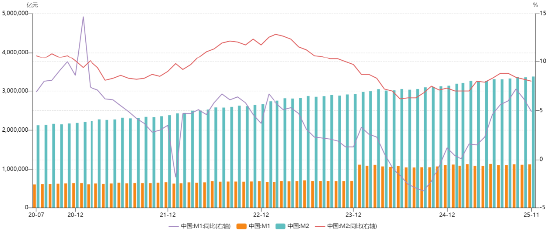
Economic Indicators - The cumulative increase in social financing scale for the first eleven months of 2025 reached 33.39 trillion yuan, an increase of 3.99 trillion yuan compared to the same period last year [1][8] - The increase in RMB loans for the first eleven months was 15.36 trillion yuan [1][6] - As of the end of November, the broad money supply (M2) stood at 336.99 trillion yuan, reflecting a year-on-year growth of 8% [1][6] - The narrow money supply (M1) was 112.89 trillion yuan, with a year-on-year increase of 4.9% [1][6] - The cash in circulation (M0) amounted to 13.74 trillion yuan, showing a year-on-year growth of 10.6% [1][6] Policy Initiatives - A joint notice was issued by the Ministry of Commerce, the People's Bank of China, and the Financial Regulatory Bureau to enhance collaboration between commerce and finance to boost consumption [1][14] - The notice emphasizes support for key areas of consumption, including goods, services, and new consumption models, proposing 11 policy measures to stimulate demand [14][46] Real Estate Market - In November, the new residential sales prices in first-tier cities decreased by 0.4% month-on-month, with a year-on-year decline of 1.2% [1][16] - The decline in new residential prices in second and third-tier cities was 0.3% and 0.4% respectively, indicating a slight narrowing of the decline [16][48] International Developments - The Bank of Japan raised its policy interest rate by 0.25 percentage points to 0.75%, marking the highest level since September 1995 [19][20] - In the U.S., the Consumer Price Index (CPI) for November rose by 2.7% year-on-year, lower than expected, leading to increased market expectations for a potential interest rate cut by the Federal Reserve in January [21][21]
政策接续发力 金融促进消费供需“双向奔赴”
Jing Ji Ri Bao· 2025-12-18 23:24
Core Viewpoint - The recent implementation plan aims to enhance the adaptability and convenience of consumer finance services, thereby stimulating consumption and meeting market demand effectively [1][2][4]. Group 1: Policy and Financial Support - Consumer finance is identified as a crucial link between consumer demand and financial supply, playing a significant role in stimulating consumption and boosting domestic demand [2]. - Financial authorities have been encouraging financial institutions to meet the effective credit needs of the real economy, particularly in sectors like accommodation, dining, entertainment, education, and tourism [2][3]. - As of September 2025, the loan balance in key service consumption areas reached 2.8 trillion yuan, reflecting a year-on-year growth of 4.9% [2]. Group 2: Product Supply and Innovation - The plan emphasizes the need to diversify consumer finance products and services, enhancing their adaptability and convenience [4]. - Major commercial banks are actively implementing monetary and fiscal policies, with consumer loan issuance reaching approximately 810 billion yuan in a single year [4]. - Agricultural Bank of China's personal consumption loan balance, including credit cards, reached 1.46 trillion yuan, with a year-on-year growth rate of 9.4% [4]. Group 3: Consumer Engagement and Lifecycle Support - Haier Consumer Finance has developed a comprehensive financial service system targeting new citizens' needs in essential life areas, achieving a total installment transaction amount of 130 million yuan [5]. - The implementation of the personal consumption loan interest subsidy policy has led to 55,000 customers obtaining loans, totaling approximately 60 million yuan [6]. Group 4: Upgrading Consumption and Environmental Sustainability - The plan promotes the "old-for-new" policy to facilitate the transition to higher-quality consumer goods, thereby expanding the scope for consumer finance [7]. - The "old-for-new" initiative has generated over 2.4 trillion yuan in sales and benefited more than 360 million people in the first ten months of the year [8]. - Financial support for large-scale equipment updates and the "old-for-new" policy is crucial for promoting consumption upgrades [7][8].
政策协同发力!消金机构掘金下沉消费赛道
Xin Lang Cai Jing· 2025-12-18 03:44
Core Viewpoint - Accelerating the filling of the domestic demand gap, especially in consumption, has become a crucial topic for driving China's economic growth, with expanding domestic demand being prioritized as one of the eight key tasks for economic work in 2026 [1][10]. Policy Measures - The Ministry of Commerce and other departments have jointly issued a notification to strengthen the collaboration between commerce and finance to boost consumption, outlining 11 measures to enhance financial support in key areas and expand cooperation between government, finance, and enterprises [1][12]. - Recent policies have been introduced to stimulate market vitality and release consumption potential, including guidelines encouraging financial institutions to increase consumer loan issuance and support service consumption [2][11]. Financial Support and Collaboration - The notification emphasizes the need for a "combination punch" of policies, enhancing collaboration between financial institutions and retail platforms to improve payment services and support for consumer financing [3][12]. - Financial institutions are encouraged to innovate financial products and services that integrate into consumption scenarios, focusing on areas such as home services, education, and health, to stimulate new consumption patterns [3][13]. Market Response and Impact - Following the implementation of the consumption loan subsidy policy, significant market activity has been observed, with companies like Zhaolian Consumer Finance reporting substantial loan issuance and customer engagement [5][15]. - Merchants have gained confidence from financial policies, with promotional tools like interest-free installment plans leading to increased sales and customer engagement [5][15]. Targeting Underdeveloped Markets - The notification highlights the importance of expanding consumption in county-level markets and rural areas, recognizing their potential for growth and the need for targeted financial support [7][17]. - Financial institutions are focusing on providing services to underserved populations, including new citizens and small businesses, to enhance financial inclusion and stimulate local consumption [18][19]. Long-term Strategy - The overall strategy for boosting consumption is shifting from short-term stimulus measures to long-term, systematic approaches aimed at enhancing consumer capacity and addressing structural issues in the economy [20].