
红利板块

Search documents
红利板块午后拉升小幅翻红,红利ETF易方达(515180)和红利低波动ETF(563020)月内净流入均超5亿元
Sou Hu Cai Jing· 2025-12-17 11:28
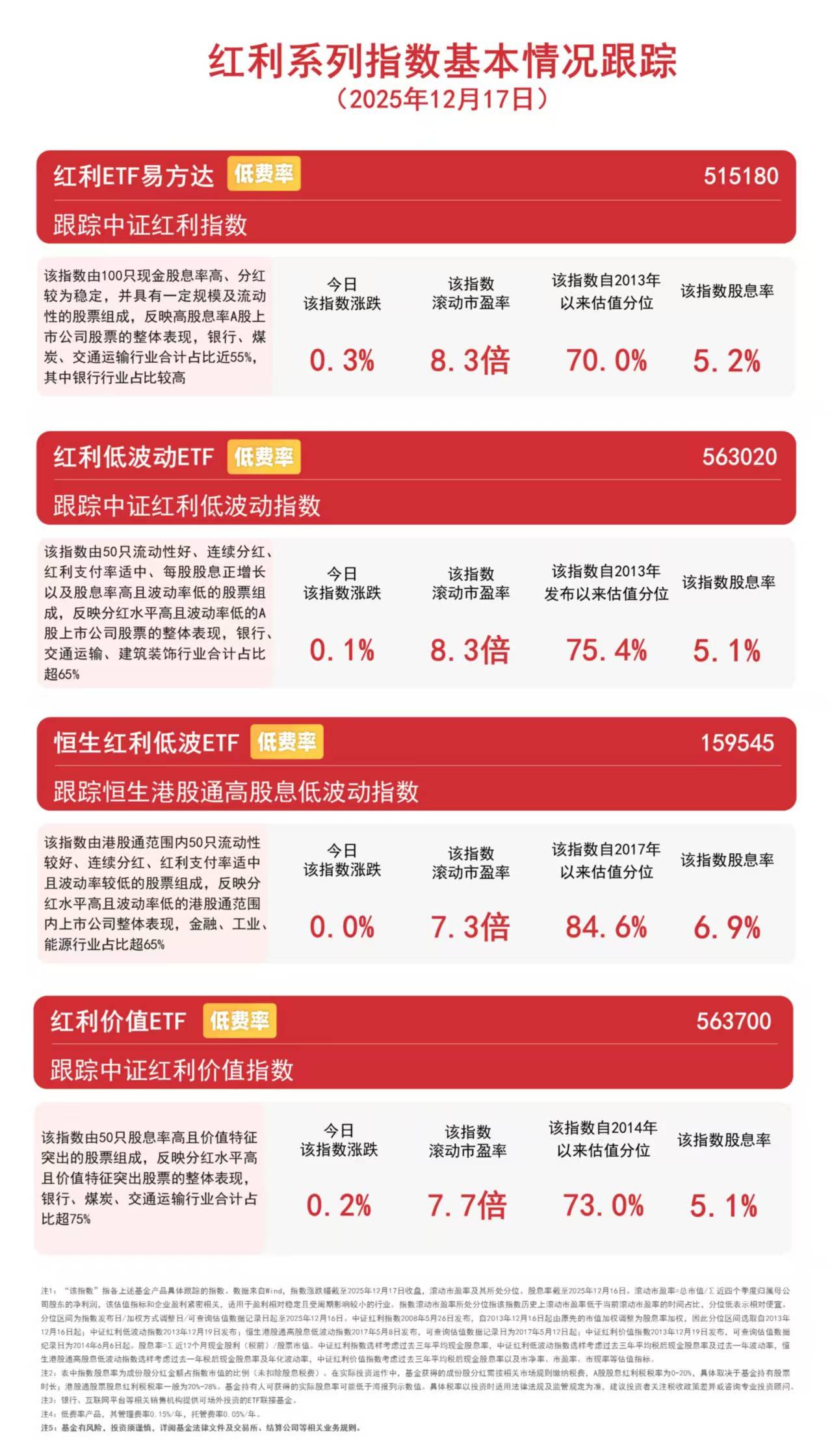
Core Viewpoint - The dividend sector saw a slight rebound in the afternoon, with the CSI Dividend Index rising by 0.3%, the CSI Dividend Value Index by 0.2%, and the CSI Dividend Low Volatility Index by 0.1% [1]. Fund Performance - The E Fund Dividend ETF (515180) and the Dividend Low Volatility ETF (563020) experienced a net inflow of over 500 million yuan each within the month [1]. - E Fund is currently the only fund company that implements low fee rates for all its dividend ETFs, with a management fee rate of 0.15% per year for its products [1]. Index Composition - The CSI Dividend Index consists of 100 stocks with high cash dividend yields and stable performance, with the banking, coal, and transportation sectors accounting for nearly 55% of the index [3]. - The CSI Dividend Low Volatility Index is composed of 50 stocks that exhibit good liquidity, continuous dividends, moderate dividend payout ratios, and low volatility, with the banking, transportation, and construction sectors making up over 65% of the index [3]. - The Hang Seng Dividend Low Volatility ETF tracks an index made up of 50 stocks within the Hong Kong Stock Connect that have good liquidity and continuous dividends, reflecting high dividend levels and low volatility [3]. Valuation Metrics - The rolling price-to-earnings ratio for the CSI Dividend Index is 8.3 times, with a valuation percentile of 70% [3]. - The rolling price-to-earnings ratio for the CSI Dividend Low Volatility Index is also 8.3 times, with a valuation percentile of 75.4% [3]. - The rolling price-to-earnings ratio for the CSI Dividend Value Index is 7.7 times, with a valuation percentile of 73% [4].

12月17日大盘简评
Mei Ri Jing Ji Xin Wen· 2025-12-17 10:40
Market Performance - The A-share market showed strength in the afternoon, with the Shanghai Composite Index rising by 1.19% to 3870.28 points, the Shenzhen Component Index increasing by 2.40%, and the ChiNext Index up by 3.39% [1] - The total market turnover reached 1.83 trillion yuan, an increase of 86.3 billion yuan compared to the previous trading day [1] - High-volatility sectors such as telecommunications, AI in the ChiNext, and non-ferrous metals performed well, while sectors like aquaculture, coal, and dividend stocks lagged behind [1] Investment Trends - Incremental capital is flowing into the market, with the CSI A500 ETF leading in turnover, totaling 45.291 billion yuan among the top five ETFs, and the overall A500 ETF turnover reaching 52.575 billion yuan, more than three times that of the CSI 300 ETF [1] - There is a noticeable increase in net subscriptions for several core broad-based products, indicating a concentrated allocation of funds towards core A-share assets after a market correction [1] Economic Outlook - The current market sentiment is moderately positive, with a marginal recovery in risk appetite [1] - The former Deputy Governor of the Bank of Japan, Makoto Nakada, warned against premature interest rate hikes, advocating for fiscal and growth policies to elevate neutral interest rates, which is interpreted as a constraint on the pace of central bank rate hikes and positively impacts market sentiment [1] Sector Analysis - The prevailing market themes include technology (AI industry chain), anti-involution, and external demand-driven manufacturing recovery [2] - The uncertainty surrounding AI commercialization, as evidenced by Oracle's revenue and cloud business falling short of expectations, contributes to market volatility [2] - Despite the promising trends in AI, concerns about stock price divergence from fundamentals exist, suggesting a focus on tangible asset expansion opportunities, particularly in the power-related non-ferrous sector [2] Real Estate and Inflation - The real estate market continues to experience a downward trend, with housing prices declining [2] - The Consumer Price Index (CPI) has turned positive for two consecutive months, influenced by gold prices and seasonal fluctuations in vegetable prices [2] Debt Market - The bond market saw a slight rebound, although the weak performance in the fourth quarter was more pronounced than expected [2] - Long-term bonds, particularly 30-year government bonds, are approaching post-tax mortgage rates, indicating a gradual recovery in their investment value [2] - The 10-year government bond remains a stabilizing force in the bond market during this adjustment phase, highlighting its robust characteristics [2]
把握“成长+价值”双主线,兴业证券最新研判
Zhong Guo Ji Jin Bao· 2025-12-16 15:32
Group 1 - The core investment strategy for 2026 focuses on "growth momentum and value reconstruction dividends," emphasizing the importance of patience and stability in the Hong Kong stock market [2] - The AI wave is compared to the internet boom of 1996-1998, with expectations that macroeconomic conditions and Federal Reserve policies will differ significantly from the early 2000s [2] - The nominal GDP growth rate is expected to improve in 2026, with a moderate inflation recovery, indicating structural opportunities in the Chinese economy [2] Group 2 - Four key areas of opportunity are identified: 1) Growth momentum driven by AI, internet, and new consumption sectors; 2) High-yield assets like insurance and banking in a low-interest environment; 3) Value discovery in traditional industries benefiting from global supply chain restructuring; 4) Strategic assets such as gold and rare earths amid global order changes [3] - The A-share market is expected to benefit from limited negative external impacts, a global AI industry trend, and supportive liquidity conditions [4] - The recovery of corporate earnings is anticipated to be a major highlight, with a shift from a "淘汰赛" (elimination race) to a "竞速赛" (speed race) in industry performance as more sectors enter a recovery phase [4][5] Group 3 - Key sectors for investment in 2026 include AI, new energy, military industry, and innovative pharmaceuticals, with a focus on companies that can leverage global competitive advantages [5] - The trend of domestic wealth reallocating towards the stock market, along with the influx of long-term capital from various sources, is expected to create positive feedback in the market [4] - The selection of individual stocks may shift from stable dividend payers to those with strong free cash flow as overall corporate profitability improves [5]

红利板块小幅回调,资金布局力度不减,红利ETF易方达(515180)和红利低波动ETF(563020)近一周连续“吸金”
Sou Hu Cai Jing· 2025-12-16 10:22
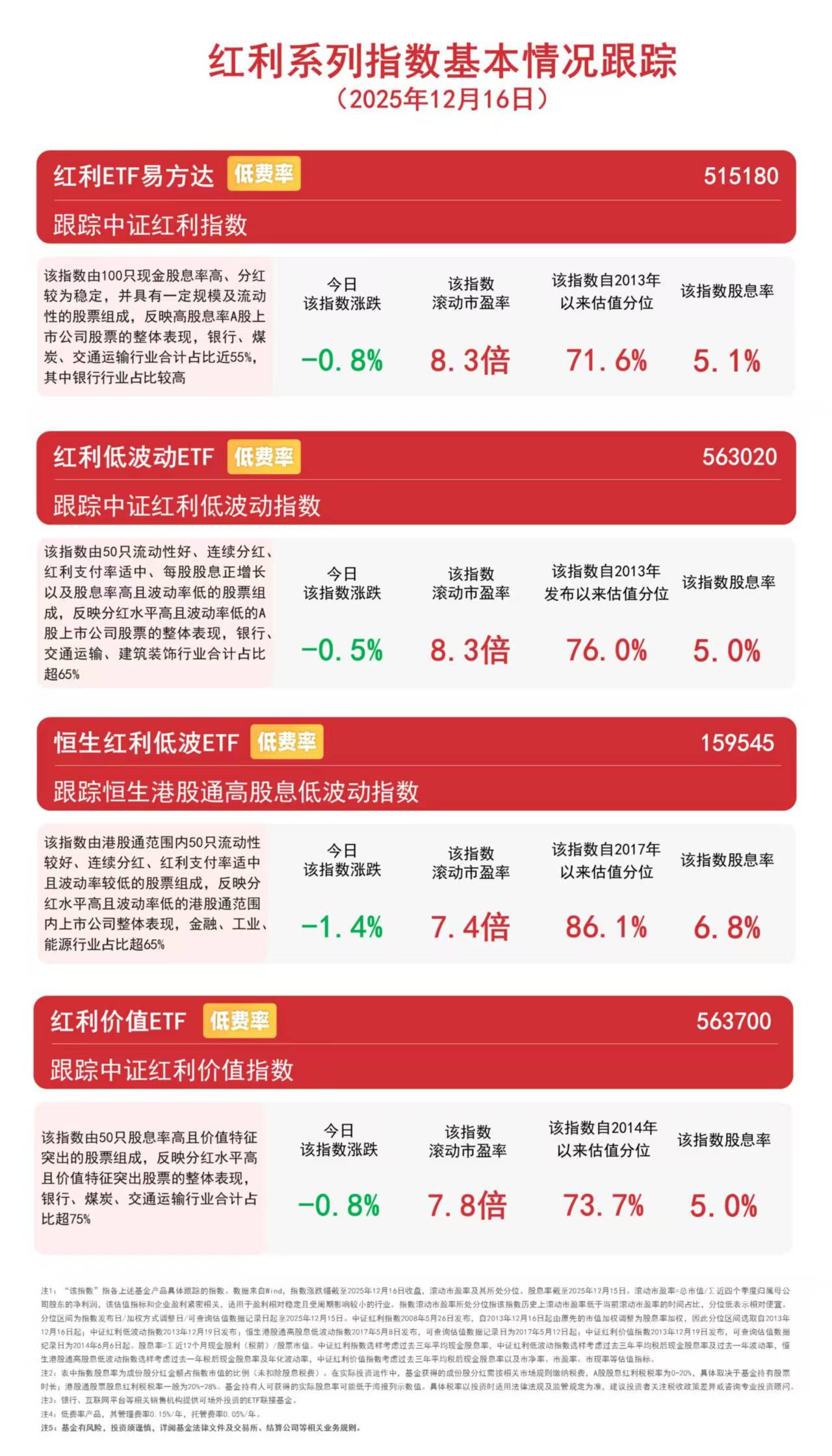
Core Viewpoint - The dividend sector experienced a slight pullback today, with various indices reflecting declines, while the E Fund's dividend ETFs saw significant net inflows over the past week, indicating strong investor interest in low-cost, high-dividend assets [1][4]. Group 1: Market Performance - The CSI Dividend Low Volatility Index fell by 0.5%, while the CSI Dividend Index and CSI Dividend Value Index both decreased by 0.8%. The Hang Seng High Dividend Low Volatility Index dropped by 1.4% [1]. - E Fund's dividend ETFs, including the E Fund Dividend ETF (515180) and the Dividend Low Volatility ETF (563020), recorded a combined net inflow exceeding 300 million yuan over the past week [1]. Group 2: Fund Management and Fees - E Fund is currently the only fund company offering all its dividend ETFs at a low fee rate of 0.15% per year, which supports investors in low-cost allocations to high-dividend assets [1][6]. - The management fee for the E Fund's dividend products is set at 0.15% per year, with a custody fee of 0.05% per year [6]. Group 3: Index Composition - The CSI Dividend Index comprises 100 stocks with high cash dividend yields and stable performance, with significant representation from the banking, coal, and transportation sectors, accounting for nearly 55% [3]. - The CSI Dividend Low Volatility Index includes 50 stocks characterized by good liquidity, continuous dividends, and low volatility, with over 65% representation from the banking, transportation, and construction sectors [3]. - The CSI Dividend Value Index consists of 50 stocks with high dividend yields and notable value characteristics, with over 75% representation from the banking, coal, and transportation sectors [4].
现金流ETF(159399)近20日净流入超7亿元,震荡市关注自由现金流配置价值
Mei Ri Jing Ji Xin Wen· 2025-12-16 06:33
Group 1 - The core viewpoint is that in a low-interest-rate environment, dividend stocks will remain quality core assets, but the selection of individual stocks may shift from stable dividends to free cash flow due to overall corporate profitability showing elasticity [1] - Free cash flow direction has the potential for both increased dividends and expanded capital expenditures, offering stronger elasticity compared to ordinary dividend stocks [1] - Investors are encouraged to pay attention to the cash flow ETF (159399), which has outperformed the CSI Dividend Index and the CSI 300 Index for nine consecutive years from 2016 to 2024 [1] Group 2 - The cash flow ETF (159399) focuses on large and mid-cap stocks, with a higher proportion of central state-owned enterprises compared to similar cash flow indices [1] - According to the fund announcement, the cash flow ETF can assess dividends monthly and has distributed dividends for ten consecutive months since its listing [1]
现金流ETF(159399)飘红,近20日净流入超8.4亿元,自由现金流资产或为优质底仓
Mei Ri Jing Ji Xin Wen· 2025-12-15 06:29
兴业证券指出,2025年A股盈利结构型复苏,各行业景气分化较大,但上市公司业绩的"含金量"在提 升。随着高增长行业增多、更多行业步入盈利复苏通道,行业表现将从"淘汰赛"转向"竞速赛"。低利率 时代下,红利板块仍将是优质底仓资产,但上市公司整体盈利具备弹性后,个股的筛选思路或由此前的 稳定红利转向自由现金流。自由现金流板块兼具分红提升和扩大资本开支的潜力,具备比普通红利板块 更强的弹性空间。 投资者可关注现金流ETF(159399)。市场表现来看,标的指数富时现金流指数2016年至2024年连续9 年跑赢中证红利指数和沪深300指数。现金流ETF(159399)的标的指数聚焦大中市值,标的指数央国 企占比高于同类现金流指数,根据基金公告,现金流ETF月月可评估分红,自上市以来连续10个月分 红,感兴趣的投资者或可持续关注。 (文章来源:每日经济新闻) ...
75亿买理财到底有没有问题?
表舅是养基大户· 2025-12-14 13:33
Group 1 - The article discusses three major events to watch for the upcoming week, including a potential interest rate hike by the Bank of Japan, the release of the U.S. non-farm payroll report, and the listing of a new domestic GPU company, Muxi Co. [2] - The focus on Mowang's recent announcement regarding the investment of 7.5 billion in cash management products has sparked significant public discourse, with mixed reactions from investors and analysts [10][11]. - Mowang's decision to use raised funds for cash management is seen as a responsible financial strategy, as it involves low-risk, principal-protected products, which can enhance cash management efficiency [12][14]. Group 2 - The article highlights a significant drop in the U.S. AI sector, particularly the Philadelphia Semiconductor Index, which fell over 5%, marking its largest single-day decline since October 10 [17]. - Oracle's disappointing earnings report and Broadcom's underwhelming quarterly results have contributed to the negative sentiment in the AI sector, raising concerns about their financial health and future growth [18][19]. - The article suggests that investors should maintain a balanced portfolio and be cautious of potential corrections in growth sectors, while also considering new investment opportunities in domestic AI-related concepts [21][24]. Group 3 - The article discusses Kweichow Moutai's new policy to control the supply of non-standard products, which aims to alleviate pressure on distributors and stabilize prices [26][27]. - The new policy may lead to a decline in sales and profits for non-standard Moutai products, while potentially benefiting other liquor companies by stabilizing the price of Moutai [29]. - The article emphasizes that despite the new policy, the underlying supply-demand dynamics in the market remain unchanged [29]. Group 4 - The article notes that despite favorable news for the dividend sector, the Reducing Volatility 100 Index has experienced five consecutive days of decline, indicating a disconnect between theoretical benefits and market performance [32]. - Historical data shows that after a year of decline, the Reducing Volatility 100 Index has generally seen significant gains over the following three years, suggesting potential recovery opportunities for investors [35].

红利板块本周回调,恒生红利低波ETF(159545)和红利ETF易方达(515180)获资金持续布局
Sou Hu Cai Jing· 2025-12-12 10:40
Core Viewpoint - The dividend sector experienced a pullback this week, with various indices reflecting declines in performance, while certain ETFs saw significant net inflows, indicating continued investor interest in high-dividend assets [1][2]. Index Performance - The China Securities Dividend Index and the China Securities Dividend Value Index both fell by 2.4%, while the China Securities Low Volatility Dividend Index decreased by 1.9%, and the Hang Seng High Dividend Low Volatility Index dropped by 2.0% [1][2]. - The dividend yield for the China Securities Dividend Index is 4.6%, while the China Securities Low Volatility Dividend Index has a yield of 4.4%, and the Hang Seng High Dividend Low Volatility Index boasts a yield of 6.8% [2][3]. ETF Inflows - The Hang Seng Dividend Low Volatility ETF (159545) and the E Fund Dividend ETF (515180) recorded net inflows of 550 million yuan and 320 million yuan, respectively, this week [1]. - E Fund is noted as the only fund company offering all its dividend ETFs at a low fee rate of 0.15% per year, which supports low-cost investment in high-dividend assets [1][3]. Sector Composition - The China Securities Dividend Low Volatility Index comprises 50 stocks with good liquidity and stable dividends, with significant representation from the banking, coal, and transportation sectors, which together account for over 60% [3]. - The Hang Seng High Dividend Low Volatility Index includes 50 stocks from the Hong Kong Stock Connect, with financial, real estate, and energy sectors making up more than 60% of its composition [3]. Historical Performance - Over the past month, the China Securities Dividend Index has decreased by 6.5%, while the China Securities Low Volatility Dividend Index has fallen by 5.9% [5]. - Year-to-date, the China Securities Low Volatility Dividend Index has shown a slight increase of 0.1%, while the Hang Seng High Dividend Low Volatility Index has risen by 21.0% [5].

红利板块延续调整,恒生红利低波ETF(159545)和红利ETF易方达(515180)受资金关注
Sou Hu Cai Jing· 2025-12-11 11:32
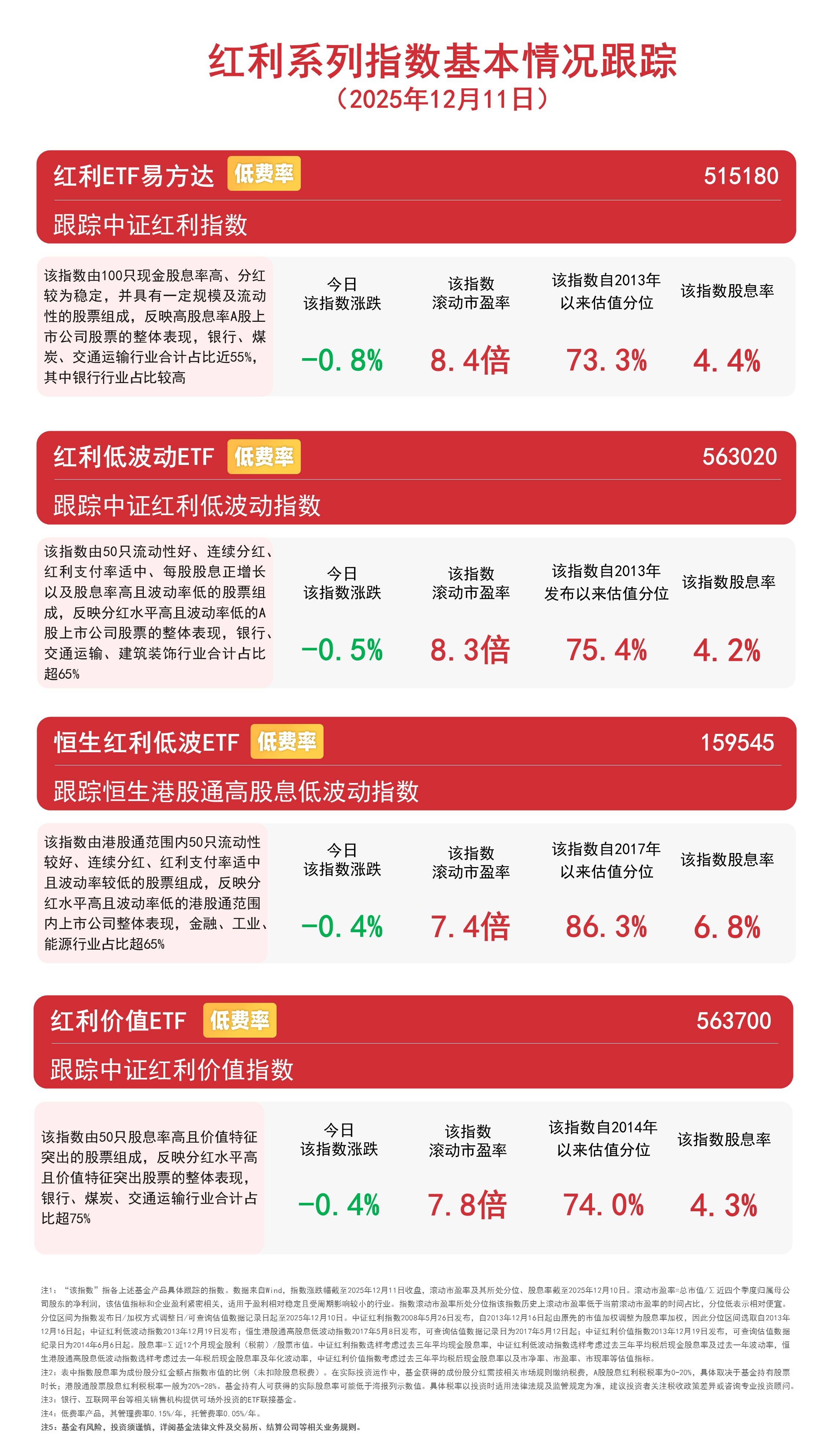
Group 1 - The market opened high but closed lower, with the Hang Seng High Dividend Low Volatility Index and the CSI Dividend Value Index both down by 0.4%, the CSI Dividend Low Volatility Index down by 0.5%, and the CSI Dividend Index down by 0.8% [1] - The Hang Seng Dividend Low Volatility ETF (159545) saw a net subscription of 45 million units throughout the day, indicating continued capital inflow [1] - According to Wind data, the Hang Seng Dividend Low Volatility ETF (159545) and the E Fund Dividend ETF (515180) received net inflows of 630 million yuan and 250 million yuan respectively over the past week [1] Group 2 - The CSI Dividend Index consists of 50 stocks with good liquidity, continuous dividends, moderate dividend payout ratios, positive growth in earnings per share, and high dividend yields with low volatility, reflecting the overall performance of A-share listed companies with high dividend levels and low volatility [3] - The banking, transportation, and construction decoration industries account for over 65% of the index [3] Group 3 - The Hang Seng Dividend Low Volatility ETF tracks the Hang Seng High Dividend Low Volatility Index, which is composed of 50 stocks within the Hong Kong Stock Connect that have good liquidity, continuous dividends, moderate dividend payout ratios, and low volatility [6][7] - The financial, industrial, and energy sectors make up over 65% of this index [7]
现金流ETF(159399)近20日净流入超9.2亿元,震荡市关注自由现金流配置价值
Mei Ri Jing Ji Xin Wen· 2025-12-11 08:05
根据本次收益分配方案,分红基准日为2025年12月3日,本月分红0.25%指每份额分红0.0029元/基 准日基金份额净值1.1568的比例,具体详基金分红公告。基金分红规则以基金法律文件为准,鉴于本基 金的特点,本基金分红不一定来自基金盈利,基金分红并不代表总投资的正回报。如提及个股仅供参 考,不代表投资建议。指数/基金短期涨跌幅及历史表现仅供分析参考,不预示未来表现。市场观点随 市场环境变化而变动,不构成任何投资建议或承诺。文中提及指数仅供参考,不构成任何投资建议,也 不构成对基金业绩的预测和保证。如需购买相关基金产品,请选择与风险等级相匹配的产品。基金有风 险,投资需谨慎。 投资者可关注现金流ETF(159399)。市场表现来看,标的指数富时现金流指数2016年至2024年连 续9年跑赢中证红利指数和沪深300指数。现金流ETF(159399)的标的指数聚焦大中市值,标的指数央 国企占比高于同类现金流指数,感兴趣的投资者或可持续关注。 (责任编辑:张晓波 ) 注:现金流ETF完全由国泰基金管理有限公司开发,本基金与伦敦证券交易所集团公司及其附属企 业(统称"LSE Group")之间没有关联,也并非受其 ...