
通胀放缓

Search documents
收入水平增长,就业逐步平衡,居民消费保持稳定,支撑俄罗斯经济
Sou Hu Cai Jing· 2025-11-24 00:42
Economic Overview - The Russian economy showed a complex but overall balanced development in Q3, with GDP growth slowing down but domestic consumption remaining stable. September's GDP grew by 0.9% year-on-year, surpassing August's 0.4%, while overall Q3 growth was only 0.6% [1][3] Consumer Spending and Income - Retail, catering, and paid services sectors saw a revenue increase of 2.5% year-on-year in September, slightly down from 3% in August. Food consumption declined, but service and non-food goods consumption continued to grow. Analysts believe that rising household income is the main driver of economic vitality [3][4] - Real disposable income for residents grew by 8.5% in Q3 and 9.2% from January to September, significantly exceeding the annual forecast of 3.8%. This increase in income creates favorable conditions for active consumption [3][4] Income Structure and Inflation - The structure of income has changed, with wage income now accounting for 40.9% of total household income, a 2% increase over the past year. This indicates a stable core income source for residents, supporting consumption even as wage growth slows [3][4] - The annualized inflation rate at the end of Q3 was approximately 4.9%, lower than expected, which helped maintain real income growth above predicted levels and increased residents' confidence in financial stability [3][4] Delayed Demand and Consumer Sentiment - Accumulated delayed demand is significant, as residents have been saving for large purchases like cars and appliances. The implementation of vehicle scrappage tax policies has further incentivized vehicle purchases, positively impacting consumer spending [4] - The consumer sentiment index shows an increase in the proportion of respondents willing to spend idle funds on high-value items, rising by 2.1 percentage points to 26.6% [4] Labor Market Trends - The unemployment rate in September was 2.2%, slightly up from 2.1% in August, indicating a cooling labor market. However, high consumer activity and disposable income growth are stabilizing consumption [5][6] - The labor market has shown signs of stabilization, with the number of job vacancies per job seeker decreasing from 5 to 2.3 over the past year, reflecting a natural adjustment after rapid expansion earlier in the year [6]


瑞士10月通胀意外放缓 央行面临应对强势瑞郎的压力
Xin Hua Cai Jing· 2025-11-03 07:58
Core Viewpoint - Swiss inflation unexpectedly slowed to near zero levels, putting pressure on the central bank to address the strong Swiss franc and stimulate price growth [1] Economic Data Summary - October CPI rose by 0.1% year-on-year, down from 0.2% in the previous month and below the market expectation of 0.3% [1] - Core inflation also unexpectedly slowed from 0.7% to 0.5% last month [1] Central Bank Challenges - The strong Swiss franc, bolstered by its status as a safe-haven currency, has reached levels close to a decade high, potentially suppressing inflation by lowering import costs [1] - The Swiss National Bank (SNB) faces a complex task as price growth has not rebounded from the lower limit of the 0-2% target range, complicating policy decisions amid a strong franc [1] Policy Options - The SNB may consider foreign exchange interventions, which would expand its balance sheet and could provoke a negative response from the U.S. [1] - Alternatively, the SNB could implement negative interest rate policies, which may harm the financial system [1]
【UNforex财经事件】贸易缓和与降息预期共振 市场风险情绪显著升温
Sou Hu Cai Jing· 2025-10-27 10:00
Group 1 - The U.S. and China have reached a preliminary consensus on a trade framework, including a temporary pause on rare earth export controls, providing a more stable negotiation basis for upcoming leader meetings [1] - Market expectations suggest that some tariffs and restrictions may ease, leading to a rise in risk assets such as stocks and crude oil [1] - The U.S. September CPI data shows a year-on-year increase of 3.0% and a month-on-month rise of 0.3%, indicating a continued trend of slowing inflation, which enhances expectations for a more accommodative stance from the Federal Reserve in its October meeting [1] Group 2 - The market is shifting focus towards central bank actions, with upcoming meetings from the Federal Reserve and other central banks expected to influence the direction of the dollar and global assets [1] - If Fed Chair Powell hints at a faster easing path, the dollar may continue to decline, while a contrary signal could trigger adjustments in risk assets [1] - Gold prices have retreated from recent highs due to reduced safe-haven demand and profit-taking by some bulls, with spot gold dropping to around $4,072, nearly 1.2% lower than last week's peak [1] Group 3 - The dollar index remains volatile, with the USD/JPY breaking the 153 mark, indicating a recovery in risk appetite that pressures the yen [2] - The Canadian central bank's upcoming meeting is highly anticipated, with expectations of a 25 basis point rate cut to 2.25%, limiting the rebound potential of the Canadian dollar [2] - U.S. stock futures have risen by approximately 0.6%-1.1% in early European trading, driven by optimism from trade developments and rate cut expectations, suggesting further upside potential for the stock market [2] Group 4 - The market has transitioned from being driven by trade news to a phase of policy and capital dynamics, where the outcomes of the Federal Reserve's decisions and subsequent macro data will determine the sustainability of market trends [3] - Investors are advised to remain flexible in a high-volatility environment, closely monitoring capital flows and volatility changes to seize trading opportunities arising from shifts in market sentiment [3]
ETO Markets 外汇:英镑在劳动力市场担忧下能否止住对美元跌势?
Sou Hu Cai Jing· 2025-10-27 09:48
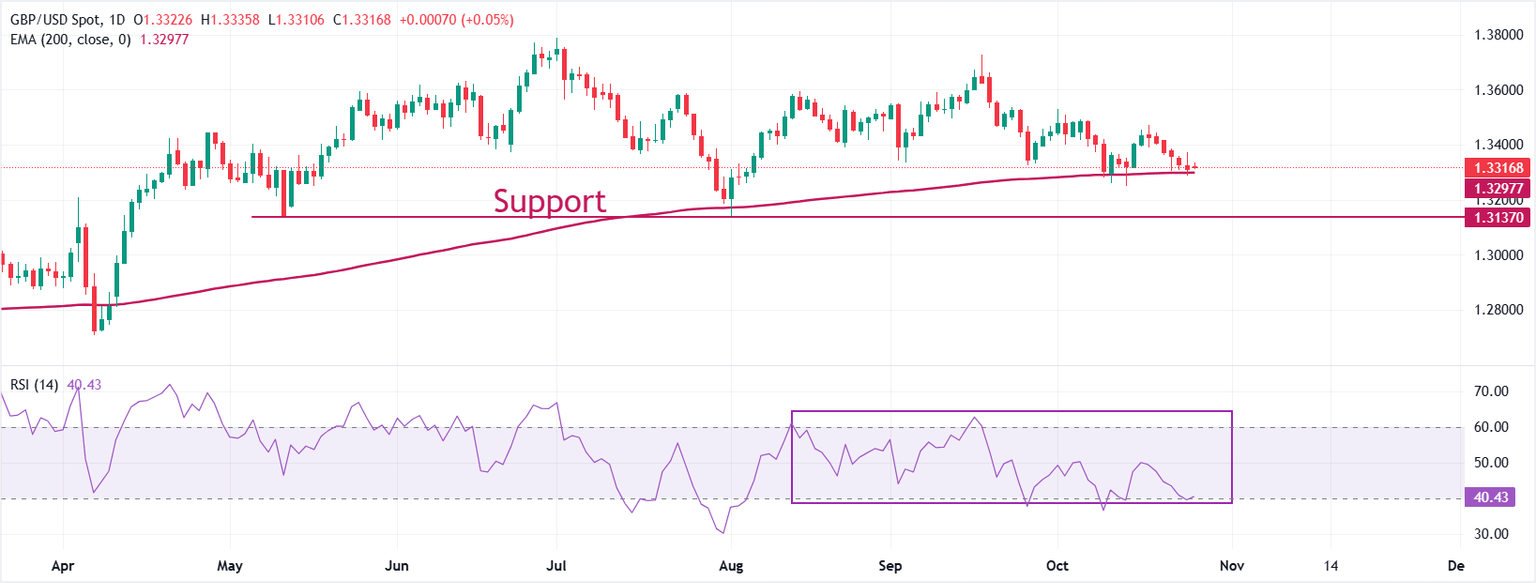
Group 1 - The British pound against the US dollar has retraced its early gains, trading around 1.3310, indicating a potential continuation of its seventh consecutive day of decline [3] - Optimistic UK retail sales data and the preliminary S&P Global Purchasing Managers' Index (PMI) data failed to support the pound, as investor sentiment remains pessimistic regarding the UK economy [2][3] - The UK Office for National Statistics reported a surprising 0.5% month-on-month increase in retail sales, contrary to expectations of a 0.2% decline, while the manufacturing PMI rose from an expected 46.6 to 49.6, still indicating contraction [3] Group 2 - Despite the positive consumer spending and business activity growth, concerns over a slowing labor market have led traders to increase bets on a dovish stance from the Bank of England [3] - The International Labour Organization (ILO) unemployment rate rose to 4.8%, the highest level since mid-2021, following weak employment data released in mid-October [3] Group 3 - Market speculation regarding a potential 25 basis points rate cut by the Federal Reserve has intensified, with traders pricing in a reduction to a range of 3.75%-4.00% [5] - US inflation has eased, providing the Federal Reserve with more room to focus on improving employment demand, as indicated by the September Consumer Price Index (CPI) report [5] Group 4 - The hope for a trade agreement between the US and China has strengthened the dollar, with President Trump expressing confidence in reaching an agreement following meetings with Chinese officials [5]
爱华中文官网: 美国主要指数扩大了涨势 美元指数走软
Sou Hu Cai Jing· 2025-10-27 08:12
Core Insights - The U.S. stock market has shown an upward trend, driven by a slight easing in inflation concerns and strong earnings from major companies [3][5][11] Market Drivers - Inflation has slightly slowed, with the U.S. Consumer Price Index (CPI) year-over-year at 3.0%, below the expected 3.1%, raising hopes that the Federal Reserve may pause its rate hikes [3][11] - Strong earnings from several large-cap stocks have further supported market optimism [3] - WTI crude oil prices remain stable above $61 per barrel, maintaining a positive sentiment in the energy sector without reigniting inflation fears [3][11] Volatility and Yield - The VIX index has decreased by 5.38%, indicating a reduction in risk aversion among investors [4][15] - The 10-year Treasury yield is stable at 4.043%, reflecting a balance between stock and bond liquidity [6] Top Stock Movers - Ford has seen a significant increase of 11.92% due to strong electric vehicle sales and optimistic guidance [8] - Western Union's stock rose by 10.07% driven by robust remittance volumes [9] - Coinbase experienced a 9.57% increase attributed to rising cryptocurrency inflows [10] Commodity Insights - WTI crude oil is priced at $61.50 per barrel, stabilizing after a recent surge driven by sanctions [13] - Gold is trading at $4,137.80 per ounce, supported by weak inflation data and stable dollar conditions [13] Other Key Areas - The Federal Reserve is expected to clarify its interest rate path following recent CPI data, with several officials scheduled to speak this week [16] - Earnings reports from major tech companies may test market sentiment resilience [16] - Month-end liquidity flows could cause short-term distortions in the market [16]

美联储戴利:劳动力市场疲软和通胀放缓,证明美联储降息合理
Sou Hu Cai Jing· 2025-10-10 09:30
Core Viewpoint - The recent comments from Federal Reserve's Daly indicate that the softening labor market and inflation levels being "far below" previous concerns validate last month's interest rate cut and suggest potential for further cuts in the future [1] Group 1: Economic Conditions - The economy is experiencing a slight slowdown, with consumers depleting their excess savings while facing higher price levels [1] - Restrictive monetary policy is also contributing to the current economic environment [1] Group 2: Labor Market Concerns - Daly emphasizes that the current moment is critical, and without proper risk management, the softening labor market could become more concerning [1]
美联储戴利:劳动力市场疲软和通胀放缓 证明美联储降息合理
Xin Hua Cai Jing· 2025-10-10 03:04
Core Viewpoint - The recent comments from the Federal Reserve's Daly indicate that the softening labor market and lower-than-expected inflation levels justify last month's interest rate cut and suggest the possibility of further rate cuts in the future [1] Group 1: Economic Conditions - The economy is experiencing a slight slowdown, with consumers depleting their excess savings while facing higher price levels [1] - There is a restrictive monetary policy currently in place, which is contributing to the economic conditions [1] Group 2: Labor Market Concerns - The labor market's weakness is a significant concern, and without proper risk management, it could become more troubling [1]
东京CPI夸大放缓幅度 日本央行10月仍有望加息
Jin Tou Wang· 2025-09-30 04:03
Group 1 - The core viewpoint of the articles indicates that the USD/JPY exchange rate is currently stable around 148, with recent CPI data from Tokyo suggesting a slowdown in inflation, which may impact monetary policy decisions in Japan [1][2] - According to Capital Economics, the weaker-than-expected CPI data in Tokyo has exaggerated the perception of nationwide inflation slowing down, leading to speculation about the likelihood of an interest rate hike in October [1] - The report estimates that recent measures, such as free childcare initiatives, have lowered Japan's overall inflation rate by approximately 0.7 percentage points, with expectations that the nationwide inflation rate will decrease from 3.3% to 3.1% [1] Group 2 - The USD/JPY is currently supported at the 200-day moving average around 148.40, with indicators showing that bullish momentum remains intact despite some weakening [2] - If the USD/JPY breaks above 149.00, it may face resistance in the 149.40-149.45 range, with a potential challenge to the psychological level of 150.00 [2] - Conversely, if the exchange rate falls below the support level of 148.40, it could lead to a rapid decline towards targets of 148.00, 147.50, and the 147.20-147.15 area, with a shift to a bearish trend if it drops below 147.00 [2]
日本央行再次维持利率不变 日债周五多数下行
Xin Hua Cai Jing· 2025-09-19 06:38
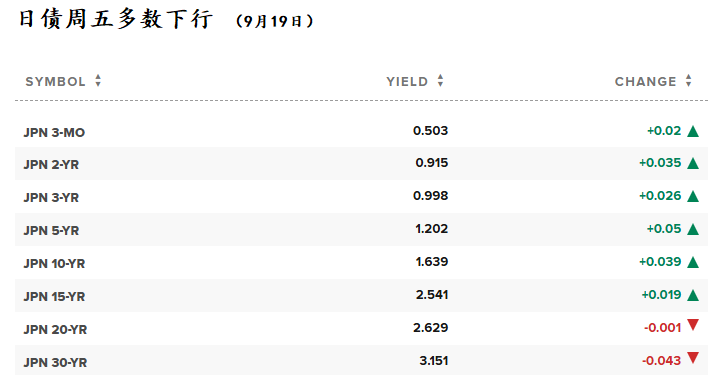
Core Viewpoint - The Bank of Japan has maintained its policy interest rate at 0.5%, aligning with market expectations, amidst ongoing uncertainties regarding the impact of U.S. tariffs on the Japanese economy [1][2]. Interest Rates and Bond Yields - The Bank of Japan has kept interest rates unchanged for four consecutive meetings, citing uncertainties related to U.S. import tariffs, even after the U.S. reduced tariffs on Japanese automobiles to 15% [2]. - As of the latest data, the 2-year Japanese government bond yield rose by 3.8 basis points to 0.918%, while the 10-year yield increased by 4 basis points to 1.64%. The 30-year yield, however, fell by 3.5 basis points to 3.159% [1][2]. Inflation Trends - Japan's overall inflation rate decreased from 3.1% in July to 2.7%, marking the lowest level since November 2024. The "core-core" inflation rate, which excludes fresh food and energy prices, fell to 3.3% from 3.4% in July [3]. - The Bank of Japan noted a "moderate" rise in inflation expectations, influenced by rising food prices, with core inflation projected between 2.5% and 3% [2][3]. Financial Market Developments - Japanese stock prices have risen, boosting the financial assets held by individuals in Japan, which totaled approximately 223.8 trillion yen (about 1.52 trillion USD) in Q2, reflecting a 1% year-on-year increase. Stock holdings grew by 4.9%, and investment trusts increased by 9% [3]. - Recent data indicated that Japanese investors net purchased 1.4785 trillion yen in overseas long-term bonds while reducing short-term bonds, while foreign investors increased their holdings of Japanese long-term bonds by 845.3 billion yen [3]. U.S. Treasury Holdings - As of the end of July, Japan held 1.1514 trillion USD in U.S. Treasury securities, an increase of 3.8 billion USD from the previous month and up 57.9 billion USD year-on-year, making Japan the largest foreign holder of U.S. debt [4].
日本央行为最早四季度加息铺平道路 美元兑日元迈向147关口
Zhong Guo Jin Rong Xin Xi Wang· 2025-09-19 05:30
Group 1 - The Bank of Japan maintained its policy interest rate at 0.50%, which aligns with market expectations, despite two committee members voting against this decision advocating for a 25 basis point hike [1] - The policy statement emphasized a moderate recovery in the economy, despite some sectors showing signs of weakness, and highlighted the need to monitor uncertainties affecting financial markets, economic activities, and prices [1] - Following the announcement, the Japanese yen strengthened, with the USD/JPY exchange rate dropping to a low of 147.211, reflecting market reactions to the central bank's stance [1] Group 2 - Analysts suggest that the decision to keep rates unchanged indicates the Bank of Japan's cautious approach amid slowing inflation and global uncertainties, signaling readiness to address external fluctuations while assessing the strength of Japan's economic recovery [2] - The narrowing interest rate differentials are expected to lead to a gradual strengthening of the yen, enhancing Japan's purchasing power and supporting domestic demand [2] - The focus is now shifting to the upcoming press conference by Governor Kazuo Ueda, which may provide further insights into the central bank's future policy direction [2]