量化选股

Search documents
私募新观察|赚钱效应显现 超九成百亿级私募年内实现正收益
Shang Hai Zheng Quan Bao· 2025-08-11 01:32
Group 1 - The core viewpoint is that the private equity market is experiencing a significant recovery, with over 90% of large private equity firms achieving positive returns this year, driven by structural market opportunities and active trading [2][3] - As of the end of July, the average return for large private equity firms was reported at 16.6%, with 54 out of 55 firms showing positive returns, indicating a strong performance in the sector [2] - The number of large private equity firms has increased to 90, reflecting the expansion of the industry amid favorable market conditions [1][2] Group 2 - The issuance market for private equity has notably improved, with a total of 1,298 private equity securities investment funds registered in July, marking an 18% increase from the previous month [3] - Large private equity firms dominated the new fund registrations in July, with significant numbers of new funds being launched, particularly in index-enhanced strategies [3] - Investor sentiment has improved, with institutional investors increasing their participation and shifting their preferences towards long-biased strategies, while individual investors are also showing signs of renewed interest [3] Group 3 - Large private equity firms are maintaining aggressive positions and actively adjusting their portfolios to capitalize on structural opportunities in the market [4][5] - The current investment focus includes sectors such as technology, innovative pharmaceuticals, non-bank financials, and cyclical stocks, with a high portfolio allocation of over 80% [4] - There is an expectation of profit-taking in popular sectors due to recent gains, particularly during the busy earnings reporting period in August, leading to potential adjustments in investment strategies [5]
形态学部分指数看多,后市或中性震荡
Huachuang Securities· 2025-08-03 05:10
Quantitative Models and Construction - **Model Name**: Volume Model **Construction Idea**: This model evaluates market trends based on trading volume changes over time [12][72] **Construction Process**: The model analyzes the trading volume of broad-based indices to determine short-term market sentiment. It transitions between "bullish," "neutral," and "bearish" signals based on volume dynamics [12][72] **Evaluation**: The model is effective in capturing short-term market sentiment but may require integration with other indicators for comprehensive analysis [12][72] - **Model Name**: Low Volatility Model **Construction Idea**: This model assesses market conditions by analyzing the volatility of indices [12][72] **Construction Process**: The model calculates the historical volatility of indices and assigns a "neutral" signal when volatility remains within a predefined range [12][72] **Evaluation**: The model provides a stable perspective on market conditions but may lag in highly volatile environments [12][72] - **Model Name**: Intelligent Algorithm Model (CSI 300 and CSI 500) **Construction Idea**: This model uses machine learning algorithms to predict market trends for specific indices [12][72] **Construction Process**: The model applies advanced algorithms to historical price and volume data, generating "bullish" signals for the CSI 300 and CSI 500 indices [12][72] **Evaluation**: The model demonstrates strong predictive capabilities for these indices, particularly in short-term scenarios [12][72] - **Model Name**: Limit-Up/Limit-Down Model **Construction Idea**: This model evaluates market sentiment based on the frequency of limit-up and limit-down events [13][73] **Construction Process**: The model tracks the number of stocks hitting daily price limits and assigns a "neutral" signal when no significant trend is observed [13][73] **Evaluation**: The model is useful for identifying extreme market conditions but may not capture subtle trends [13][73] - **Model Name**: Long-Term Momentum Model **Construction Idea**: This model identifies long-term trends by analyzing momentum indicators [14][74] **Construction Process**: The model calculates momentum metrics for indices like the SSE 50, which recently transitioned to a "bullish" signal [14][74] **Evaluation**: The model is effective for long-term trend analysis but may miss short-term fluctuations [14][74] - **Model Name**: A-Share Comprehensive Weapon V3 Model **Construction Idea**: This composite model integrates multiple signals to provide an overall market outlook [15][75] **Construction Process**: The model aggregates signals from various short-term, medium-term, and long-term models, currently indicating a "bearish" outlook [15][75] **Evaluation**: The model offers a holistic view but may dilute the impact of individual signals [15][75] - **Model Name**: HK Stock Turnover-to-Volatility Model **Construction Idea**: This model evaluates the Hong Kong market by analyzing turnover relative to volatility [16][76] **Construction Process**: The model calculates the ratio of turnover to volatility, currently signaling a "bullish" outlook for the Hang Seng Index [16][76] **Evaluation**: The model is effective for medium-term analysis but may require additional factors for short-term predictions [16][76] Model Backtesting Results - **Volume Model**: Short-term signal transitioned to "neutral" for most broad-based indices [12][72] - **Low Volatility Model**: Maintains a "neutral" signal [12][72] - **Intelligent Algorithm Model**: "Bullish" signals for CSI 300 and CSI 500 indices [12][72] - **Limit-Up/Limit-Down Model**: "Neutral" signal for medium-term analysis [13][73] - **Long-Term Momentum Model**: SSE 50 transitioned to "bullish" [14][74] - **A-Share Comprehensive Weapon V3 Model**: Overall "bearish" signal [15][75] - **HK Stock Turnover-to-Volatility Model**: "Bullish" signal for the Hang Seng Index [16][76]
金融工程量化月报:风险偏好持续提升,量化选股组合超额收益显著-20250802
EBSCN· 2025-08-02 11:17
Quantitative Models and Construction Methods 1. Model Name: PB-ROE-50 Strategy - **Model Construction Idea**: The core idea is to identify expectation gaps in the market and enhance portfolio returns by incorporating surprise expectation factors (e.g., SUE, ROE YoY growth) [31] - **Model Construction Process**: - Based on the PB-ROE pricing model derived by Wilcox (1984), stocks with significant expectation gaps are selected to form a pool - From this pool, 50 stocks are selected using factors such as standardized unexpected earnings (SUE) and ROE YoY growth to construct the PB-ROE-50 portfolio [31] - **Model Evaluation**: The strategy achieved positive excess returns across different stock pools, demonstrating its effectiveness in capturing market expectation gaps [31] 2. Model Name: Institutional Research Strategy - **Model Construction Idea**: This strategy leverages public and private institutional research data to extract alpha by analyzing the frequency of company visits and stock performance relative to benchmarks before the visits [39] - **Model Construction Process**: - Public Research Selection: Stocks are selected based on the number of visits by public institutions and their relative performance to the CSI 800 index - Private Research Tracking: Stocks are selected based on the number of visits by well-known private institutions and their relative performance to the CSI 800 index [39] - **Model Evaluation**: Both public and private research strategies generated significant positive excess returns, indicating the value of institutional research data in stock selection [39] --- Model Backtesting Results 1. PB-ROE-50 Strategy - **Excess Return (YTD)**: - CSI 500: 3.62% - CSI 800: 9.73% - All Market: 10.36% [35] - **Excess Return (Last Month)**: - CSI 500: 0.59% - CSI 800: 2.91% - All Market: 2.34% [35] - **Absolute Return (YTD)**: - CSI 500: 12.68% - CSI 800: 15.10% - All Market: 20.07% [35] - **Absolute Return (Last Month)**: - CSI 500: 5.88% - CSI 800: 7.02% - All Market: 6.77% [35] 2. Institutional Research Strategy - **Excess Return (YTD)**: - Public Research: 7.03% - Private Research: 18.00% [42] - **Excess Return (Last Month)**: - Public Research: 3.66% - Private Research: 5.58% [42] - **Absolute Return (YTD)**: - Public Research: 12.26% - Private Research: 23.77% [42] - **Absolute Return (Last Month)**: - Public Research: 7.80% - Private Research: 9.80% [42] --- Quantitative Factors and Construction Methods 1. Factor Name: Percentage of Advancing Stocks (Market Sentiment Indicator) - **Factor Construction Idea**: Strong-performing stocks often exhibit a demonstration effect, and the percentage of advancing stocks can reflect market sentiment. A higher percentage indicates optimism, while an overly high percentage may signal overheating [12] - **Factor Construction Process**: - Formula: $ \text{Percentage of Advancing Stocks (N days)} = \frac{\text{Number of CSI 300 stocks with positive returns over N days}}{\text{Total number of CSI 300 stocks}} $ - The indicator is smoothed using two moving averages (N1 = 50, N2 = 35). When the short-term average (fast line) exceeds the long-term average (slow line), it signals a bullish market sentiment [12][13][15] - **Factor Evaluation**: The indicator effectively captures upward opportunities but struggles to avoid risks in declining markets. It may also miss gains during prolonged market exuberance [12] 2. Factor Name: Moving Average Sentiment Indicator - **Factor Construction Idea**: This factor uses an eight-moving-average system to assess the trend state of the CSI 300 index. By assigning values to different ranges of the moving average, the relationship between indicator states and index trends becomes clearer [20] - **Factor Construction Process**: - Calculate the eight moving averages of the CSI 300 closing price (parameters: 8, 13, 21, 34, 55, 89, 144, 233) - Assign values based on the range of the moving averages: - Range 1/2/3: -1 - Range 4/5/6: 0 - Range 7/8/9: 1 - A bullish signal is generated when the number of moving averages below the current price exceeds 5 [20][26] - **Factor Evaluation**: The indicator provides a clear relationship between sentiment states and index trends, aiding in market timing [20] 3. Factor Name: Leverage Ratios (Debt Indicators) - **Factor Construction Idea**: High leverage ratios indicate greater debt pressure and liquidity risks. Three calculation methods (traditional, strict, and relaxed) are used to assess leverage comprehensively [44] - **Factor Construction Process**: - Traditional Leverage Ratio: $ \text{Traditional Leverage Ratio} = \frac{\text{Short-term Debt + Long-term Debt + Bonds Payable}}{\text{Total Assets}} $ - Strict Leverage Ratio: $ \text{Strict Leverage Ratio} = \frac{\text{Short-term Debt + Interest Payable + Financial Liabilities + Short-term Bonds + Lease Liabilities + Long-term Debt + Bonds Payable + Long-term Payables}}{\text{Total Assets}} $ - Relaxed Leverage Ratio: $ \text{Relaxed Leverage Ratio} = \frac{\text{Strict Leverage Components + Other Current Liabilities + Liabilities Held for Sale + Non-current Liabilities Due Within One Year}}{\text{Total Assets}} $ [44] - **Factor Evaluation**: The relaxed leverage ratio provides more opportunities for short positions compared to traditional metrics [44] 4. Factor Name: Financial Cost Burden Ratio - **Factor Construction Idea**: This factor measures the pressure of interest payments on companies by isolating interest expenses from financial costs, providing a clearer view of financial burdens [48] - **Factor Construction Process**: - Formula: $ \text{Financial Cost Burden Ratio} = \frac{\text{Interest Expenses}}{\text{EBIT}} $ [48] - **Factor Evaluation**: The factor effectively highlights companies with high financial stress, aiding in risk identification [48] --- Factor Backtesting Results 1. Percentage of Advancing Stocks - **Latest Value**: Above 70% as of July 31, 2025, indicating high market sentiment [12] 2. Moving Average Sentiment Indicator - **Latest State**: CSI 300 index is in a sentiment boom zone as of July 31, 2025 [20] 3. Leverage Ratios - **Top Stocks by Relaxed Leverage Ratio**: - Example: Dizhiyiyao-U (64.10%), Shenzhouxibao (64.06%), Zhongyida (59.68%) [45] 4. Financial Cost Burden Ratio - **Top Stocks by Financial Cost Burden**: - Example: Liaoning Chengda (241084.42), Yinbaoshanxin (2314.41), Ashichuang (69.43) [49]
部分指数形态学看多,后市或乐观向上
Huachuang Securities· 2025-07-27 03:12
- The report includes multiple quantitative models for A-share market timing, such as the "Volume Model," "Low Volatility Model," "Feature Institutional Model," "Feature Volume Model," "Smart Algorithm Model," and "Long-term Momentum Model" [12][13][14][76] - The "Volume Model" indicates a bullish signal for most broad-based indices in the short term [12][76] - The "Low Volatility Model" provides a neutral signal for the short term [12][76] - The "Feature Institutional Model" shows a bearish signal for the short term [12][76] - The "Feature Volume Model" indicates a bullish signal for the short term [12][76] - The "Smart Algorithm Model" shows bullish signals for the CSI 300 and CSI 500 indices in the short term [12][76] - The "Long-term Momentum Model" flips to bullish for the SSE 50 index in the long term [14][78] - The "Comprehensive Weapon V3 Model" and "Comprehensive Guozheng 2000 Model" indicate bullish signals for the A-share market [15][79] - For the Hong Kong market, the "Turnover-to-Volatility Model" provides a bullish signal for the mid-term [16][80] - Backtesting results for the "Double Bottom Pattern" show a weekly return of 1.73%, outperforming the SSE Composite Index by 0.05% [46][53] - Backtesting results for the "Cup-and-Handle Pattern" show a weekly return of 2.87%, outperforming the SSE Composite Index by 1.2% [46][47]
灵均投资36.79%领跑!量化1000指增策略碾压300指增,中小盘风格主导私募业绩分化
Sou Hu Cai Jing· 2025-07-26 16:41
Core Insights - Quantitative private equity has shown significant performance differentiation in the market this year, with small and mid-cap strategies outperforming large-cap strategies, reflecting structural changes in the market that deeply impact different investment strategies [1] Group 1: Performance of Quantitative Strategies - As of July 11, the Quantitative 1000 index enhancement strategy has performed the best, with Lingjun Investment leading at a 36.79% year-to-date return, while other institutions like Xinhong Tianhe, Longqi, and Qilin also surpassed the 30% mark [3] - The Quantitative 500 index enhancement strategy also performed well, with Xinhong Tianhe and Abama's related products achieving over 30% year-to-date returns [3] - In contrast, the Quantitative 300 index enhancement strategy lagged, with the highest year-to-date return at only 19.13% [3] - The Quantitative stock selection strategy demonstrated the strongest profitability, with Xiaoyong's strategy leading the market at 46.26% year-to-date return, and other institutions like Ruishengming and Ziwuyou also exceeding 40% [3] Group 2: Market Trends and Structural Changes - The market this year has clearly favored small and mid-cap stocks, providing abundant sources of excess returns for related quantitative strategies [4] - The CSI 1000 index, primarily composed of small and mid-cap stocks, has significantly outperformed the CSI 300 index, benefiting from policies favoring specialized and innovative enterprises [4] - The lower research coverage of small and mid-cap stocks leads to more pricing discrepancies, creating opportunities for quantitative strategies to capture excess returns [4] - Increased market volatility has also created a favorable environment for quantitative strategies, as small and mid-cap stocks typically exhibit higher volatility, allowing strategies to profit from capturing liquidity premiums [4] Group 3: Scale Effects and Strategy Differentiation - Billion-yuan private equity firms exhibit clear scale advantages in index enhancement strategies, dominating the top 20 in both the Quantitative 1000 and 500 index enhancement strategies [5] - Large institutions, with assets under management exceeding 5 billion, achieved an average return of 18.30% in their index enhancement products, with a staggering 99.25% of products generating positive excess returns [5] - Medium-sized private equity firms had an average return of 17.30%, while small firms saw their average return drop to 16.41% [5] - The performance differentiation among quantitative private equity firms is increasingly evident, with over a 15 percentage point difference between the highest and the 20th return in the Quantitative 1000 index enhancement strategy [5]


摩根红利优选股票A:2025年第二季度利润64.92万元 净值增长率2.05%
Sou Hu Cai Jing· 2025-07-22 01:51
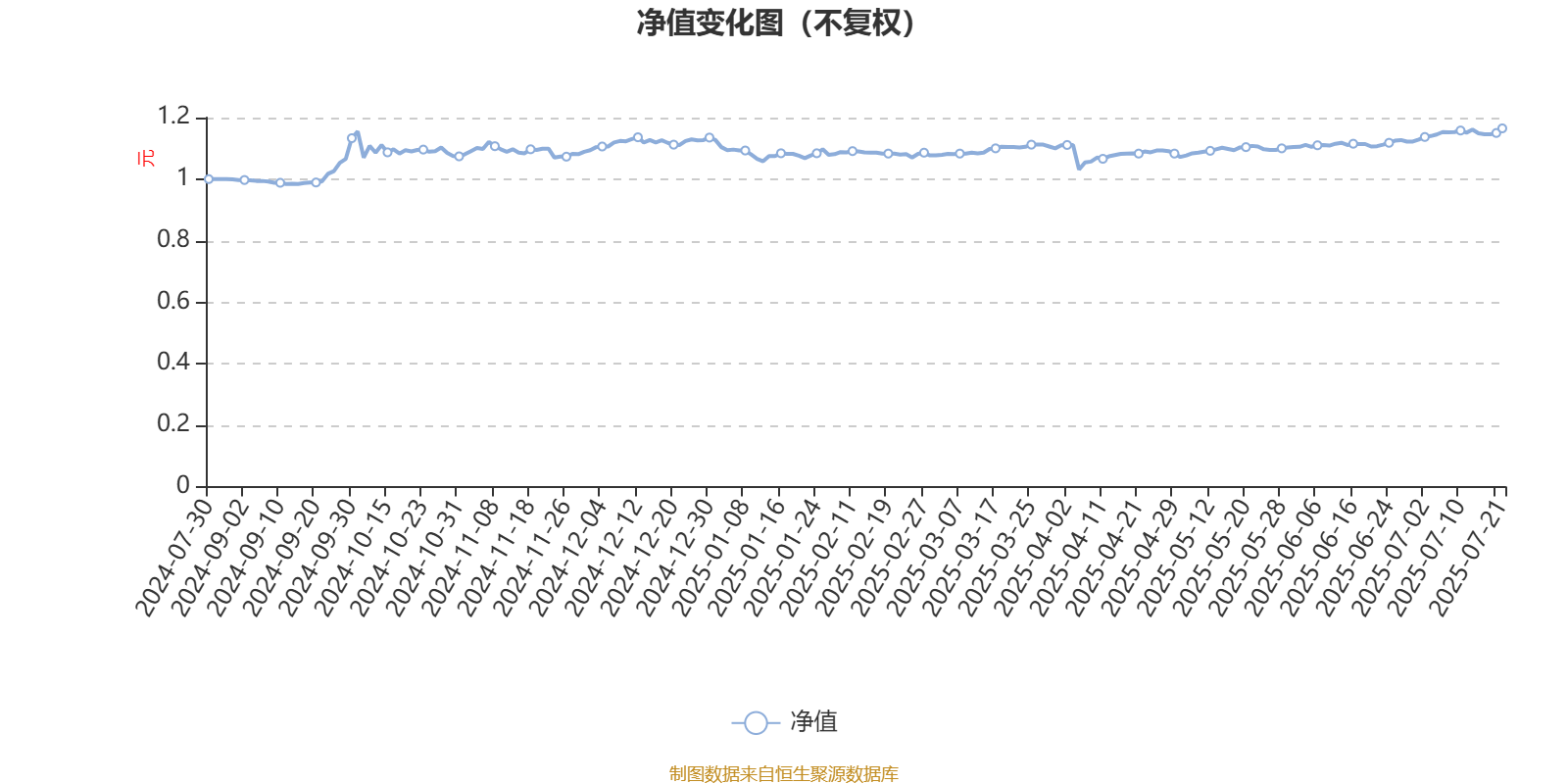
Core Insights - The AI Fund Morgan Dividend Preferred Stock A (021187) reported a profit of 649,200 yuan for Q2 2025, with a weighted average profit per fund share of 0.0195 yuan [3] - The fund's net asset value growth rate for the reporting period was 2.05%, and as of the end of Q2, the fund size was 34.82 million yuan [3][10] - The fund is classified as a standard equity fund, focusing on cyclical stocks, and aims to maintain a high position in the market [3] Fund Performance - As of July 21, the unit net value was 1.165 yuan, with a three-month cumulative net value growth rate of 7.61%, ranking 13th out of 18 comparable funds [3] - The six-month cumulative net value growth rate was 8.31%, ranking 14th out of 18 comparable funds [3] Investment Strategy - The fund manager indicated that the fund will maintain a high position in the market, using a quantitative stock selection model based on the CSI Dividend Index to construct the stock portfolio [3] - The quantitative model will undergo regular dynamic adjustments to optimize stock allocation, aiming to consistently exceed the benchmark return [3] Fund Holdings - As of Q2 2025, the fund's top ten holdings included Industrial Bank, Postal Savings Bank, Sinopec, Nanjing Steel, Conch Cement, Western Mining, Bank of Beijing, Bank of Communications, Jiangsu Bank, and Nanjing Bank [13] Historical Performance - Since inception, the average stock position of the fund has been 90.7%, compared to the industry average of 88.74% [8] - The fund reached a peak stock position of 94.4% by the end of 2024, with a low of 81.77% at the end of Q3 2024 [8]
成长稳健组合年内满仓上涨33.13%
量化藏经阁· 2025-07-19 04:52
Core Viewpoint - The article provides a comprehensive performance tracking of various active quantitative strategies by GuoXin JinGong, focusing on their absolute and excess returns compared to the mixed equity fund index, highlighting the effectiveness of these strategies in outperforming the market [2][3][4]. Group 1: Performance Tracking of Quantitative Strategies - The "Excellent Fund Performance Enhancement Portfolio" achieved an absolute return of 2.75% this week and 10.32% year-to-date, ranking in the 45.63 percentile among active equity funds [1][12]. - The "Super Expectation Selected Portfolio" recorded an absolute return of 3.68% this week and 24.40% year-to-date, ranking in the 11.53 percentile among active equity funds [1][9]. - The "Brokerage Golden Stock Performance Enhancement Portfolio" had an absolute return of 1.91% this week and 14.13% year-to-date, ranking in the 31.39 percentile among active equity funds [1][21]. - The "Growth and Stability Portfolio" posted an absolute return of 2.15% this week and 29.61% year-to-date, ranking in the 7.26 percentile among active equity funds [1][22]. Group 2: Strategy Descriptions - The "Excellent Fund Performance Enhancement Portfolio" aims to outperform the median return of active equity funds by utilizing quantitative methods based on the holdings of top-performing funds [4][34]. - The "Super Expectation Selected Portfolio" selects stocks based on positive earnings surprises and analyst upgrades, focusing on both fundamental and technical analysis [9][38]. - The "Brokerage Golden Stock Performance Enhancement Portfolio" is constructed using a stock pool from brokerage recommendations, optimizing for individual stock and style deviations [16][42]. - The "Growth and Stability Portfolio" employs a two-dimensional evaluation system for growth stocks, prioritizing those with upcoming earnings announcements to capture excess returns [19][47]. Group 3: Historical Performance - The "Excellent Fund Performance Enhancement Portfolio" has achieved an annualized return of 20.31% from January 2012 to June 2025, outperforming the mixed equity fund index by 11.83% [35][37]. - The "Super Expectation Selected Portfolio" has an annualized return of 30.55% since January 2010, exceeding the mixed equity fund index by 24.68% [39][41]. - The "Brokerage Golden Stock Performance Enhancement Portfolio" has an annualized return of 19.34% from January 2018 to June 2025, outperforming the mixed equity fund index by 14.38% [43][46]. - The "Growth and Stability Portfolio" has achieved an annualized return of 35.51% since January 2012, exceeding the mixed equity fund index by 26.88% [48].

上证3500了,现在入量化选股晚吗?
雪球· 2025-07-18 08:00
Core Viewpoint - The article discusses the evolution and current state of quantitative stock selection strategies in the private equity sector, emphasizing their performance and adaptability in various market conditions [3][4][5]. Group 1: Historical Development - Quantitative stock selection began to gain traction around 2021, as traditional index-enhanced strategies struggled due to a sluggish market, leading many top private equity managers to explore new avenues [4]. - In 2022, the flexibility and anti-drawdown characteristics of quantitative stock selection became apparent, with top-performing products achieving positive returns despite market turbulence [4]. - By 2023, the strategy gained mainstream acceptance, with nearly 90% of quantitative stock selection products yielding positive returns, significantly outperforming major indices [5]. Group 2: Performance and Market Conditions - The first half of 2024 saw a resurgence in quantitative stock selection performance, with some managers reporting returns exceeding 50%, driven by high trading volumes and increased market volatility [6]. - The article highlights that a conducive environment for quantitative strategies includes high trading volumes and volatility, which have been prevalent since the 2023 market rally [8]. Group 3: Investment Timing Concerns - Investors express concerns about entering the market at high points, particularly as the index approaches 3500 points, a level historically associated with bull markets [9][11]. - The article suggests that the timing of entry is less critical for quantitative stock selection, as the strategy is not tied to specific indices and can adapt to various market conditions [13]. Group 4: Specific Fund Analysis - Two private equity funds are highlighted: - Fund A has achieved a 36% return this year and 117% over the past year, utilizing a multi-factor strategy with high turnover and leverage [14][15]. - Fund B has reported a 30% return this year and 83% over the past year, employing a high-frequency trading strategy with low correlation to other market participants [16][17].

组合收益高达54.97%!“银行AH+小微盘”如何领先市场?
Ge Long Hui· 2025-07-02 18:56
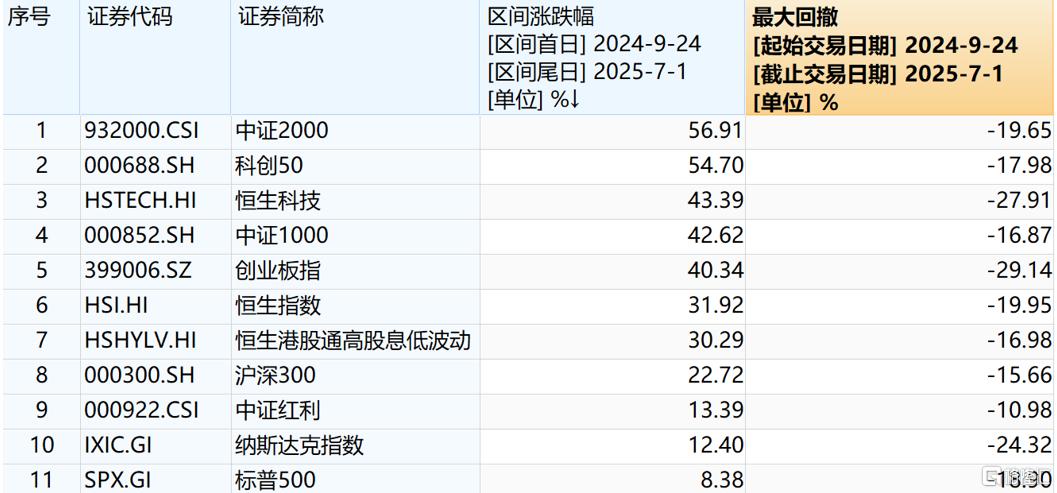
Group 1 - The "Bank AH + Small Micro Plate" portfolio has achieved a historical high, increasing by 54.97% from last year, with a maximum drawdown of 13.89% [1] - The portfolio's performance has outpaced major indices, with only the CSI 2000 showing a higher growth rate, but with a larger maximum drawdown of 19.65% [1] - The portfolio consists of 40% Bank AH Preferred ETF (517900), 30% 1000 ETF Enhanced (159680), and 30% CSI 2000 Enhanced ETF (159552), employing a "high dividend base + enhanced growth assets" strategy [2][4] Group 2 - The Bank AH Preferred ETF (517900) has shown significant growth, increasing by 24% since the beginning of 2025, with a 411% surge in fund shares [4][6] - The low interest rate environment and the decline in 10-year government bonds have created a demand for bank stocks due to their high dividend and strong risk-averse attributes [6] - The dynamic adjustment mechanism of the Bank AH index allows for the identification of undervalued bank stocks, enhancing returns while providing stability [6] Group 3 - The portfolio's structure is designed to provide a safety net with high dividends while pursuing growth through small-cap stocks, which combine index beta and excess alpha [7] - The CSI 2000 Enhanced ETF (159552) has achieved a net value growth rate of 29.18% in the first half of the year, ranking first among similar broad-based ETFs [9] - Since its inception, the CSI 2000 Enhanced ETF has accumulated a net value growth of 68.21%, significantly outperforming the CSI 2000 index [10] Group 4 - Two signals support the continuation of the small-cap stock trend: ongoing liquidity support and the release of policy dividends from mergers and acquisitions regulations [11] - The CSI 2000 Enhanced ETF (159552) demonstrates the effectiveness of quantitative discipline in achieving sustained excess returns [12]
【金工】情绪指标发出看多信号,量化选股组合超额收益显著——金融工程量化月报20250701(祁嫣然/张威)
光大证券研究· 2025-07-02 13:14
Market Sentiment Tracking - As of June 30, 2025, the proportion of rising stocks in the CSI 300 has increased month-on-month, with over 60% of stocks rising, indicating high market sentiment [3] - The momentum sentiment indicator shows a fast line moving upwards and a slow line moving downwards, with the fast line above the slow line, suggesting a bullish outlook in the near term [3] - The short-term CSI 300 index is in a sentiment boom range [3] Fund Separation Degree Tracking - As of June 30, 2025, the fund separation degree has slightly increased and is currently at a low level, indicating a high degree of fund clustering [4] - The excess returns of clustered stocks have slightly increased, while the excess returns of clustered funds have slightly decreased [4] PB-ROE-50 Strategy Tracking - In June 2025, the PB-ROE-50 strategy achieved positive excess returns across various stock pools [5] - The strategy based on the CSI 500 stock pool gained an excess return of 0.92% [5] - The strategy based on the CSI 800 stock pool achieved an excess return of 3.92% [5] - The strategy based on the entire market stock pool obtained an excess return of 4.59% [5] Institutional Research Strategy Tracking - In June 2025, both public and private research selection strategies generated positive excess returns [6] - The public research selection strategy achieved an excess return of 5.55% relative to the CSI 800 [6] - The private research tracking strategy gained an excess return of 1.90% relative to the CSI 800 [6] Negative List - As of June 30, 2025, several stocks with high interest-bearing debt ratios ranked poorly, including Zhongyida, Guiding Compass, and Modern Investment, among others [7] - Stocks with high financial cost burden ratios include Liao Ning Cheng Da, Yin Bao Shan Xin, and A Shi Chuang, with all indicators exceeding 10 times [7]