
险资入市

Search documents
险资入市空间再释放!直接利好沪深300等指数
Mei Ri Jing Ji Xin Wen· 2025-12-08 04:33
Core Viewpoint - The adjustment of risk factors for insurance companies' related business is expected to enhance the investment capacity of insurance funds in the stock market, particularly benefiting core assets and contributing to market stability [1][2]. Group 1: Regulatory Changes - The National Financial Supervision Administration announced a reduction in risk factors for insurance companies' holdings of certain index stocks, decreasing from 0.3 to 0.27, a drop of 10% [1]. - This regulatory change is interpreted as a release of space for insurance capital to enter the market, reinforcing the "long money" and "ballast stone" attributes of insurance funds [2]. Group 2: Market Impact - The new regulation is expected to increase the stock investment scale by approximately 150 billion yuan, raising the anticipated insurance capital in the equity market to about 2.15 trillion yuan by 2026 [2]. - The adjustment is projected to directly benefit indices such as the CSI 300 and the CSI Low Volatility 100, becoming a significant driver for a "slow bull" market in 2026 [2]. Group 3: Financial Metrics - The adjustment is estimated to provide A-share listed insurance companies with an additional 78.9 billion yuan in stock allocation space, with a minimum capital optimization of 20 billion yuan [2]. - The average solvency adequacy ratio for core and comprehensive solvency is expected to improve by 1.5 and 2.1 percentage points, respectively, following the adjustment [2]. Group 4: Index Overview - The CSI 300 index, comprising the 300 most representative securities in the A-share market, is viewed as a core asset and a standard for individual investors [3]. - The current risk premium for the CSI 300 index stands at 5.33, slightly above the historical average of 5.15 since 2014, indicating that the index valuation remains within a reasonable range [3].
保险因子下调,场内稀缺双板块配置工具,保险证券ETF(515630)涨超3%
Xin Lang Cai Jing· 2025-12-08 02:45
Group 1 - The core viewpoint of the news is that the recent regulatory adjustments by the National Financial Regulatory Administration are aimed at encouraging insurance capital to enter the market, which has led to a significant increase in the performance of the securities and insurance sector, as evidenced by the rise in the CSI 800 Securities and Insurance Index by 2.91% [1] - The adjustment of risk factors for insurance companies' long-term holdings in specific indices, including a 10% reduction in solvency risk factors, is expected to slightly improve solvency and reflects a supportive regulatory attitude towards long-term investments [1] - The emphasis on dividend stocks in the notification aligns with the current trend of insurance companies focusing on dividend stock investments, indicating a strategic direction for the insurance industry [1] Group 2 - The CSI 800 Securities and Insurance Index is designed to provide investors with a diversified investment target by selecting securities from the securities and insurance industry based on the CSI 800 Index [2] - As of November 28, 2025, the top ten weighted stocks in the CSI 800 Securities and Insurance Index account for 63.12% of the index, with major companies including China Ping An, Dongfang Wealth, and CITIC Securities [2]





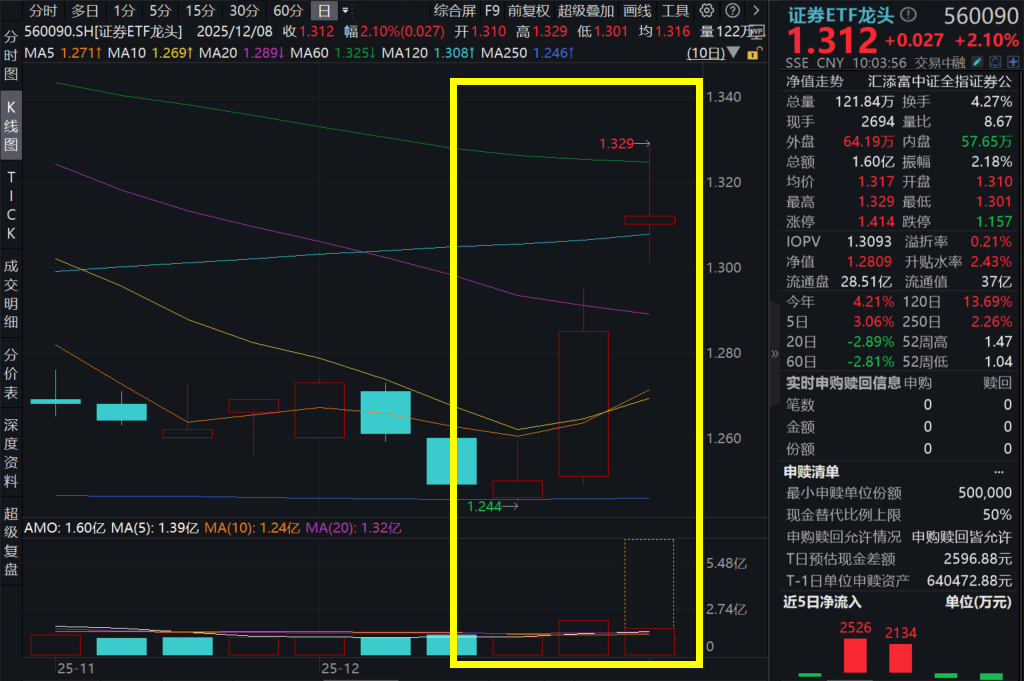
重磅利好来袭!券商资本杠杆优化,券商全线飙涨,兴业证券涨停,证券ETF龙头(560090)涨超2%!相关风险因子下调,千亿增量长钱入市可期!
Sou Hu Cai Jing· 2025-12-08 02:31
Core Viewpoint - The brokerage sector experienced a strong rebound driven by favorable policy announcements, with significant gains in major securities ETFs and constituent stocks [1][3]. Group 1: Market Performance - As of 10:06 on December 8, the leading securities ETF (560090) surged over 2%, reaching a peak increase of over 3%, marking a potential three-day rally [1]. - All constituent stocks of the securities ETF saw substantial increases, with notable performances including a limit-up for Industrial Securities and over 4% gains for Huatai Securities [3]. Group 2: Regulatory Developments - On December 6, regulatory leaders delivered a speech emphasizing the need to accelerate the development of first-class investment banks and institutions, mentioning the relaxation of restrictions for quality institutions and differentiated regulation for small and foreign brokerages [5]. - The recent adjustments in regulations are expected to enhance the capital space and leverage limits for brokerages, potentially leading to improved return on equity (ROE) for quality firms [6]. Group 3: Insurance Capital Market Involvement - On December 5, a new notification was issued to adjust risk factors related to insurance companies, which is anticipated to improve their solvency ratios and encourage long-term investments in the market [7]. - Analysts predict that the adjustments will lead to an influx of insurance capital into the market, with estimates suggesting that up to 1,086 billion yuan could be allocated to the stock market if insurance companies increase their equity investments [8][9].



2025年12月08日:期货市场交易指引-20251208
Chang Jiang Qi Huo· 2025-12-08 02:09
期货市场交易指引 2025 年 12 月 08 日 | | 宏观金融 | | --- | --- | | ◆股指: | 中长期看好,逢低做多 | | ◆国债: | 震荡运行 | | | 黑色建材 | | ◆焦煤: | 区间交易 | | ◆螺纹钢: | 区间交易 | | ◆玻璃: | 观望不追高 | | | 有色金属 | | ◆铜: | 轻仓持多 | | ◆铝: | 建议多单考虑减仓 | | ◆镍: | 建议观望或逢高做空 | | ◆锡: | 区间交易 | | ◆黄金: | 区间交易 | | ◆白银: | 多单持有,新开仓谨慎 | | ◆碳酸锂: | 偏强震荡 | | | 能源化工 | | ◆PVC: | 区间交易 | | ◆烧碱: | 暂时观望 | | ◆纯碱: | 暂时观望 | | ◆苯乙烯: | 区间交易 | | ◆橡胶: | 区间交易 | | ◆尿素: | 区间交易 | | ◆甲醇: | 区间交易 | | ◆聚烯烃: | 偏弱震荡 | | | 棉纺产业链 | | ◆棉花棉纱: | 震荡偏强 | | ◆PTA: | 震荡上行 | | ◆苹果: | 震荡偏强 | | ◆红枣: | 震荡偏弱 | | | 农业 ...
险资强化长钱入市逻辑,头部券商监管红利有望释放
2025-12-08 00:41
险资强化长钱入市逻辑,头部券商监管红利有望释放 20251207 摘要 监管调整险资风险因子,指数成分股风险因子从 0.3 降至 0.27,持仓两 年以上科创板股票从 0.4 降至 0.36,预计释放约 210 亿元最低资本, 或带来 764 亿元增量资金入市,虽规模有限,但释放鼓励险资配置优质 权益资产的信号。 险资入市呈现增配趋势,预计 2026-2027 年每年将有约 9,000 亿增量 资金进入权益市场,长期资金入市逻辑有效,利好飞银板块,推荐中国 平安、中国太保、新华保险、中国人寿及中国人保。 证监会鼓励头部券商提升杠杆率,有助于打开业务发展空间,提升 ROE,构成行业基本面利好,并成为板块估值修复的催化因素。监管层 推动行业经营模式转变,从规模导向转向风险定价和专业定价。 券商风控体系以净资本和流动性为核心,资本实力和杠杆限制是业务规 模上限的主要约束因素。放宽资本杠杆限制,可以推动行业进一步发展 业务,更好地支持资本市场服务功能。 Q&A 周五金监总局发布的关于调整保险公司相关业务风险因子的政策对市场有何影 响? 该政策主要涉及对部分权益资产的风险因子进行调整。具体来说,对于保险公 司持仓超过三 ...
调整险企风险因子,或撬动超千亿增量资金入市
Zheng Quan Shi Bao· 2025-12-07 23:44
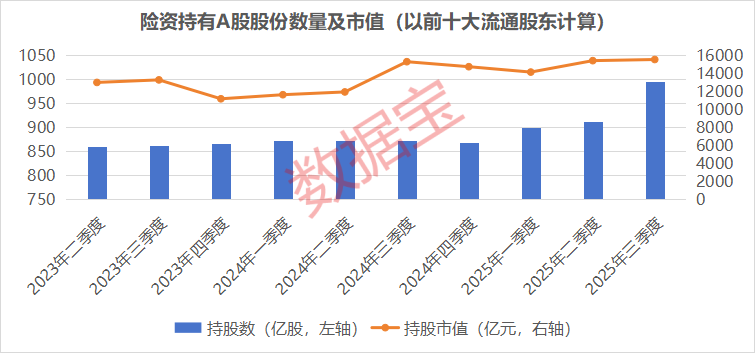
受上述消息刺激,A股保险指数上周五(12月5日)尾盘大涨,中国太保、中国平安当日涨幅均超过5%。 多次优化风险因子 险资长钱加速入市可期 事实上,这并非首次对保险公司风险因子的优化。2023年9月,国家金融监督管理总局发布《关于优化保险公 司偿付能力监管标准的通知》,其中提出,对于保险公司投资沪深300指数成份股,风险因子从0.35调整为 0.3;投资科创板上市普通股票,风险因子从0.45调整为0.4。 今年5月,央行、金融监管总局和证监会在国新办发布会上宣布一揽子金融政策,其中有关保险行业的增量政 策包括:进一步扩大保险资金长期投资试点范围,为市场注入更多增量资金;调整偿付能力监管规则,将股 票投资风险因子进一步下调10%。 招银国际今年5月研报指出,经测算,若将股票投资风险因子对应释放的最低资本全部用于配置沪深300股 票,有望带来逾1500亿元增量入市资金,险资长钱加速入市可期。 从A股市场来看,以前十大流通股东的持股情况来看(保留中国人寿、平安银行两只大股东为险资的个股), 截至2025年三季度末,险资持股数量接近996亿股,持股市值(期末收盘价)达到1.56万亿元,持股数量及持 股市值均创近10个季 ...



相关风险因子下调 险资增量长钱入市可期
Zheng Quan Ri Bao· 2025-12-07 15:43
Core Viewpoint - The recent notification from the National Financial Regulatory Administration aims to enhance the solvency of insurance companies and encourage them to increase their market investments, particularly in long-term assets [1][2][3]. Group 1: Regulatory Changes - The notification adjusts risk factors for insurance companies' investments in specific indices, which will improve their solvency ratios and create more room for market investments [1][2]. - The risk factor for stocks held over three years in the CSI 300 index and the CSI Dividend Low Volatility 100 index has been reduced from 0.3 to 0.27, while the risk factor for stocks in the Sci-Tech Innovation Board held over two years has been lowered from 0.4 to 0.36 [2][3]. Group 2: Market Impact - If the released funds are fully allocated to the CSI 300 index components, it is estimated that approximately 108.6 billion yuan will enter the market [1][3]. - As of the end of Q3 this year, the balance of insurance capital invested in stocks was 3.62 trillion yuan, with a potential increase in solvency ratios by 1 percentage point if no additional stock allocation occurs [3][4]. Group 3: Future Investment Strategies - The notification aligns with previous regulatory efforts to encourage insurance capital to invest more in the market, emphasizing long-term and patient capital [4]. - By 2025, policies will be implemented to ensure that large state-owned insurance companies allocate 30% of new premiums to A-share investments and increase the equity investment limit to 50% of total assets [4]. Group 4: Current Trends - The proportion of equity investments by insurance companies has reached a record high, with a total of 5.59 trillion yuan invested in stocks and securities, accounting for 14.92% of total investment [4].
周末,大利好!
中国基金报· 2025-12-07 14:22
Key Points - The article summarizes significant events over the weekend and the latest assessments from major securities firms regarding the Chinese market and economy [2] Group 1: Economic and Policy Developments - Chinese Vice Premier He Lifeng held a video call with U.S. Treasury Secretary Janet Yellen and Trade Representative Katherine Tai to discuss practical cooperation and resolving economic concerns [3] - The People's Bank of China has increased its gold reserves for the 13th consecutive month, now holding 7.412 million ounces, reflecting a strategic move to bolster financial stability [4] - The China Securities Regulatory Commission (CSRC) is focusing on differentiated regulation for quality institutions while tightening oversight on problematic firms, aiming to enhance capital efficiency [5] Group 2: Market Insights and Predictions - Insurance companies are expected to benefit from lowered risk factors for long-term holdings in indices like CSI 300 and STAR Market, potentially leading to significant equity allocations [6][7] - A new performance assessment guideline for fund managers has been proposed, which may result in salary reductions exceeding 30% for underperforming managers, aiming to enhance accountability in the fund management industry [8] - The 2025 National Medical Insurance Drug List will include 114 new drugs, with 50 classified as innovative, indicating a focus on advancing healthcare and pharmaceutical sectors [9] Group 3: Securities Firms' Analysis - CITIC Securities suggests that the current market volatility is a normal phase before potential positive changes in fundamentals, with a focus on resource and traditional manufacturing sectors [12] - Shenwan Hongyuan highlights that the lowered risk factors for insurance companies could lead to significant equity investments, particularly in the context of the upcoming spring market [13] - China International Capital Corporation (CICC) believes that the recent bond market fluctuations will have limited impact on equity markets, supported by a strong RMB and favorable economic conditions [14] - Guotai Junan emphasizes the importance of upcoming policy meetings and their potential impact on market sentiment and structural opportunities [18] - GF Securities notes that while the market may experience short-term fluctuations, there remains significant upside potential, particularly in dividend-paying and consumer sectors [22]

金融行业周报:险资股票因子下调,看好券商板块盈利修复-20251207
Western Securities· 2025-12-07 12:26
Investment Rating - The report indicates a positive outlook for the insurance sector, with a recommendation to focus on strong insurance companies such as New China Life Insurance, China Ping An, China Life Insurance H, and China Taiping [2][17] Core Insights - The non-bank financial sector (Shenwan) index increased by 2.27%, outperforming the CSI 300 index by 0.99 percentage points, while the insurance sector saw a significant rise of 5.08% [1][9] - The insurance sector's growth is attributed to several factors, including a reduction in long-term stock holding risk factors, expected strong performance in dividend insurance products, and improved global liquidity due to anticipated interest rate cuts in the US [2][16] - The brokerage sector is expected to experience a valuation correction, with a current price-to-book (PB) ratio of 1.36x, indicating potential for recovery in profitability and valuation [2][19] - The banking sector has underperformed, with a decline of 1.18%, and is currently undervalued with a PB ratio of 0.55x, suggesting room for future valuation improvement [3][20] Summary by Sections Insurance Sector - The insurance index rose by 5.08%, significantly outperforming the CSI 300 index by 3.80 percentage points, driven by regulatory adjustments that lowered risk factors for long-term stock holdings [1][13] - The sector is expected to benefit from a favorable environment for dividend insurance products, with strong growth anticipated in the coming year [2][16] - Key recommendations include focusing on companies like New China Life Insurance and China Ping An, which are positioned for growth [17] Brokerage Sector - The brokerage index increased by 1.14%, with a current PB ratio of 1.36x, indicating a potential mismatch between profitability and valuation [2][19] - Regulatory changes are expected to enhance capital efficiency for leading brokerages, creating opportunities for investment in firms with strong fundamentals [2][18] - Recommended stocks include Guotai Junan, Huatai Securities, and Orient Securities, particularly those involved in mergers or restructuring [19] Banking Sector - The banking sector saw a decline of 1.18%, with a PB ratio of 0.55x, indicating that banks are currently undervalued [3][20] - Concerns about asset quality, particularly related to real estate and local government debt, have affected market perceptions, but there is potential for recovery as regulatory support continues [23][24] - Recommendations include focusing on high-quality city commercial banks in economically developed regions, such as Hangzhou Bank and Ningbo Bank [20][24]



A股,重磅利好!
Zheng Quan Shi Bao Wang· 2025-12-07 09:23
登录新浪财经APP 搜索【信披】查看更多考评等级 重点关注 12月6日,证监会主席吴清在中国证券业协会第八次会员大会上,提出"对优质机构优化评价指标、适度拓宽资本空间与杠杆上限,提升资本利用效率"。 12月5日,金融监管总局发布了《关于调整保险公司相关业务风险因子的通知》(以下简称《通知》),根据持仓时间差异,明确保险公司投资的沪深300 指数成份股、中证红利低波动100指数成份股以及科创板股票,将享受较低的风险因子;同时,还进一步调低了保险公司出口信用保险业务和中国出口信 用保险公司海外投资保险业务的保费风险因子和准备金风险因子。 对于普遍存在资本紧张的保险行业而言,此次《通知》将降低已有持仓的资本占用并提升偿付能力充足率水平,从而腾挪出资本空间,进一步提升险资入 市并长期持有的积极性。 基金经理绩效薪酬与基金业绩强挂钩。根据《基金管理公司绩效考核管理指引》征求意见稿,对基金经理薪酬进行了调整,过去三年产品业绩低于业绩比 较基准超过十个百分点且基金利润率为负的,其绩效薪酬应当较上一年明显下降,降幅不得少于30%;低于业绩比较基准超过十个百分点但基金利润率为 正的,其绩效薪酬应当下降;低于业绩比较基准不足十个 ...
