指数化投资

Search documents
创金合信基金董梁:指数增强基金获更多关注 看好恒生科技、红利、科创板综合指数的布局机会
Xin Lang Ji Jin· 2025-06-23 07:26
Group 1 - The number of newly established index-enhanced funds has reached 76 this year, surpassing the total for the previous year, indicating a growing trend in index-based investment [1] - The increase in public funds' interest in index-enhanced funds is attributed to three main reasons: disillusionment with star fund managers, attractive new indices launched by index companies, and regulatory encouragement for index-based investments [1][2] - Leading fund sales platforms are focusing on index-enhanced funds due to their potential to outperform benchmark indices, reflecting a shift towards mainstream index-based investment strategies [1][2] Group 2 - Small-cap index-enhanced funds have shown impressive performance this year, with indices like the CSI 1000 and CSI 2000 outperforming large-cap indices such as the CSI 300, making it easier to achieve excess returns [2] - Excess returns from index-enhanced funds primarily come from stock selection models that overweight and underweight index constituents, as well as capturing short-term market styles [2] - Challenges for index-enhanced funds include strategy crowding due to the expansion of these products and frequent market style shifts, which may dilute excess returns [2] Group 3 - Current investment opportunities are seen in the Hang Seng Tech Index, Dividend Index, and the Sci-Tech Innovation Board Composite Index, as Chinese assets are perceived to be undervalued compared to global markets [3] - The Hang Seng Tech Index includes core assets from China's technology and internet sectors, which are significantly undervalued compared to the Nasdaq Index, presenting a potential for substantial gains upon valuation re-rating [3] - The Dividend Index has shown strong long-term performance with an annualized return of around 14% since 2014, benefiting from the current low-interest-rate environment [3] - Investment in the Sci-Tech Innovation Board Composite Index is considered valuable due to its broad coverage and representation in the technology sector, which is expected to be a key investment theme in the coming years [3]
4万亿市场,突发大消息!知名巨头,动手了
Zhong Guo Ji Jin Bao· 2025-06-20 13:16
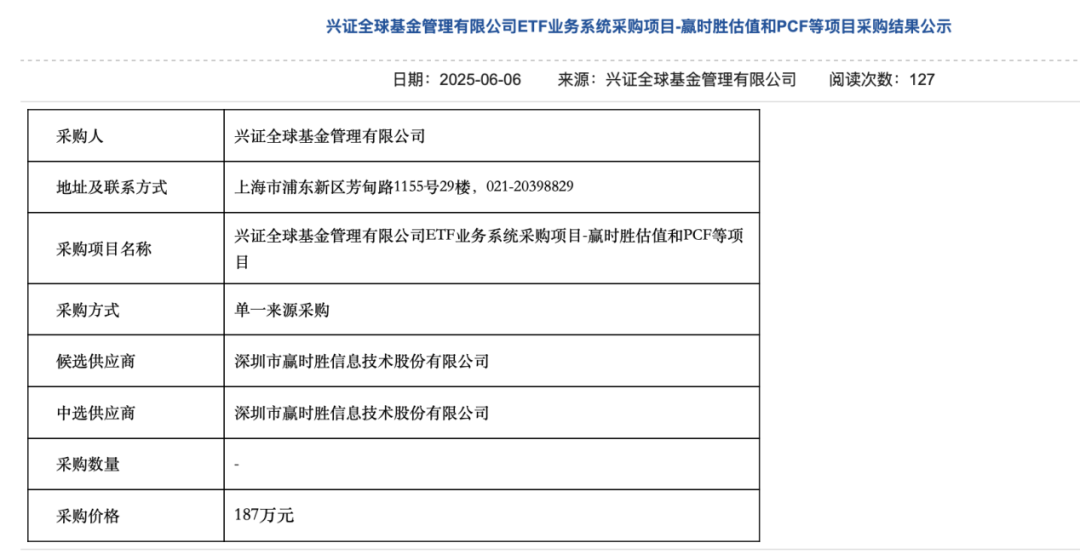
近日,兴证全球基金披露一单ETF业务系统采购项目,对外发出布局ETF业务的信号,有望成为最新一家布局ETF业务的大型基金公司。对此,兴证全球 基金最新回应称,目前正在研究讨论。 多位业内人士表示,截至目前,全市场ETF规模已经突破4万亿元大关,指数化投资大时代成为行业共识。不过ETF市场"二八效应"明显,如何在激烈的市 场竞争中占得一席之地,考验着新入局者的智慧。 【导读】入局ETF市场信号,兴证全球基金披露一单ETF业务系统采购项目 近年来,指数基金成为公募基金行业规模增长的新引擎。股票ETF、债券ETF接连成为行业新风口,易方达、华夏等头部基金公司已经全面拥抱指数业 务。又有公募基金巨头决定进军这一市场。 有望成为新入局者 一则采购公示透露出公募基金巨头的最新战略决策。 近日,兴证全球基金管理有限公司披露的采购公示显示,深圳市赢时胜(300377)信息技术股份有限公司开发的赢时胜估值和PCF项目成功中标ETF业务 系统项目采购,采购金额为187万元。 | | 1 1 1 1 1 1 1 1 1 1 1 1 1 1 1 1 1 1 1 1 1 1 1 1 1 1 1 1 1 1 1 1 1 1 1 1 1 ...

4万亿市场,突发大消息!知名巨头,动手了!
中国基金报· 2025-06-20 12:51
Core Viewpoint - The article highlights the growing trend of public fund companies entering the ETF market, with Xingzheng Global Fund signaling its intention to develop ETF business through a recent procurement project for an ETF business system [2][4][5]. Industry Overview - The ETF market in China has surpassed 4 trillion yuan, indicating a significant shift towards index-based investment strategies [2][6]. - Major fund companies like E Fund and Huaxia have already embraced index business, showcasing the competitive landscape of the ETF market [2][6]. Recent Developments - Xingzheng Global Fund has disclosed a procurement project for an ETF business system, with a procurement amount of 1.87 million yuan, indicating its strategic move into the ETF space [4][5]. - The installation of the ETF system is expected to be completed soon, allowing for rapid product approval through a fast-track process [5]. Market Dynamics - The ETF market has seen a surge in participation from various fund companies since 2020, with notable entries from firms that previously did not engage in ETF offerings [7]. - The increasing demand for ETF products is driven by favorable policies and the need for efficient asset allocation among both individual and institutional investors [8]. Competitive Landscape - The article discusses the "80/20 effect" in the ETF market, where a few leading companies dominate the majority of market share, posing challenges for new entrants [2][5]. - New entrants are encouraged to explore differentiated strategies, such as focusing on niche markets or innovative product offerings, to carve out a competitive advantage [10][11]. Future Outlook - The potential for "curve overtaking" exists for new entrants if they can identify and meet specific market needs, especially as the ETF market transitions from a focus on scale to quality [11]. - The article notes that the proportion of passive products in the U.S. stock market is around 16%, while in China, it is only 3% to 4%, indicating significant growth potential for the ETF business in China [11].
解码指数逻辑 赋能市值新程—北京上市公司协会开展指数化投资赋能市值管理培训
Zheng Quan Ri Bao Wang· 2025-06-19 14:31
东方财富证券零售业务部总监兼企业客户部副总监吴伟强着眼中长期资金入市趋势和被动指数投资规模 快速扩张的市场背景,深入剖析了上市公司需要重点关注的核心观测维度。他基于东方财富证券独创 的"价值创造、价值成长、价值传递、价值维护"四要素市值管理评价体系,探索新形势下的实践路径, 提出"做内功、借外力、做推广"的核心方法论,并就上市公司如何运用金融科技手段更高效与机构投资 者和个人投资者交流提供了具体建议。未来,东方财富证券将充分发挥专业优势,为上市公司提供一揽 子的市值管理综合解决方案,推动资本市场高质量发展。 本次活动聚焦指数化投资背景下市值管理的实践方向,与会嘉宾围绕政策解读、工具应用等议题展开深 度碰撞,通过政策解读、案例研讨等多元形式,助力资本市场"长钱长投"生态建设,推动"指数赋能— 价值提升—资本反哺"逻辑链的落地深化。北京上市公司协会,也将持续为上市公司链接资本市场搭建 坚实桥梁。 随后,东方财富证券北京分公司总经理高金艳表示,当前指数化投资浪潮席卷全球,被动指数基金规模 首次超越主动权益类基金,标志着指数化投资进入"黄金时代"。她强调,指数作为资本市场"晴雨表"与 资源配置"指挥棒",其编制逻辑直 ...
引导资金精准投向科技创新重点领域 沪市首批6只科创债ETF上报
Zheng Quan Ri Bao Wang· 2025-06-18 10:43
Group 1 - The core viewpoint emphasizes the development of Sci-Tech bonds (科创债) and the introduction of related financial products such as ETFs to support technological innovation and enhance the financing channels for innovative enterprises [1][2] - The first batch of six Sci-Tech bond ETFs has been submitted for approval, which includes three tracking the CSI AAA Sci-Tech Innovation Corporate Bond Index and three tracking the SSE AAA Sci-Tech Innovation Corporate Bond Index [1] - Since the pilot program began in 2021, the issuance of Sci-Tech bonds has accelerated, with a total of 1,273 bonds in the market and a balance exceeding 1.3 trillion yuan, of which over 1.1 trillion yuan is in the Shanghai Stock Exchange [1] Group 2 - The development of bond ETFs focused on Sci-Tech bonds is expected to guide social funds towards key areas of technological innovation, supporting the high-quality development of innovative enterprises [2] - The bond ETF market has seen significant growth, with 20 products totaling 274.7 billion yuan, which is more than five times the scale at the beginning of 2024 [2] - The Shanghai Stock Exchange plans to continue expanding its offerings of Sci-Tech bond ETFs and other stable income products to enhance investor experience and meet the needs of long-term capital [2]
号外!号外!2025申万宏源第三届ETF实盘大赛,盛大启幕!
券商中国· 2025-06-18 07:01
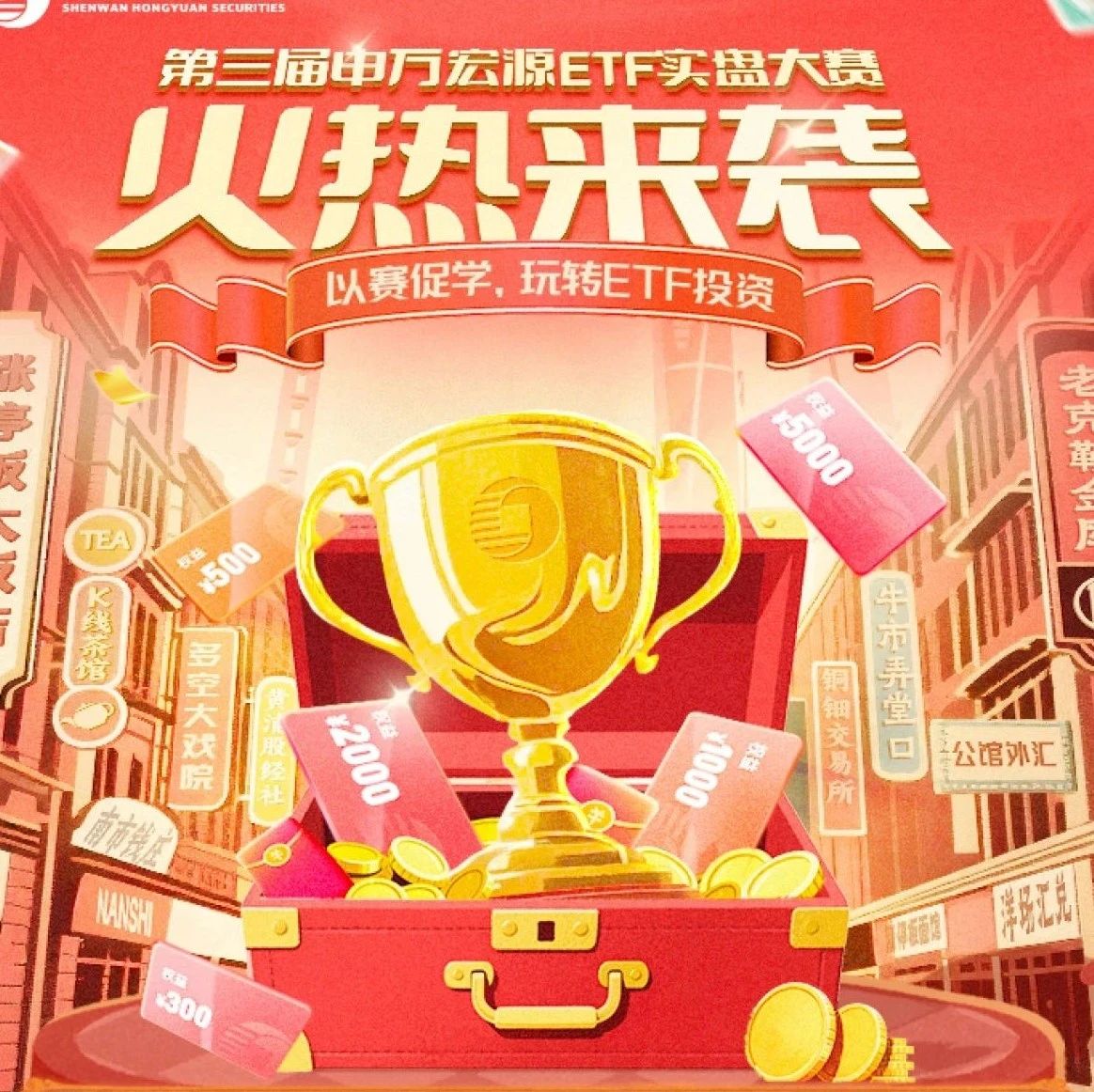
由申万宏源证券倾力打造的第三届ETF实盘大赛将于2025年6月18日正式开赛!本届大赛面向全体符合条件 的个人及机构投资者开放报名,赛事旨在通过真实市场环境下的ETF交易竞技,深入推进指数化投资理 念,锤炼投资者资产配置实战能力,为蓬勃发展的ETF市场注入崭新动能。 把握时代机遇,掘金ETF蓝海 伴随中国资本市场深化改革与居民财富管理需求升级,ETF凭借其透明度高、费率低廉、交易便捷、流动性强 等显著优势,已成为投资者优化资产配置不可或缺的核心工具。 市场持续高速扩容,Wind最新数据显示,截 至2025年6月10日,国内ETF总规模已突破4.16万亿元大关,年内规模增长近4400亿元。本届大赛,正是投资 者将知识转化为实战能力的绝佳练兵场! 赛事核心亮点,点燃投资热情 真金白银·实战砺剑: 采用注册报名制,凡在申万宏源证券开立普通A股或场内基金账户,且风险测评等级达 C3及以上的投资者均可参赛。赛事覆盖沪深交易所全品类场内ETF,在真实市场环境中检验投资策略与交易智 慧。 寓教于赛·学赛相长: 为助力参赛者快速提升ETF认知"电量",大赛特设"大咖论市"专栏、"大赛专区"投教视频 及"ETF理财课堂"等丰富 ...
重磅!科创板将设置科创成长层!科创成长ETF(588110)午后应声拉升上涨1.20%
Sou Hu Cai Jing· 2025-06-18 06:30
Group 1 - The China Securities Regulatory Commission (CSRC) Chairman announced plans to enhance the STAR Market's demonstration effect, including the establishment of a STAR Market Growth Tier and the reintroduction of the fifth listing standard for unprofitable companies [1] - The STAR Market Growth ETF (588110) saw a strong increase of 1.20% as of June 18, 2025, with notable gains in constituent stocks such as Shengyi Electronics (688183) up 16.63% and Tiande Yu (688252) up 9.28% [1] - The STAR Market Growth ETF has experienced a significant increase in trading volume, with a turnover rate of 4.74% and a daily average transaction of 15.45 million yuan over the past week [1] Group 2 - The STAR Market Growth ETF has achieved a net value increase of 38.29% over the past year, ranking 185 out of 2854 index equity funds, placing it in the top 6.48% [2] - The ETF's highest monthly return since inception was 25.02%, with an average monthly return of 7.25% during the months it increased [2] Group 3 - The management fee for the STAR Market Growth ETF is 0.50%, and the custody fee is 0.10%, making it one of the lowest in its category [3] - The STAR Market Growth Index consists of 50 high-growth companies selected based on revenue and net profit growth rates, reflecting the overall performance of high-growth stocks on the STAR Market [3] - The top ten weighted stocks in the STAR Market Growth Index account for 53.67% of the index, including companies like Haiguang Information (688041) and Hengen Technology (688608) [3] Group 4 - The introduction of new indices in the STAR Market is positively impacting domestic index investment development by enriching the investment target pool and providing more diverse underlying assets for ETFs [4] - The emergence of thematic and industry indices is guiding investors to accurately allocate resources in emerging industries, enhancing the capital market's effectiveness in serving new productive forces [4]





科创板ETF产品数量和规模双突破 有效引导金融“活水”浇灌“硬科技”
Zheng Quan Ri Bao· 2025-06-17 16:13
Core Insights - The successful listing of the Huatai-PineBridge SSE STAR Market New Materials ETF on June 16 marks a new investment path focused on the new materials sector, aligning with the "Eight Measures for Deepening STAR Market Reform" [1][2] - Since the implementation of the "Eight Measures," the number and scale of STAR Market ETFs have significantly increased, with 57 new ETFs launched, bringing the total to 88 and a combined scale exceeding 250 billion yuan [1][4][5] - The STAR Market index ecosystem is evolving towards a more specialized and refined structure, with 13 new indices launched since the "Eight Measures," enhancing investment precision and diversity [2][3] STAR Market Index Development - The STAR Market index system has expanded to 29 indices, including broad-based indices like the STAR 50 and STAR 100, as well as thematic indices focusing on sectors such as AI, biotechnology, and materials [2][3] - The introduction of new indices is seen as a key driver for the development of index-based investment in China, providing a wider range of investment options for market participants [3][6] ETF Product Expansion - The number of STAR Market ETFs has increased to 88, with a total scale of approximately 251.58 billion yuan, reflecting a nearly 60% growth since the "Eight Measures" were announced [4][5] - The ETF ecosystem now includes a comprehensive range of products covering broad-based, thematic, and strategic indices, facilitating easier access for investors [5][6] Positive Feedback Loop - The expansion of the STAR Market index and ETF system is creating a positive feedback loop, where increased investment leads to the growth of "hard tech" companies, which in turn enhances the representativeness and attractiveness of the indices [6][7] - This cycle is expected to drive continuous capital inflow into the STAR Market, supporting the development of new quality production capabilities [6][7] Future Directions - The Shanghai Stock Exchange plans to further optimize the ETF market by incorporating them into fund transfer platforms and enhancing liquidity mechanisms [7] - There is a focus on improving index compilation rules and increasing investor education to sustain the positive cycle and attract more capital into key sectors [7]
为什么一开始就「认怂」的人,最后反而赚到了钱?
雪球· 2025-06-17 10:06
Core Viewpoint - The article emphasizes the importance of understanding investment psychology, setting realistic expectations, and maintaining a disciplined investment strategy to achieve long-term financial growth [3][7][21]. Group 1: Understanding Investment Psychology - Investors often face cognitive gaps and emotional challenges that lead to poor decision-making in financial markets [5][12]. - Acknowledging one's limitations and adopting a humble approach to investing is crucial for long-term success [6][7]. Group 2: Setting Realistic Expectations - Long-term returns for various asset classes are outlined, with equities expected to yield 8%-10% annually, while bonds may provide 3%-5% [8]. - A diversified investment strategy can aim for a combined return of 6%-8%, with potential for 8%-12% through passive strategies like index investing [8][19]. Group 3: Risk Management and Asset Allocation - Understanding potential drawdowns is essential, with equities possibly experiencing declines of 70%-80%, while bonds may see 5% and commodities up to 30% [10]. - A diversified portfolio should consider asset classes, market distribution, and time allocation to mitigate risks and enhance returns [15][16][19]. Group 4: Strategy Implementation and Consistency - The article introduces the "雪球三分法" (Snowball Three-Factor Method) for long-term investment, focusing on asset, market, and time diversification [26]. - Consistency in following a well-defined investment strategy is critical, as emotional reactions to market fluctuations can derail long-term plans [21][23].

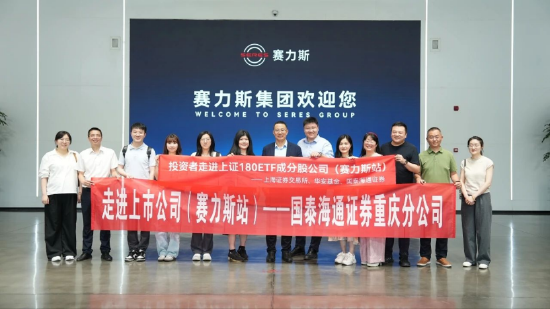
“走进ETF成分股公司·赛力斯站”活动在重庆成功举办
Xin Lang Ji Jin· 2025-06-17 07:05
Group 1 - The event "Walking into ETF Component Companies: Cyberspace Station" was successfully held in Chongqing, focusing on the interaction between investors and quality enterprises, particularly in the smart electric vehicle sector represented by Seres [1][3] - The Shanghai Stock Exchange (SSE) is committed to enhancing the ETF market and promoting high-quality development, aligning with the regulatory body's investor-centric philosophy [3][6] - Seres, a core component of the SSE 180 ETF, reported a revenue of approximately 145.2 billion yuan in 2024, a year-on-year increase of 305%, and a net profit of 5.95 billion yuan, making it the fourth profitable new energy vehicle company globally [6][8] Group 2 - In 2025, Seres plans to deepen its strategic cooperation with Huawei, enhance production capacity after acquiring a "super factory," and accelerate its overseas market expansion [8] - The SSE 180 Index, which includes influential blue-chip companies in the Shanghai market, has a 15% weight in the new energy vehicle industry, providing investors with a convenient tool to invest in industry leaders [8][10] - The event included a test drive of the Seres M9, allowing participants to experience the performance and technology of smart electric vehicles firsthand, fostering direct communication between investors and the company [10]