
量化紧缩

Search documents
美股怎么了? 三大“灰犀牛”正在逼近
Qi Huo Ri Bao Wang· 2025-07-17 00:46
Group 1: Market Reactions and Economic Indicators - On July 7, Trump announced a new round of tariff measures, leading to a muted reaction in financial markets, with the S&P 500 and Nasdaq indices down by only 0.79% and 0.92% respectively [1] - The U.S. stock market rebounded in the first half of the year due to factors such as TACO trading, fiscal expansion, resilient job market, and stock buybacks, despite facing four instances of simultaneous declines in stocks, bonds, and currencies [1] - Historical data suggests that U.S. monetary tightening or economic stagflation poses the greatest threat to the stock market, although the potential for the Federal Reserve to restart rate cuts may provide support [1] Group 2: Liquidity and Debt Issuance - The U.S. Treasury's resumption of debt issuance in Q3 is expected to create a "drain" effect on dollar liquidity, potentially forcing the Federal Reserve to release liquidity by slowing down quantitative tightening or cutting rates [2] - The net debt issuance by the U.S. Treasury is projected to be around $1 trillion in Q3, partly to refinance maturing debt and meet other financing needs [2] Group 3: Inflation and Tariff Impact - Recent tariff threats from the Trump administration could raise the effective tariff rate from 13.4% to 14.9%, with a potential increase to 18%-20% in a "no deal" scenario, raising concerns about stagflation risks in the U.S. economy [5][6] - There are indications that inflationary pressures from tariffs are beginning to manifest, with a survey showing the highest percentage of small businesses planning to raise prices since March 2024 [6] Group 4: Corporate Earnings and Market Volatility - The second quarter earnings season for U.S. stocks has begun, with expectations of a significant slowdown in profit growth, largely influenced by tariff uncertainties [9] - According to FactSet, S&P 500 companies are expected to see only a 5% profit growth in Q2, marking the slowest growth since Q4 2023, with six out of eleven sectors projected to grow year-over-year [9] - The technology sector, particularly large tech companies, is expected to drive earnings growth, but any decline in tech stock performance could lead to increased pressure on the broader market [9][10]

美联储结束缩表的门槛到底有多高?华尔街质疑沃勒预测!
Jin Shi Shu Ju· 2025-07-15 02:54
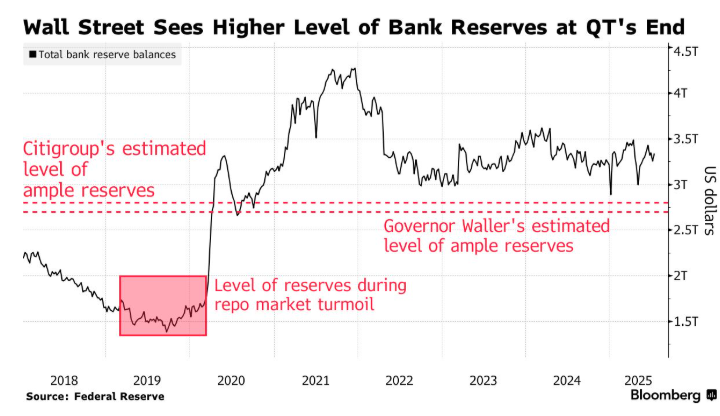
Group 1 - The Federal Reserve's board member Waller indicated that bank reserves could be reduced from approximately $3.34 trillion to around $2.7 trillion as part of the ongoing quantitative tightening process [1] - JPMorgan strategists believe that the necessary level of "adequate reserves" to avoid disrupting the overnight funding market may need to be higher than previously anticipated [1][4] - Citigroup strategists forecast that bank reserves could decline to $2.8 trillion by the end of the year [1] Group 2 - Market participants are closely monitoring the cash levels held by banks at the Federal Reserve to determine when to halt the balance sheet reduction [4] - Following the increase in the debt ceiling, Wall Street is observing signs of rising Treasury cash balances, which could drain excess liquidity from the financial system and make it more susceptible to shocks [4] - JPMorgan's report highlighted that the threshold for "adequate reserves" may need to be higher due to the emphasis on liquidity in the current regulatory framework, especially in light of the regional banking crisis in March 2023 [4] Group 3 - A survey conducted by the New York Fed indicated that the median expectation for reserve balances at the end of quantitative tightening is $2.875 trillion [5] - The Federal Reserve began reducing its balance sheet in June 2022, and in April 2023, policymakers slowed the pace of this reduction [5] - Waller mentioned that the ratio of reserves to GDP fell below 7% in September 2019, while it was 8% in January 2019, indicating that the banking system faced "no significant pressure" at that time [5]
美联储理事沃勒准备金预测遭质疑 华尔街警告流动性危机
智通财经网· 2025-07-15 01:59
Group 1 - Wall Street strategists believe that the required reserve levels predicted by Federal Reserve Governor Waller should be higher to prevent system disruptions [1] - Waller indicated that the Fed could reduce bank reserves to approximately $2.7 trillion, down from the current level of about $3.34 trillion, allowing for continued balance sheet reduction known as "quantitative tightening" [1] - JPMorgan strategists suggest that the adequate reserve levels may need to be increased to avoid disruptions in the overnight funding market [1] Group 2 - Market participants are closely monitoring the cash reserves of banks at the Federal Reserve to determine when to halt balance sheet contraction [4] - The U.S. Congress has raised the debt ceiling, and Wall Street is focused on the growing cash balance of the Treasury, which is withdrawing excess liquidity from the system, potentially making the market susceptible to unexpected events like the regional banking crisis in March 2023 [4] - The New York Fed's latest survey indicated that the median reserve balance level when quantitative tightening ends is expected to be $2.875 trillion [4] Group 3 - Policymakers are striving to avoid a repeat of the repo market turmoil experienced in September 2019, which was triggered by a shortage of funds due to unprecedented reserve levels [5] - Waller noted that in September 2019, bank reserves as a percentage of GDP fell below 7%, while in January 2019, the ratio was around 8%, indicating no significant pressure on the financial system at that time [5] - Waller currently believes that a reserve level below 9% of GDP would indicate a shortage situation [5]


美银:英国央行或于10月放缓量化紧缩
news flash· 2025-07-11 11:34
Core Viewpoint - Bank of America suggests that the Bank of England may slow down its quantitative tightening from October, reducing the annual bond reduction from £100 billion to £60 billion [1] Group 1 - The potential slowdown in quantitative tightening is attributed to the tightening of monetary policy that is exerting additional pressure on the economy [1] - Adjusting the pace of quantitative tightening could help alleviate the impact on financial conditions and economic growth [1]

美债警报解除反酿大危机?5000亿流动性“海啸”正扑向美股
Zhi Tong Cai Jing· 2025-07-11 08:31
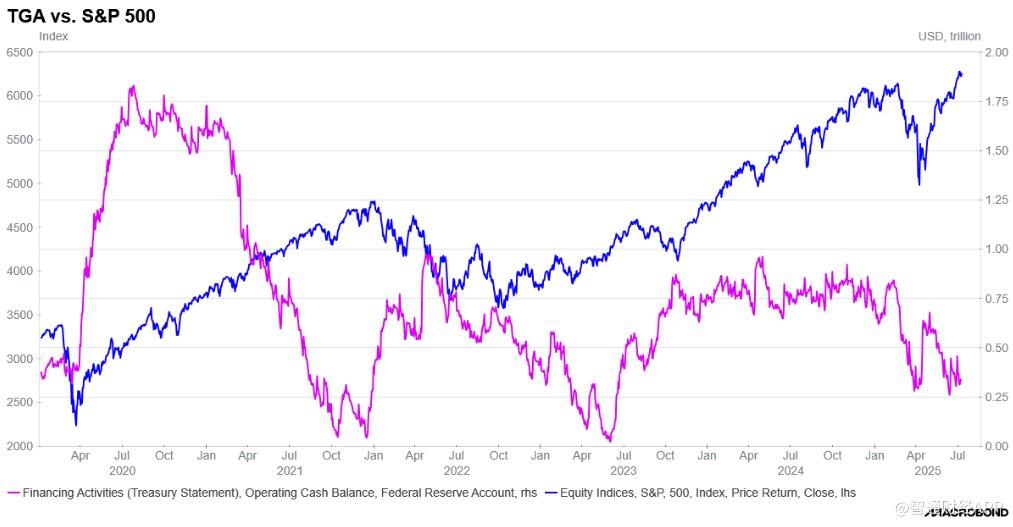
Group 1 - The "Big and Beautiful" tax and spending bill has temporarily alleviated concerns over a U.S. debt default by raising the borrowing limit by $5 trillion, but it exacerbates long-term debt issues, with an estimated increase of $3.4 trillion in national debt over the next decade [1] - The Treasury General Account (TGA) has been depleted during the debt standoff, dropping from approximately $840 billion in February to about $340 billion by July 8, and its rebuilding may tighten liquidity conditions [1][2] - The TGA plays a crucial role in the Federal Reserve's balance sheet, and its increase could lead to a significant reduction in reserve balances, potentially resulting in a liquidity loss of around $510 billion by the end of September [2][3] Group 2 - Historically, TGA rebuilding has negatively impacted the S&P 500 index, as seen in January 2022 when TGA rebuilding and increased reverse repo activities led to a significant drop in reserve balances, affecting margin levels and the index [4][5] - The last TGA rebuilding in the summer of 2023 did not impact the stock market due to the depletion of reverse repo tools, but current conditions suggest that with reverse repos nearing their low point and ongoing quantitative tightening, a decline in reserves is expected [5] - The anticipated increase in TGA and a decrease in reserve balances to around $3 trillion or lower could lead to a liquidity crunch in the market [5]
英国央行行长贝利:将会密切关注量化紧缩过程中收益率曲线的变陡情况。
news flash· 2025-07-09 10:21
Group 1 - The Bank of England's Governor Bailey emphasized the importance of closely monitoring the steepening of the yield curve during the quantitative tightening process [1]
英国央行行长贝利:金融稳定是增长的基石。风险和不确定性仍然很高。对杠杆策略表示特别关注。发布讨论文件旨在增强回购市场韧性。全球前景风险仍然高企。英国借款人具有韧性,银行业能够提供支持。收益率曲线陡峭化是全球趋势,不仅限于英国。量化紧缩(QT)是一个开放的选择。
news flash· 2025-07-09 10:18
Core Viewpoint - The Governor of the Bank of England, Bailey, emphasizes that financial stability is fundamental to growth, highlighting ongoing risks and uncertainties in the market [1] Group 1: Financial Stability - Financial stability is identified as the cornerstone of economic growth [1] - There is a particular focus on leveraged strategies due to associated risks [1] - A discussion paper has been released to enhance the resilience of the repurchase market [1] Group 2: Global Economic Outlook - Global economic risks remain elevated, impacting overall market conditions [1] - The trend of a steepening yield curve is observed globally, not limited to the UK [1] - Quantitative tightening (QT) remains an open option for monetary policy [1] Group 3: Banking Sector Resilience - UK borrowers are noted for their resilience, indicating a stable borrowing environment [1] - The banking sector is positioned to provide necessary support amidst current economic challenges [1]
英国央行行长贝利:量化紧缩是一个开放的选择。
news flash· 2025-07-09 10:16
Core Viewpoint - The Governor of the Bank of England, Andrew Bailey, stated that quantitative tightening remains an open option for the central bank [1] Group 1 - The Bank of England is considering various monetary policy tools, including quantitative tightening, to address economic conditions [1] - Bailey emphasized the importance of flexibility in monetary policy to respond to changing economic circumstances [1] - The central bank's approach will be data-driven, focusing on inflation and economic growth indicators [1]
德国财政扩张推升收益率预期 多家大行警示德债风险
news flash· 2025-07-08 16:32
Core Viewpoint - Germany's fiscal expansion is increasing debt supply and driving economic growth, leading to warnings from major global banks regarding German government bond risks [1] Group 1: Economic Impact - The fiscal spending actions in Germany are expected to boost economic growth [1] - Major banks are adjusting their forecasts for German bond yields due to this fiscal expansion [1] Group 2: Yield Predictions - Goldman Sachs strategists predict that the 10-year German government bond yield will reach 2.80% by the end of 2025 and 3.25% by 2026 [1] - HSBC's Chris Attfield and other strategists have raised their yield forecasts, citing fiscal expansion and the potential for the European Central Bank to reduce bond purchases next year [1] - The 10-year yield forecast for the end of 2025 has been increased by 25 basis points to 2.45%, while the 30-year yield forecast has been raised by 45 basis points to 3% [1]
7月4日汇市晚评:日本央行量化紧缩计划遭反对 美元/日元仍承压于145下方
Jin Tou Wang· 2025-07-04 10:35
Currency Market Overview - The Euro is fluctuating around 1.1760 against the US Dollar, while the British Pound has risen for the fourth consecutive trading day, trading above 1.3700 [1] - The US Dollar against the Japanese Yen is under pressure, remaining below 145.00, and the Australian Dollar is consolidating below 0.6600 [1] - The Canadian Dollar has dropped to around 1.3570, approaching an eight-month low of approximately 1.3540 [1] Key Developments in the US Dollar - President Trump announced that a tariff letter will be issued on Friday, with a floating range of 10%-70%, effective from August 1 [2] - US non-farm payroll data exceeded expectations, leading traders to abandon bets on a rate cut by the Federal Reserve in July [2] - Federal Reserve's Bostic noted that the labor market remains healthy, and the US economy may experience prolonged high inflation [2] Developments in Major Non-USD Currencies - ECB official Demarco stated that the Euro will not replace the Dollar as a reserve currency [3] - Japan's FY2025 wage growth forecast has been revised down to 5.25%, remaining above 5% for two consecutive years [3] - The Bank of England's survey indicates that UK businesses have lowered their wage growth expectations for the year [3] - ECB's Lagarde emphasized the need to improve the economy to enhance the Euro's global standing [3] Technical Analysis - The Euro/USD is trading above bullish moving averages, with the 20-day simple moving average (SMA) around 1.1570 [6] - The Australian Dollar/USD has broken through a multi-week range, indicating an upward trend, with key support at 0.6540-0.6530 [7] - The Dollar/Canadian Dollar has faced resistance near the 200-period SMA on the 4-hour chart, indicating a bearish outlook [7] Upcoming Economic Data - Key economic data to watch includes Switzerland's June adjusted unemployment rate and the Eurozone's May PPI [8]