存款搬家

Search documents
这个趋势信号要关注,居民存款搬家已经连续两个月了
第一财经· 2025-09-14 15:44
Core Viewpoint - The article discusses the recent trend of "deposit migration" in China, where residents are moving their savings from traditional bank deposits to non-bank financial institutions, correlating this behavior with the performance of the domestic stock market [3][6]. Financial Data Summary - In August, resident deposits decreased by 110 billion yuan, a year-on-year decline of 600 billion yuan, marking two consecutive months of negative growth [5][6]. - Non-bank deposits increased by 1.18 trillion yuan in August, showing a significant year-on-year increase of 550 billion yuan, despite a month-on-month decline [5][6]. - The M1-M2 gap narrowed to -2.8%, the lowest since June 2021, indicating enhanced liquidity and a shift towards more active funds [5][6]. Deposit Structure Changes - The structure of deposits shows a clear trend of residents moving funds into the stock market, as evidenced by the contrasting changes in resident and non-bank deposits [6][7]. - The increase in non-bank deposits is interpreted as a signal of residents preparing to invest in capital markets, reflecting a shift in asset allocation [6][9]. Market Dynamics - The article highlights that the increase in non-bank deposits is often linked to a bullish stock market, with the performance of the stock market influencing the flow of funds into non-bank financial products [9][10]. - Analysts suggest that the current trend of deposit migration is likely to continue, driven by declining deposit attractiveness and a robust capital market [10][11]. Consumer Behavior Insights - Despite the increase in non-bank deposits, there remains a cautious attitude among residents regarding future economic conditions, with a strong inclination towards saving rather than spending or investing [11][12]. - The report indicates a persistent trend of deleveraging among residents, with a notable decrease in household loans, reflecting a broader economic caution [11][12]. Policy Implications - The article emphasizes the importance of government policies aimed at stimulating consumer spending, including direct incentives and loan support measures [12]. - It suggests that sustained improvements in employment and income are crucial for reviving consumer demand and stabilizing retail loan growth [12].


存款搬家如何向实体经济传导?——2025年8月金融数据点评
一瑜中的· 2025-09-14 15:27
Group 1 - The ongoing "deposit migration" indicates that the worst phase of the economic cycle has passed, as evidenced by the improvement in the enterprise-resident deposit gap and the proportion of new currency to M2 [4][14][15] - Chinese residents do not possess excess savings but rather defensive deposits, with the current deposit migration reflecting a structural change from "excessive defensive deposits" to "normal deposits" rather than a shift from savings to consumption [4][20][27] - The ability of deposit migration to stimulate the real economy hinges on converting savings into investment savings, which can influence corporate cash flow and long-term expectations [4][8][9] Group 2 - The relationship between corporate loans and economic conditions is not straightforward; the presence of corporate funds does not necessarily indicate a positive economic outlook, as loans are just one of many funding sources [5][30][31] - The current stock market presents a favorable configuration value due to clear market stabilization policies, which have reduced stock volatility and increased risk-adjusted returns [5][33] - The ongoing deposit migration is a key factor influencing non-bank liquidity, with the stock market's activity primarily dependent on changes in resident deposit migration [5][33] Group 3 - In August, the financial data showed a continued increase in non-bank deposits, while loans decreased, indicating a shift in the financial landscape [36][41][45] - The social financing scale in August was 2.57 trillion yuan, reflecting a year-on-year decrease, with the stock market financing showing a slight increase [41][42] - The overall M2 growth rate remained stable at 8.8%, with new M1 growth at 6%, indicating a steady financial environment [45]

模拟芯片国产替代的春天来了,谁受益?| 0914 张博划重点
Hu Xiu· 2025-09-14 14:46
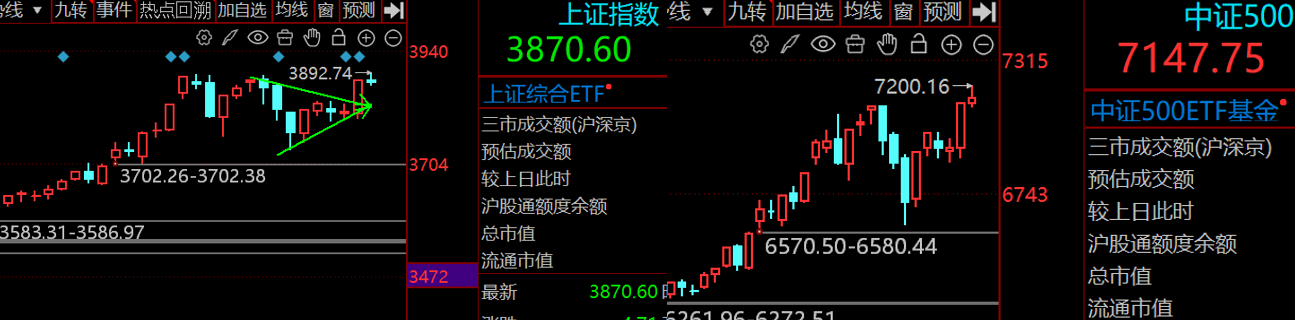
Market Performance - On September 12, the market experienced a pullback after an initial rise, with all three major indices closing lower [1] - The total trading volume in the Shanghai and Shenzhen markets reached 2.52 trillion, an increase of 83.2 billion compared to the previous trading day [1] - The Shanghai Composite Index fell by 0.12%, the Shenzhen Component Index decreased by 0.43%, and the ChiNext Index dropped by 1.09% [1]
2025年8月金融数据点评:政府债支撑减弱,存款搬家延续
Yin He Zheng Quan· 2025-09-14 14:03
Investment Rating - The report maintains a "Recommended" rating for the banking sector [1]. Core Insights - The support from government bonds for social financing has weakened, with August's new social financing at 2.57 trillion yuan, a year-on-year decrease of 463 billion yuan, and a stock growth rate of 8.81%, down 0.17 percentage points month-on-month [3]. - The demand for credit from households and enterprises remains weak, with August's new RMB loans increasing by 623.3 billion yuan, a year-on-year decrease of 417.8 billion yuan [3]. - The phenomenon of "deposit migration" continues, with M1 and M2 showing year-on-year changes of +6% and +8.8%, respectively [3]. Summary by Sections Social Financing - The issuance of government bonds decreased significantly, with August's issuance at 1.37 trillion yuan, down 2.52 trillion yuan year-on-year [3]. - Non-financial corporate domestic stock financing increased by 45.7 billion yuan, a year-on-year increase of 32.5 billion yuan [3]. Credit Demand - As of the end of August, the balance of RMB loans from financial institutions grew by 6.8% year-on-year, a decrease of 0.1 percentage points from the previous month [3]. - The household sector's loans increased by 30.3 billion yuan, a year-on-year decrease of 159.7 billion yuan, indicating weak consumer demand [3]. Deposit Trends - Financial institutions' RMB deposits increased by 2.06 trillion yuan in August, a year-on-year decrease of 160 billion yuan [3]. - Non-bank deposits increased by 1.18 trillion yuan, a year-on-year increase of 550 billion yuan, attributed mainly to the ongoing deposit migration [3]. Investment Recommendations - The report suggests that the banking sector's fundamentals are accumulating positive factors, with a potential for marginal improvement in mid-term performance [3]. - Specific stock recommendations include Industrial and Commercial Bank of China, Agricultural Bank of China, Postal Savings Bank of China, Jiangsu Bank, Hangzhou Bank, and China Merchants Bank [3].






湾财周报 大事记 六部门严打汽车行业乱象;存款继续搬家
Nan Fang Du Shi Bao· 2025-09-14 13:24
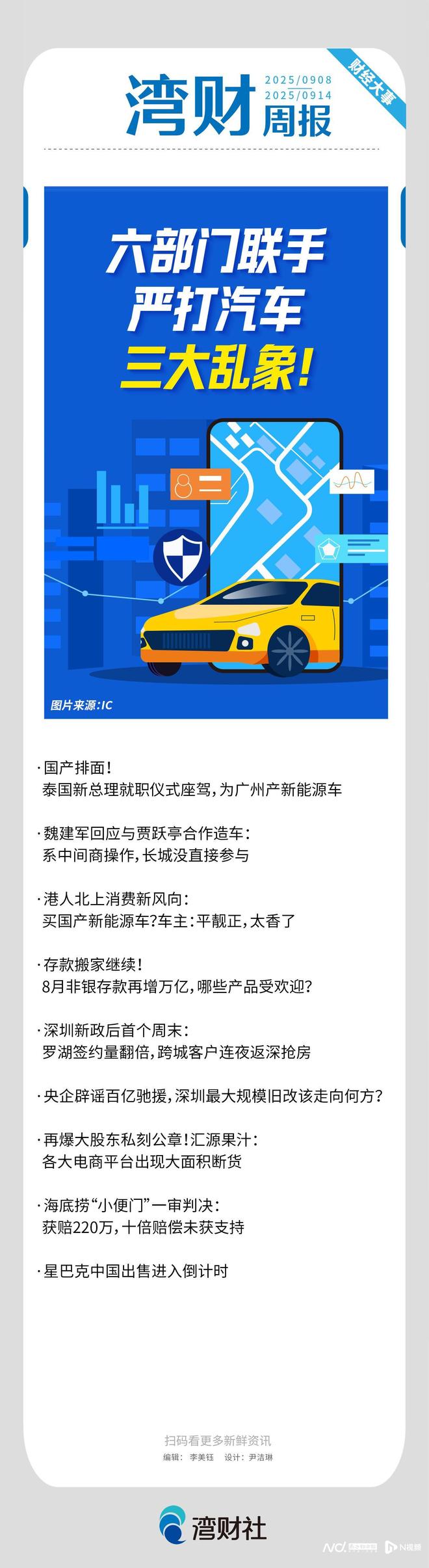
Group 1 - The core viewpoint of the news is the joint action by six government departments to combat online chaos in the automotive industry, launching a three-month special rectification campaign [4][5] - The campaign targets illegal and irregular behaviors by both car companies and unlawful groups, aiming to standardize competition and reduce unethical practices in the industry [5] - Several car companies, including GAC Aion and Zeekr, have expressed their support for the initiative, emphasizing the importance of a clear online environment for sustainable development and user value [5] Group 2 - The new Thai Prime Minister Anutin Charnvirakul was seen using a Guangzhou-produced Xpeng X9 during his swearing-in ceremony, highlighting the connection between Chinese automotive products and Thai leadership [6] - The increasing trend of Hong Kong residents purchasing domestic electric vehicles in mainland China is noted, driven by improved cross-border accessibility and a shift in consumer behavior towards larger purchases [9] Group 3 - Weichai Chairman Wei Jianjun clarified that the collaboration with Faraday Future on the SuperOne model is an intermediary operation, with no direct involvement from Great Wall Motors, although he sees potential benefits for Chinese car manufacturers [8] - The ongoing internal conflict at Huiyuan Juice has led to significant supply disruptions on major e-commerce platforms due to allegations of unauthorized actions by its major shareholder [14] Group 4 - Starbucks is in the final stages of negotiations to sell its China business, with several private equity firms, including Hillhouse Capital and EQT, as potential buyers, aiming to finalize the deal by the end of October [16]
非银存款连续两月大幅多增,居民“存款搬家”趋势强化?
Di Yi Cai Jing· 2025-09-14 10:35
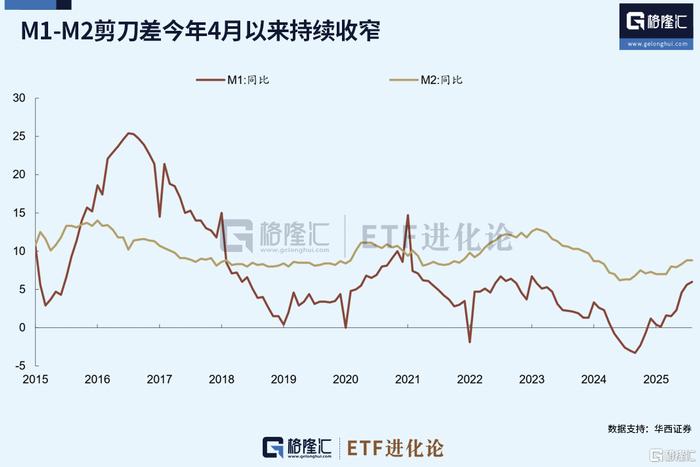
居民存款和非银存款连续两个月呈现"跷跷板"关系,被市场解读为"存款搬家",并与近期国内股市行情 联系起来。 从央行最新发布的8月金融数据来看,居民存款连续两个月超季节性下行,非银存款再度多增。8月,居 民存款新增1100亿元,同比少增6000亿元,连续两个月同比负增长。与此同时,8月非银存款新增1.18 万亿元,虽同比回落,但与去年同期相比仍大幅多增。另外,M1(狭义货币)-M2(广义货币)剪刀 差进一步收窄至2021年6月以来的最低值,资金活性增强与"存款搬家"趋势引发市场广泛关注。 资金活性提升 M1-M2剪刀差进一步收窄、非银存款再度多增,是8月金融数据的重要特征。 在货币供应量方面,8月末M2余额331.98万亿元,同比增长8.8%,增速与上月持平,比上年同期高2.5个 百分点;M1余额为111.23万亿元,同比增长6%,比上月加快0.4个百分点,继续维持较高增长。 M1增速回升带动M1-M2剪刀差进一步收窄,8月末该差值为-2.8%,较上月收窄0.4个百分点,是2021年 6月以来的最低值。今年以来M1-M2剪刀差明显收敛,进一步印证更多资金转化为活期存款,有助于投 入消费、投资等经济活动。 在央行 ...
非银存款连续两个月大幅多增,“存款搬家”趋势强化?
Di Yi Cai Jing· 2025-09-14 10:04
Core Insights - The recent financial data indicates a "deposit migration" trend, with a notable decrease in household deposits and an increase in non-bank deposits, which is linked to the performance of the domestic stock market [1][3][4] Group 1: Financial Data Overview - In August, household deposits decreased by 110 billion yuan, a year-on-year decline of 600 billion yuan, marking two consecutive months of negative growth [1][3] - Non-bank deposits increased by 1.18 trillion yuan in August, showing a significant year-on-year increase despite a decline compared to the previous month [1][2] - The M1-M2 spread narrowed to -2.8%, the lowest since June 2021, indicating enhanced liquidity and a shift towards more active funds [2][3] Group 2: Market Dynamics - The increase in non-bank deposits is interpreted as a signal of residents moving funds into capital markets, particularly as the stock market shows strong performance [6][7] - Analysts suggest that the current trend of "deposit migration" is likely to continue, driven by lower deposit interest rates and a strong equity market [5][7] - The capital market's performance is seen as a key factor attracting funds from bank deposits to non-bank financial institutions [6][7] Group 3: Consumer Behavior and Economic Outlook - Despite the increase in non-bank deposits, there remains a cautious attitude among residents regarding future economic conditions, reflected in a strong preference for saving over borrowing [8][9] - The household sector is exhibiting a trend of deleveraging, with a significant reduction in loan growth compared to deposits [8][9] - Government policies aimed at stimulating consumer spending are becoming increasingly important, with measures such as consumption vouchers and interest subsidies for personal loans being implemented [10]
存款去哪了?央行数据揭秘:1.1万亿资金大迁徙,银行慌了
Sou Hu Cai Jing· 2025-09-14 09:41
Core Insights - A significant shift in deposit behavior is occurring, with over 1.1 trillion RMB withdrawn from banks in July, indicating a trend of "deposit migration" among the public [3][4][5] - The decline in bank deposit interest rates is a primary driver of this migration, with rates for savings accounts falling below 0.3% and three-year fixed deposits around 1.25% [4][5][6] - Non-bank financial institutions are seeing a substantial increase in deposits, with a rise of 1.65 trillion RMB in July, highlighting a clear shift in where individuals are placing their funds [3][4] Deposit Migration Trends - The average decrease in household deposits in July exceeded the average growth from 2018 to 2024, showcasing an unprecedented scale of withdrawal [4] - The banking wealth management market has become a major beneficiary of this trend, with a total scale exceeding 30 trillion RMB, particularly in fixed-income products [5][6] - The stock market has also attracted significant investment, with the A-share market experiencing a notable increase in trading activity and new account openings [7][8] Investment Shifts - Public funds, especially bond funds, are gaining popularity, with average yields surpassing 4%, making them attractive compared to traditional bank deposits [9][10] - Insurance financial products are also performing well, with some companies reporting investment returns exceeding 5%, appealing to long-term investors [10][11] Regional Differences - There are notable regional disparities in deposit migration, with higher per capita deposits in first-tier cities, but a more active migration behavior observed in these areas due to greater financial literacy [12] Banking Response - In response to the outflow of deposits, banks are implementing various strategies, including promoting their own wealth management products and innovating product offerings to retain customers [13] Future Outlook - The trend of deposit migration is expected to continue, driven by ongoing interest rate marketization and an increasing acceptance of investment risks among residents [15][16]

散户,真跑步入场了?
Ge Long Hui A P P· 2025-09-14 09:04
Core Viewpoint - The data from August indicates a continued trend of deposit migration, with a significant increase in non-bank deposits, suggesting a shift of funds from traditional savings to more active investment avenues like the equity market [1][4][5]. Group 1: Deposit Trends - In August, total new deposits reached 2.06 trillion yuan, with only 110 billion yuan coming from new resident deposits, a year-on-year decrease of 600 billion yuan [4]. - Non-bank deposits saw a substantial increase of 1.18 trillion yuan in August, following a record increase of 2.14 trillion yuan in July, marking the highest level since 2015 [5][4]. - The M1 growth rate expanded to 6.0% year-on-year in August, while M2 growth remained at 8.8%, narrowing the M1-M2 spread to 2.8%, the lowest in nearly 51 months [1][3]. Group 2: Market Implications - The acceleration of deposit migration is believed to be driven by a recovering equity market, with analysts suggesting that the stock market may be a primary destination for these funds [5][7]. - The number of new A-share accounts opened in August reached 2.65 million, a month-on-month increase of over 30%, indicating a growing interest from retail investors [8]. - Public fund market data shows a significant increase in equity fund subscriptions, with stock funds seeing a net increase of 108.79 billion units and a growth in scale of 485.54 billion yuan in August [12][13]. Group 3: Fund Market Dynamics - The total public fund market size grew by 571.66 billion yuan in August, alongside a 285.7 billion yuan increase in wealth management products, aligning closely with the 1.18 trillion yuan increase in non-bank deposits [12][13]. - The share of household deposits in the A-share market was 53% in July, indicating potential for further growth as the market recovers [13].
央行8月金融数据出炉:存款增长结构性分化,居民存款搬家或成趋势
Huan Qiu Wang· 2025-09-14 02:48
Group 1 - The People's Bank of China reported an increase of 20.5 trillion yuan in RMB deposits for the first eight months of the year, with August alone contributing 2.06 trillion yuan [1] - In August, household deposits increased by only 110 billion yuan, marking a low point for the year and raising concerns about residents' saving behavior and the flow of funds in the financial market [1][3] - Non-bank financial institutions showed strong deposit performance, with an increase of 1.2 trillion yuan in August, which is 550 billion yuan more than the same period in 2023, continuing a high growth trend since July [3] Group 2 - The growth of household deposits has significantly slowed, with August's increase of 110 billion yuan being 600 billion yuan less than the same month last year, although the year-on-year decline has narrowed compared to July [3] - Analysts suggest that the slowdown in household deposit growth may be influenced by several factors, including a peak period for the maturity of fixed-term deposits and a shift of funds from bank deposits to securities accounts due to improved market sentiment [3][4] - The current financial data indicates a diversification in residents' asset allocation, moving away from a heavy concentration in fixed-term deposits, which may enhance fund utilization efficiency and promote direct financing development [4]