金融强国

Search documents
重磅会议开幕:关于“十五五”规划,我们列了五大主线
吴晓波频道· 2025-10-20 01:17
Core Viewpoint - The "15th Five-Year Plan" is a crucial period for China's modernization towards 2035 and high-quality economic development, guiding the direction for the next five years [4][3]. Strategic Deployment - The "15th Five-Year Plan" serves as a key five-year period towards the 2035 modernization goal and is essential for high-quality economic development [4][3]. Industry Planning - Key industries to focus on during the "15th Five-Year Plan" include technology (new quality productivity), finance, agriculture, and energy [5]. - Long-term strategic goals include achieving a 70% urbanization rate by 2028, completing debt tasks from 2024 to 2028, reaching carbon peak by 2030, and achieving a 90% application rate for artificial intelligence [5]. Achievements from the 14th Five-Year Plan - During the "14th Five-Year Plan," China's GDP grew at an average rate of 5.5%, reaching 134 trillion RMB, with per capita GDP increasing from 10,632 USD in 2020 to 13,445 USD in 2024 [6]. "Two Major" Projects - The "15th Five-Year Plan" emphasizes the "Two Major" projects, which focus on implementing national strategic initiatives and enhancing security capabilities in key areas [8]. - Significant projects include the Sichuan-Tibet Railway, Western Land-Sea New Corridor, and the National Water Network, with a planned investment of 800 billion RMB for 1,459 projects by 2025 [9]. Technological Innovation - The "15th Five-Year Plan" will shift China's technological development model from factor-driven to innovation-driven and demand-driven [15]. - Key industries identified for technological focus include high-end intelligent manufacturing, critical technology sectors, new infrastructure in communications, artificial intelligence, and energy reform [15][16]. Financial Development - The "Financial Power" initiative aims to enhance China's financial competitiveness, focusing on six key areas: strong currency, strong central bank, strong financial institutions, strong international financial center, strong financial regulation, and strong financial talent [28][29]. - China's financial competitiveness ranking improved from 41.2 in 2020 to 45.3 in 2024, moving from 8th to 4th globally [36]. Consumer Spending and Economic Growth - The "15th Five-Year Plan" aims to stimulate consumer spending by increasing residents' income and reducing consumption burdens through optimized fiscal spending [50][53]. - Key sectors for potential consumer growth include the "silver economy," health services, and new consumption patterns driven by increased government investment in education, healthcare, and elderly care [62]. Social Welfare and Public Services - The "15th Five-Year Plan" addresses challenges in public service equality, income stability, and the aging population [61]. - Key investment themes include health and childcare services, human capital services, and emerging consumption sectors [63].


全球资本市场格局裂变,中国如何出牌?
Jing Ji Guan Cha Bao· 2025-10-19 03:36
Group 1: Forum Overview - The "Tongzhou Global Development Forum (2025)" focused on the new patterns of global capital market development, addressing opportunities, challenges, and innovative paths [1] - The forum emphasized the importance of building a resilient, fair, and inclusive capital market for global economic recovery and sustainable growth [1] Group 2: Keynote Speeches - Wu Xiaoqiu highlighted the need for a strategic shift in China's capital market from traditional financing to mechanisms that encourage social innovation and wealth management [2] - He proposed reforms in the asset side, funding side, and regulatory side to enhance market transparency and increase the cost of violations [2] - Wu Weixing discussed the stagnation of global financial globalization post-2008 financial crisis, emphasizing the need for a balance between openness and security in China's financial strategy [3] - Liu Xiaolei noted the differentiated responses of international capital in the A-share market due to the US-China trade war, with American funds showing less aversion compared to non-American funds [4] - Zhang Xuejun pointed out the characteristics of high valuations and hard technology in the fourth technological revolution, advocating for a multi-tiered financial service system for hard tech companies [4] - Zhu Xiaoneng discussed the emergence of digital assets and their role in shaping a new ecosystem in capital markets, highlighting the differences between digital and online investments [4] - Summer emphasized the impact of global tariff wars on capital flows, suggesting that capital is moving from developed to emerging markets, and noted the potential for the renminbi to appreciate long-term [5]
寻找中国经济突围之路,和讯财经中国2025年会即将启幕
和讯· 2025-10-18 02:04
Core Viewpoint - The article emphasizes the challenges and opportunities facing the Chinese economy in 2025, highlighting the need for sustainable development and the activation of the private economy as key areas of focus for the upcoming "Finance China 2025 Conference" [3][4]. Group 1: Economic Challenges and Opportunities - In 2025, the Chinese economy is experiencing significant challenges, including deep adjustments in the real estate sector, pressure on local finances, weak external demand, and slow recovery in domestic demand [3]. - The overall economic operation is stabilizing and improving, but structural contradictions remain prominent, with investment, consumption, and exports not synchronizing [3]. - The conference aims to explore paths for balancing stable growth with structural optimization amid increasing global uncertainties and deepening domestic transformations [3][4]. Group 2: Conference Focus and Themes - The "Finance China 2025 Conference" will focus on macro policy coordination, structural reforms, technological innovation, industrial upgrades, the development of the private economy, financial openness, and risk prevention [4]. - The event will gather experts and scholars from various fields to analyze the current economic situation and discuss substantial reforms to optimize systems and mechanisms [4]. Group 3: Finance China Awards - The 23rd Finance Cloud Awards will be held concurrently, adhering to principles of fairness, justice, and openness, evaluating corporate value, social responsibility, technological innovation, and brand marketing [5]. - The awards will cover various sectors, including listed companies, banks, insurance, securities, funds, and futures, aiming to promote high-quality development in the domestic financial market [5]. - The "Finance China Annual Conference" has become one of the most influential annual events in the Chinese financial sector, recognized as a barometer for the following year's financial dynamics [5].
量客投资荣获私募金牛奖
Zhong Guo Zheng Quan Bao· 2025-10-17 08:51
10月15日,由中国证券报主办的"固本 砺新 行远——2025私募基金高质量发展大会暨国信证券杯·第十 六届私募金牛奖颁奖典礼"在深圳举行。上海量客私募基金管理有限公司荣获金牛私募管理公司(三年 期相对价值策略)奖。 金牛奖是由新华社旗下中国证券报主办的权威奖项,凭借着对评选规则的严格执行和对资管行业发展规 律的尊重,金牛奖评选赢得了资管行业和社会各界的普遍认可,是中国资本市场财富管理领域最具公信 力的奖项之一。 公司表示,今年既是"十四五"规划的收官之年,也是"十五五"规划谋篇布局的关键节点。量客投资亦希 望以此次再获殊荣为契机,深度融入金融行业"五篇大文章"的实践进程:依托自上而下的"宏观-量化-交 易"多策略体系,助力客户构建数字金融核心能力,夯实普惠金融与养老金融发展基础,积极参与科技 金融与绿色金融的全面升级。最终将专业资产管理能力,既落实到高质量金融发展的时代浪潮中,也转 化为实实在在的优质产品与服务,陪伴客户共同成长。 国内经济正处于从"数量规模"向"质量效益"转型的阶段。作为金融行业的重要细分领域,私募基金积极 响应"金融强国"战略号召,不仅为资本市场注入充足流动性与耐心资本,为资产管理行业提 ...
对内支撑实体对外助力开放 “债市基石”立起来
Zheng Quan Ri Bao· 2025-10-16 16:07
Core Viewpoint - The "14th Five-Year Plan" outlines a clear strategy for expanding China's bond market, which has achieved significant growth in scale, product innovation, risk control, and international connectivity, positioning it as a cornerstone for building a financial powerhouse and promoting high-quality economic development [1][2][4]. Group 1: Market Scale and Growth - As of August 2025, the total custody balance of China's bond market exceeded 192 trillion yuan, representing a growth of over 60% compared to the end of the "13th Five-Year Plan," with a single-year issuance scale of 79.62 trillion yuan in 2024 [2][3]. - The bond market has become the second largest in the world, with a robust framework supporting its expansion [1][2]. Group 2: Product Innovation - Continuous product innovation has led to the introduction of specialized financial tools targeting sectors like artificial intelligence and renewable energy, enhancing the market's ability to meet diverse financing needs [1][2][8]. - The launch of the "Technology Board" in May 2025 specifically caters to financing needs in semiconductor and biomedicine sectors, while public REITs have expanded to cover various asset types, unlocking over 100 billion yuan in existing assets [2][8]. Group 3: Risk Control - The bond market has maintained a low default rate of around 1%, supported by a market-oriented and legal framework for default resolution [3][4]. - By June 2025, over 60% of local government financing platforms had exited, effectively mitigating systemic financial risks [3][4]. Group 4: International Connectivity - By August 2025, 1,170 foreign institutions from 80 countries and regions had entered the market, holding approximately 4 trillion yuan in bonds, marking a nearly fourfold increase since the launch of the "Bond Connect" [3][4]. - China's bonds have been included in major international indices, enhancing their global appeal and positioning [3][4]. Group 5: Future Directions - The bond market is expected to focus on product innovation, risk control, and deepening international openness to support economic transformation and enhance financial competitiveness [8]. - There is a need to optimize the bond product structure, develop high-yield bond markets, and improve risk management tools to better serve diverse financing demands [8][9].
博时基金掌舵人交替 张东的新棋局是什么?
Jing Ji Guan Cha Wang· 2025-10-16 14:15
Core Viewpoint - The announcement of Zhang Dong as the new chairman and acting general manager of Bosera Fund marks a significant leadership transition, ending the "Jiang Xiangyang era" and raising industry expectations for Zhang's strategic direction [1][5]. Group 1: Leadership Transition - Jiang Xiangyang has served as the general manager since July 2015 and chairman since April 2020, leading Bosera Fund for over ten years [2]. - Jiang has moved to a new role at China Merchants Group, indicating a shift in leadership dynamics within the company [2]. Group 2: Company Background - Bosera Fund, established in July 1998, is one of the first five fund management companies in mainland China, with six shareholders including China Merchants Securities and China Great Wall Asset Management [2]. Group 3: Industry Growth - During Jiang's tenure, the public fund industry in China experienced rapid growth, with the number of fund products increasing from 2,360 in Q1 2015 to 12,900 by Q2 2025, and total assets under management rising from 7.06 trillion yuan to over 33 trillion yuan [3]. - Bosera Fund's asset management scale grew from 132.44 billion yuan in Q2 2015 to 1,132.01 billion yuan by Q2 2025, improving its industry ranking from 16th to 8th [3]. Group 4: Current Fund Composition - Bosera Fund currently exhibits a "strong bond, weak equity" characteristic, with over 60% of its non-monetary fund scale in money market and bond funds, while equity and mixed funds have decreased by 30% from their peak in 2021 [3]. Group 5: Financial Performance - In the first half of 2025, Bosera Fund reported a net profit of 763 million yuan, a slight increase of 0.93% year-on-year, with revenue of 2.356 billion yuan, up 6.37% [4]. - The company faced revenue fluctuations from 2022 to 2024 due to industry fee reductions and market conditions, with net profits of 1.724 billion, 1.524 billion, and 1.515 billion yuan respectively [4]. Group 6: Strategic Vision of New Leadership - Zhang Dong, with over 30 years of experience in finance and wealth management, aims to enhance Bosera Fund's positioning as a creator of client value, discoverer of investment value, leader in high-quality development, and contributor to the construction of a financial powerhouse [5][6]. - Zhang plans to improve pricing and allocation capabilities across various assets, develop flagship products in fintech and green finance, and expand customer base through innovations in inclusive and pension finance [6]. - The industry anticipates that Zhang's extensive background in wealth management and resources within the China Merchants network may strengthen the company's strategic initiatives, although the challenge remains to improve equity investment capabilities while maintaining its traditional strengths in fixed income [6].
黄奇帆预测,大A市值要涨4倍,到400万亿!
Sou Hu Cai Jing· 2025-10-14 00:49
Core Insights - The Shanghai Composite Index has reached 3900 points for the first time in ten years, marking the third occurrence in its history [1][2] - Historical patterns suggest that after surpassing 3900 points, the market tends to experience significant upward momentum, as seen in 2007 and 2015 [2][3][4] Economic Cycle Analysis - The article discusses a cyclical pattern in the economy, indicating that high points in the stock market occur approximately every ten years, driven by economic cycles [5][7] - The current market surge is linked to a new round of technological investments, particularly following the introduction of the AI model DeepSeek-R1, which has disrupted the market [11][12][13] Policy Shifts - A notable policy shift is highlighted with the introduction of the concept of a financial powerhouse in 2024, which will be a key goal in the 15th Five-Year Plan [15] - The article emphasizes the importance of wealth replacement and the transition from manufacturing and urbanization to a focus on finance and technology [16][17] Market Growth Potential - The current ratio of capital market value to GDP in China is approximately 0.7, indicating significant growth potential compared to the ideal ratio of 1:1 to 1:1.2 [22][26] - Projections suggest that by 2040, China's GDP could reach 350 trillion yuan, with the stock market potentially growing to 400 trillion yuan, representing a fourfold increase over 15 years [26][27] Long-term Market Outlook - The article posits that if the growth trajectory continues, the A-share market could experience a long-term bullish trend, with a potential fourfold increase over the next 15 years [29]

中信期货:以高质量发展践行金融强国使命 谱写中国式现代化期货新篇章
Qi Huo Ri Bao Wang· 2025-10-13 00:38
Core Insights - The article discusses the significant impact of the State Council's guidelines on the development of China's futures market, emphasizing the role of institutions like CITIC Futures in implementing these strategies to enhance the market's service to the real economy [1][8] Group 1: Enhancing Service to the Real Economy - The guidelines aim to improve the quality and efficiency of the commodity futures market in serving the real economy, particularly in supporting risk management for manufacturing enterprises [2] - CITIC Futures has focused on integrating various business models, such as "on-exchange + off-exchange" and "futures + spot," to upgrade product services and enhance interaction between the financial system and the real economy [2] - By mid-2025, CITIC Futures had served over 10,000 industrial clients, with steady growth in transaction volumes related to hedging and delivery, indicating an increase in both the breadth and depth of services to the real economy [2] Group 2: Financial Functionality and Innovation - CITIC Futures has implemented the central government's financial strategies by enhancing services in key areas, focusing on green finance and inclusive finance to better serve the real economy [3][4] - In green finance, the company has expanded its market applications for strategic emerging industries and provided risk management services for industries related to lithium carbonate and polysilicon, positioning itself as a leader in market holdings for these products [3] - The inclusive finance initiatives have led to over 400 "insurance + futures" projects, benefiting approximately 925,000 farmers and agricultural enterprises, showcasing significant social and economic impacts [4] Group 3: Market Development and Stability - CITIC Futures has promoted a diversified service model targeting both institutional and retail clients, contributing to a balanced investor structure and increased market capacity [5][6] - The company has maintained the largest margin scale in the industry for 14 consecutive years, with leading transaction and holding shares, enhancing market stability and resilience [6] Group 4: Internationalization and Global Integration - The company has accelerated its international business capabilities, essential for supporting national strategies and enhancing the pricing power of commodities [7] - CITIC Futures has attracted international institutions to participate in the Chinese futures market and has developed a comprehensive service system through its Hong Kong subsidiary, facilitating cross-border transactions [7] - The firm has also enhanced its global research capabilities, improving its cross-border service strength through bilingual reports and international forums [7]
金融强国:服务实体能力再上台阶
Jing Ji Ri Bao· 2025-10-13 00:00
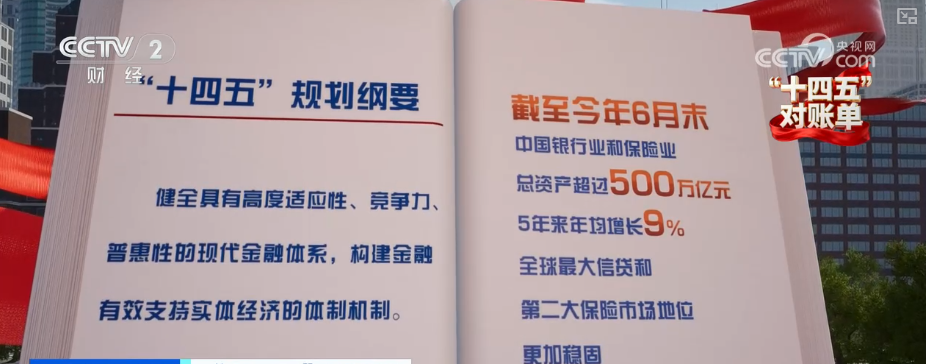
Core Insights - The article emphasizes the strategic goal of building a strong financial nation under the leadership of the Communist Party of China, highlighting significant achievements in financial reform and modernization [1] Group 1: Financial System Development - The financial system in China has seen comprehensive reforms, with a focus on enhancing governance and modernizing the financial governance framework [2] - As of the "14th Five-Year Plan" period, the total assets of the banking and insurance sectors have exceeded 500 trillion yuan, with an average annual growth rate of 9% over the past five years [2] - The number of financial institutions has increased, with 143 Chinese banks listed among the global top 1,000, and six of the top ten banks being Chinese [2] Group 2: Financial Services to the Real Economy - Over the past five years, the banking and insurance sectors have provided an additional 170 trillion yuan in funding to the real economy through various financial instruments [3] - Loans to small and micro enterprises have reached 36 trillion yuan, which is 2.3 times the amount at the end of the "13th Five-Year Plan" period, with interest rates decreasing by 2 percentage points [3] - The insurance sector has paid out 9 trillion yuan in claims, a 61.7% increase compared to the previous five-year period [3] Group 3: Financial Regulation and Risk Management - The financial regulatory system has undergone significant reforms, with a focus on enhancing regulatory effectiveness and implementing a multi-tiered regulatory framework [4] - The regulatory authority has imposed penalties on 20,000 institutions and 36,000 individuals, with a total fine amounting to 21 billion yuan [4] - The risk management strategy has successfully reduced the number of high-risk financial institutions and their asset scale significantly [5][7] Group 4: Financial Opening and Internationalization - The financial sector has seen steady progress in opening up, with over 10 trillion yuan held by foreign institutions and individuals in domestic stocks, bonds, and deposits [8] - The People's Bank of China has signed bilateral currency swap agreements with 32 countries, enhancing the international use of the renminbi [9] - The establishment of Shanghai as a global center for renminbi asset allocation and risk management is underway, promoting international participation in the financial market [9] Group 5: Business Environment Improvement - The cross-border trade and investment facilitation levels have significantly improved, with nearly 300 billion USD in related transactions since the beginning of the "14th Five-Year Plan" [10] - Policies have been upgraded to enhance cross-border financing for high-tech and small enterprises, with over 16,000 companies assisted in financing [10]
重塑发展格局 多组亮眼数据铸就“金融与实体经济共生共荣”生动答卷
Yang Shi Wang· 2025-10-11 05:02
Group 1 - The core viewpoint emphasizes the importance of high-quality financial development in supporting China's modernization efforts during the "14th Five-Year Plan" period [1][3][30] - By June 2025, total assets of China's banking and insurance sectors are projected to exceed 500 trillion yuan, with an average annual growth rate of 9% over five years [3][30] - The banking and insurance industries have provided an additional 170 trillion yuan in funding to the real economy through various financial instruments [5][30] Group 2 - The A-share market's total market capitalization is expected to surpass 100 trillion yuan by August 2025, reflecting a significant increase in the quality of listed companies [5][30] - The number of companies listed on the Beijing Stock Exchange has grown from 81 to 277, with a total market value nearing 900 billion yuan [10][30] - The proportion of national-level specialized and innovative enterprises on the Beijing Stock Exchange has increased from 41% in 2021 to 70% in 2024 [10][30] Group 3 - Financial services have significantly supported the agricultural sector, enhancing efficiency and productivity through modernized farming practices [14][19][25] - The establishment of standardized breeding parks has improved the scale and efficiency of livestock farming, aided by financial support [18][19][28] - The financial sector has played a crucial role in transforming traditional farming methods into more industrialized and profitable operations [25][29] Group 4 - The financial sector has achieved multiple significant milestones during the "14th Five-Year Plan," providing strong momentum for high-quality economic development [30][34] - Experts highlight that the next five years will be critical for transitioning from a financial power to a financial stronghold, with a focus on technological and industrial innovation [34][35] - The integration of technology and finance is expected to drive new growth, with an emphasis on green finance becoming a global benchmark [36][34]