
AI大模型

Search documents
“国产AI大模型双雄”即将上市,一图看懂
Xin Lang Cai Jing· 2026-01-07 10:07
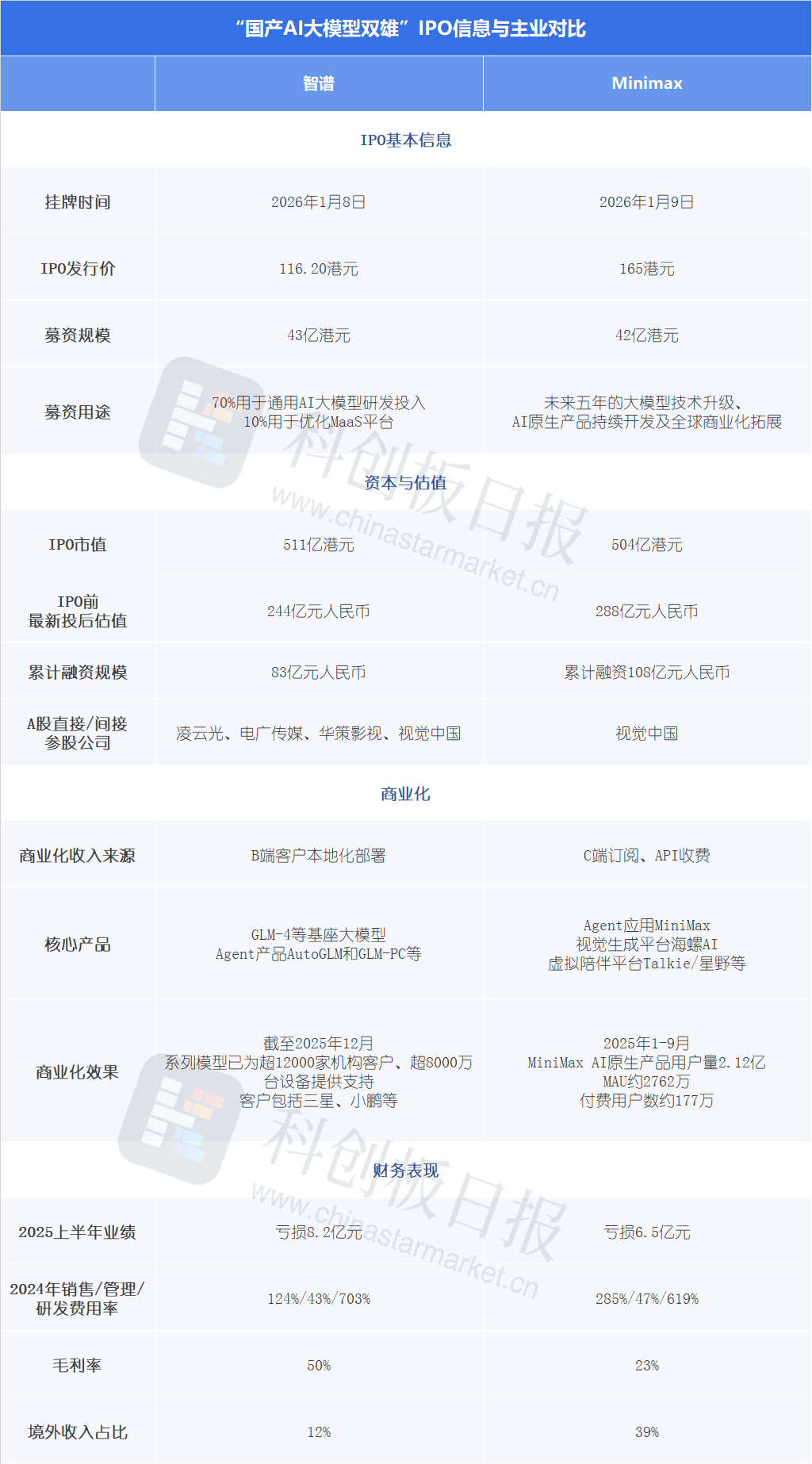
Core Viewpoint - Two domestic AI model companies, Zhiyu Huazhang and Minimax, are set to debut on the Hong Kong Stock Exchange, with IPOs scheduled for January 8 and January 9, 2026, respectively [1][2]. Group 1: IPO Information - Zhiyu plans to issue 37.42 million H-shares at an IPO price of HKD 116.20, aiming to raise HKD 4.3 billion [1][2]. - Minimax intends to issue 25.39 million shares at an IPO price of HKD 165, targeting a fundraising of HKD 4.2 billion [1][2]. - The market capitalization at IPO is projected to be HKD 51.1 billion for Zhiyu and HKD 50.4 billion for Minimax [2][4]. Group 2: Fund Utilization - Zhiyu will allocate 70% of the funds raised for general AI model research and development, and 10% for optimizing its MaaS platform [2][4]. - Minimax plans to use the funds for model technology upgrades, continuous development of AI-native products, and global commercialization over the next five years [2][4]. Group 3: Financial Performance - For the first half of 2025, Zhiyu reported a loss of CNY 820 million, while Minimax recorded a loss of CNY 650 million [3][5]. - Zhiyu's gross margin stands at 50%, compared to Minimax's 23% [3][5]. - The overseas revenue proportion is 12% for Zhiyu and 39% for Minimax [3][5]. Group 4: Commercialization and Client Base - Zhiyu's core product includes GLM-4 and other foundational models, serving over 12,000 institutional clients and supporting more than 80 million devices [2][5]. - Minimax's user base for its AI-native products reached 212 million, with a monthly active user count of approximately 27.62 million and about 1.77 million paying users [2][5].

中国车企CES秀肌肉
Hua Er Jie Jian Wen· 2026-01-07 09:56
Core Insights - Chinese automakers are redefining the future of the automotive industry at CES, shifting focus from hardware to AI models and advanced driving architectures [1] - The competition is now centered around software capabilities and supply chain integration, marking a significant transition from manufacturing to standard-setting [1][11] Group 1: Technological Advancements - Geely introduced its "Universal AI 2.0" system, featuring the World Action Model (WAM), which enhances the vehicle's intelligence through a layered design [2] - WAM allows for a complete intelligent feedback loop, enabling continuous evolution in automotive intelligence [2] - Geely's strategy has led to a 20%-30% reduction in project numbers while enhancing quality, indicating a focus on efficiency [3] Group 2: Strategic Integration - Geely's brands, including Zeekr and Lynk & Co, have unified their driving software under the "G-ASD" system, promoting technology sharing across models [3] - This integration allows for rapid deployment of advanced technologies, such as the Thor-U chip, across different vehicle brands [3] - Great Wall Motors is pursuing a dual strategy of mechanical and intelligent advancements, showcasing its Hi4-Z hybrid architecture to address consumer concerns about range and energy consumption [4] Group 3: Supply Chain and Market Positioning - Chinese supply chain companies are demonstrating their production capabilities, with Leap Motor showcasing its aggressive electronic architecture strategy [5] - Black Sesame Intelligence presented its A2000 autonomous driving chip, targeting the L2+/L3 market, while other companies displayed advancements in lidar technology [6] - The automotive industry is expected to undergo significant changes, with a shift from funding and qualifications to AI model integration as the new entry barrier [7] Group 4: Future Industry Dynamics - The high costs associated with advanced driving technologies are leading to a consolidation trend, where only a few major players will dominate the market [9] - Companies unable to develop large models or afford high-performance chips may face significant challenges, leading to potential market exits [9] - The transition from "software-defined vehicles" to "AI-defined vehicles" will fundamentally alter the automotive business model, emphasizing AI capabilities over traditional hardware metrics [10][11]


想要复刻Anthropic模式,智谱仍面临许多挑战
3 6 Ke· 2026-01-07 09:52
Group 1 - The core viewpoint of the article highlights the challenges and opportunities faced by large model companies, particularly focusing on their transition towards a more stable business model centered around API services for B2B clients [2][3][10] - The article discusses the significant interest in IPOs for large model companies, with notable subscription rates for companies like Zhipu and MiniMax, indicating a strong market appetite [1] - It emphasizes the competitive landscape, where companies like Anthropic are leading the enterprise-level LLM API market, with a projected 32% market share by 2025, and the need for domestic companies to adapt to this trend [2][15] Group 2 - Zhipu's business model is shifting from localized deployment to a focus on API services, aiming to increase the revenue share from API business to 50% [4][9] - The financial performance of Zhipu shows a concerning trend, with net losses increasing significantly from 1.44 billion in 2022 to 29.58 billion in 2024, and a projected loss of 23.58 billion in the first half of 2025 [19][21] - The article outlines the challenges faced by Zhipu in achieving profitability, with a negative gross margin for its cloud deployment business and high R&D costs primarily driven by computing power expenses [5][14][21] Group 3 - The competitive environment in the domestic market is described as a "red ocean," with price wars becoming a significant factor as companies strive to capture market share [22][26] - Zhipu's strategy includes integrating its G2B and B2B operations to streamline resources and improve efficiency, reflecting a broader trend among large model companies to focus on core capabilities [27][29] - The article concludes that the ability to convert R&D investments into stable cash flow will be a critical test for all large model companies as they navigate the transition to public markets [29]
CES2026开幕,国际足联主席因凡蒂诺点赞海信世界杯定制产品
Xin Hua Cai Jing· 2026-01-07 09:43
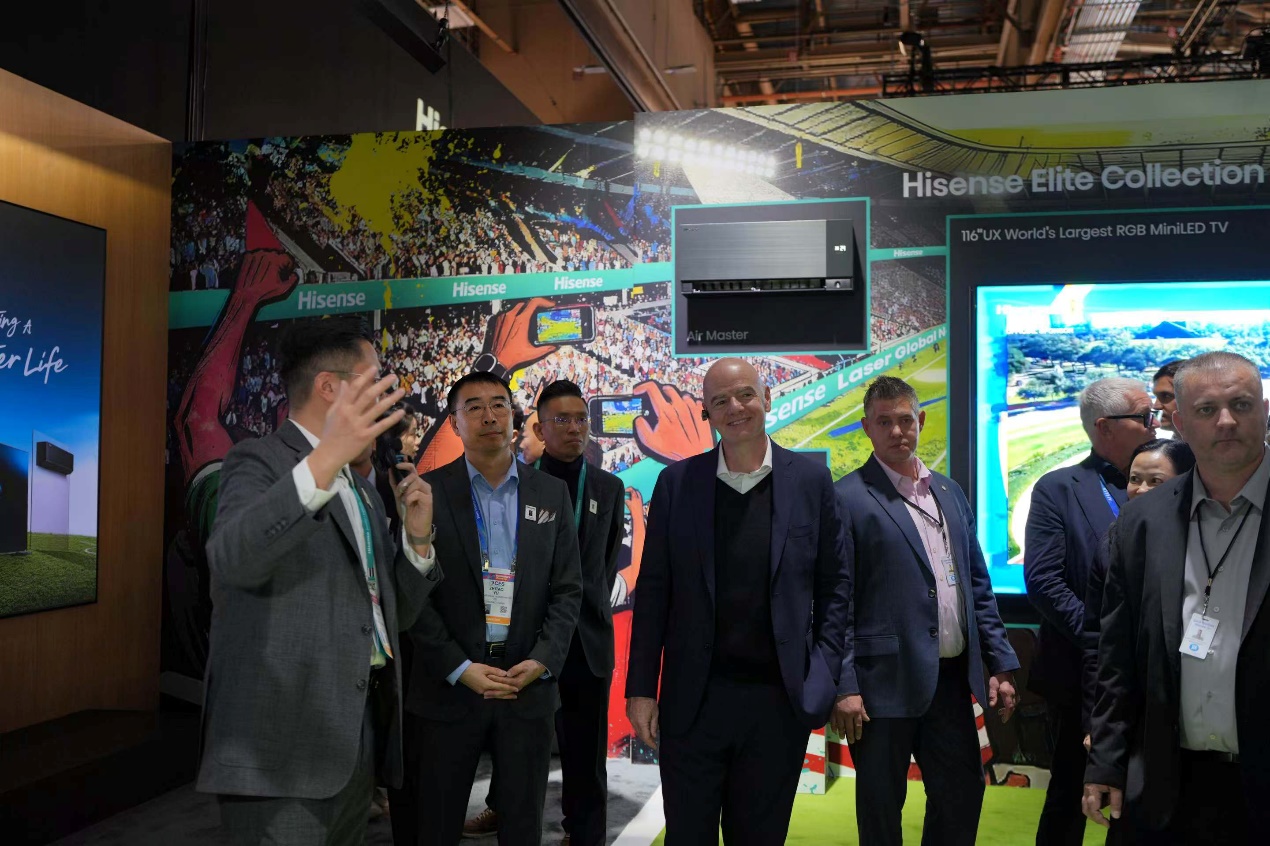
Core Viewpoint - Hisense showcases cutting-edge technology at CES 2026, including the innovative RGB-Mini LED technology, as the official sponsor of the 2026 FIFA World Cup, highlighting its commitment to enhancing the viewing experience for sports fans [1][4]. Group 1: Product Launches and Innovations - Hisense launched the new RGB-Mini LED TV UX, which replicates the details of the soccer field and jerseys with stunning picture quality, impressing visitors including FIFA President Infantino [3]. - The company introduced a series of World Cup-themed products, including a refrigerator with AI culinary management features that can intelligently recognize ingredients and optimize storage, and an air conditioner that adjusts airflow based on human movement for a comfortable viewing experience [3]. Group 2: Brand Positioning and Partnerships - Hisense has a long-standing relationship with the FIFA World Cup, having been the first Chinese consumer electronics brand to sponsor the event in 2018, which has significantly enhanced its global brand recognition [4]. - The collaboration with FIFA is based on shared values, allowing Hisense to expand its partnership and leverage technological innovations, particularly in the RGB-Mini LED technology, which is becoming a trend in high-end televisions [4].

CES中企展位最大面积背后:45岁的TCL,正站在全球化的新起点
Di Yi Cai Jing Zi Xun· 2026-01-07 07:03
Core Viewpoint - The China-Korea Business Forum held on January 5, 2026, highlighted the deepening economic cooperation between China and South Korea, with TCL as a key player in global market expansion and technological innovation [1][3]. Group 1: Economic Cooperation - The forum was attended by over 400 participants, including government officials and business leaders from both countries, emphasizing the importance of collaboration in various sectors [1]. - TCL aims to strengthen its global presence by collaborating with South Korean companies, particularly in technology-intensive industries [1][6]. - The cooperation between TCL and South Korean firms covers materials, equipment, and core electronic categories, enhancing supply chain stability [6][7]. Group 2: Technological Advancements - TCL is focusing on next-generation display technologies, including Mini LED and printed OLED, to enhance its product offerings and maintain competitive advantages [13][14]. - The company has made significant strides in AI integration, showcasing products like AI-powered air conditioners and AR glasses at CES [15][14]. - TCL's R&D efforts have led to breakthroughs in display technology, positioning the company as a leader in the global market [13][16]. Group 3: Market Position and Growth - TCL's global TV shipment volume is projected to reach 29 million units in 2024, ranking second worldwide, with a market share of 14.3% [16]. - The company has seen substantial growth in Mini LED TV shipments, with a year-on-year increase of 153.3% and a market share of 29.4% [16]. - TCL's strategic partnerships and technological advancements are expected to further enhance its market position and global influence [16].


CES中企展位最大面积背后:45岁的TCL,正站在全球化的新起点
第一财经· 2026-01-07 07:00
Core Viewpoint - The article highlights the deepening economic cooperation between China and South Korea, particularly in the technology and manufacturing sectors, with TCL as a key player aiming to expand its global presence and technological capabilities through partnerships with South Korean companies [1][5][7]. Group 1: Economic Forum and Cooperation - The China-Korea Business Forum held on January 5, 2026, featured over 400 attendees, including government officials and business leaders from both countries, emphasizing the importance of collaboration in enhancing global supply chain influence [1]. - TCL, celebrating its 45th anniversary, is focused on strengthening its global layout and aims to replicate its success internationally by collaborating with South Korean firms [1][7]. Group 2: Technological Advancements and Strategic Partnerships - Chinese manufacturing possesses systemic advantages in the global value chain, driven by a complete supply chain, high efficiency, and innovation, with a shift towards quality and sustainability in manufacturing [4]. - TCL has established strategic partnerships with major South Korean companies like Samsung and LG, covering various sectors including semiconductor displays and smart terminals, enhancing its supply chain stability [7][8]. Group 3: Market Expansion and Competitive Landscape - TCL is actively participating in the competitive South Korean market, which is characterized by advanced technology and strong brand presence, using it as a benchmark for its product capabilities [9]. - The company has achieved significant milestones, such as being the first globally to mass-produce Mini LED TVs and leading in printed OLED technology, which bolsters its confidence in global competition [9][19]. Group 4: Future Prospects and Innovations - TCL plans to deepen cooperation with South Korean firms in key product areas like small-sized screens and photovoltaic technology, anticipating increased demand for high-end materials and equipment [8]. - The company is also focusing on next-generation display technologies and AI applications, showcasing innovations at CES, including the world's first printed OLED vehicle screen and advanced AI products [17][19]. Group 5: Global Market Performance - TCL's global TV shipment is projected to reach 29 million units in 2024, ranking second worldwide, with a market share of 14.3%, and a notable increase in Mini LED TV shipments by 153.3% [19][20]. - The company has established a unique path in the global supply chain by leveraging deep cooperation and cutting-edge technology, enhancing its manufacturing advantages while penetrating core technology fields [20].

“科技之星 弃A赴港”?浪潮之下 暗流涌动
Xin Lang Cai Jing· 2026-01-07 01:56
Core Viewpoint - The Hong Kong stock market is experiencing a surge in listings from technology companies, particularly those in the AI and GPU sectors, as firms like Zhipu and MiniMax prepare to go public, highlighting a shift from the A-share market to Hong Kong due to more favorable listing conditions [1][11][31]. Group 1: Listing Trends and Market Dynamics - Zhipu is set to list on January 8, 2026, as the "first stock of AI general models," while MiniMax will follow on January 9, 2026 [1]. - Wall Street's "AI Six Tigers," including Zhipu and MiniMax, are seen as potential stars that previously aimed for the A-share market but have opted for Hong Kong [1][11]. - The recent listing of Wallran Technology as the "first GPU stock in Hong Kong" further emphasizes the trend of tech companies moving south [1][11]. Group 2: Listing Pathways and Regulatory Framework - Companies typically have two pathways for listing: the A-share Sci-Tech Innovation Board or the Hong Kong Stock Exchange under the 18C regulations [1][26]. - The 18C regulations, introduced in 2023, eliminate the requirement for continuous profitability and lower the market capitalization thresholds for both commercialized and non-commercialized companies [4][26]. - The Hong Kong 18C framework is designed to support hard-tech companies, similar to the A-share Sci-Tech Innovation Board, but with more flexible requirements [26][28]. Group 3: Financial and Structural Requirements - Under the 18C rules, commercialized companies must have a market cap of at least 40 billion HKD, while non-commercialized companies require 80 billion HKD [4][28]. - The 18C regulations allow companies to list without profitability, with revenue requirements set at 2.5 billion HKD for commercialized firms and none for non-commercialized ones [6][28]. - The focus on R&D spending is significant, with commercialized companies needing to allocate at least 15% of operating expenses to R&D, while non-commercialized firms must allocate 30% [7][28]. Group 4: Market Appeal and Investor Considerations - The Hong Kong market is viewed as a more attractive option for tech companies due to its international capital access and flexible regulatory environment [34]. - The presence of major institutional investors in Hong Kong provides a stable foundation for new stock offerings, enhancing market confidence [34]. - The ability to maintain control through various share structures, such as AB shares, is a significant advantage for companies like MiniMax [32][33]. Group 5: Challenges and Risks - The increasing number of listings has raised concerns about market liquidity and the potential for a wave of IPO failures, particularly among unprofitable tech firms [16][37]. - The risk of a potential wave of delistings looms as many companies may fail to meet profitability targets within the required timeframe [38]. - Regulatory challenges persist, particularly regarding the definition of "specialized technology" and the criteria for companies seeking to list under the 18C framework [39][40].
火石创造年度盘点:纵览2025热门产业脉搏
Sou Hu Cai Jing· 2026-01-07 00:45
Core Insights - The year 2025 marks the end of the "14th Five-Year Plan" and the beginning of the "15th Five-Year Plan," focusing on industrial and corporate development in China, with an emphasis on emerging fields such as artificial intelligence, low-altitude economy, quantum technology, humanoid robots, and industrial mother machines [1] Artificial Intelligence - The fourth technological revolution is driven by artificial intelligence, with 29 provinces prioritizing "artificial intelligence" in their 2025 work plans, aiming for deep integration with traditional industries [2] Low-altitude Economy - The low-altitude economy is becoming a competitive arena globally, with 30 provinces including it in their 2025 government work reports, exploring differentiated development paths based on regional characteristics [3] Quantum Technology - Quantum technology is a key focus in the "15th Five-Year Plan," seen as essential for fostering new productive forces and high-quality development, with cities like Hefei, Beijing, and Shanghai leading the way [4] Humanoid Robots - Humanoid robots are recognized as one of the "Top Ten Engineering Achievements of 2025," representing a fusion of artificial intelligence and advanced manufacturing, with significant development in regions like Beijing-Tianjin-Hebei, Yangtze River Delta, and Pearl River Delta [5] Industrial Mother Machines - Industrial mother machines are crucial for manufacturing competitiveness, with the "15th Five-Year Plan" advocating for breakthroughs in key technologies, showing regional clustering in areas like the Yangtze River Delta and Pearl River Delta [6] AI Large Models - 2025 is a pivotal year for AI large models, with 611 generative AI services registered as of November 1, showcasing a pyramid distribution across provinces [7] Embodied Intelligence - Embodied intelligence is highlighted in the government work report for the first time, with various policies being introduced to accelerate its development, attracting global tech companies [8] Additive Manufacturing - Additive manufacturing is rapidly integrating into China's economy, with significant clustering in regions like Beijing-Tianjin-Hebei, Yangtze River Delta, and Pearl River Delta, alongside emerging hubs in central and western regions [9][10] Computing Power - Computing power is deemed essential in the digital economy, with regions actively developing resources to transform potential into high-quality growth, supported by the "East Data West Computing" initiative [11] High-end Medical Devices - The high-end medical device sector is experiencing rapid technological advancements and industrial upgrades, driven by geopolitical tensions and tariff escalations, with a focus on innovation and domestic substitution [12] Financial Services in Technology - The company has established technology finance service platforms in multiple provinces, supporting technology-based enterprises with significant loan disbursements, exemplified by nearly 80 billion yuan in loans in Hubei [14]

300公里高空跑大模型,苏州科达押注遥感卫星万亿赛道
阿尔法工场研究院· 2026-01-07 00:04
Core Viewpoint - The article discusses the innovative application of hyperspectral remote sensing technology, particularly through the efforts of Suzhou Keda, which aims to integrate AI models into satellites for enhanced environmental monitoring and data analysis [6][7][8]. Group 1: Hyperspectral Technology Overview - Hyperspectral remote sensing captures hundreds of continuous spectral bands, allowing for detailed identification of material compositions, such as detecting nitrogen deficiency in crops or identifying pollution sources [9][10]. - The technology is increasingly being utilized in various fields, including environmental monitoring, agriculture, and emergency response, due to its ability to provide deep insights rather than just broad coverage [9][10]. Group 2: Development and Commercialization - China has launched over 20 hyperspectral satellites as part of its long-term strategy for environmental monitoring, establishing a preliminary integrated observation network [11][14]. - The commercialization of hyperspectral data is beginning to take shape, with the first domestic case of hyperspectral data being valued at over 27 million yuan, indicating a shift towards recognizing remote sensing data as a tradable digital asset [14]. Group 3: Suzhou Keda's Innovations - Suzhou Keda is leading the development of a hyperspectral satellite that will be the first fully privately developed and operated in China, featuring an integrated AI system for on-orbit data processing [16][17]. - The satellite aims to reduce data transmission by 90% and improve response times from hours to minutes by processing data in space and only transmitting high-value information [17][18]. Group 4: Integrated Ecosystem Approach - The company is not only focusing on a single satellite but is also developing a comprehensive ecosystem that integrates satellite, drone, and ground-level data processing to enhance the utility of hyperspectral technology [20][26]. - This integrated approach aims to create a closed-loop system for real-time monitoring and response, leveraging the company's existing expertise in various environmental applications [26]. Group 5: Future Prospects and Challenges - While the technology is promising, challenges remain, including low data utilization rates and the need for industry standards, as many users prefer cheaper alternatives [20][26]. - The success of this initiative will depend on collaboration between state-owned enterprises and private companies, as well as the integration of hyperspectral data into smart city frameworks [26].


6大领域177项成果助推产业升级
Xin Lang Cai Jing· 2026-01-06 19:29
Group 1 - The 10th "Innovation and Entrepreneurship Competition of Science and Technology in Jiangsu" announced 177 winning projects from 827 entries, showcasing diverse technological advancements across six core sectors: information technology, equipment manufacturing, new materials, life sciences, modern agriculture, and food science [1] - The competition emphasized "hardcore technology," with many awarded projects achieving significant technological innovations at a leading domestic level, particularly in the equipment manufacturing sector [2] - Notable projects include a key technology for efficient exploration of deep oil and gas resources developed by a team from Sinopec, utilizing AI to enhance traditional analysis methods [2] Group 2 - Award-winning projects address real-world industrial challenges and public needs, demonstrating practical applications of technology in various sectors [3] - The "self-propelled flexible flower thinning robot" project developed by Jiangsu Academy of Agricultural Sciences targets labor efficiency issues in fruit farming, achieving a 50% reduction in labor for flower management [3] - An AI-based intelligent capsule robot for gastrointestinal examinations, developed by Wuxi Reshine Medical Technology Co., aims to provide non-invasive diagnostics, expanding access to healthcare [3] Group 3 - The innovation ecosystem is characterized by strong collaboration among universities, research institutions, and enterprises, with 89 projects led or participated by academic entities and 121 by enterprises [4][5] - Successful projects include a mass-producible anion exchange membrane electrolyzer stack developed in collaboration with the University of Science and Technology of China, highlighting effective technology transfer from research to industry [5] - The competition serves as a bridge for industry-academia collaboration, facilitating direct engagement between participants and companies to address industrial needs [5]