AI芯片

Search documents
英伟达:祝贺谷歌TPU成功,但GPU领先一代
是说芯语· 2025-11-26 04:54
Core Insights - Google is making significant strides in the AI chip market, aiming to capture 10% of Nvidia's annual revenue through its TPU offerings [6][12][26] - Nvidia is responding aggressively to Google's advancements, emphasizing its established position and capabilities in the AI hardware space [2][20][22] Group 1: Google's Strategy - Google has successfully launched its Gemini 3 AI model using its proprietary TPU, which has led to increased interest from major clients like Meta and financial institutions [3][4] - The company is promoting the deployment of TPUs in clients' data centers, highlighting benefits such as enhanced security and performance for sensitive applications [14][15] - Google has developed a "Google version of CUDA" to facilitate the use of TPUs, aiming to simplify the integration process for clients [14][19] Group 2: Nvidia's Response - Nvidia's CEO Jensen Huang is closely monitoring Google's TPU developments and is actively courting potential clients to prevent them from switching to Google [20][21] - Nvidia is employing a straightforward strategy of financial investment to secure commitments from companies like Anthropic and OpenAI to continue using its GPUs [21][22] - Despite Nvidia's strong financial performance, the company faces market volatility and pressure to meet high expectations, which has led to significant fluctuations in its stock price [27][31][32] Group 3: Market Dynamics - Both Google and Nvidia have seen their stock prices outperform the S&P 500, with Alphabet showing particularly strong gains [9][11] - The competition between Google and Nvidia is reshaping the AI industry landscape, with both companies vying for dominance in the AI chip market [8][26] - Other major players, including Amazon and Microsoft, are also developing their own AI chips, indicating a broader trend in the industry towards self-sufficiency in AI hardware [26]




英伟达股价巨震!
国芯网· 2025-11-26 04:41
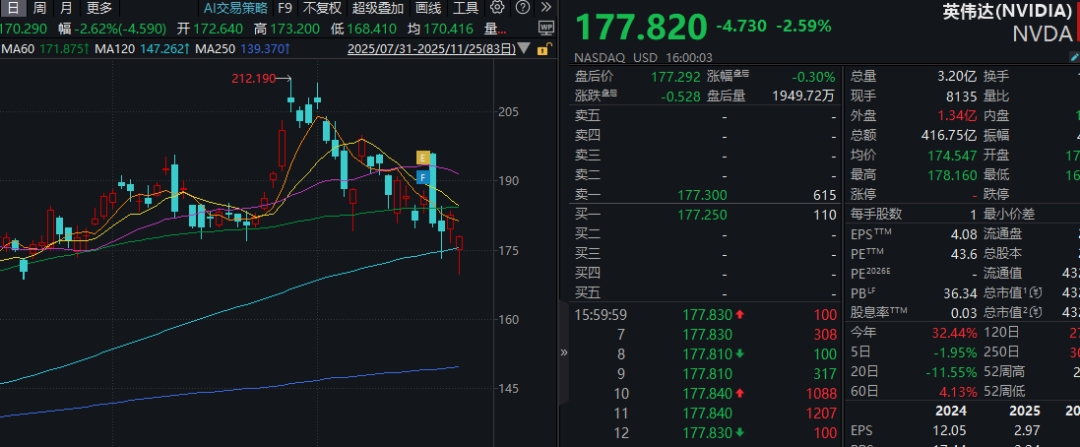
Core Viewpoint - The article discusses the recent fluctuations in Nvidia's stock price and its implications for the semiconductor industry, particularly in relation to Google's advancements in AI and its TPU technology [2][4][5]. Group 1: Nvidia's Stock Performance - Nvidia's stock price experienced a significant drop of over 7%, resulting in a market value loss of nearly $350 billion, closing at $177.82, the lowest in over two months [2]. - The stock reached a historical high of $212 on October 29, with a total market capitalization of $5.15 trillion, but has since declined by approximately 16%, equating to a market value loss exceeding $800 billion [2]. Group 2: Google's TPU Developments - Google announced the upcoming release of its seventh-generation TPU chip, Ironwood, which is set to launch in the coming weeks [5]. - Google is reportedly considering deploying TPU technology in its data centers, potentially generating billions in revenue and demonstrating the reliability of its technology [4]. - Anthropic has partnered with Google to deploy up to 1 million TPU chips for training its AI model, Claude, with a projected capacity of 1GW by 2026, representing a multi-billion dollar expansion plan [5]. Group 3: Market Positioning - Nvidia maintains a dominant position in the AI chip market, offering higher performance and versatility compared to Google's TPU, which is more specialized and has lower power consumption [5]. - Google does not sell TPUs directly but allows companies to rent them through Google Cloud, which could impact market dynamics and competition in the semiconductor space [5].

英伟达:祝贺谷歌TPU成功,但GPU领先一代
量子位· 2025-11-26 04:21
Core Insights - Google is making significant strides in the AI chip market, aiming to capture 10% of Nvidia's annual revenue through its TPU offerings [1][7] - Nvidia is responding to Google's advancements by emphasizing its core position as a reliable partner and its superior hardware solutions for AI [2][3] Google’s TPU Strategy - Google has been developing its TPU technology for over a decade, with recent moves to promote local deployment of TPUs in client data centers [14][15][16] - The company highlights two main advantages of its TPU offerings: enhanced security and compliance for sensitive data, and performance benefits demonstrated by the Gemini 3 model [17][18] - Google is actively engaging with clients to encourage the use of TPUs, claiming that they are more cost-effective than Nvidia's GPUs [20] Nvidia’s Response - Nvidia is closely monitoring Google's TPU developments and is attempting to secure major clients like OpenAI and Meta to prevent them from adopting TPUs [25][26] - The company is using aggressive financial strategies, including significant investments in AI startups, to ensure continued reliance on its GPU technology [27][28] - Nvidia's CEO has publicly acknowledged Google's TPU achievements while maintaining a competitive stance [30][31] Market Dynamics - Both Google and Nvidia have seen their stock prices outperform the S&P 500, with Alphabet showing particularly strong gains [11][12] - The competition between these two tech giants is reshaping the AI industry landscape, with other major players like Amazon and Microsoft also developing their own AI chips [33] Future Outlook - Analysts suggest that while Nvidia maintains a stronghold in training chips, the greatest opportunity for challengers lies in the inference chip market [34] - Nvidia's recent financial performance has been mixed, with market expectations creating volatility in its stock price [35][41]

美股“深V”反转!美联储,大消息
Zheng Quan Shi Bao· 2025-11-26 00:16
美股盘中突然爆发。 当地时间11月25日(周二),美国股市三大股指盘中"深V"反转,全线收涨。其中道琼斯工业指数重回47000点整数关口之上,纳斯达克指数重回23000点 整数关口之上。 超威半导体(AMD)股价巨震,盘中跌势惨烈,一度大跌逾9%,但其后明显收窄跌幅。 消息面上,美联储理事斯蒂芬·米兰周二在电视采访中表示,由于美联储过高的利率目标,导致就业市场恶化。他建议加大降息力度以支持经济。 芝商所"美联储观察"工具显示,市场预计美联储12月会议上降息25个基点的概率为84.9%。 美股市场大型科技股多数上涨。具体到个股,Meta涨近4%,谷歌A、亚马逊涨超1%。微软、苹果、特斯拉均小幅上涨,涨幅均不足1%。 银行股整体上行,摩根大通、高盛、花旗、摩根士丹利、美国银行等多股涨超1%,富国银行涨幅不足1%。 航空股集体上涨,西南航空、美联航均涨逾3%,美国航空、达美航空均涨逾2%。 抗疫概念股普遍上涨,BioNTech涨超3%,Moderna涨超2%,阿斯利康涨近2%,吉利德科学涨逾1%。 芯片股涨跌分化,两大AI芯片巨头盘中一度重挫,但收盘时均大幅收窄跌幅。 其中,英伟达一度重挫逾7%,其后收窄跌幅,至收 ...

英伟达回应谷歌芯片威胁
Di Yi Cai Jing Zi Xun· 2025-11-25 23:54
当地时间周二,英伟达罕见回应市场对其AI芯片主导地位受威胁的担忧,称公司GPU"仍领先行业一 代",可支持所有AI模型并覆盖多场景计算,是目前唯一具备通用平台能力的厂商。英伟达强调,将持 续深化与多家科技巨头的合作。 有报道称,英伟达重要大客户Meta正考虑在未来数据中心采用谷歌自研TPU,并从明年起租用谷歌云芯 片资源。报道提到,谷歌TPU被推销为英伟达GPU的"成本更优替代品",并引发投资者忧虑,这或削弱 英伟达在AI基础设施中的统治地位。 ...
摩尔线程上市,市值会复制寒武纪10倍神话吗?
Sou Hu Cai Jing· 2025-11-25 17:15
Core Viewpoint - Moer Thread, known as the "first domestic GPU stock," has launched its IPO on the Sci-Tech Innovation Board with a record issuance price of 114.28 yuan per share, raising 8 billion yuan, and achieving a staggering offline subscription multiple of 1571 times, indicating strong market enthusiasm [1][5]. Group 1: Company Overview - Moer Thread was established on June 11, 2020, by Zhang Jianzhong, a former NVIDIA executive with 15 years of experience [3]. - The core team has a strong "NVIDIA gene," with co-founders having extensive backgrounds at NVIDIA, including roles in marketing and GPU architecture [3]. - The company has developed the MUSA architecture, focusing on a full-function GPU route, covering both graphics and AI fields [3]. Group 2: Financial Performance - Moer Thread's revenue has shown explosive growth, increasing from 46 million yuan in 2022 to a projected 1.24 billion yuan in 2024, with a compound annual growth rate of 208.44% [5]. - In the first half of 2025, the company reported revenue of 702 million yuan, surpassing the total revenue of the previous three years [5]. - Despite high growth, the company has incurred significant losses, with net profits of -1.84 billion yuan in 2022, -1.67 billion yuan in 2023, and -1.49 billion yuan in 2024 [5][6]. Group 3: Market Position and Competition - The Chinese GPU market is projected to grow from 142.54 billion yuan in 2024 to 1,336.79 billion yuan by 2029, with an annual growth rate of 53.7% [16]. - Moer Thread's strategy contrasts with that of Cambricon, which focuses on ASIC chips for specific applications, while Moer Thread aims for a versatile platform targeting various markets [9][12]. - Both companies have demonstrated compatibility with domestic large models, indicating their capability to adapt to cutting-edge AI applications [9]. Group 4: Challenges and Ecosystem - Building a robust developer ecosystem is a significant challenge for Moer Thread, as NVIDIA's CUDA ecosystem dominates the market [12]. - Moer Thread has introduced the MUSA architecture to lower migration costs for enterprises and attract developers to its ecosystem [12]. - The company faces risks such as high R&D costs, potential inclusion on the U.S. entity list, and a lack of profitability, with expectations of achieving profitability by 2027 [16].

华为百度接连“秀肌肉” 大厂自研AI芯片为何不再闷声?
Nan Fang Du Shi Bao· 2025-11-25 15:04
Core Insights - Domestic AI chip companies have been relatively low-profile in recent years, but recent announcements from major players like Huawei and Baidu have broken this silence, revealing their AI chip development roadmaps [1][2][4] - The competitive landscape is shifting as domestic companies aim to capture market share left by Nvidia, with a focus on clear product roadmaps and advanced capabilities [2][10] Domestic AI Chip Development - Huawei plans to release four Ascend AI chips over the next three years, while Baidu has announced two Kunlun AI chips in the next two years [1][4] - The Ascend 950 series will include two models, 950PR and 950DT, designed for different stages of AI inference and training, with specific memory and bandwidth capabilities [7][8] Performance and Technology - Despite advancements, domestic AI chips still lag behind international competitors in terms of performance metrics such as process technology and memory bandwidth [3][10] - The "super node + cluster" strategy is being adopted by major companies to enhance AI computing capabilities, compensating for limitations in individual chip performance [14][17] Market Dynamics - The AI chip market is becoming increasingly competitive, with a focus on both training and inference capabilities, as companies like Huawei and Baidu seek to establish their products in the market [19][20] - The demand for AI inference is rising, with predictions that it will become a core segment of AI infrastructure services [20][21] Future Outlook - Companies are exploring IPO opportunities and external market engagements, as seen with Baidu's Kunlun chip seeking to expand its market presence [12][13] - The development of super nodes and clusters is seen as crucial for overcoming the limitations of current chip manufacturing processes, particularly in the context of U.S. sanctions [16][18]


大模型、AI芯片齐开花 谷歌市值涨10万亿威胁英伟达霸主地位
Feng Huang Wang· 2025-11-25 12:50
Group 1 - Alphabet's stock price has increased by 35% since mid-October last year, adding nearly $1 trillion to its market capitalization [1] - The company's market capitalization has grown by over $1.5 trillion this year, approximately 10.65 trillion yuan [1] - Alphabet's market value is now about $590 billion less than Nvidia's $4.4 trillion [1] Group 2 - Meta is negotiating with Google to use its Tensor Processing Units (TPUs) in its data centers by 2027 and may rent chips from Google Cloud next year [2] - The agreement between Google and Meta positions TPUs as a viable alternative to Nvidia's chips, which are currently the gold standard for tech giants needing powerful computing for AI models [2] - Alphabet's stock is expected to rise for the third consecutive trading day, with pre-market trading showing an increase of 3.5%, while Nvidia's stock fell by 3.5% [2]
长电科技(600584):季度营收历史新高,先进封装加速落地
Orient Securities· 2025-11-25 12:35
Investment Rating - The investment rating for the company is "Buy" (maintained) with a target price of 45.12 CNY [1][4] Core Views - The company achieved a record high quarterly revenue of 100.6 billion CNY in Q3 2025, with a year-on-year growth of 6% and a net profit of 4.8 billion CNY, reflecting a 5.7% increase year-on-year and an 81% increase quarter-on-quarter [8] - The company is experiencing significant growth in its computing electronics, industrial and medical electronics, and automotive electronics segments, with respective year-on-year revenue increases of 70%, 41%, and 31% [8] - The company is focusing on optimizing its product structure and transitioning to advanced packaging technologies, which is expected to enhance profitability as new capacities come online [8] Financial Summary - The company’s projected net profits for 2025-2027 are 17.2 billion CNY, 22.2 billion CNY, and 27.0 billion CNY respectively, with adjustments made to expense ratios and gross margins [4][9] - Revenue for 2025 is expected to reach 40.846 billion CNY, reflecting a 13.6% year-on-year growth [6] - The gross margin is projected to improve to 14.4% by 2026, indicating a positive trend in profitability [6]

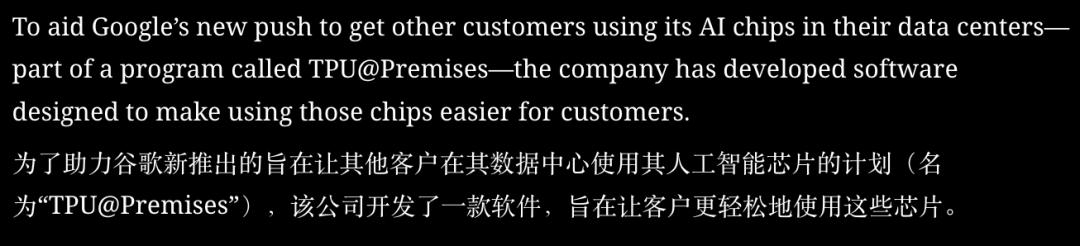
谷歌训出Gemini 3的TPU,已成老黄心腹大患,Meta已倒戈
3 6 Ke· 2025-11-25 11:44
Core Insights - Google is launching an aggressive TPU@Premises initiative to sell its computing power directly to major companies like Meta, aiming to capture 10% of Nvidia's revenue [1][14] - The TPU v7 has achieved performance parity with Nvidia's flagship B200, indicating a significant advancement in Google's hardware capabilities [1][6] Summary by Sections Google's Strategy - Google is shifting from being a "cloud landlord" to a "arms dealer" by allowing customers to deploy TPU chips in their own data centers, breaking Nvidia's monopoly in the high-end AI chip market [2][3] Meta's Involvement - Meta is reportedly in talks with Google to invest billions of dollars to integrate Google's TPU chips into its data centers by 2027, which could reshape the industry landscape [3][5] Technological Advancements - The latest Google model, Gemini 3, trained entirely on TPU clusters, is closing the gap with OpenAI, challenging the long-held belief that only Nvidia's GPUs can handle cutting-edge model training [5][10] - The Ironwood TPU v7 and Nvidia's B200 are nearly equal in key performance metrics, with TPU v7 slightly leading in FP8 computing power at approximately 4.6 PFLOPS compared to B200's 4.5 PFLOPS [7][10] Competitive Landscape - Google's TPU v7 features a high inter-chip connectivity bandwidth of 9.6 Tb/s, enhancing scalability for large model training, which is a critical advantage for clients like Meta [8][10] - Google is leveraging the PyTorch framework to lower the barrier for developers transitioning from Nvidia's CUDA ecosystem, aiming to capture market share from Nvidia [11][13] Nvidia's Response - Nvidia is aware of the competitive threat posed by Google's TPU v7 and has been making significant investments in startups like OpenAI and Anthropic to secure long-term commitments to its GPUs [14][16] - Nvidia's CEO has acknowledged Google's advancements, indicating a recognition of the competitive landscape shifting [14]