
碳达峰碳中和

Search documents
上海金浦高立新:先进制造投资思考
投资界· 2025-10-16 03:23
Core Viewpoint - The article emphasizes the significance of advanced manufacturing as a key sector in the global industrial transformation and technological competition, highlighting its role in enhancing national competitiveness and enabling growth in strategic areas such as renewable energy, semiconductors, new materials, and artificial intelligence [5][8]. Group 1: Definition and Characteristics of Advanced Manufacturing - Advanced manufacturing is defined by three core characteristics: it must be internationally leading, possess high gross margins due to market scarcity, and demonstrate high growth potential [10][11][12]. - The sector is characterized by being technology-intensive, intelligent, digitalized, and sustainable, with a focus on high-end and precision manufacturing [13][14]. Group 2: Investment Opportunities in Advanced Manufacturing - Investment strategies should focus on four directions: "one advantage" (areas where China excels, such as renewable energy), "one weakness" (semiconductors), "one necessity" (national defense and aerospace), and "one intelligence" (smart manufacturing and AI) [16][17]. - The renewable energy sector, particularly wind and solar power, is highlighted as a significant opportunity, with China leading globally in installed capacity [20][21]. Group 3: Challenges in Semiconductor Industry - The semiconductor industry is identified as a weak area for China, particularly in critical segments like photolithography and EDA (Electronic Design Automation), where foreign companies dominate [24][26]. - The complexity of semiconductor manufacturing is emphasized, with a need for long-term technological accumulation to overcome current limitations [27][28]. Group 4: Artificial Intelligence as a Strategic Focus - AI is viewed as both an independent industry and a technology that can enhance other sectors, with investment opportunities primarily in vertical applications rather than general-purpose AI [30][32]. - The article outlines the importance of algorithms, data, and computing power in AI development, noting that while China excels in data, it lags in computing power [33][34]. Group 5: Long-term Investment Outlook - The AI sector is described as a "long slope with thick snow," indicating a favorable investment environment with potential for significant growth and the emergence of world-class companies [35][37]. - The article concludes with a focus on risk management and the importance of understanding market dynamics to avoid pitfalls in investment decisions [37].


研究推进美丽北京建设持续深入打好污染防治攻坚战等事项
Bei Jing Ri Bao Ke Hu Duan· 2025-10-15 23:49
Group 1 - The meeting emphasized the importance of pollution prevention and control, aiming to achieve annual and "14th Five-Year Plan" goals, and to continuously improve the ecological environment quality in the capital [2][3] - Key tasks include winning the blue sky defense battle, enhancing air pollution control, and promoting the use of new energy vehicles, especially for old vehicles and non-road mobile machinery [2] - The meeting highlighted the need for strict supervision and enforcement in construction sites and road transport to prevent pollution, as well as the protection of water sources and soil environment [2] Group 2 - The fourth quarter is identified as a critical period for achieving annual goals and the "14th Five-Year Plan" completion, with a focus on economic stability and growth [3] - The meeting called for optimizing the business environment, enhancing talent services, and providing policy support to help enterprises overcome difficulties and improve competitiveness [3] - Emphasis was placed on expanding effective investment and planning major projects to play a key role in stabilizing growth [3]
新型储能:技术多元并进 规模世界第一
Ke Ji Ri Bao· 2025-10-15 23:20
Core Insights - The article highlights the rapid development and implementation of new energy storage technologies in China, which are crucial for building a new power system and achieving carbon neutrality goals [1][2][3]. Group 1: New Energy Storage Capacity - By the end of 2024, China's new energy storage capacity is expected to reach 73.76 million kilowatts, accounting for over 40% of the global total, which is 20 times the capacity at the end of the 13th Five-Year Plan [1]. - As of June 2023, the installed capacity of new energy storage in China reached 94.91 million kilowatts, a 29% increase compared to the projected capacity for 2024 [2]. Group 2: Policy Support and Development - The growth of new energy storage is supported by a clear policy framework established since the 14th Five-Year Plan, including several key documents aimed at promoting the scale, industrialization, and marketization of new energy storage [3]. - The application of new energy storage technologies is becoming increasingly effective, with regions like Zhejiang, Jiangsu, Chongqing, and Xinjiang achieving over 1,000 equivalent utilization hours annually [3]. Group 3: Technological Innovations - The introduction of various storage technologies, such as the 1,000 megawatt-hour "coal power + molten salt" storage project, represents significant advancements in the sector [4]. - Lithium-ion battery storage remains the dominant technology in the new energy storage landscape, with ongoing innovations leading to commercial applications and demonstration projects [4][5]. Group 4: Future Development Trends - The future of new energy storage is expected to feature a diverse and collaborative development model, addressing the complex demands of the power system [6].
生态环境部:分级分类推进美丽中国地方实践
Xin Hua She· 2025-10-15 15:22
Core Points - The Chinese government is committed to high-quality development with an emphasis on ecological priority and green low-carbon initiatives, making significant progress in building a "Beautiful China" [1][2] - The Ministry of Ecology and Environment has developed detailed task lists, policy measures, and responsibility divisions to ensure the effective implementation of the "Beautiful China" initiative [1] - The construction of "Beautiful China" pilot areas has been fully launched, with regions like Beijing-Tianjin-Hebei, Yangtze River Delta, and Guangdong-Hong Kong-Macao Greater Bay Area taking the lead in action plan formulation [1] Group 1 - The goal of "Beautiful China" construction is to coordinate high-quality development with high-level protection, focusing on carbon reduction, pollution control, and ecological improvement [2] - The National Committee for Environmental Protection has conducted research on the progress of environmental and development strategy transformations over the past decade, preparing policy recommendations for the State Council [2] - The annual meeting of the National Committee is themed "Firmly Promote Comprehensive Green Transformation and Foster Harmony Between Humanity and Nature" [2]
北京市政府召开常务会议,研究推进美丽北京建设持续深入打好污染防治攻坚战等事项
Bei Jing Ri Bao Ke Hu Duan· 2025-10-15 14:29
Core Points - The Beijing municipal government held an executive meeting to discuss the progress of the "Beautiful Beijing" initiative and pollution prevention efforts, emphasizing the importance of achieving annual and "14th Five-Year Plan" goals [1][2] Group 1: Pollution Prevention and Environmental Protection - The meeting stressed the need to accelerate the implementation of key tasks to improve the ecological environment quality in the capital, with a focus on winning the "Blue Sky Defense War" and enhancing air pollution control [2] - Specific measures include deepening autumn and winter air pollution prevention, promoting the electrification of small vehicles, old trucks, and non-road mobile machinery, and advancing the creation of green enterprises [2] - The government will enhance supervision of construction sites and road transport, increase nighttime enforcement inspections, and strictly investigate road spillage [2] - Water pollution prevention will be prioritized, with measures to protect water sources and ensure safe drinking water for urban and rural areas [2] - The meeting highlighted the importance of managing soil environmental risks and preventing new pollution, while also promoting carbon peak and carbon neutrality initiatives [2] Group 2: Economic Growth and Business Environment - The fourth quarter is identified as a critical period for achieving annual goals and completing the "14th Five-Year Plan," with a focus on stabilizing economic growth [3] - The government aims to optimize the business environment by enhancing talent services, industrial support, and policy backing, while actively addressing enterprises' needs [3] - Specific sectors such as catering, accommodation, exhibitions, construction, and cultural entertainment will receive targeted measures to ensure stable growth [3] - The government plans to expand effective investment by implementing, reserving, and planning major projects to play a key role in stabilizing growth [3]
生态环境部部长黄润秋:我国可再生能源新增装机规模达86%
2 1 Shi Ji Jing Ji Bao Dao· 2025-10-15 12:33
Core Viewpoint - The forum emphasizes the importance of a comprehensive green transition and the harmonious coexistence of humans and nature, highlighting China's commitment to accelerating green transformation and addressing climate change as it marks the 10th anniversary of the Paris Agreement [1] Group 1: Achievements in Green Development - Significant progress in green low-carbon development has been made, with 1.12 billion kilowatts of coal power units and 950 million tons of crude steel capacity undergoing ultra-low emissions transformation [2] - Nearly 50 million high-emission vehicles have been eliminated, and by 2024, renewable energy will account for 86% of new power installations in China, surpassing half of the global new installations [2] - The establishment of the world's largest carbon trading market covers over 60% of national carbon emissions, with the steel, cement, and aluminum industries included in carbon market management [2] Group 2: Improvement in Ecological Environment Quality - The average concentration of PM2.5 in key cities has decreased by 56% compared to ten years ago, with heavy pollution days reduced by 92% and good air quality days increased to 87.2% [2] - The proportion of surface water with good quality has exceeded 90% for the first time, and the water quality of major rivers like the Yangtze and Yellow Rivers has consistently maintained Class II standards [2] - Public satisfaction with the ecological environment has remained above 90% for four consecutive years, indicating a significant enhancement in people's perception of environmental quality [2] Group 3: Enhancements in Ecosystem Quality - Over 30% of land area has been designated as ecological protection red lines, with 90% of terrestrial ecosystem types and 74% of key wildlife populations effectively protected [3] - China's forest coverage has surpassed 25%, with forest stock exceeding 20 billion cubic meters, contributing to a quarter of the world's new green area [3] Group 4: Strengthening Environmental Governance - The introduction of the "Ecological Environment Protection Supervision Work Regulations" and the establishment of a comprehensive ecological environment monitoring network have improved governance [3] - The implementation of a unified management system for over 3.86 million fixed pollution sources has been initiated [3] Group 5: Global Environmental Engagement - China actively participates in global climate governance, contributing to significant international agreements and initiatives, including the "Kuwait Consensus" and the "Kunming-Montreal Global Biodiversity Framework" [4] - The establishment of the Kunming Biodiversity Fund supports projects in 15 developing countries, enhancing global cooperation in green development [4] Group 6: Future Directions and Recommendations - The ecological environment department aims to align with the goal of building a beautiful China, focusing on high-quality development and high-level protection [5] - Recommendations include enhancing research on low-carbon energy transition, promoting global environmental governance, and fostering international cooperation for a just green transition [6]
零碳园区等节能降碳项目,将获中央专项资金支持!
中关村储能产业技术联盟· 2025-10-15 09:14
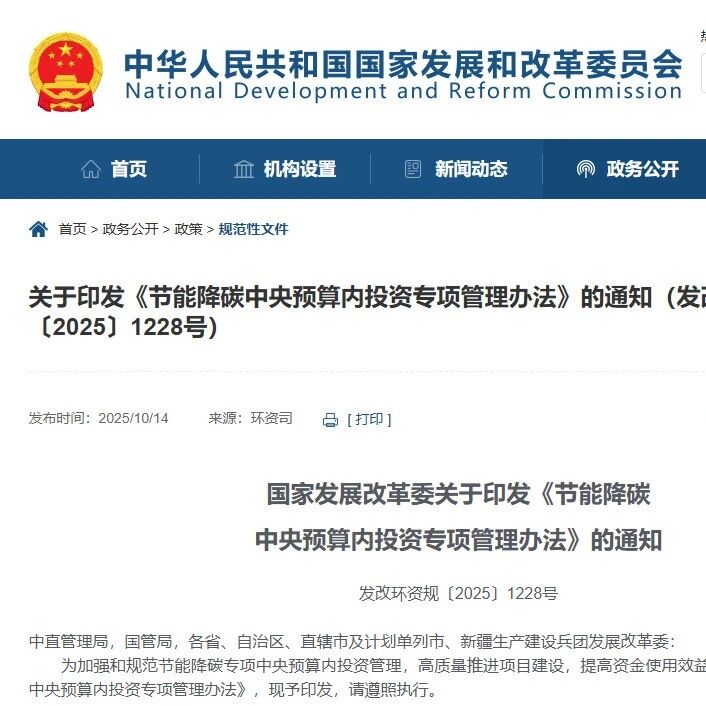
Core Viewpoint - The article discusses the issuance of the "Special Management Measures for Central Budget Investment in Energy Conservation and Carbon Reduction," aimed at supporting projects that align with the goals of carbon peak and carbon neutrality, promoting a comprehensive green transformation of economic and social development [2][4]. Summary by Sections Special Support Areas - The special support focuses on key industry energy conservation and carbon reduction projects, clean substitution of coal consumption, circular economy initiatives, low-carbon, zero-carbon, and negative-carbon demonstration projects, and foundational capacity building for carbon peak and carbon neutrality [2][3][11]. Investment Proportions - The support ratio for key industry energy conservation and carbon reduction projects, clean coal substitution projects, circular economy projects, and low-carbon demonstration projects is set at 20% of the approved total investment. For local government projects related to carbon peak and carbon neutrality, the support ratios vary by region: 60% for the East, 70% for the Central, and 80% for the West and Northeast regions. Central and national agency projects are generally fully funded [3][14]. Funding Mechanisms - The central budget investment funds will be allocated through direct investment, capital injection, and investment subsidies based on actual conditions [3][8]. Project Eligibility and Requirements - Projects must be new or under construction with complete preliminary procedures and cannot be used for completed projects. The focus is on projects that can effectively contribute to energy conservation and carbon reduction [8][12]. Application and Approval Process - Provincial development and reform departments are responsible for project application and must establish a dynamic reserve mechanism for projects. They will select eligible projects from the national major construction project database for annual investment plan submissions [16][21]. Performance Monitoring and Evaluation - The National Development and Reform Commission will strengthen performance target reviews and monitoring of investment plans, ensuring that projects are supervised throughout their lifecycle. Any issues identified during evaluations will be addressed promptly, and performance evaluation results will influence future investment allocations [35][36].
国新证券每日晨报-20251015
Guoxin Securities Co., Ltd· 2025-10-15 02:51
Domestic Market Overview - The domestic market experienced a pullback after an initial rise, with the Shanghai Composite Index closing at 3865.23 points, down 0.62%. The Shenzhen Component Index closed at 12895.11 points, down 2.54%. The STAR Market 50 index fell by 4.26%, and the ChiNext index decreased by 3.99%. The total trading volume of the A-share market reached 25,966 billion yuan, showing an increase compared to the previous day [1][4][9] - Among the 30 sectors tracked, 11 sectors saw gains, with banking, coal, and food and beverage sectors leading the increases. In contrast, the telecommunications, electronics, and non-ferrous metals sectors experienced significant declines. Notably, indices related to cultivated diamonds, superhard materials, and selected insurance performed actively [1][4][9] Overseas Market Overview - The U.S. stock market showed mixed results, with the Dow Jones Industrial Average rising by 0.44%, while the S&P 500 index fell by 0.16% and the Nasdaq dropped by 0.76%. Notable gainers included Walmart, which rose nearly 5%, and Caterpillar, which increased by over 4%. Conversely, the tech giants index fell by 1.26%, with Nvidia dropping over 4% and Amazon declining by more than 1% [2][4] Economic Insights - The Chinese Premier Li Qiang held a meeting with economic experts and entrepreneurs to discuss the current economic situation and future work strategies. He emphasized the need for a broader perspective to accurately assess the resilience of China's economy amid international changes and to strengthen confidence while addressing issues. Li highlighted the importance of implementing counter-cyclical adjustments and expanding domestic demand [10][12] - The meeting revealed that 1,734 stocks rose while 3,554 fell, indicating a turbulent market with 146 stocks rising over 5% and 446 falling over 5%. The market is currently in a phase of consolidation, with a focus on macroeconomic financial data [10][12] Industry Developments - The Ministry of Commerce announced countermeasures against five U.S. subsidiaries of Hanwha Ocean Corporation due to their involvement in U.S. investigations that harm Chinese enterprises' rights. This action reflects ongoing tensions in international trade relations [13] - The National Development and Reform Commission (NDRC) issued guidelines to support energy-saving and carbon reduction transformations in key industries such as electricity, steel, and chemicals. The initiative aims to align with national goals for carbon neutrality and promote green economic transformation [14][15][16] - China's manned spaceflight sector achieved a milestone with the registration of its first international standard, enhancing its influence in global aerospace standards [17]
国家发改委:支持供热、算力等基础设施节能降碳改造
Zheng Quan Ri Bao· 2025-10-15 01:18
Core Viewpoint - The National Development and Reform Commission (NDRC) has released the "Special Management Measures for Energy Conservation and Carbon Reduction Central Budget Investment" to enhance and standardize the management of central budget investments for energy conservation and carbon reduction, aiming for high-quality project implementation and improved fund utilization efficiency [1][2]. Group 1: Management Measures - The management measures focus on promoting "soft construction" to establish effective mechanisms for solving practical problems and advancing green and low-carbon circular development [1][2]. - The emphasis on "soft construction" marks a significant shift from merely hardware investment to building long-term mechanisms, ensuring that financial inputs translate into sustainable emission reduction benefits [1][2]. Group 2: Project Support and Focus Areas - The NDRC will support energy conservation and carbon reduction projects based on project characteristics, regional economic development levels, and local carbon reduction goals, with a focus on areas excelling in carbon peak and neutrality, energy conservation, and circular economy [2]. - Key supported sectors include energy conservation and carbon reduction in major industries such as electricity, steel, non-ferrous metals, building materials, petrochemicals, chemicals, and machinery, as well as projects related to clean coal consumption replacement and low-carbon demonstration [2]. Group 3: Importance of Computing Infrastructure - Supporting energy conservation and carbon reduction in computing infrastructure is deemed necessary and forward-looking, as the rapid growth of the digital economy leads to increased energy consumption in data centers [3]. - Enhancements in energy efficiency in this sector will directly promote the application of green technologies such as liquid cooling and AI intelligent scheduling, thereby strengthening the green foundation of the digital industry and improving its environmental compliance and competitiveness in the international market [3].
逐绿向新 “十四五”时期能源转型“加速跑”
Xin Hua Wang· 2025-10-14 23:54
Core Insights - China's energy transition has achieved remarkable milestones, with national electricity generation exceeding 10 trillion kilowatt-hours in 2024, accounting for one-third of global electricity generation, and energy production equivalent to approximately 5 billion tons of standard coal, representing over one-fifth of the global total [1][2] Group 1: Energy Transition Achievements - The "14th Five-Year Plan" period is recognized as the fastest phase for China's green and low-carbon energy transition, with non-fossil energy consumption increasing by 1 percentage point annually while coal's share decreases correspondingly [2][3] - By July 2024, China's renewable energy installed capacity reached 2.17 billion kilowatts, maintaining the global lead, with wind power at 570 million kilowatts and solar power exceeding 1.1 billion kilowatts, marking a doubling since the end of the "13th Five-Year Plan" [2][3] - The share of non-fossil energy in installed capacity has historically surpassed 60%, with renewable energy generation capacity exceeding coal power for the first time in 2024 [2][4] Group 2: Regional Innovations and Models - Various regions are innovating energy development models, such as Yunnan's hydropower utilization, Sichuan's green hydrogen industry, and Tibet's solar and wind energy projects, leading to a clean energy system dominated by renewables [3] - The "pastoral photovoltaic" model in Qinghai demonstrates the integration of solar energy with livestock farming, enhancing vegetation cover and improving the livelihoods of local herders [3] Group 3: Cross-Regional Energy Transactions - The first cross-regional green electricity transaction from Tibet to Shanghai successfully delivered 7.85 million kilowatt-hours, reducing coal consumption by 24,100 tons and cutting CO2 emissions by 60,100 tons [4] - The energy transition has shifted the electricity supply structure from coal-dominated to green energy-dominated, with significant upgrades in power transmission and grid management [4][5] Group 4: Technological Innovations - Continuous technological innovation has been a driving force in the energy transition, with China holding over 40% of global renewable energy patents and achieving record advancements in solar and wind technologies [6][7] - The new energy storage capacity is projected to reach 95 million kilowatts by mid-2025, a nearly 30-fold increase over five years, providing robust support for stable electricity supply [6][7] Group 5: Energy Efficiency and Future Goals - Since the beginning of the "14th Five-Year Plan," China's energy consumption per unit of GDP has decreased by 11.6%, equivalent to reducing CO2 emissions by 1.1 billion tons [8] - New targets set for 2035 include increasing the share of non-fossil energy consumption to over 30% and achieving a total installed capacity of wind and solar power six times that of 2020 [8]