
经济增长

Search documents
经济金融高频数据周报(10.13-10.17)-20251014
Caixin Securities· 2025-10-14 12:42
Global Economy and Inflation - Global economic activity is declining, with the Baltic Dry Index (BDI) averaging 1940.2 points from October 4 to October 10, down 88.60 points from the previous week [4][15][16] - The CRB Commodity Price Index averaged 299.26 points during the same period, reflecting a decrease of 1.02 points [20][22] Domestic Economy and Inflation - China's official manufacturing PMI for September 2025 is 49.8%, an increase of 0.4 percentage points from the previous month [5][27] - The average price of pork in China is 23.89 yuan per kilogram, down 0.28 yuan from the previous week [35][36] Industrial Production - The operating rate of high furnaces in China is 84.25%, a decrease of 0.02 percentage points from the previous week [6][43] - The operating rate for rebar steel mills is 39.98%, down 0.67 percentage points [44] Consumption - Essential goods consumption remains stable, with the Keqiao Textile Price Index at 104.97 points, up 0.14 points from the previous week [7][57] - The average daily sales of passenger cars in China reached 222,400 units, an increase of 90,000 units from the previous week [59] Investment - Real estate transactions in 30 major cities averaged 17.40 million square meters, down 0.43 million square meters from the previous week [8][65] - The operating rate of asphalt plants increased to 40.10%, up 5.70 percentage points [70] Exports - The export container freight index is at 1014.78 points, down 72.63 points from the previous week [78] - The total foreign trade cargo throughput at major Chinese ports was 27,217.5 million tons, an increase of 1,219 million tons from the previous week [79] Emerging Industries - The Philadelphia Semiconductor Index averaged 6703.36 points, up 224.30 points from the previous week [10][83] - The DXI Index, reflecting DRAM market conditions, averaged 125,150.70 points, an increase of 8,496.98 points [84]
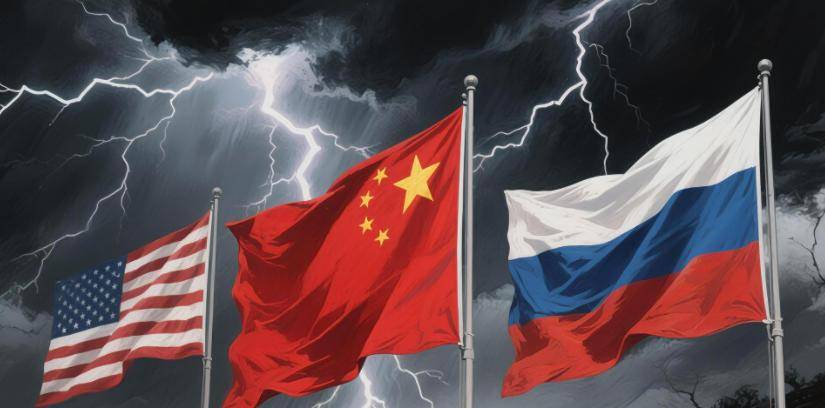
中美俄2025年GDP预测:美国216万亿,俄罗斯16万亿,中国令人意外
Sou Hu Cai Jing· 2025-10-14 11:18
Group 1 - The global economic landscape in 2025 will prominently feature the performances of the US, China, and Russia, with the US maintaining a GDP of approximately 216 trillion RMB, showcasing its strong economic power [3] - China's GDP is projected to reach around 141.75 trillion RMB, with a growth target of 5% for 2025, reflecting a robust economic stance [3][16] - Russia's GDP is expected to decline to 16 trillion RMB, with a growth forecast reduced from 2.5% to 1.5%, indicating significant economic challenges [5][13] Group 2 - The US economy, while appearing strong with a GDP of 216 trillion RMB, faces underlying issues such as persistent inflation and declining domestic purchasing power [7][9] - The US national debt has surpassed 37 trillion USD, leading to an average debt burden of 110,000 USD per citizen, raising concerns about fiscal sustainability [9] - In contrast, China is effectively managing its local debt and is close to completing a 2 trillion RMB debt swap, indicating a healthier fiscal position compared to the US [20] Group 3 - China's economic resilience is attributed to technological advancements and industrial upgrades, with significant growth in exports, particularly in automobiles and ships [18] - The shift in China's export structure and its non-hegemonic approach to international relations contribute to its stable economic growth [18][22] - Russia's economy, while showing some resilience through increased oil exports and new trade partnerships, remains heavily impacted by sanctions and military expenditures [15][22] Group 4 - The contrasting economic trajectories of the three nations highlight the importance of long-term sustainability over short-term gains, with the US facing "low growth, high consumption" challenges, Russia struggling under sanctions, and China demonstrating steady progress [20][24] - The future global economic order will depend on each country's ability to address internal challenges and seize development opportunities [24]

诺贝尔经济学奖给了科技创新
Zheng Quan Shi Bao Wang· 2025-10-14 02:52
Core Insights - The Nobel Prize in Economic Sciences this year highlights the importance of technological innovation in addressing the current economic stagnation globally, emphasizing the need for disruptive technological advancements to overcome development bottlenecks [1] Group 1: Nobel Laureates and Their Contributions - The three economists awarded are Joel Mokyr, Philippe Aghion, and Peter Howitt, with Mokyr receiving half the prize for identifying the prerequisites for sustained growth through technological progress, while Aghion and Howitt share the other half for their theory on creative destruction leading to sustained growth [1] - Mokyr's research focuses on the socio-political structures that influenced the Industrial Revolution, arguing that innovation requires a conducive environment and scientific understanding, which were lacking in certain regions [2] - Aghion and Howitt developed the Aghion-Howitt model, which quantifies the principles of Schumpeter's theory of creative destruction, explaining how innovation drives productivity and replaces outdated technologies [3] Group 2: Key Theoretical Insights - Aghion and Howitt assert that corporate R&D investment is crucial for technological innovation, which in turn propels economic growth, and that new technologies inevitably displace old ones [4] - They also highlight the relationship between market competition and economic growth, establishing a "U-shaped" curve, indicating that both excessive competition and monopolistic practices can hinder growth [4] - Their findings suggest that appropriate economic policies can foster national economic growth and that technological changes can lead to cyclical economic fluctuations [4] Group 3: Implications for Global Economy - The relationship between technological innovation and economic growth is critical, especially as the global economy faces a bottleneck, with a collective hope for a technological revolution to enhance growth potential [5] - The competition between major economies, particularly the U.S. and China, is fundamentally a technological race, with China's advantages stemming from its technological capabilities rather than mere resource availability [5] - The article critiques the approach of using technology as a weapon for monopolistic practices, suggesting that such strategies may ultimately lead to other nations, like China, achieving significant technological advancements [5]
美联储保尔森:支持今年再降息两次,每次25个基点
Sou Hu Cai Jing· 2025-10-13 23:41
Core Viewpoint - The Federal Reserve's Anna Paulsen supports two additional interest rate cuts this year, each by 25 basis points, indicating a proactive approach to monetary policy amidst economic uncertainties [1] Economic Growth - Paulsen anticipates that the economy will continue to grow above trend levels in the third quarter, suggesting a resilient economic environment [1] - However, she notes that the foundation supporting this growth is relatively narrow, raising concerns about future demand sources [1] Monetary Policy Considerations - Paulsen believes that monetary policy should disregard the impact of tariffs on consumer price increases, arguing that there are no conditions that would allow tariff-induced price hikes to evolve into sustained inflation [1]
美联储鲍尔森支持2025年再降息两次 每次25个基点
Sou Hu Cai Jing· 2025-10-13 17:16
Core Viewpoint - The Federal Reserve's Anna Paulsen supports two additional interest rate cuts in 2025, each by 25 basis points, indicating a proactive approach to monetary policy despite current economic conditions [1] Economic Growth - Paulsen anticipates that the economy will continue to grow above trend levels in the third quarter, suggesting resilience in economic performance [1] - However, she notes that the foundation supporting this growth is relatively narrow, raising concerns about future demand sources [1] Monetary Policy - Paulsen believes that monetary policy should disregard the impact of tariffs on consumer price increases, arguing that there are no conditions that would allow tariff-induced price hikes to evolve into sustained inflation [1]
2025年诺贝尔经济学奖,揭晓!
Zhong Guo Zheng Quan Bao· 2025-10-13 12:09
Core Points - The 2025 Nobel Prize in Economic Sciences has been awarded to Joel Mokyr, Philippe Aghion, and Peter Howitt for their contributions to understanding innovation-driven economic growth [1][3] - The prize amount is 11 million Swedish Krona, equivalent to over 8.3 million RMB [1] - The laureates' work emphasizes the role of new technologies in sustaining economic growth and the necessity of managing "creative destruction" constructively to avoid hindrances from companies and interest groups that may be disadvantaged by innovation [3] Summary by Sections - **Award Announcement** - The Nobel Prize in Economic Sciences for 2025 has been jointly awarded to three economists [1] - The prize recognizes their insights into innovation and economic growth [1] - **Significance of Work** - The laureates illustrate how new technologies can drive continuous economic growth [3] - Their research highlights the importance of managing the conflicts arising from "creative destruction" to ensure that innovation is not obstructed by existing companies [3] - **Historical Context** - The Nobel Prize in Economic Sciences was established in 1968, and since then, it has been awarded 56 times to over 90 laureates [3] - The previous year's award was given to three American economists for their work on the impact of institutions on economic prosperity [3]

俄罗斯央行将保持长期紧缩态势
Jing Ji Ri Bao· 2025-10-12 22:04
Core Viewpoint - The Central Bank of Russia emphasizes maintaining price stability as its core objective amid a complex economic landscape characterized by demand-driven growth and increasing supply-demand imbalances [1][5]. Group 1: Economic Growth and Inflation - The Russian economy has been experiencing rapid growth driven by strong domestic demand, with rising household incomes, credit expansion, and fiscal stimulus contributing to this momentum [1]. - However, supply-side constraints, labor shortages, and external factors such as OPEC+ production limits have exacerbated supply-demand imbalances, leading to significant inflationary pressures [1][2]. - The Central Bank raised the benchmark interest rate from 16.00% to 21.00% between July and October 2024 to combat inflation [1]. Group 2: Monetary Policy and Interest Rates - The tightening monetary policy is showing effects, with rising market interest rates, cooling credit activity, and a gradual return to rational domestic demand [2]. - The Central Bank plans to maintain the benchmark interest rate at 21.00% until June 2025, followed by a reduction to 18.00% in mid-2025, and a current rate of 17% as of September [2]. - The Central Bank forecasts an average benchmark interest rate of 18.8% to 19.6% for 2025, decreasing to 12.0% to 13.0% in 2026, and further to 7.5% to 8.5% by 2027-2028 [4]. Group 3: External Environment and Economic Projections - The Central Bank anticipates that trade tensions among major economies will continue to suppress global demand growth, with oil prices expected to average $55 per barrel in 2025-2026 and rise to $60 per barrel in 2027-2028 [3]. - GDP growth is projected to slow to 1.0%-2.0% in 2025 and further to 0.5%-1.5% in 2026, with a return to potential growth rates of 1.5%-2.5% by 2027 [3]. - Inflation rates are expected to decrease to 6.0%-7.0% in 2025 and further to around 4.0% in 2026, stabilizing at that level in the long term [3]. Group 4: Fiscal Policy and Economic Stability - The Central Bank emphasizes that fiscal policy will significantly influence economic conditions in the coming years, necessitating adjustments in monetary policy based on fiscal parameters [5]. - A robust and balanced fiscal policy is deemed essential for maintaining macroeconomic stability, especially in the context of ongoing sanctions and global economic fragmentation [5]. - The overarching goal remains to maintain price stability, providing a stable environment for businesses and households, thereby enhancing the attractiveness of the ruble as a currency for savings and transactions [5][6].
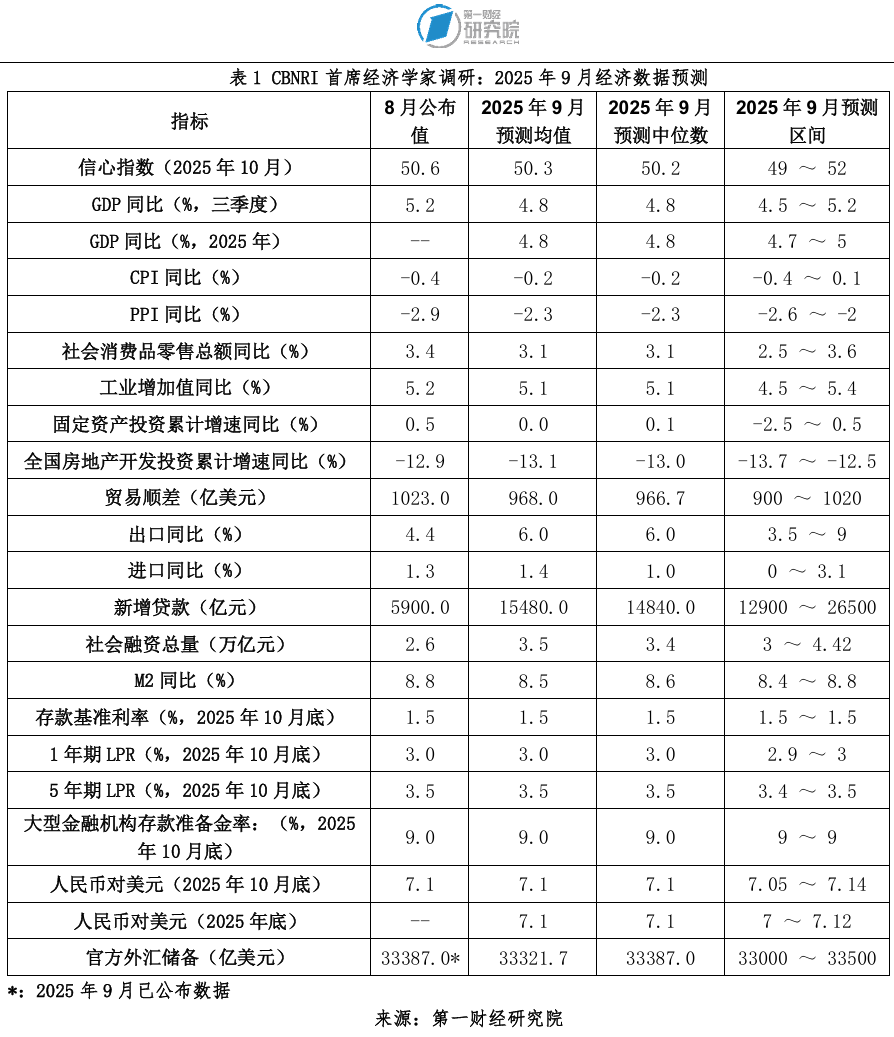
一财首席经济学家调研:三季度GDP增速预测均值4.8%
Di Yi Cai Jing· 2025-10-12 11:48
Economic Growth Outlook - The fourth quarter is expected to continue a moderate growth trend, with an annual GDP growth forecast of 4.8% [1][5] - Economists predict an average GDP growth target of 4.5% to 5% for the next five years to achieve the 2035 vision [1][23] Confidence Index - The "Chief Economist Confidence Index" for October is reported at 50.3, remaining above the neutral line [5][6] - Economic uncertainties from trade wars and global geopolitical issues are acknowledged [5] GDP Predictions - The average predicted GDP growth for the third quarter is 4.8%, reflecting a decline from the second quarter [7][8] - Predictions for 2025 GDP growth also average 4.8% [7] Price Indices - The average predicted CPI for September is -0.2%, while the PPI is forecasted at -2.3% [8][9] - The CPI prediction reflects a slight improvement from the previous month's -0.4% [8] Retail Sales - The predicted year-on-year growth for social retail sales in September is 3.1%, down from 3.4% in the previous month [9][10] - Factors affecting retail sales include the waning demand for durable goods and high base effects from the previous year [9] Industrial Output - The average predicted year-on-year growth for industrial value added in September is 5.1%, slightly lower than the previous month's 5.2% [10][11] - Some sectors are showing signs of production slowdown, while others like steel production remain resilient [10] Fixed Asset Investment - The average predicted growth rate for fixed asset investment in September is 0%, a decrease from 0.5% in the previous month [12] - The real estate market is experiencing challenges, impacting overall investment growth [12] Real Estate Investment - The predicted cumulative growth rate for real estate development investment in September is -13.1% [13] - Despite a seasonal uptick in sales, the overall market remains under pressure [13] Trade Balance - The average predicted trade surplus for September is $96.8 billion, down from $102.3 billion [14] - Exports are expected to show a year-on-year growth of 6%, supported by strong demand [14] New Loans and Financing - The forecast for new loans in September is set at 1.548 trillion yuan, a significant increase from the previous month's 590 billion yuan [15] - The total social financing volume is predicted to reach 3.5 trillion yuan [16] Money Supply - The average predicted year-on-year growth for M2 in September is 8.5%, slightly lower than the previous month's 8.8% [17] Monetary Policy Outlook - Adjustments to LPR rates and reserve requirements are expected to be minimal in the near term [18] - The monetary policy is anticipated to remain moderately accommodative, with potential for further easing [18] Currency and Foreign Reserves - The predicted exchange rate for the yuan against the dollar at the end of October is 7.1 [20] - As of the end of September, China's foreign exchange reserves stood at $333.87 billion, reflecting a slight increase [21] Policy Measures - The focus of fiscal policy in the fourth quarter will be on government bond issuance and support for infrastructure and innovation [22] - Monetary policy will continue to be flexible and supportive of economic growth while managing risks [22]
数据模糊不清之际,华尔街将目光转向银行财报寻求方向
Hua Er Jie Jian Wen· 2025-10-10 12:32
Group 1 - The upcoming quarterly earnings reports from major banks like JPMorgan and Goldman Sachs are crucial for assessing the health of the U.S. economy, especially in light of the government shutdown affecting economic data releases [1][4] - Analysts expect an overall year-on-year earnings growth of 8.8% for S&P 500 companies in the third quarter, which is vital for maintaining the upward momentum of the stock market [1][3] - The current high market valuations and investor enthusiasm for technology and AI sectors make the performance of the third-quarter earnings season particularly significant [1][3] Group 2 - The earnings reports from banks will provide insights into consumer spending and credit demand, which are essential for understanding economic trends amid concerns over a weakening labor market [2][4] - The government shutdown has delayed the release of key economic data, including the non-farm payroll report and consumer price index, which heightens the importance of bank earnings as an economic indicator [3][4] - Market sentiment is heavily reliant on expected earnings growth, and any signs of weakness could negatively impact overall market conditions [3]


世界银行将加纳增长率上调至4.3%
Shang Wu Bu Wang Zhan· 2025-10-09 16:55
Group 1 - The World Bank projects Ghana's economic growth rate to reach 4.3% by the end of 2025, an increase from the previous forecast of 3.9% [1] - Economic growth in Ghana is expected to be driven primarily by the services sector, which is projected to grow by 9.9% [1] - The World Bank forecasts continued positive growth for Ghana, with expected growth rates of 4.6% in 2026 and 4.8% in 2027 [1] Group 2 - Ghana's inflation rate is projected to reach 15.4% by the end of 2025, while official data shows a significant decrease to 9.4% in September 2025 from 21.5% the previous year [1] - The Ghanaian cedi has appreciated over 20% in the first eight months of 2025 after a 19% depreciation in 2024, attributed to tight fiscal and monetary policies and increased export revenues from cocoa and gold [2] - Ghana faces refinancing pressures with a $500 million European bond redemption due in 2025, which will rise to 1.2% of GDP by 2026 [2] Group 3 - Frequent power outages are impacting productivity in Ghana, leading to operational disruptions and increased costs for businesses [2] - Stable electricity supply and competitive energy prices are crucial for maintaining industrial productivity and attracting new investments [2]