GDP预测

Search documents
Fed Leaves Rates Unchanged, Projects One Cut in 2026
Youtube· 2026-03-18 18:33
Core Insights - The committee indicates uncertainty regarding the implications of Middle East developments on the US economy, while remaining attentive to risks associated with their mandate [1] - A forecast for one more interest rate cut is anticipated in 2027 [1] Economic Projections - The Personal Consumption (PC) inflation forecast for this year is revised to 2.7%, an increase from the previous estimate of 2.4% in December [2] - Core inflation is also projected at 2.7% for this year, up from 2.5% [2] - The GDP growth forecast has been adjusted upward by 0.1% for both this year and next year, now estimated at 2.4% and 2.3% respectively [3] - The unemployment rate forecast for 2026 remains at 4.4%, with a slight decrease to 4.3% expected next year, up from 4.2% in December [3] - The longer-run estimate for the Federal funds rate, viewed as a proxy for the neutral rate, has increased to 3.1% [3]


2025年GDP预测:中国逼近20万亿美元,美国能突破30万亿吗?
Sou Hu Cai Jing· 2026-02-13 11:09
Group 1 - The core prediction for China's GDP in 2025 is approximately 19.64 trillion USD, which is just shy of the 20 trillion USD mark, primarily calculated using the average exchange rate [7][8] - China's nominal GDP growth is projected at 4.06% due to a deflation rate of 1%, with a real growth rate of 5% [3][5] - If inflation were to occur instead of deflation, the nominal GDP growth could reach 7%, resulting in a GDP of 144.2 trillion RMB [5] Group 2 - The United States is expected to surpass 30 trillion USD in GDP by 2025, with a nominal growth rate projected between 4.5% and 5% [11][14] - The U.S. GDP for 2024 is estimated at 29.18 trillion USD, indicating a growth requirement of only 2.8% to reach the 30 trillion USD threshold [11][14] - The GDP gap between China and the U.S. is projected to widen to nearly 11 trillion USD by 2025, marking the largest absolute difference in history [16]

韩国国家智库KDI上调韩国GDP和通胀预测
Jin Rong Jie· 2026-02-11 03:14
Group 1 - The Korea Development Institute (KDI) has raised its GDP forecast for South Korea, now expecting a growth rate of 1.9% for 2026, up from the previous estimate of 1.8% [1] - KDI also increased its inflation forecast for 2026, now predicting an average inflation rate of 2.1%, higher than the earlier expectation of 2.0% [1]
2025年北方GDP10强城市预测:天津超1.85万亿,济南第5,徐州第10
Sou Hu Cai Jing· 2026-01-09 11:10
Core Insights - The economic landscape of northern China's top ten cities is expected to show steady progress and increasing competition by 2025, with Beijing maintaining its unshakeable leadership position [1][4] Group 1: Economic Forecasts - Beijing's GDP is projected to exceed 5.26 trillion yuan, with an increase of approximately 280 billion yuan and a nominal growth rate of 5.59%, leading the northern region [1][8] - Tianjin is expected to surpass 1.85 trillion yuan, reaching about 1.86 trillion yuan, but its nominal growth rate of 3.20% is relatively slow compared to its competitors [3][8] - Qingdao is forecasted to achieve a GDP of 1.79 trillion yuan, with a significant increase of 1.17 trillion yuan and a leading nominal growth rate of 7.0%, driven by its emerging industries [3][8] Group 2: City Rankings and Growth Dynamics - Zhengzhou is anticipated to reach a GDP of 1.54 trillion yuan, maintaining its position as the fourth largest city in the north, while Jinan is projected to have a GDP of 1.43 trillion yuan, with a nominal growth rate of 5.94%, slightly higher than Zhengzhou's 5.84% [3][4][8] - Xi'an is expected to maintain its sixth position with a GDP of approximately 1.40 trillion yuan [5][8] - Cities like Yantai, Tangshan, and Dalian are projected to enter the trillion-yuan club, with Yantai at 1.14 trillion yuan (5.64% growth), Tangshan at 1.05 trillion yuan (4.78% growth), and Dalian expected to exceed 1 trillion yuan for the first time at 1.01 trillion yuan (5.68% growth) [5][8] Group 3: Emerging Trends - Xuzhou is highlighted as a rising star, with a projected GDP of 1,005.38 billion yuan, marking a significant increase of 516.7 billion yuan and a growth rate of 5.42%, indicating a diversification of economic focus beyond traditional regions [5][6][8] - The competition among these cities is expected to intensify, with industrial upgrades, innovation, and regional collaboration becoming key factors in determining their rankings [8]
2025年GDP30强城市预测:苏州超2.8万亿,宁波远超郑州,唐山第27
Sou Hu Cai Jing· 2026-01-04 17:06
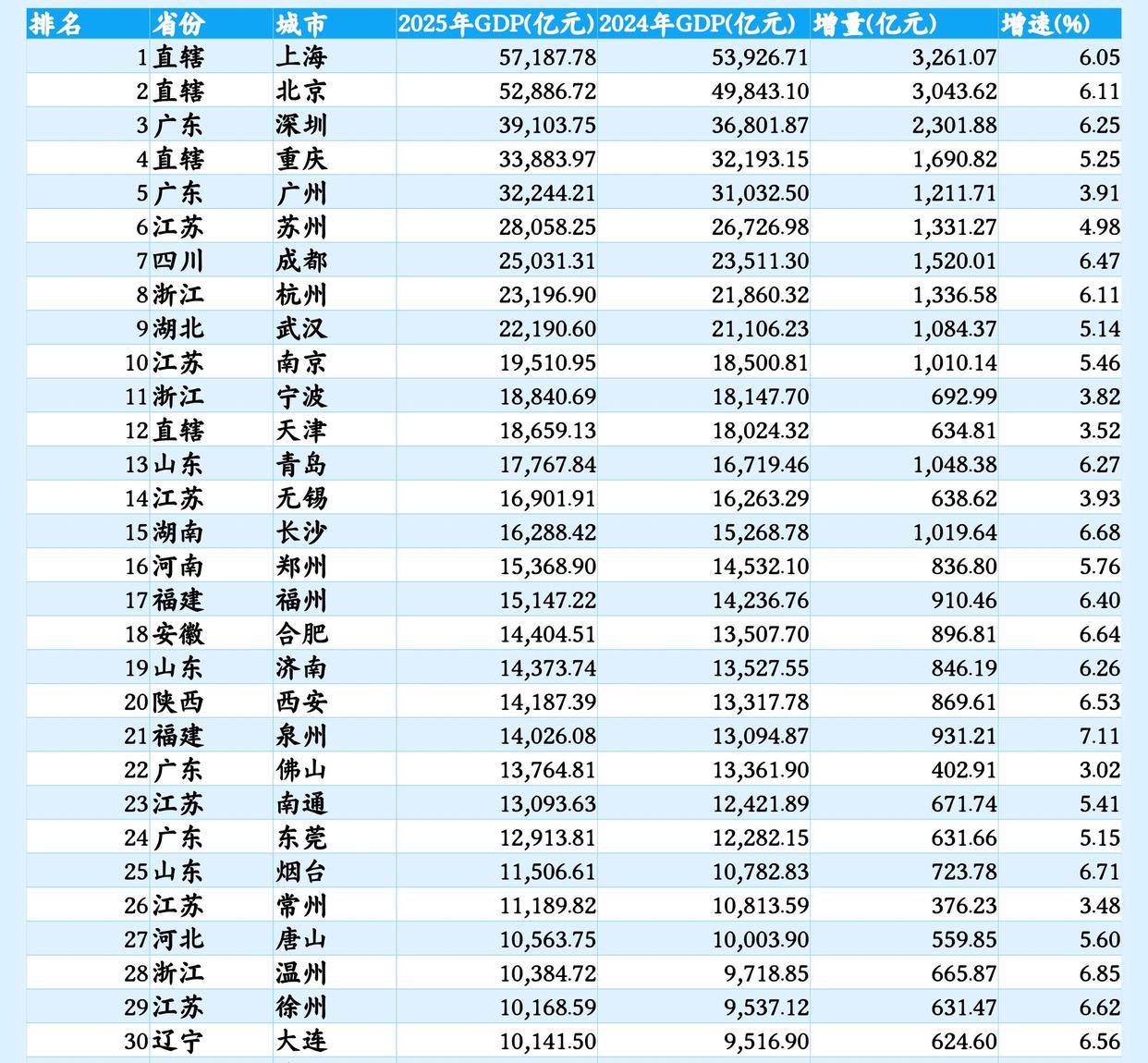
Core Insights - The economic landscape of China's cities is expected to undergo significant changes by 2025, with a clear division between leading cities and emerging regional players [1] - A competitive race among cities is anticipated, driven by varying growth rates and economic performances [1] Economic Forecasts - The top cities by GDP in 2025 are projected to be: - Shanghai: 57.19 trillion yuan, up from 53.93 trillion yuan, an increase of 3.26 trillion yuan - Beijing: 52.89 trillion yuan, up from 49.84 trillion yuan, an increase of 3.04 trillion yuan - Shenzhen: 39.10 trillion yuan, up from 36.80 trillion yuan, an increase of 2.30 trillion yuan [2] - Other notable cities include: - Chengdu: 25.03 trillion yuan, with a growth of 1.52 trillion yuan - Hangzhou: 23.20 trillion yuan, with a growth of 1.34 trillion yuan - Wuhan: 22.19 trillion yuan, with a growth of 1.08 trillion yuan [2] Growth Engines - Quanzhou leads with a remarkable growth rate of 7.11%, followed by cities like Changsha, Yantai, Wenzhou, and Xuzhou, showcasing strong industrial vitality [2] - The Yangtze River Delta cities, particularly Suzhou, are expected to demonstrate resilience, with Suzhou's GDP projected to exceed 28 trillion yuan [3] Regional Dynamics - Central and Western cities are rising, with Chengdu expected to surpass 25 trillion yuan, and both Wuhan and Changsha showing significant growth [4] - Qingdao is highlighted for its strong performance in Northern China, with a projected GDP of 17.77 trillion yuan [4] Challenges for Traditional Cities - Cities like Guangzhou, Foshan, and Tianjin are experiencing slower growth, indicating a need for industrial upgrades and transformation [5] - Zhengzhou faces increasing competition, with its GDP growth lagging behind that of Ningbo, which is expanding its lead [5] Overall Economic Landscape - The 2025 forecast outlines a new economic map for China, with core cities in the Yangtze River Delta and Guangdong-Hong Kong-Macau Greater Bay Area leading, while competition among regions intensifies [6] - The ability to adapt to new production forces and transition between old and new economic drivers will be crucial for cities' rankings [6]
2025年GDP30强城市预测:深圳近4万亿,福州接近郑州,温州破万亿
Sou Hu Cai Jing· 2025-12-12 17:35
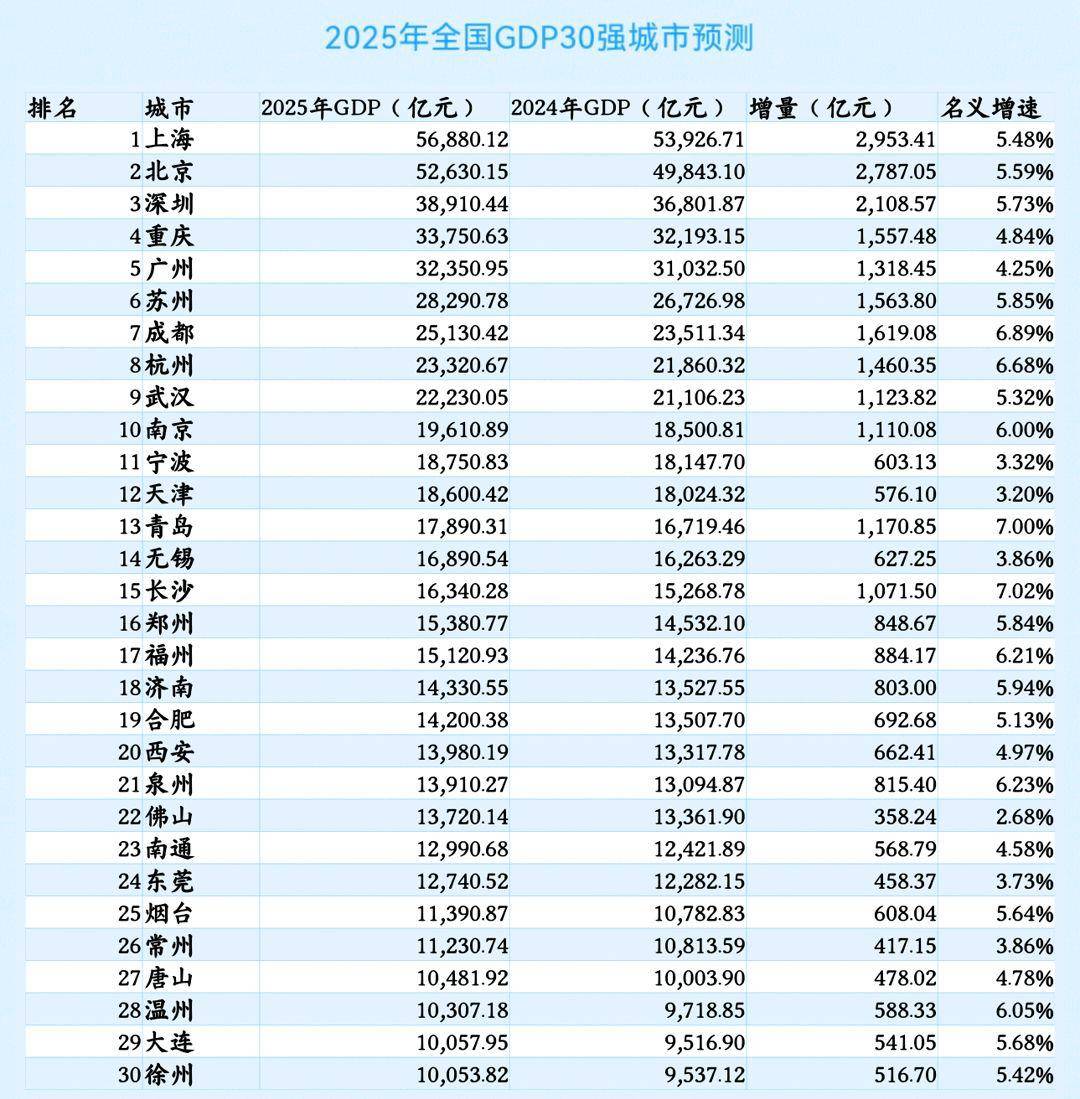
Core Insights - The 2025 GDP forecast for major Chinese cities highlights significant economic growth, with Shanghai leading at 56,880 billion yuan, followed by Beijing at 52,630 billion yuan, and Shenzhen at 38,910 billion yuan [1][2] Group 1: Major Cities and Economic Growth - Shanghai is projected to maintain its position as the top city with a GDP of 56,880 billion yuan, showing a nominal growth rate of 5.48% [2] - Beijing is expected to reach a GDP of 52,630 billion yuan, with a nominal growth rate of 5.59% [2] - Shenzhen's GDP is forecasted to be 38,910 billion yuan, with a nominal growth rate of 5.73%, driven by its status as a global tech innovation hub [2][3] Group 2: Emerging Cities - New first-tier cities like Chengdu and Hangzhou are showing impressive growth rates, contributing to a more balanced economic development across China [1] - Wenzhou is notable for being the first city to surpass a GDP of 1 trillion yuan, reaching 10,307 billion yuan, marking a significant milestone in regional economic development [1][6] Group 3: Shenzhen's Economic Model - Shenzhen's economy is characterized by a strong innovation ecosystem, with an expected annual patent authorization exceeding 100,000, accounting for 15% of the national total [3] - The city is projected to attract over 100 billion USD in foreign investment, with strategic emerging industries expected to grow by 12% [2][3] Group 4: Fuzhou's Economic Development - Fuzhou is forecasted to achieve a GDP of 15,120 billion yuan, with a growth rate of 6.21%, benefiting from free trade zone policies and a focus on digital economy [5] - The city aims to enhance its marine economy, with expected output surpassing 500 billion yuan and a 10% increase in port throughput [5] Group 5: Wenzhou's Economic Transformation - Wenzhou's GDP is projected to reach 10,307 billion yuan, with a growth rate of 6.05%, driven by its vibrant private economy [6][8] - The city is focusing on innovation, with an expected 5,000 new patents annually and a significant increase in cross-border e-commerce activities [6][8]
音频 | 格隆汇11.25盘前要点—港A美股你需要关注的大事都在这
Ge Long Hui A P P· 2025-11-24 23:16
Group 1 - The Nasdaq index surged by 2.69%, with Tesla and Google both rising over 6%, while the Chinese index increased by 2.82% [2] - WTI January crude oil futures rose by 1.34%, and spot gold increased by 1.8% [2] - The probability of the Federal Reserve lowering interest rates by 25 basis points in December has risen to 80% [2] Group 2 - Goldman Sachs' chief economist expects the Federal Reserve to lower rates in December [2] - Deutsche Bank has raised its target for the S&P 500 index to 8000 points for next year [2] - Bank of America predicts that gold prices could reach $5000 per ounce by 2026 [2] Group 3 - The People's Bank of China conducted a 10 trillion yuan MLF operation on November 25 [2] - S&P has raised its GDP forecast for China to 4.4% for next year [2] - Net inflows into emerging market ETFs have continued for the fifth consecutive week, with a corresponding trend of capital inflow into China [2] Group 4 - Xiaomi Group's Lei Jun invested over 100 million Hong Kong dollars to increase his stake in the company [2] - The second-largest shareholder of Saiwei Electronics, the National Fund, reduced its stake by 1.07% from September 23 to November 24 [2] - Southbound funds net bought 8.5 billion Hong Kong dollars in stocks, significantly increasing positions in Alibaba and Tencent [2]
IMF预测2026年日本GDP被印度超越,退居第5
日经中文网· 2025-10-16 08:02
Core Viewpoint - India's GDP is projected to surpass Japan's by 2026, reaching approximately $4.5056 trillion, and is expected to rise to the third position globally by 2029 [1][6]. Group 1: GDP Projections - Japan's nominal GDP is estimated to be $4.4636 trillion in 2026, dropping from the fourth to the fifth position globally due to the depreciation of the yen and the shrinking GDP in dollar terms [1][3]. - In 2024, Japan's GDP is projected at $4.0193 trillion, ranking fourth after the US, China, and Germany, having fallen from third place in 2023 [3]. - By 2025, Japan's GDP is expected to reach $4.2798 trillion, with the reversal of positions between India and Japan occurring later than previously anticipated [3][6]. Group 2: Economic Growth Factors - India's significant population growth and the surge in the middle class are driving economic expansion [4][6]. - India's domestic automobile sales surpassed Japan's in 2022, making it the third largest market globally after China and the US [6]. - Projected growth rates indicate that India will achieve high growth of 6.6% in 2025 and 6.2% in 2026, while Japan's real wage growth is expected to support personal consumption at 1.1% in 2025, slowing to 0.6% in 2026 due to weak external demand [6]. Group 3: Future Outlook - By 2030, Japan's GDP is anticipated to rise to $5.1198 trillion but will be surpassed by the UK at $5.1997 trillion, resulting in Japan falling to sixth place globally [6].

中美俄2025年GDP预测:美国216万亿,俄罗斯16万亿,中国令人意外
Sou Hu Cai Jing· 2025-10-14 11:18
Group 1 - The global economic landscape in 2025 will prominently feature the performances of the US, China, and Russia, with the US maintaining a GDP of approximately 216 trillion RMB, showcasing its strong economic power [3] - China's GDP is projected to reach around 141.75 trillion RMB, with a growth target of 5% for 2025, reflecting a robust economic stance [3][16] - Russia's GDP is expected to decline to 16 trillion RMB, with a growth forecast reduced from 2.5% to 1.5%, indicating significant economic challenges [5][13] Group 2 - The US economy, while appearing strong with a GDP of 216 trillion RMB, faces underlying issues such as persistent inflation and declining domestic purchasing power [7][9] - The US national debt has surpassed 37 trillion USD, leading to an average debt burden of 110,000 USD per citizen, raising concerns about fiscal sustainability [9] - In contrast, China is effectively managing its local debt and is close to completing a 2 trillion RMB debt swap, indicating a healthier fiscal position compared to the US [20] Group 3 - China's economic resilience is attributed to technological advancements and industrial upgrades, with significant growth in exports, particularly in automobiles and ships [18] - The shift in China's export structure and its non-hegemonic approach to international relations contribute to its stable economic growth [18][22] - Russia's economy, while showing some resilience through increased oil exports and new trade partnerships, remains heavily impacted by sanctions and military expenditures [15][22] Group 4 - The contrasting economic trajectories of the three nations highlight the importance of long-term sustainability over short-term gains, with the US facing "low growth, high consumption" challenges, Russia struggling under sanctions, and China demonstrating steady progress [20][24] - The future global economic order will depend on each country's ability to address internal challenges and seize development opportunities [24]

高盛:7月核心PCE符合预期但贸易逆差骤扩大 下调Q3美国GDP预测至1.6%
Zhi Tong Cai Jing· 2025-09-02 03:57
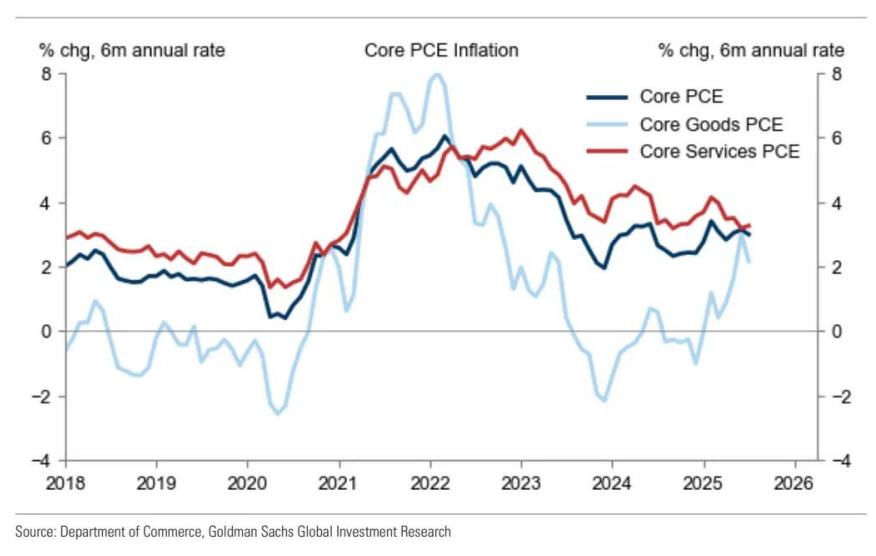
Group 1 - Goldman Sachs reports that the July core Personal Consumption Expenditures (PCE) price index met market expectations, but the unexpected widening of the goods trade deficit led to a downward revision of the U.S. third-quarter economic growth forecast [1] - The July core PCE price index increased by 0.27% month-on-month and rose to 2.88% year-on-year, aligning with Goldman Sachs' previous predictions and market expectations [1] - The overall PCE price index rose by 0.20% month-on-month and increased to 2.60% year-on-year, consistent with Goldman Sachs and market forecasts [1] Group 2 - In July, U.S. personal income grew by 0.4% month-on-month, driven by increases in employment compensation, owner income, rental income, and asset income [3] - Personal spending also showed strong performance, with a month-on-month increase of 0.5%, slightly above Goldman Sachs' forecast [3] - The savings rate in July remained at 4.4%, a slight decrease from the previously reported June figure of 4.5% [3] Group 3 - The U.S. goods trade deficit widened significantly in July, expanding by $18.7 billion to $103.6 billion, exceeding Goldman Sachs and market expectations [4] - The widening deficit was primarily due to a $18.6 billion increase in imports, while exports saw a slight decrease [4] - Goldman Sachs emphasized that the unexpected trade deficit is the main reason for the downward adjustment of the third-quarter GDP tracking estimate by 0.2 percentage points to 1.6% [4]