
全国统一大市场

Search documents
三问“疆品南下 粤品北上”:跨越山海的百亿工程,如何炼成?
Nan Fang Nong Cun Bao· 2025-12-18 00:33
Core Viewpoint - The "Xinjiang Products Southbound, Guangdong Products Northbound" initiative is a significant trade project aimed at enhancing economic cooperation between Guangdong and Xinjiang, facilitating the exchange of local products and promoting mutual benefits for both regions [7][9][12]. Group 1: Project Overview - The initiative has facilitated a bilateral trade exchange of 182 billion yuan since its inception, with over 79 billion yuan exchanged in the current year alone [12][13]. - The project serves as a platform for the sale of distinctive products from both regions, enhancing local farmers' incomes and promoting economic growth [5][11]. Group 2: Strategic Importance - The initiative is designed to break the traditional one-way support model, fostering a two-way empowerment concept and integrating the economies of Guangdong and Xinjiang into the national market [28][30]. - It aligns with national strategies to strengthen domestic circulation and build a unified market, leveraging Guangdong's market potential and Xinjiang's geographical advantages [39][41]. Group 3: Operational Mechanisms - The project emphasizes logistical improvements, including the establishment of a 5G smart logistics port in Kashgar, which enhances the efficiency of product distribution [64][68]. - Direct flight routes and international rail services have been introduced to facilitate trade, with significant increases in cargo volume and value reported [75][72]. Group 4: Long-term Impact - The initiative aims to create lasting benefits for local communities by enhancing product branding and market presence through media and promotional activities [110][134]. - Continuous engagement through online platforms and physical experience centers in the Greater Bay Area has been established to maintain consumer interest and drive sales [115][126]. Group 5: Community Benefits - The project has been instrumental in improving the livelihoods of local farmers, with notable increases in product sales and market reach, transforming local agricultural practices [131][141]. - Training programs for local farmers in e-commerce and modern agricultural practices have been implemented, boosting confidence and skills for future growth [139][142].


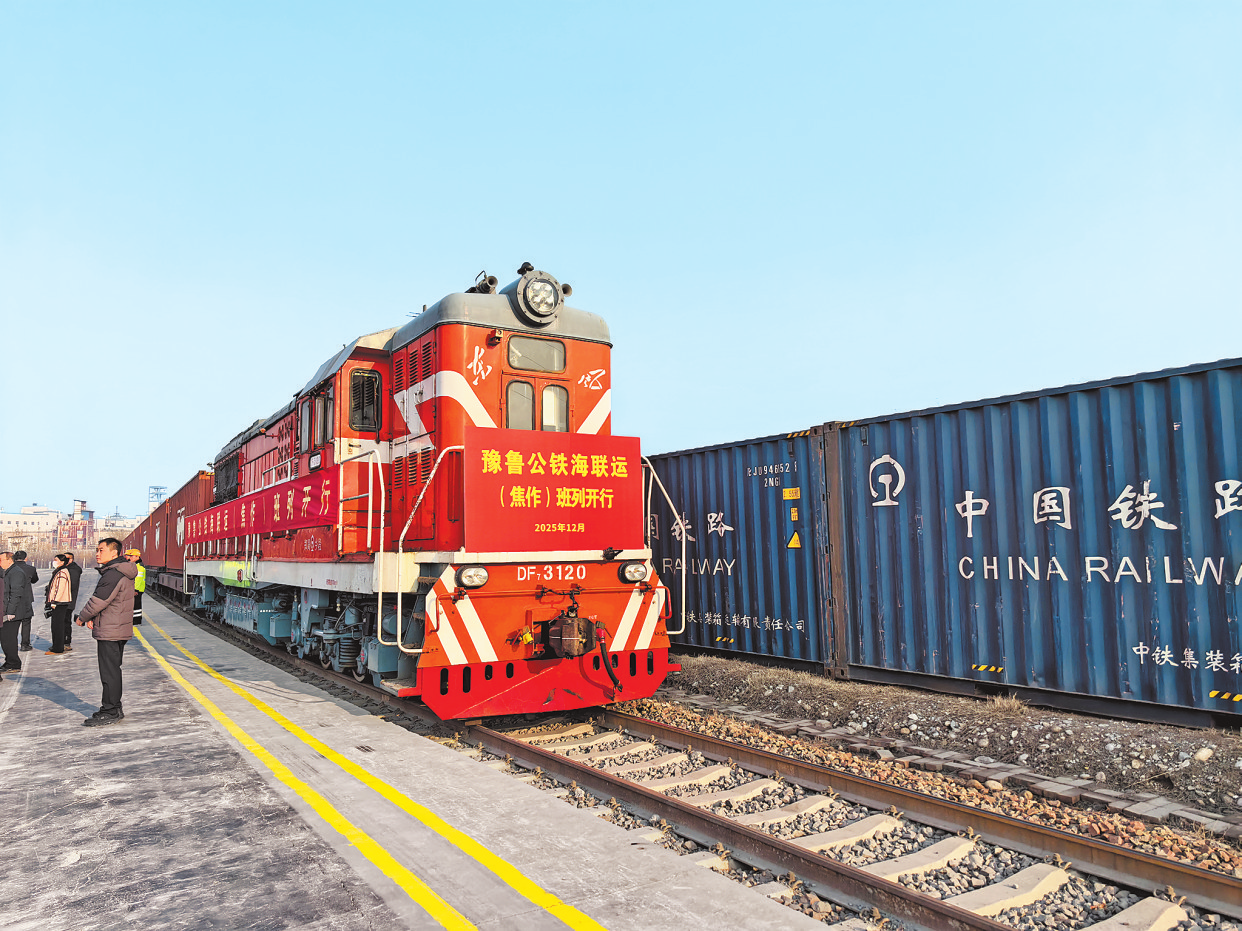
这条黄金通道一路向东出海,链接全球 豫鲁公铁海联运(焦作)班列开行
He Nan Ri Bao· 2025-12-17 23:48
Core Viewpoint - The successful launch of the Yulu Public-Rail-Sea Intermodal Transport (Jiaozuo) train service marks a significant step in enhancing logistics efficiency and reducing costs for local manufacturers, facilitating their access to international markets [3][4]. Group 1: Launch and Operations - The Yulu Public-Rail-Sea Intermodal Transport (Jiaozuo) train service commenced on December 17, carrying goods such as automotive tires and titanium dioxide from Jiaozuo to Qingdao Port for international shipping [3]. - The service allows for direct container transport to the port, reducing costs by 30% and improving safety and reliability for exporters [3]. - The Jiaozuo-Shandong Port rail-sea service has achieved a stable operation of two trains per week with a punctuality rate exceeding 98% [4]. Group 2: Strategic Partnerships - A cooperation agreement was signed among Jiaozuo Municipal Government, China Railway Zhengzhou Group, and Shandong Port Group to advance the construction of the intermodal transport corridor [4]. - The focus is on integrating logistics, trade, finance, and shipping resources to enhance the local industrial sector's access to port services [5]. Group 3: Infrastructure and Development - Jiaozuo is positioned as a key city in the Zhengzhou metropolitan area and has developed a robust infrastructure for multi-modal transport, including six major railway lines [4]. - The Jiaozuo Municipal Government has prioritized the development of intermodal transport corridors as part of its infrastructure improvement initiatives [4]. Group 4: Future Plans and Support - The Shandong Port Group aims to provide comprehensive port services to local enterprises, enhancing their competitiveness in international markets [5]. - The Jiaozuo city government plans to establish a regular coordination mechanism to support the development of the intermodal transport services [6]. - Jiaozuo State-owned Assets Group is set to play a leading role in integrating railway and port resources to streamline logistics operations for local businesses [7].
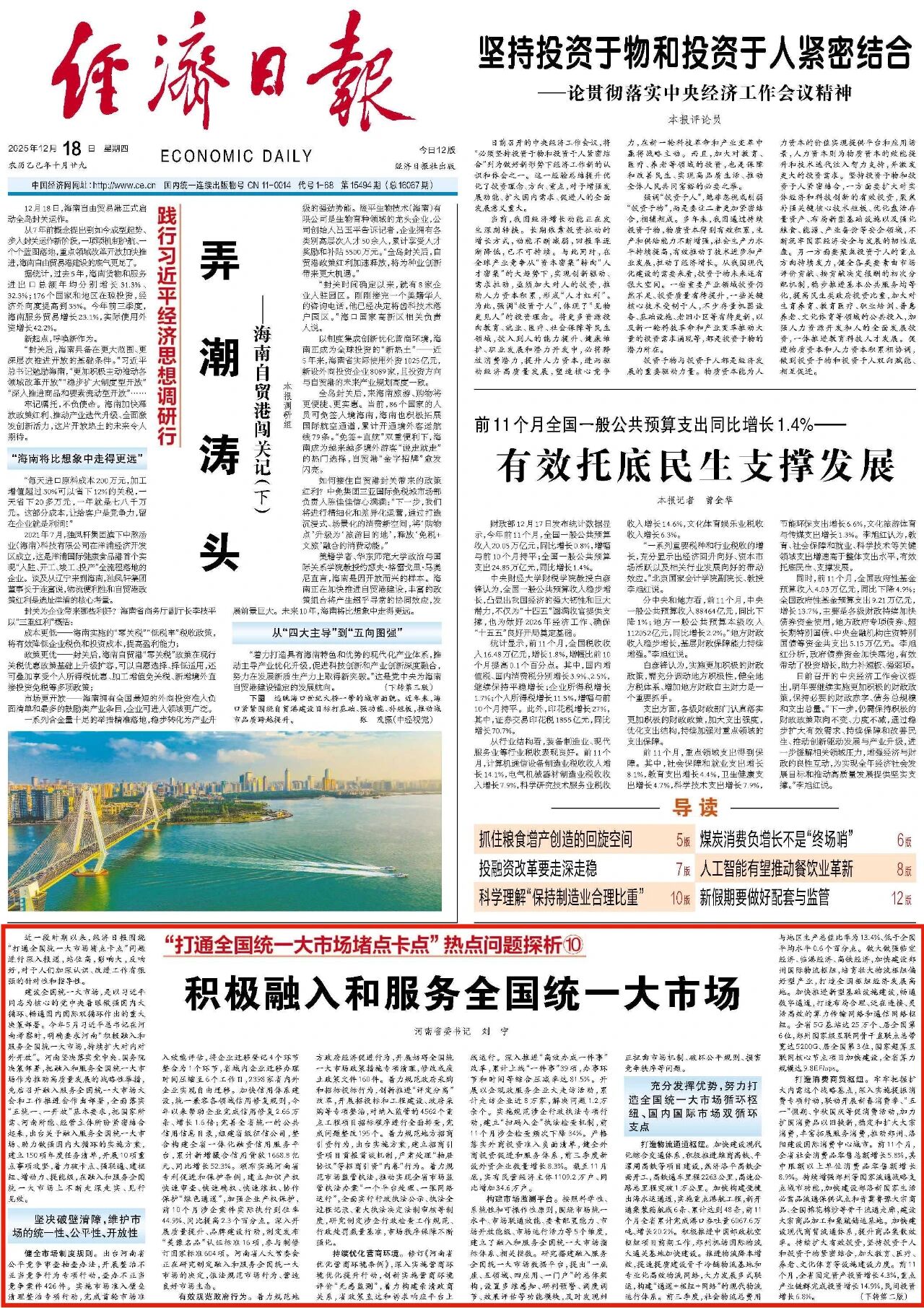
《经济日报》刊发刘宁署名文章:积极融入和服务全国统一大市场
Jing Ji Ri Bao· 2025-12-17 23:35
Core Viewpoint - The article emphasizes the importance of integrating and serving the national unified market as a strategic measure for promoting high-quality development in Henan Province, aligning with the central government's directives to strengthen domestic circulation and facilitate international exchanges [2][20]. Group 1: Implementation of National Unified Market - Henan has established a comprehensive implementation plan with 150 annual tasks and 10 key initiatives to enhance connectivity and remove barriers in the national unified market [2][20]. - The province has held conferences to promote the integration and service of the national unified market, focusing on the "Five Unifications and One Opening" principle [2][20]. Group 2: Market Regulation and Fair Competition - The province has introduced measures to ensure market unity, fairness, and openness, including the establishment of a fair competition review system and the resolution of 426 cases of unfair competition [3][4]. - A special action to clear market access barriers has streamlined the process for business relocations, reducing the time for enterprise migration to six working days [3][4]. Group 3: Optimizing Business Environment - Henan has revised its business environment regulations and implemented actions to enhance the efficiency of administrative processes, achieving an 81.5% reduction in processing time for various business-related tasks [5][21]. - The province has conducted extensive outreach to businesses, visiting nearly 80,000 companies and resolving over 12,000 issues [5][21]. Group 4: Infrastructure and Logistics Development - The province is advancing the construction of a modern transportation system, with high-speed rail and highway projects contributing to a total of 2,263 kilometers of high-speed rail and over 10,000 kilometers of highways [6][22]. - Henan has also focused on enhancing its logistics capabilities, achieving a 20.2% increase in port throughput, totaling 60.68 million tons in the first eleven months [6][22]. Group 5: Economic Growth and Investment - The province has seen a 4.3% increase in fixed asset investment, with key industrial sectors experiencing a 14.9% growth in investment [7][21]. - The number of newly established foreign-funded enterprises increased by 8.3% in the first three quarters, reflecting a positive trend in foreign investment [5][21]. Group 6: International Trade and Connectivity - Henan has expanded its international logistics capabilities, with 68 international freight routes established, connecting to 32 countries, and a 24.6% increase in cargo throughput at Zhengzhou Airport [9][22]. - The province's total import and export value reached 840.24 billion yuan, growing by 13.5% year-on-year, ranking it 10th in the country [9][22].
积极融入和服务全国统一大市场
Jing Ji Ri Bao· 2025-12-17 23:32
Core Viewpoint - The article emphasizes the importance of building a unified national market in China, as directed by the central government, to strengthen domestic circulation and facilitate international trade [1]. Group 1: Implementation of National Market Integration - The Henan province has actively implemented the central government's directives by organizing conferences and formulating plans to integrate and serve the national unified market, establishing 150 annual tasks and focusing on ten key initiatives [1]. - The province has introduced a "Five Unifications and One Opening" policy to align national needs, provincial capabilities, and business expectations [1]. Group 2: Market Regulation and Fair Competition - Henan has enacted measures to enhance market fairness, including the establishment of a competitive review system and the investigation of 426 cases of unfair competition [2]. - The province has streamlined market entry processes, reducing the time for business relocations to six working days and enabling 2,398 companies to move freely [2]. - A unified public credit information directory has been created, resulting in a 52.3% increase in credit loans facilitated, totaling 166.88 billion yuan [2]. Group 3: Government Behavior and Procurement Regulation - The province has undertaken a comprehensive review of local government policies that hinder the unified market, amending or abolishing 160 policy documents [3]. - A new mechanism for investment attraction has been established to regulate local government behavior and prevent unfair practices [3]. Group 4: Business Environment Optimization - Henan has revised its business environment regulations, implementing actions to enhance the overall business climate and reduce administrative burdens by 81.5% [4]. - The province has conducted extensive outreach to businesses, visiting nearly 80,000 companies and resolving over 12,000 issues [4]. Group 5: Logistics and Infrastructure Development - The province is advancing the construction of a modern transportation system, with high-speed rail and highway expansions, achieving a total of 2,263 kilometers of high-speed rail [5][6]. - The logistics sector has seen a 20.2% increase in port throughput, reaching 60.68 million tons [6]. Group 6: Consumer and Trade Hub Development - Henan is focusing on expanding domestic demand through various promotional activities, resulting in a 5.8% increase in retail sales [7]. - The province is enhancing its commercial infrastructure to improve the efficiency of goods distribution [7]. Group 7: Resource Allocation and Market Reform - Efforts are being made to create a unified market for various resources, including land, labor, and capital, with a focus on facilitating efficient resource allocation [8]. - The province has seen a 63.7% increase in technology contract transactions, totaling 230.96 billion yuan [8]. Group 8: International Trade and Belt and Road Initiative - Henan is enhancing its role in the Belt and Road Initiative by expanding international air and rail routes, with a 24.6% increase in cargo throughput at Zhengzhou Airport [9]. - The province's total import and export value reached 840.24 billion yuan, growing by 13.5% [9].
民生领域反垄断执法再加力 平台经济成重点
Zhong Guo Jin Rong Xin Xi Wang· 2025-12-17 23:21
Core Points - The National Market Regulation Administration has taken significant actions against monopolistic practices, including 35 cases of monopoly agreements and 25 cases of abuse of market dominance, resulting in a total fine of 2.93 billion yuan [1] - The administration has also concluded 950 cases related to business concentration in the livelihood sector, supporting companies in improving operational efficiency through mergers and acquisitions [1] Group 1: Antitrust Enforcement in Key Sectors - In the pharmaceutical sector, 12 major cases were handled over three years, with fines totaling 1.219 billion yuan, 362 million yuan, and 223 million yuan for specific companies, leading to price reductions of over 40% for involved drugs, with some reductions reaching 95% [1] - In public utilities, 16 cases of monopolistic behavior in water, electricity, gas, and heating sectors were addressed, resulting in fines of 183 million yuan, effectively curbing practices like bundled sales and ensuring consumer choice [1] Group 2: Platform Economy Regulation - The administration is enhancing regular supervision of the platform economy, focusing on competitive behaviors and issues like "lowest price" guarantees and "choose one of two" practices, aiming to protect the interests of small merchants and consumers [2] - A draft guideline for antitrust compliance in internet platforms has been released for public feedback, aiming to provide practical guidance for platform enterprises and address monopolistic behaviors [2][3] Group 3: Future Regulatory Focus - Future regulatory efforts will emphasize breaking local protectionism and administrative monopolies, which are crucial for optimizing the business environment and protecting consumer interests [3] - The administration plans to increase enforcement against the abuse of administrative power, promote fair competition review systems, and enhance policy coordination to ensure a unified national market [3][4] Group 4: Comprehensive Regulatory Approach - The administration adheres to a dual approach of regulation and service, employing a comprehensive regulatory toolset to promote self-discipline among enterprises and ensure a healthy market environment [4] - A core regulatory mechanism focusing on risk warning, compliance guidance, and precise regulation will be further refined to foster a competitive and orderly market environment [4]
固收:地方政府“加杠杆”最新动向及边际变化
2025-12-17 15:50
Summary of Key Points from the Conference Call Industry Overview - The focus is on the fiscal policy and economic strategies of local governments in China for 2026, emphasizing the need for increased investment and control of hidden debts [1][3][11]. Core Insights and Arguments - **Fiscal Policy**: China will continue to implement an active fiscal policy in 2026, maintaining a narrow fiscal deficit rate of 4% to ensure the stability of wages, operations, and livelihood expenditures [1][4]. - **Investment in Infrastructure**: The central budget for 2026 is expected to exceed 735 billion yuan, with increased investment in major safety projects and other key areas, optimizing the management of special bonds [1][7]. - **Focus on Domestic Demand**: Expanding domestic demand is identified as the core guiding principle for 2026, with plans for resident income increase and consumption stimulation actions to be implemented in the first quarter [1][6]. - **Role of Financial Tools**: Central budget investment funds, special bonds, and new policy financial tools will play a crucial role in leveraging local government project capital, driving fixed asset investment recovery across various sectors, including real estate and manufacturing [1][8]. - **Control of Hidden Debt**: Local governments are urged to actively control the increase of hidden debts and regulate financing platform operations to mitigate fiscal risks [1][11]. Additional Important Content - **Investment Strategy**: The central economic work conference emphasizes the need for local governments to avoid ineffective investments and focus on projects with tangible returns, addressing the decline in fixed asset investment [3][12]. - **Sector-Specific Development**: Provinces are encouraged to develop key industrial chains to promote regional economic growth while managing new hidden debts [1][9]. - **Technological and Infrastructure Investment**: To counteract slowing investment and consumption growth, there will be increased investment in technology innovation, infrastructure improvements, and public welfare sectors such as childcare and healthcare [2][15]. - **Artificial Intelligence Development**: Various provinces are focusing on artificial intelligence in their "14th Five-Year Plan," with distinct roles based on regional strengths, promoting coordinated development across the country [16][17]. This summary encapsulates the critical points discussed in the conference call, highlighting the strategic direction for local governments and the anticipated economic landscape for 2026.
中央强调加紧清理拖欠企业账款
第一财经· 2025-12-17 15:24
2025.12. 17 本文字数:3270,阅读时长大约5分钟 作者 | 第一财经 祝嫣然 日前召开的中央经济工作会议明确,制定全国统一大市场建设条例,深入整治"内卷式"竞争,并强 调"加紧清理拖欠企业账款"。 中央财办有关负责同志12月17日详解2025年中央经济工作会议精神时表示,明年要在市场、政府、 企业三个层面采取更具针对性的措施,进一步增强统一大市场的建设成效,实现各类资源要素高效配 置。包括要持续完善市场运行规则、持续规范地方政府经济促进行为、加快完善重点行业产能调控机 制等。 国家发改委副秘书长肖渭明近日在中国经济年会上透露,目前改进提升营商环境的最大动作,就是清 理政府欠款,即单个合同或单个项目欠款50万元以下的,到2025年底要全部清理完毕。要持续破除 阻碍全国统一大市场的卡点、堵点,清理不合理限制,打破市场分割和地方保护,深入推进招投标改 革,改进提升营商环境。 第一财经记者注意到,多部门正加力加快解决拖欠企业账款。工信部党组扩大会议传达学习中央经济 工作会议精神时强调,加紧清理拖欠企业账款,切实减轻企业负担。国资委主任张玉卓也撰文指出, 着力解决拖欠民营企业账款问题,推动国有企业带头解开 ...

海南全岛封关 购物、就业攻略请收好
Yang Shi Xin Wen· 2025-12-17 15:17
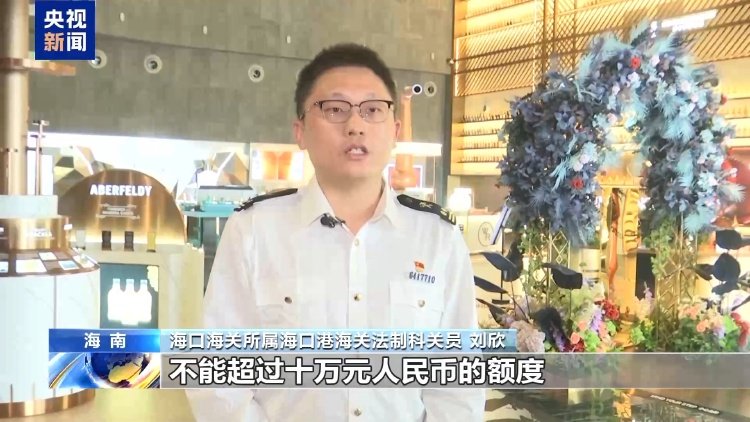
Core Viewpoint - Hainan Free Trade Port will officially start full island closure on December 18, 2025, aiming to enhance trade facilitation and establish itself as an international tourism consumption center while continuing the duty-free shopping policy and expanding the product list to meet changing consumer demands [1]. Policy Upgrades for Residents - The duty-free shopping policy for residents has been upgraded since November 1, allowing residents to purchase "immediate purchase and pick-up" items without limit on the number of purchases within a calendar year, provided they have at least one record of leaving the island [4][2]. - The "immediate purchase and pick-up" items are limited to 15 categories, including cosmetics, perfumes, clothing, and bags, with a single item price cap of 20,000 yuan, and an annual duty-free shopping limit of 100,000 yuan per person [6]. Integration of Duty-Free and Other Industries - The integration of duty-free shopping with tourism, culture, and entertainment industries is expected to deepen, promoting diverse consumption forms and creating more job opportunities in Hainan [9]. Talent Attraction and Business Environment - Hainan Free Trade Port offers incentives for attracting talent in key sectors such as tourism, modern services, high-tech industries, and agriculture, including personal income tax exemptions for high-income individuals [11]. - The corporate income tax for encouraged industries in Hainan is capped at 15%, significantly lower than the mainland average, providing a favorable environment for entrepreneurs [17]. - The streamlined process for starting a business allows entrepreneurs to begin operations with a written commitment to meet relevant requirements, reducing bureaucratic hurdles [15]. Future Opportunities - The opening of Hainan as a duty-free zone is expected to create a "national flow entry" for industries like cross-border e-commerce, high-end manufacturing, and logistics, leading to increased job opportunities and a demand for skilled labor [19]. - The policies implemented in Hainan are seen as a model for high-level opening up and can serve as a reference for other regions in China [21].
必须做到既“放得活”又“管得好”——学习领会“五个必须”做好明年经济工作
Xin Hua Wang· 2025-12-17 14:49
Group 1 - The core message emphasizes the need for a balance between "letting go" and "managing well" in economic work, highlighting the importance of breaking down institutional barriers while ensuring a rule-based economy [1][9] - The concept of "letting go" aims to eliminate obstacles to productivity, while "managing well" focuses on establishing a legal framework for economic activities [1][6] - The central economic work meeting outlines the necessity of combining effective market mechanisms with proactive government roles to stimulate economic vitality and ensure stability [1][2][12] Group 2 - The implementation of machine-based bidding processes in Hunan has increased the winning rate of private enterprises from 73.65% to 82.9%, showcasing a move towards a fairer competitive market environment [2] - The "14th Five-Year Plan" emphasizes the need for a unified, open, competitive, and orderly market system, aiming to enhance the role of the market in resource allocation [2][10] - The introduction of new regulations and measures, such as the Administrative Law Enforcement Supervision Regulations, aims to strengthen oversight and accountability in market operations [5][10] Group 3 - The establishment of a social credit system is identified as a foundational aspect of the market economy, with recent policies aimed at enhancing credit construction and ensuring fair competition [10][11] - The central economic work meeting has set clear directives for stabilizing the real estate market and managing local government debt risks, emphasizing the importance of risk prevention in economic governance [11] - The need for continuous reform to improve the efficiency of market mechanisms and government interventions is highlighted, with various local initiatives aimed at enhancing market vitality [12][13][14]
新华述评·聚焦中央经济工作会议|必须做到既“放得活”又“管得好”——学习领会“五个必须”做好明年经济工作
Xin Hua She· 2025-12-17 14:48
Group 1 - The core idea emphasizes the need for a balance between "letting go" and "managing well" in economic work, highlighting the importance of breaking down institutional barriers while ensuring a rule-based economy [1][10] - The "Five Musts" outlined by Xi Jinping provide a framework for addressing development challenges, stimulating internal dynamics, and mitigating risks [1][10] - The focus on creating a fair and competitive market environment is essential for promoting high-quality development, as indicated by the increase in the bidding success rate of private enterprises in Hunan from 73.65% to 82.9% [2] Group 2 - The establishment of a high-standard market system is crucial for maximizing resource allocation efficiency, as stated by experts [3] - Recent measures, such as the approval of the Administrative Law Enforcement Supervision Regulations, aim to clarify responsibilities and enhance market vitality through reduced administrative approvals [4] - The importance of market rules and a conducive environment for fair competition is emphasized, ensuring equal access to production factors for all business entities [5] Group 3 - The government's role is essential in regulating market order, with recent policies focusing on risk prevention and maintaining economic stability [12] - The ongoing reforms aim to enhance the efficiency of resource allocation and reduce institutional costs, as seen in various regional initiatives [16] - The need for continuous improvement in the relationship between an effective market and a proactive government is highlighted as a key focus for future reforms [15]