
区域协调发展

Search documents
经济随笔丨用中国经济的鲜活故事答高考作文题
Yang Shi Xin Wen Ke Hu Duan· 2025-06-09 01:48
Group 1 - The article emphasizes the resilience and adaptability of Chinese enterprises in the face of external economic pressures, highlighting their efforts to explore new markets and upgrade their operations [5][4] - It discusses the importance of having clear goals and dreams for the future, as articulated by leaders like Xi Jinping, which serve as a guiding force for the economy [4][7] - The concept of "second breath" is introduced, illustrating how industries and companies can overcome challenges and enter new phases of growth [4][6] Group 2 - The article draws a parallel between the Chinese economy and a wheel, where the spokes represent various economic provinces and sectors working together to support overall growth [7][6] - It highlights the role of both state-owned and private enterprises in driving economic progress, emphasizing the complementary nature of different economic sectors [7][8] - The need for coordinated regional development and the establishment of new mechanisms for cross-regional cooperation is underscored as essential for economic stability and growth [7][4]


许维鸿:东北振兴“连锁效应”渐显
Sou Hu Cai Jing· 2025-06-08 22:37
Economic Growth in Northeast China - The Northeast region is experiencing a significant investment growth, with a reported increase of 7.6% in fixed asset investment in the first four months of the year, compared to a national average of 4.0% [1] - Dalian is projected to become the first city in Northeast China with a GDP exceeding 1 trillion yuan by 2025, indicating a positive economic trajectory for the region [1] Strategic Importance - Northeast China plays a crucial role in China's new development pattern, which emphasizes domestic circulation and the mutual promotion of domestic and international circulation [1] - The region's economic revitalization is essential for maintaining the overall stability of China's economic development [1] Regional Cooperation and Trade - The Northeast serves as a key gateway for China's northern opening, enhancing cooperation with Northeast Asia and facilitating domestic and international trade [2] - The region benefits from increased economic ties with Russia, particularly as Russia pivots towards China amid Western sanctions, leading to a boost in local economic activity [2] Talent and Investment Attraction - The revitalization efforts in Northeast China are beginning to attract talent and capital back to the region, reversing previous trends of outmigration [2] - The historical development of cities and infrastructure in Northeast China, such as its advanced railway system, contributes to its renewed attractiveness for investment and talent [2] Cultural and Tourism Development - The cultural and tourism sectors in Northeast China are witnessing a surge, driven by increased consumer demand for unique experiences and cultural offerings [3] - Events like the Harbin Ice and Snow Festival are drawing significant tourist interest, showcasing the region's potential for cultural tourism [3] Innovation and Research - Northeast China has a strong foundation in research and development, with notable achievements in various industries such as military-civilian integration, optics, and robotics [4] - The region's universities and research institutions have historically contributed to significant innovations, which are now being better integrated into local economic development efforts [4]
2025年三线城市排名出炉:中山第3,邯郸第10,阜阳第14
Sou Hu Cai Jing· 2025-06-06 01:49
Core Insights - The 2025 "New First-Tier City Charm Ranking" reveals the vitality rankings of 70 third-tier cities in China, with Zhongshan, Urumqi, and Lanzhou taking the top three spots [1][3][15] - The ranking serves as an important window for observing the development tiers of Chinese cities [1] Group 1: City Rankings and Characteristics - Zhongshan ranks third among third-tier cities, benefiting from its position as a key node in the Guangdong-Hong Kong-Macao Greater Bay Area and leveraging the historical opportunities brought by the Shenzhen-Zhongshan Link [3][15] - Urumqi and Lanzhou occupy the first and second positions, respectively, showcasing their competitive advantages [1][15] - Handan, ranked tenth, represents a northern industrial city undergoing transformation, focusing on green and high-end upgrades of traditional industries while fostering new growth sectors [5][7] Group 2: Economic and Industrial Development - Handan is positioned as a significant player in the regional industrial chain reconstruction, reflecting the determination and initial success of old industrial bases [7][15] - Fuyang, ranked fourteenth, is emerging as a stronghold in central China, converting its population dividend into talent and market dividends, with rapid development momentum [7][8] - The introduction of new industries in Fuyang, such as renewable energy and electronic information, indicates a growing industrial layout [9] Group 3: Common Characteristics of Third-Tier Cities - Third-tier cities exhibit distinct common characteristics, acting as regional engines, with cities like Ganzhou, Yichang, and Wuhu playing crucial roles in their respective provincial or regional developments [11][13] - These cities are focusing on unique development paths, such as tourism in Guilin and Sanya, industrial development in Liuzhou and Zibo, and leveraging policy and location advantages in Haikou and Yinchuan [13] - The dual role of these cities as both important receivers of industrial spillover from core city clusters and as battlegrounds for local industrial upgrades underscores their significance in supporting resilient economic development in China [13][15]
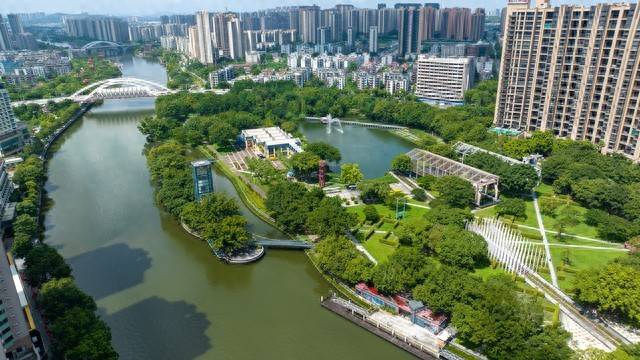
以区域重大战略联动推动区域融合发展(深入学习贯彻习近平新时代中国特色社会主义思想)
Ren Min Ri Bao· 2025-06-05 22:02
Core Viewpoint - The implementation of major regional strategies in China is crucial for optimizing regional economic layout and promoting high-quality development, addressing the significant disparities in economic development, resource endowment, and ecological environment across different regions [1][2][3]. Group 1: Importance of Major Regional Strategies - Major regional strategies are essential for enhancing regional economic development and provide new pathways for regional integration, contributing to theoretical innovation in regional development [2][3]. - The strategies aim to strengthen the development of key regions, promote integration among multiple regions, and optimize the regional economic layout by leveraging comparative advantages [3][4]. Group 2: Specific Regional Strategies - The Beijing-Tianjin-Hebei coordinated development focuses on alleviating non-capital functions of Beijing, transforming development disparities into collaborative growth [4]. - The Yangtze River Economic Belt emphasizes ecological priority and green development, promoting environmental protection while advancing economic growth [4][5]. - The Guangdong-Hong Kong-Macau Greater Bay Area aims to enhance cooperation under the "One Country, Two Systems" framework, integrating Hong Kong and Macau into national development [4][5]. Group 3: Regional Coordination and Integration - The integration of major regional strategies is necessary for promoting coordinated development across regions, addressing imbalances in economic development, infrastructure, and public services [6][7]. - The strategies facilitate the free flow of resources and collaborative development, enhancing regional economic quality and efficiency [6][7]. Group 4: Pathways for Strengthening Regional Strategies - Strengthening the interconnection and collaboration among major regional strategies is vital for achieving effective implementation and maximizing their synergistic effects [8][9]. - Establishing a unified national market and breaking down regional barriers will enhance the integration of regional strategies and promote overall economic development [9][10]. Group 5: Future Directions and Mechanisms - The focus on building a modern economic system will require a coordinated policy framework and cross-departmental collaboration to foster innovation and optimize industrial layout [12][13]. - Enhancing the mechanisms for connecting major regional strategies will ensure high-quality implementation and promote regional integration [13][14].
中部省份打造“新增长极”密码:省域经济发展模式从单核到多极的动态平衡术丨观城势·轻研报
2 1 Shi Ji Jing Ji Bao Dao· 2025-06-03 13:10
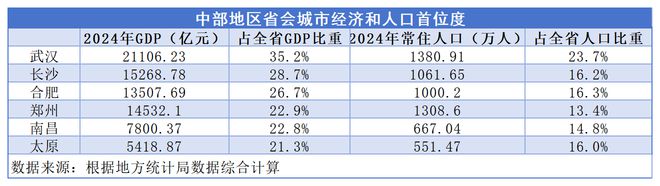
Core Insights - The article discusses the evolving economic landscape of central provinces in China, focusing on the shift from a "strong provincial capital" model to a "multi-polar" development approach [1][2] - It highlights the economic and population primacy of provincial capitals like Wuhan, which leads the central region, while also addressing the challenges faced by other cities [3][5] Economic Performance - In 2024, Wuhan's GDP is projected to be 2110.6 billion yuan, accounting for 35.2% of Hubei's total GDP, with a population of 13.8 million, representing 23.7% of the province's population [4] - Other central provincial capitals like Changsha, Hefei, Zhengzhou, Nanchang, and Taiyuan show varying degrees of economic and population primacy, with their GDP and population shares being 28.7%, 26.7%, 22.9%, 22.8%, and 21.3% respectively [4][5] Development Trends - The article notes that while the population primacy of central provincial capitals has generally increased since the 14th Five-Year Plan, some cities like Wuhan, Changsha, and Taiyuan have seen a decline in economic primacy [2][7] - Zhengzhou, Hefei, and Nanchang have experienced growth in economic primacy, with Zhengzhou's GDP share increasing by 1.1 percentage points since 2020 [7][8] Urbanization Strategies - Central provinces are exploring new growth poles through the development of provincial sub-centers and urban agglomerations to avoid the "one city dominates" issue [2][10] - The article emphasizes the importance of urban agglomeration development, with examples from Hubei's "one main, two sub" strategy and the establishment of urban clusters like the Changsha-Zhuzhou-Xiangtan urban area [9][11] Policy Support - Various provincial governments are implementing policies to enhance the capabilities of provincial capitals while also fostering the growth of sub-centers, indicating a balanced approach between "strong provincial capitals" and "multi-polar" development [12]
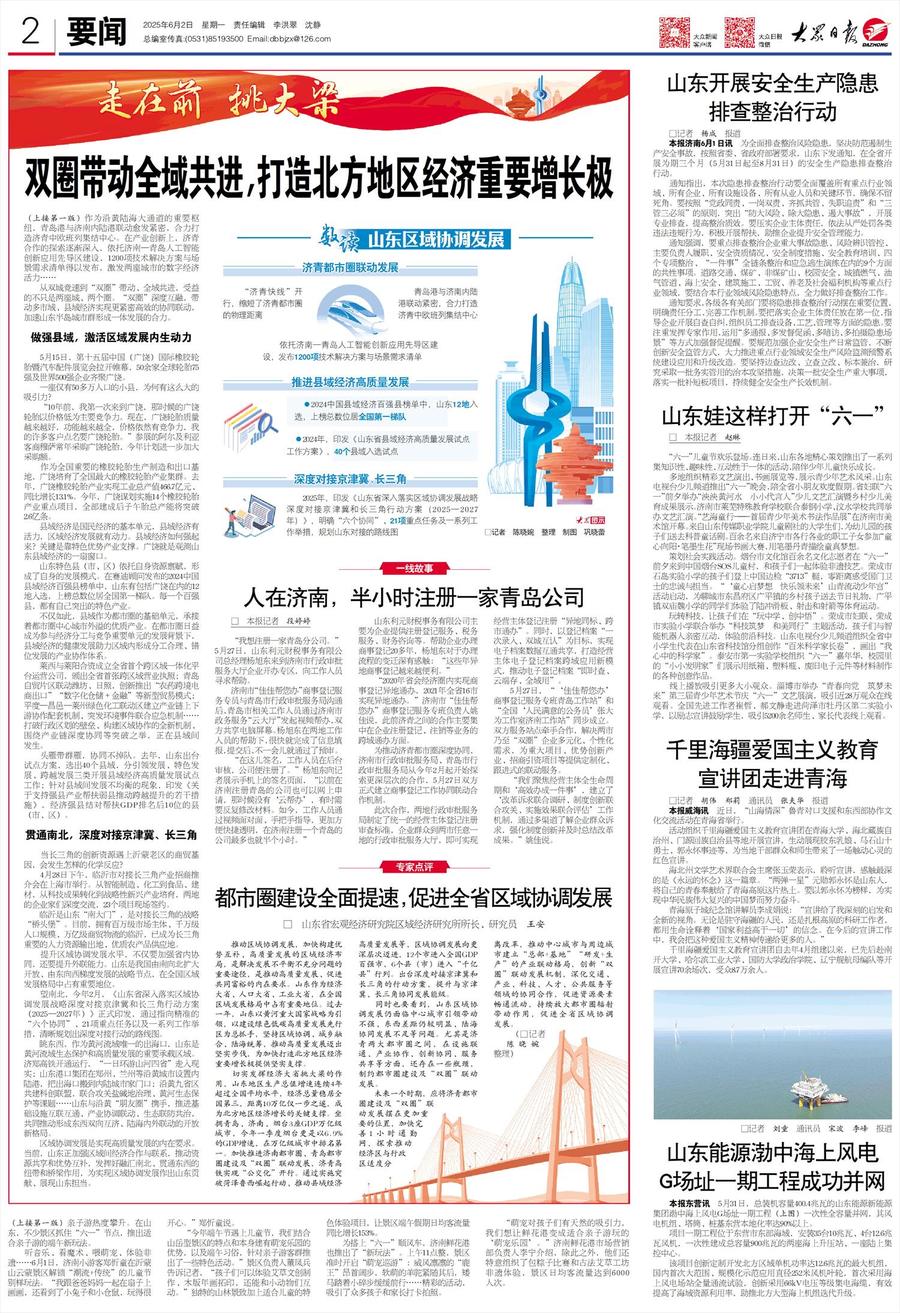
都市圈建设全面提速,促进全省区域协调发展
Qi Lu Wan Bao Wang· 2025-06-03 03:23
Group 1 - The core viewpoint emphasizes the collaborative development of the Jinan-Qingdao metropolitan area and the establishment of a comprehensive economic network in Northern China, focusing on regional coordination and high-quality development [1][10][11] - The Jinan-Qingdao high-speed rail is highlighted as a key infrastructure project that facilitates rapid transit and economic integration between the two cities, promoting a "public transport" model for urban connectivity [11][12] - The article notes that Shandong province has seen a significant increase in GDP growth, with the region's economic growth rate surpassing the national average for four consecutive years, positioning it as a critical economic driver in Northern China [11][12] Group 2 - The rubber tire industry in GuoRao is identified as a major contributor to the local economy, with an industrial output value of 88.7 billion yuan, reflecting a year-on-year growth of 131% [2] - The article discusses the implementation of 14 key projects in the rubber tire sector, which, once completed, will increase production capacity to over 2 billion tires [2] - The county economy is recognized as an essential component of regional economic development, with Shandong having 12 counties listed among the top 100 counties for economic performance in 2024, the highest in the nation [1][2] Group 3 - The article outlines the strategic plan for deepening cooperation with the Beijing-Tianjin-Hebei region and the Yangtze River Delta, aiming to enhance industrial collaboration and resource sharing [8][11] - It emphasizes the need for improved connectivity and collaboration between urban centers and surrounding areas to foster a more balanced economic development [10][12] - The establishment of a unified business registration and administrative service system between Jinan and Qingdao is highlighted as a step towards streamlining business operations and enhancing service efficiency [4][12]
山西13部门联手推动承接制造业转移
Zhong Guo Chan Ye Jing Ji Xin Xi Wang· 2025-06-03 00:55
Core Viewpoint - The provincial government has issued the "Implementation Opinions" to actively and orderly undertake the transfer of manufacturing industries, aiming to accelerate the construction of a modern industrial system and promote regional coordinated development [1][2]. Group 1: Key Industries and Focus Areas - The province will tailor its approach to undertake key industrial transfers, focusing on the integration of energy materials and manufacturing industries, supporting the development of fine chemicals and high-end daily chemical products [1]. - In the equipment manufacturing sector, the focus will be on intelligent coal machinery, rail transit equipment, new energy equipment, and energy-saving environmental protection equipment, with an aim to enhance the technical level of complete products and basic components [1]. - The electronic information industry will prioritize semiconductors, information technology innovation, computing power, and photovoltaics, actively developing electronic information and related supporting industries, while incubating and nurturing technology-based SMEs and innovative enterprises [1]. Group 2: Industrial Layout and Development Strategy - The "Implementation Opinions" emphasize concentrated layout and promote industrial agglomeration development, strengthening various industrial undertaking platforms and guiding industries to gather in economic and technological development zones, high-tech industrial development zones, chemical parks, and specialized towns [1]. - The strategy includes promoting high-quality industrial transfer in central cities and urban agglomerations, while encouraging special types of regions to undertake the development of characteristic industries [1]. Group 3: Cooperation and Policy Framework - To facilitate industrial transfer cooperation, the "Implementation Opinions" propose innovative cooperation models, including cross-regional manufacturing transfer benefit-sharing mechanisms and "government + chain leader + park" investment attraction [2]. - The province aims to accelerate the establishment of free trade pilot zones and leverage international cooperation industrial parks, processing trade industrial parks, bonded zones, and dry ports to undertake gradient transfer of processing trade [2]. - The implementation of industrial transfer will be supported by improving the service system, strengthening the guarantee of industrial undertaking factors, and refining the work promotion mechanism to optimize the policy environment for undertaking manufacturing transfers [2].

省委十四届九次全会精神在全省干部群众中引发热烈反响——既为一域增光,更为全局添彩
Xin Hua Ri Bao· 2025-06-02 23:06
Group 1: National Development Strategy - The core viewpoint emphasizes Jiangsu's commitment to leading in the implementation of national major development strategies, focusing on high-quality development and effectively addressing risks and challenges [1] Group 2: Regional Coordination and Infrastructure Development - The new high-speed rail project connecting Shanghai, Nanjing, and Hefei is expected to optimize the railway network along the Yangtze River and support the integrated development of the Yangtze River Delta [2] - The China Railway First Group is committed to building the longest underground high-speed railway station in the country, enhancing the quality of railway infrastructure in the region [2] Group 3: Technological Innovation and Collaboration - Jiangsu's Industrial Technology Research Institute is actively participating in the construction of the Yangtze River Delta National Technology Innovation Center, focusing on resource sharing and talent cultivation [3] - The Nanjing Customs is implementing measures to enhance cross-border logistics efficiency and optimize the business environment for key industries such as biomedicine and integrated circuits [3] Group 4: Social Welfare and Economic Cooperation - Jiangsu's aid to Xinjiang is being enhanced by aligning national strategic requirements with local needs, focusing on deepening industrial cooperation and improving living standards [4] - The Hongdou Group is leveraging its presence in Cambodia to promote healthcare and education projects, contributing to the Belt and Road Initiative [4] Group 5: International Collaboration and Low-Carbon Development - The Zhongjiang International Group is advancing small-scale livelihood projects in Papua New Guinea and has initiated a strategic partnership for a low-carbon hub project in Malaysia [5] Group 6: Food Security and Financial Stability - Jiangsu's grain and material reserves bureau is focusing on enhancing food security through improved purchasing, storage, and market regulation systems [6] - The provincial financial office is addressing financial risks through targeted measures for listed companies and large enterprises, while also combating illegal financial activities [6] Group 7: Environmental Protection and Water Management - The Wuxi water conservancy system is implementing comprehensive measures for water safety and ecological restoration in Taihu Lake, aiming for improved water quality [7] - Jiangsu Port Group is launching projects to enhance water transport safety and quality, contributing to regional economic development [7]
双圈带动全域共进,打造北方地区经济重要增长极
Da Zhong Ri Bao· 2025-06-02 01:15
Group 1: Regional Development Strategy - Shandong is positioned as a crucial link connecting northern and southern China, aiming to become an important economic growth pole in the northern region [1] - The province is integrating into national development strategies, focusing on ecological protection and high-quality development in the Yellow River basin [1][9] - The emergence of the Jinan and Qingdao metropolitan areas is enhancing regional economic development and connectivity [2][4] Group 2: Transportation and Infrastructure - The Jinan metropolitan area is developing a comprehensive highway network and a "米字型" high-speed rail system, facilitating daily connections to 366 cities [3] - The Qingdao metropolitan area is constructing a robust highway network and has achieved near rail-bus integration between Qingdao and Weifang [3] - The "济青快线" significantly reduces travel time between Jinan and Qingdao, enhancing inter-city collaboration [4] Group 3: Industrial Collaboration - The Jinan and Qingdao metropolitan areas are forming advanced manufacturing clusters, with specific focus on shipbuilding and industrial machinery [3] - Collaborative efforts in technology innovation and digital economy are being fostered between the two metropolitan areas [4] - Shandong's county-level economies are being strengthened through specialized industries, with significant contributions from the rubber tire industry in GuoRao [6][7] Group 4: Economic Integration with Other Regions - Shandong is enhancing its connections with the Yangtze River Delta, facilitating industrial cooperation and project signings [8] - The province is also focusing on ecological protection and high-quality development in the Yellow River basin, promoting inter-regional collaboration [9] - Shandong's strategic location is pivotal for national economic development, serving as a bridge for both domestic and international trade [1][8]
更好发挥外贸外资“第一梯队”作用
Ren Min Ri Bao· 2025-06-01 19:29
Core Insights - The recently issued "Work Plan for Deepening the Reform and Innovation of National Economic and Technological Development Zones" aims to enhance high-level openness and promote high-quality development across the country [1] Group 1: Economic Development and Trade - The number of national economic and technological development zones is set to reach 232 by 2024, covering all 31 provinces, regions, and municipalities [1] - These zones are crucial for building an open economy, with over 60,000 foreign-funded enterprises and 99,000 foreign trade companies, contributing to 23.4% of the national foreign investment and 24.5% of total imports and exports in 2024 [1] Group 2: Industrial Growth and Employment - National economic and technological development zones are expected to achieve a regional GDP of 16.9 trillion yuan in 2024, with over 24 million jobs created in large-scale industrial and service enterprises [2] - A diverse industrial system has emerged, covering sectors such as electronics, high-end equipment manufacturing, automotive, petrochemicals, new energy, and new materials [2] Group 3: Regional Coordination and Support - These zones actively support regional development, enhancing economic growth in underdeveloped areas, with the central and northeastern regions projected to achieve a GDP of 6.65 trillion yuan and an industrial output of 3.73 trillion yuan, representing 67% and 74% of the eastern regions, respectively [2] Group 4: Management and Business Environment - The zones are focused on optimizing management systems to create a first-class business environment, with about 60% of them having fewer than 10 internal institutions to provide streamlined services [3] - Collaboration with over 30 free trade pilot zones and more than 60 comprehensive bonded zones has led to significant institutional innovations in resource flow, rights protection, and market order [3]