
公募基金改革

Search documents
汇添富不能接受泡泡玛特下跌
Hu Xiu· 2025-06-13 09:33
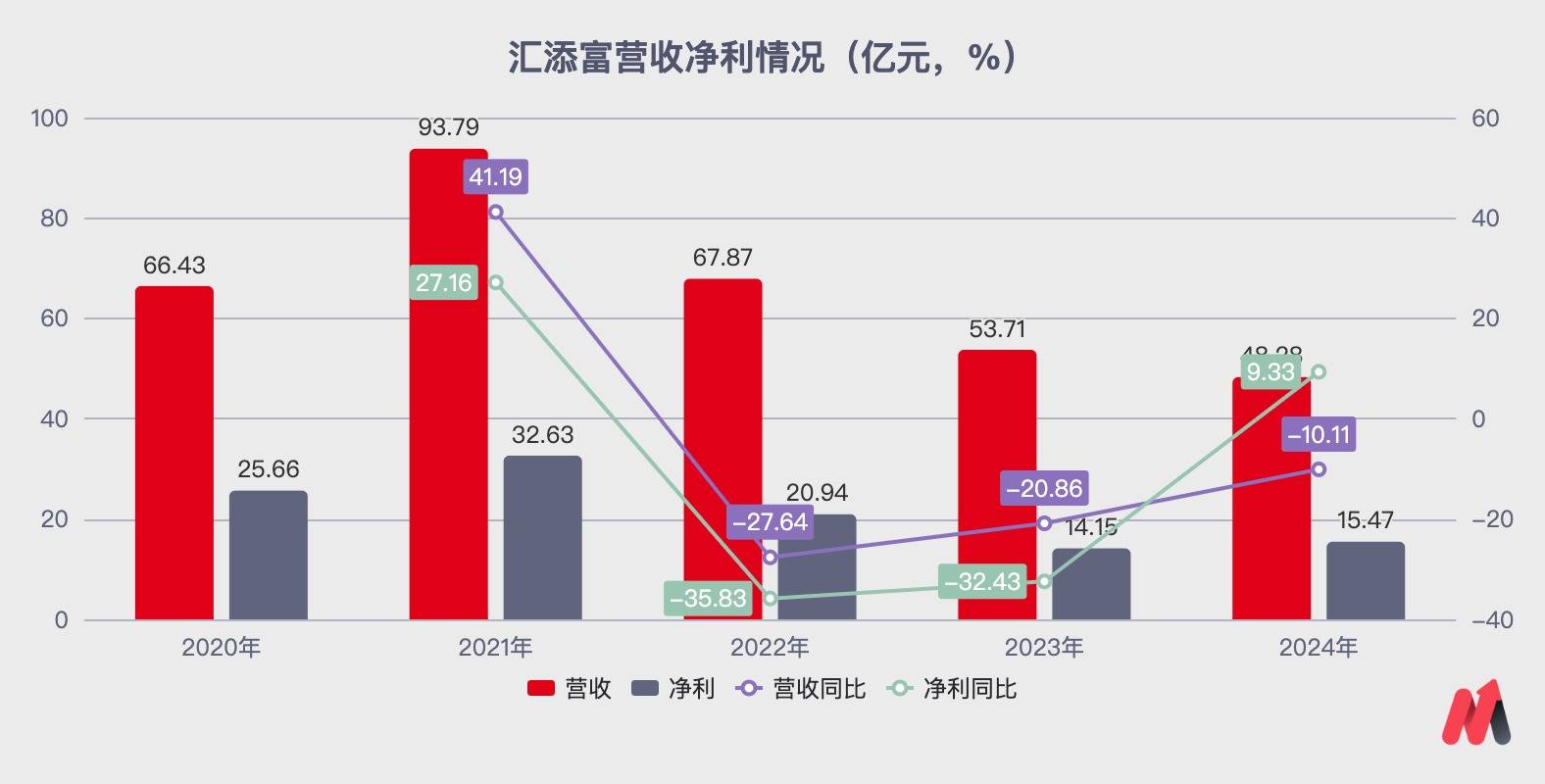
Core Viewpoint - The article discusses the shift in investment focus from traditional liquor stocks like Kweichow Moutai to newer consumer products like Pop Mart's Labubu toys, highlighting the performance of fund manager Hu Xinwei and the challenges faced by his fund management company, Huitianfu [1][4][12]. Group 1: Fund Performance and Strategy - Hu Xinwei's management of the Huitianfu Consumption Industry Mixed Fund saw a significant decline, with the fund's net value dropping from a peak of 9.977 yuan to 4.591 yuan, representing a decline of over 50% [1][4]. - In contrast, Hu's other fund, Huitianfu Consumption Upgrade, achieved approximately 20% returns this year due to a strategic reduction in Moutai holdings and increased investment in Pop Mart [4][5]. - The disparity in performance among Hu's funds has raised concerns about fairness to investors, as some funds have significantly outperformed others [4][5]. Group 2: Company Challenges and Market Position - Huitianfu's overall market position has deteriorated, with its 2024 revenue at 4.828 billion yuan, down 10.12% year-on-year, and a net profit of 1.548 billion yuan, up 9.33% [4][10]. - The company has seen a decline in its ranking within the industry, dropping to 9th place, primarily due to cost-cutting measures and a focus on increasing efficiency [4][10]. - Huitianfu's investment strategy has been criticized for being overly concentrated in specific sectors like consumption and technology, leading to missed opportunities in emerging industries [10][11]. Group 3: Investment Philosophy and Future Outlook - Hu Xinwei's investment philosophy has evolved to emphasize dividend yield and a more balanced asset allocation, moving away from a heavy reliance on consumer stocks [7][8]. - The article suggests that Hu's recent aggressive investment in Pop Mart may represent a high-stakes gamble for his career, as the market dynamics could shift rapidly [12]. - The need for Huitianfu to rebuild its research and investment trust is highlighted as a critical challenge for its survival in the competitive fund management landscape [12].



公募基金撒“红包雨”:年内分红超900亿元,创近三年新高
2 1 Shi Ji Jing Ji Bao Dao· 2025-06-05 12:49
Group 1 - The core viewpoint of the article highlights that public fund dividend enthusiasm continues to rise in 2025, with a total dividend amount of 93.55 billion yuan in the first five months, marking a 40% increase compared to the same period last year, and reaching a three-year high [1][4] - Bond funds and stock index funds accounted for the majority of dividends, with 71.40 billion yuan and 12.91 billion yuan respectively, representing 76.32% and 13.80% of the total dividends [2][5] - The number of funds distributing dividends, the frequency of distributions, and the total dividend amount have all reached new highs in nearly three years, with 2,635 public funds distributing dividends 3,823 times in the first five months of 2025 [3][4] Group 2 - The significant increase in dividend amounts for equity funds, which reached 17.57 billion yuan, represents a 157.15% increase compared to 6.83 billion yuan in the same period last year [4] - The trend of high dividend payouts is supported by the performance of bond and stock index funds, which have seen price increases and strong profit bases from the previous year [8][10] - Future public fund reforms are expected to enhance the frequency and scale of dividends, with a focus on improving investor returns and diversifying dividend models [10]
今年来基金累计分红近900亿元 创近三年同期新高
Shang Hai Zheng Quan Bao· 2025-06-04 19:18
Group 1 - The enthusiasm for public fund dividends continues to rise, with total dividends approaching 90 billion yuan this year, marking a 1.4 times increase compared to the same period last year and reaching a three-year high [1] - Equity funds have shown a significant increase in dividend distribution, with the total dividend amount being nearly seven times that of the same period last year [1] - The trend of increasing dividends has become a consensus among many fund companies, driven by public fund reforms that emphasize investor returns over scale [1] Group 2 - ETFs have emerged as a major contributor to equity fund dividends, accounting for 70% of the total dividend amount in this category this year, with 20 ETFs distributing dividends five times or more [2] - Many high-performing equity funds have also increased their dividend distributions, with over 80% of equity funds that have distributed dividends this year showing positive returns over the past year [2] - The combination of "regular dividends + excess return distribution" is expected to be adopted by more fund companies as market effectiveness improves and economic recovery expectations strengthen [2]
信用业务周报:近期内外风险扰动或带来哪些影响?-20250603
ZHONGTAI SECURITIES· 2025-06-03 12:58
Report Industry Investment Rating - Not provided in the given content Core Viewpoints of the Report - The current market is at a critical juncture with intertwined domestic and foreign policy variables, which will have complex impacts on the market. The core framework of high - quality development may be continuously strengthened, and the reform of public funds may reshape the industry ecosystem. Although there are some risks overseas, they are generally controllable in the medium term. The report maintains the "high - low switch" view and is relatively optimistic about the technology sector [5][6]. Summary by Relevant Catalogs Market Observation - **Market Deduction under Intertwined Disturbances**: Domestically, the "15th Five - Year Plan" sets the tone, and the reform of public funds may reshape the market. Overseas, there are intensified tariff games between the US and Europe, and increased policy uncertainty in the US. The US - EU may reach a trade agreement this year, and the risk of a "black swan" event in US stocks and bonds is limited. The US International Trade Court has blocked the "reciprocal tariff" from taking effect, but Trump may bypass the ruling [5][6]. - **Investment Suggestions**: Maintain the "high - low switch" view. Build a bottom - position portfolio with stable assets such as dividends, gold, long - term bonds, and weighted stocks. Pay attention to the opportunities of safety - related assets and technology stocks for bottom - fishing. The high - prosperity of AI upstream computing power and servers will continue, and there will be opportunities in the domestic substitution direction of semiconductors [6]. Market Review - **Market Performance**: Most major market indices declined last week, with the ChiNext 50 having the largest decline of - 2.10%. Among the major industries, the healthcare and telecommunications service indices performed relatively well, while the optional consumption and materials indices performed weakly. Among the 30 Shenwan primary industries, 18 industries rose, with environmental protection, pharmaceutical biology, and national defense and military industry having relatively large increases, and the automobile, power equipment, and non - ferrous metals industries having relatively large declines [9][10][18]. - **Trading Heat**: The average daily trading volume of the Wind All - A Index last week was 1093.905 billion yuan, down from the previous value, but still at a relatively high historical level (70.50% of the three - year historical quantile) [23]. - **Valuation Tracking**: As of May 30, 2025, the valuation (PE_TTM) of the Wind All - A Index was 18.94, a decrease of - 0.01 from the previous week, and it was at the 64.90% quantile of the past five - year history. Among the 30 Shenwan primary industries, 17 industries' valuations (PE_TTM) recovered [29]. Economic Calendar - The report mentions paying attention to global economic data, but specific data are not provided [31]
把握资金脉络,掘金优质区域
HTSC· 2025-06-03 04:22
证券研究报告 银行 把握资金脉络,掘金优质区域 华泰研究 2025 年 6 月 03 日│中国内地 中期策略 把握资金脉络,掘金优质区域 年初以来中信银行指数取得 9.2%绝对收益+11.6%相对收益(截止 5/30), 排名市场第二,银行板块凭借红利底色与避险属性,投资价值仍持续凸显, 公募基金改革落地、中国资产重估有望进一步推升板块配置热情。银行基本 面逐步筑底回稳,板块内部分化或持续,经济新旧动能转型过程中,预计优 质区域基建、新兴产业有望成为稳信贷重要抓手,当地区域行有望充分受益。 个股推荐:1)经济大省挑大梁政策导向下,发达区域优质银行业绩韧性较 强,如南京、杭州、成都、重庆 AH、渝农 AH 等;2)资金低配、经营稳健 的银行,如兴业、招行等。3)港股大行股息优势突出,如农行 H、工行 H。 资金观察:红利为底,权重为势 多维资金助推板块行情,近一年险资、ETF 持续买入,公募、外资为新增量。 一方面,险资普遍加大红利股配置力度,银行股盈利稳健、股息回报较高, 为增持优选。除享受红利收益、资本利得之外,长股投方式可享受并表收益 与银保合作生态附加值,配置吸引力较强;中央汇金等资金增持以沪深 300 ...





证券:筑底蓄势,头部集聚
HTSC· 2025-06-03 02:28
Group 1 - The report highlights the ongoing deepening of capital market reforms in China, with the introduction of the new "National Nine Articles" aimed at investor protection and enhancing the investment financing functions, fostering a market ecosystem conducive to long-term investment [1][15][16] - The total market capitalization of A-shares has surpassed 100 trillion yuan, indicating a significant expansion of the capital market, which is expected to provide broader opportunities for the securities industry [1][22][24] - The report emphasizes the increasing concentration of the securities industry, with the top 10 firms accounting for 74% of industry revenue and 63% of net profit in 2024, reflecting a notable rise in industry concentration since 2010 [2][28][29] Group 2 - The report identifies a structural differentiation in the performance of capital-heavy and light-capital businesses within the securities industry, with capital-heavy businesses driving growth while light-capital businesses are showing signs of recovery [3][45][46] - The international business of major securities firms is entering a growth phase, with significant profit contributions from international subsidiaries, particularly from firms like CICC and Huatai [4][35] - The report forecasts a stable performance for the industry in 2025, with projected ROE under different scenarios ranging from 5.2% to 6.8%, indicating a cautious but optimistic outlook [5][49] Group 3 - The report notes that the securities industry is benefiting from a robust capital market, with various business segments such as brokerage, margin financing, and stock pledges closely aligned with market conditions [24][28] - The report highlights the importance of comprehensive service capabilities among leading securities firms, as competition shifts from single business lines to full-service offerings [28][37] - The report suggests that the ongoing reforms in public funds and the introduction of floating fee structures are expected to enhance the quality of investment products and improve the long-term investment ecosystem in the A-share market [19][21][22]

“管理费与收益捆绑”时代来了!16位基金经理同台竞技,谁能封神
Hua Xia Shi Bao· 2025-05-30 04:36
Core Viewpoint - The public fund industry is experiencing a resurgence in issuance, with 16 out of 26 newly approved floating fee rate funds entering the issuance period, marking the largest collective launch of active equity funds in nearly two years [2][3]. Group 1: Fund Manager Insights - The lineup of fund managers for the new products is impressive, featuring seasoned veterans, experienced mid-career professionals, and emerging talents [2][3]. - Notable fund managers include Wang Junzheng from Huaxia Fund and Yuan Hang from Penghua Fund, both with over 10 years of experience and annualized returns exceeding 10% [3]. - Mid-career managers such as Zhuang Chao from Huaxia Fund and Tian Junwei from Bosera Fund are also prominent, each with over 8 years of industry experience [3][4]. Group 2: Performance Disparities - There are significant performance disparities among fund managers, with some showing negative returns despite similar tenures [5]. - For instance, Huang Ding from Jiao Yin Shi Luo De Fund has a best tenure return rate of -0.89%, contrasting sharply with other managers like Bian Zheng from Huitianfu Fund, who achieved a 38.02% return [5]. - Experienced managers like Meng Jie from Manulife Fund face scrutiny as 11 out of 15 of his managed products have negative returns, including a -22.01% return for a fund managing over 700 million yuan [5][6]. Group 3: New Fee Mechanism - The floating fee rate product design aims to align management fees with investor returns, adjusting fees based on performance relative to benchmarks [7]. - If a fund underperforms by more than 3 percentage points, the management fee drops to 0.6% per year; if it outperforms by more than 6 percentage points, the fee can rise to 1.5% [7]. - This mechanism encourages long-term holding and aims to enhance the investor experience, shifting the standard for evaluating fund manager performance [7][8]. Group 4: Investor Considerations - Investors are advised to carefully assess fund managers' investment philosophies, historical performance stability, and risk control capabilities, especially in relation to the goals of floating fee rate products [8].

中银基金:积极践行中国特色金融文化,共同促进行业高质量发展
Cai Jing Wang· 2025-05-28 03:02
Core Viewpoint - The China Securities Regulatory Commission (CSRC) has issued an action plan to promote the high-quality development of public funds, focusing on shifting the industry from "scale" to "return" and fostering a turning point for high-quality development [1] Group 1: Investor-Centric Reforms - The reform plan emphasizes a significant overhaul of the public fund assessment mechanism, aiming to optimize fund operation models and align fund company revenues with investor returns [2] - Specific measures include establishing a floating management fee system based on performance benchmarks, enhancing the constraints of performance comparison benchmarks, and gradually reducing investor costs [2] - Starting from March 21, 2025, certain index funds managed by the company will have their index usage fees covered by the fund manager, reducing costs for investors [2] - The company plans to maintain a strong dividend distribution, having distributed over 3.6 billion yuan across 90 instances in 2024, to enhance investor satisfaction [2] Group 2: Product Innovation and Development - The rapid growth of index products has led to the emergence of over a thousand ETF products, prompting the CSRC to promote high-quality development in index investment [3] - The reform plan calls for increasing the scale and stability of public fund equity investments and introducing more on-market and off-market index funds [3] - The company is expanding its index product offerings, having launched several new funds in 2025, including the Zhongyin CSI 300 Index Fund and Zhongyin STAR Market 50 ETF [3] - Future plans include accelerating the development of passive equity products and enhancing the alignment with national strategies and thematic investment opportunities [3] Group 3: Risk Management and Compliance - The public fund industry in China is entering its 27th year, with the new "National Nine Articles" reflecting a strong emphasis on regulatory oversight and risk prevention [4] - The reform plan outlines clear requirements for maintaining risk management, including improving multi-level liquidity risk prevention mechanisms and guiding long-term investment behaviors [4] - The company is committed to enhancing risk management and compliance, focusing on a platform-based, team-oriented, and integrated investment research system [4] - Ongoing reforms will strengthen governance across various dimensions, including product and risk management, while continuing to prioritize investor interests [4]
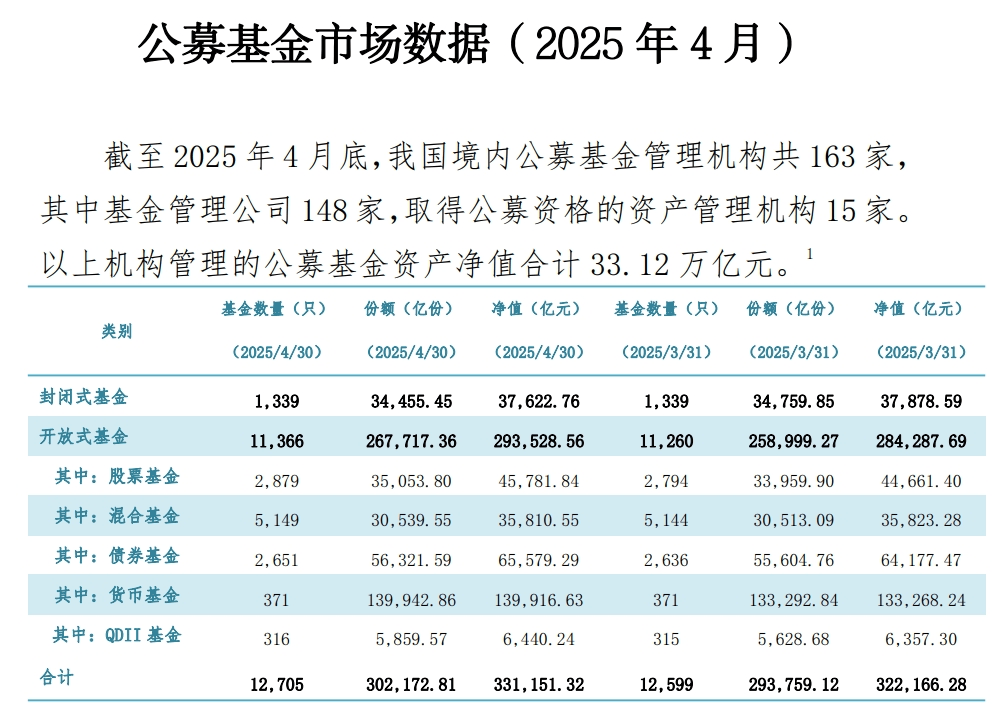
再创新高!境内公募基金规模突破33万亿元
Sou Hu Cai Jing· 2025-05-28 02:41
表中"封闭式基金"包含申报为封闭运作和定期开放的基金。由于四舍五入原因,可能存在分项之和不等于合计的情形。基金数量统计不含已向 证监会报送清盘的基金。数据来源于中国证监会。 数据显示,截至2025年4月底,境内公募基金份额和净值均高于3月末同期,实现"双增长",分别达到302172.81亿份和331551.32亿元。 2025年4月,尽管A股一度受国际局势影响下挫,但随着"国家队"积极护盘、机构投资者纷纷唱多和上市公司密集回购,大盘迅速企稳回升并 收复失地;同时,境外市场有所回暖,债券市场调整后出现反弹;此外,存款利率不断走低,间接导致了"存款搬家"。 | 类别 | 基金数量(只) | 份额(亿份) | 净值(亿元) | 基金数量(只) | 份额(亿份) | 净值(亿元) | | --- | --- | --- | --- | --- | --- | --- | | | (2025/4/30) | (2025/4/30) | (2025/4/30) | (2025/3/31) | (2025/3/31) | (2025/3/31) | | 封闭式基金 | 1,339 | 34,455.45 | 37,622. ...
首批26只新型浮动费率基金获批
Sou Hu Cai Jing· 2025-05-25 23:05
首批26只新型浮动费率基金获批 最近,事关8亿多基民的公募基金改革正在落地。5月23日,首批26只新型浮动费率产品拿到了证监会的 上市"许可证"。这意味着,最快下周就有产品将上架开售。 除了浮动费率,本轮公募基金改革关键点还在于全面升级对基金公司和基金经理的考核"指挥棒",引导 他们真正和基民"同甘共苦"。 浮动费率之后,管理费就要和每个基民的持有期限、持有期间基金有没有跑赢业绩比较基准、有没有给 基民挣到钱挂钩了。比如基民买了"小牛基金",如果拿了不满一年就卖了,管理费还是1.2%。 如果拿满一年想卖,那管理费就要分三种情况了。先假设"小牛基金"锚定的业绩比较基准是沪深300。 情况一:"小牛基金"赚钱了,年化收益率还比沪深300跑赢6%以上,相当于每年帮基民挣到了6%以上 的超额收益。基金公司最多可以收每年1.5%的管理费。 情况二:"小牛基金"年化收益率比沪深300跑输3%或更多,基金公司最多只可以收每年0.6%的管理费。 基金表现明显跑输了市场,业绩差只能少收费。 情况三:除了以上情况,基金仍按每年1.2%收管理费。 在这种浮动费率下,基民同样买1000元基金,表现好的基金每年管理费可以收到15元,表 ...