
春节效应

Search documents
热门赛道速递|A股市场“春节效应”大数据观察,这些赛道值得关注!
和讯· 2026-02-05 09:59
Core Viewpoint - The article discusses the "Spring Festival Effect" in the A-share market, emphasizing that it is not merely about price increases or decreases, but rather about market rhythm and style shifts during this period [3][4]. Group 1: Market Trends - Historical data from 2015 to 2025 indicates that the A-share market exhibits systematic and quantifiable characteristics around the Spring Festival, particularly in overall trends and style rotations [5]. - Pre-festival, market sentiment is generally stable, with the average increase of the Shanghai Composite Index and CSI 300 Index being approximately 0.62% and 0.77% respectively in the last five trading days before the festival, and an upward probability of about 63.6% [6][11]. - Post-festival, the market often enters a sustained upward phase, with the average increase of major indices turning positive within the first ten trading days after the festival, showing an upward probability of 72.7% for the Shanghai Composite Index and 81.8% for the CSI 1000 Index [11][12]. Group 2: Style Rotation - There is a clear rotation in market style before and after the Spring Festival. Before the festival, larger-cap stocks tend to outperform due to lower trading activity and higher certainty in earnings, as indicated by the better performance of the CSI 300 Index compared to the CSI 1000 Index [13][15]. - After the festival, the market sees a significant reversal in style, with the CSI 1000 Index showing an average increase of 2.47% in the first five trading days post-festival, outperforming the CSI 300 Index, which only saw a marginal increase of 0.01% [15][16]. - This shift indicates a return of funds and an increase in risk appetite, with investors favoring smaller-cap growth stocks that are more sensitive to liquidity [15][20]. Group 3: Future Market Predictions - For the 2026 Spring Festival, the report suggests a high probability of a phase of market recovery post-festival, driven by valuation levels, policy expectations, and capital inflows, although the path may be more complex than in previous years [18][19]. - The rotation logic of preferring defensive large-cap stocks before the festival and more elastic assets afterward remains relevant, with a focus on sectors that align with current policy support for technological innovation and new production capabilities [20][21]. - Key sectors to watch post-festival include artificial intelligence, high-end manufacturing, and renewable energy, which are expected to benefit from strong policy drivers and high industry growth [21][22].


帮主郑重收评:银行股午后为何暴拉?市场分化中看懂资金调仓
Sou Hu Cai Jing· 2026-02-05 08:57
Core Viewpoint - The market is experiencing a divergence characterized by "defensive reallocation" meeting "policy-driven support," with significant movements in the financial and consumer sectors while precious metals and tech hardware continue to decline [3][4][6] Group 1: Market Dynamics - The market's downturn is primarily affecting precious metals and certain tech hardware sectors due to external market sentiment and profit-taking, indicating a low risk appetite among investors [3] - Funds are reallocating towards large consumer and financial sectors, driven by the "Spring Festival effect" and supportive policies [3][4] Group 2: Financial Sector Insights - The surge in bank stocks is attributed to three main factors: policy support from the central bank, the defensive characteristics of high dividends and low valuations, and anticipatory positioning for economic stabilization [4][5] - The recent announcement of zero tariffs for residents in Hainan's free trade port is expected to boost consumer spending, particularly benefiting retail and film sectors [4] Group 3: Investment Strategies - Investors are advised to recognize the current market phase and adopt a "structural defense" approach, focusing on stable performance and policy-friendly sectors [5] - For strong financial and consumer sectors, it is recommended to follow trends cautiously and avoid chasing stocks that have seen excessive intraday gains [5] - Growth sectors undergoing adjustments should be closely monitored, with a focus on identifying strong industry leaders for potential long-term investment [5] - A balanced investment strategy is suggested, utilizing a "barbell" approach to allocate assets between defensive sectors and maintaining cash reserves for future opportunities [5][6] Group 4: Future Market Observations - Attention should be given to the sustainability of the financial sector's performance and whether market volume can increase effectively [6] - The response of the U.S. stock market to significant tech events, such as SpaceX's satellite system application, may influence the sentiment of the tech sector in the A-share market [6]

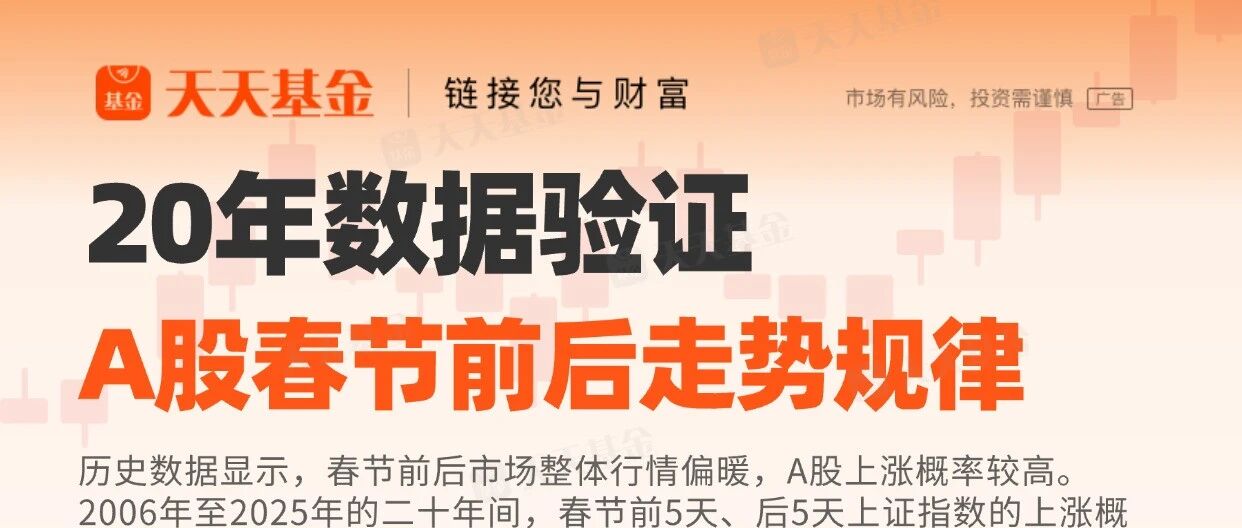
20年数据验证,春节前后的市场行情有何规律?
天天基金网· 2026-02-05 08:43
一 大大基金 | 链接您与财富 市场有风险,投资需谨慎 |广告 20 - = - " " 技术 う削后走势如准 历史数据显示,春节前后市场整体行情偏暖,A股上涨概率较高。 2006年至2025年的二十年间,春节前5天、后5天上证指数的上涨概 率分别高达80%、75%。 近20年上证指数春节前后表现 | 年份 | 节前5日 | 节前1日 | 节后1日 | 节后5日 | | --- | --- | --- | --- | --- | | 2025 | 0.19% | -0.06% | -0.65% | 2.08% | | 2024 | 3.43% | 1.28% | 1.56% | 4.85% | | 2023 | 2.18% | 0.76% | 0.14% | -0.04% | | 2022 | -4.57% | -0.97% | 2.03% | 3.02% | | 2021 | 3.92% | 1.43% | 0.55% | -2.49% | | 2020 | -3.17% | -2.75% | -7.72% | -3.38% | | 2019 | × 0.63% | 1.30% | 1.36% | 2.45 ...
周末利空不断!地产、金银都麻烦了!下周,A股或会历史重演
Sou Hu Cai Jing· 2026-02-01 18:39
春节假期前的这个周末,市场消息面颇不平静。 两则重磅利空突然发酵,让不少投资者捏了一把冷汗。 一则是国际金银价格在近期创下新高后,突然掉头 向下,出现暴跌行情。 另一则,是A股上市房企集中披露的年度业绩预告,亏损金额触目惊心,有公司甚至一年亏掉了超过820亿元。 这两件事,单拎出任何一件都足以让相关板块抖三抖,如今却凑到了一起。 要知道,黄金、白银等贵金属板块,以及与之联动的工业有色股票,在过去一 段时间里是市场的人气先锋,它们在上证指数里占有不小的权重。 而房地产板块,虽然股价低迷已久,但它仍然是A股市场中一块巨大的"压舱石"。 这两个权重板块同时传出坏消息,就像给节前市场突然浇了两盆冷水。 很多人开始担心,本就走势纠结的大盘,会不会在下周被直接"拖下水"? 2026年2月 1日这个周一,开盘恐怕不会太轻松。 这就造成了业绩的"财务大洗澡"。 亏掉的这800多亿,相当大一部分是纸面财富的蒸发。 这里面藏着一个关键的财务逻辑:存货减值是可以"转回"的。 也就是说,今天因为市场不好,我把这 块地价值计为0,计了800亿亏损。 如果未来一两年,市场回暖,这块地又能按正常价格卖出去了,那么当初计为亏损的部分,就能在 ...
中采PMI点评(26.01):1月PMI:春节效应前置
Shenwan Hongyuan Securities· 2026-01-31 15:24
Group 1: PMI Data Overview - January manufacturing PMI decreased to 49.3%, down 0.8 percentage points from December's 50.1%[1] - Non-manufacturing PMI fell to 49.4%, a decline of 0.8 percentage points from the previous month's 50.2%[1] Group 2: Factors Influencing PMI Changes - The significant drop in January PMI is attributed to the early return of workers for the Spring Festival and weak domestic demand[2] - The national migration scale index increased from 4% to approximately 8.6% year-on-year, indicating an earlier return home[2] Group 3: Sector-Specific Insights - Labor-intensive sectors, such as consumer goods and high-energy industries, saw larger PMI declines of 2.1 and 1 percentage points, respectively, to 48.3% and 47.9%[3] - The construction sector's PMI dropped 4 percentage points to 48.8%, while service sector PMI remained relatively stable at 49.5%, down only 0.2 percentage points[3] Group 4: Future Economic Outlook - Despite short-term weaknesses in manufacturing and construction due to the Spring Festival, the overall economic recovery trend is expected to continue in the coming months[4] - Service sector expectations may improve due to increased travel and holiday consumption, supported by recent policy measures[4]
成交额超83亿,A500ETF基金(512050)红盘向上,机构称2月有望迎来更好的时间窗口
Xin Lang Cai Jing· 2026-01-27 03:33
Group 1 - The A500 index (000510) increased by 0.08% as of January 27, 2026, with notable gains from stocks such as Hunan Gold (+10.01%), Tianfu Communication (+8.54%), and Zijin Mining (+6.68%) [1] - The A500 ETF fund (512050) saw a 0.16% rise, with the latest price at 1.25 yuan, and a trading volume of 83.66 billion yuan, indicating active market participation [1] - Over the past year, the A500 ETF fund (512050) recorded an average daily trading volume of 52.56 billion yuan, with a recent weekly scale increase of 4.47 billion yuan [1] Group 2 - According to Everbright Securities, the spring market rally has distinct timing characteristics, with January being a preparation phase and February expected to provide a better window for significant market movements, particularly influenced by the Spring Festival effect [2] - Historical data from 2013 to 2025 shows that major indices tend to perform stronger as the Spring Festival approaches, especially in the week before the holiday, with positive average changes recorded [2] - The A500 index comprises 500 securities selected from various industries based on market capitalization and liquidity, reflecting the overall performance of representative listed companies [2] Group 3 - The A500 ETF fund (512050) has several related funds, including the 华夏中证A500ETF联接 A (022430), C (022431), and Y (022979), as well as the 华夏中证A500指数增强 A (023619) and C (023620) [3]
多地银行房贷放款速度加快 部分一线城市二手房市场企稳回升
Xin Hua Wang· 2025-08-12 06:29
尽管2月份居民中长期贷款出现负增长,但《证券日报》记者注意到,近期,在部分城市,银行对 于个人住房贷款的额度有所增加,放贷速度也在加快。 从诸葛找房数据研究中心重点监测的10城周度数据来看,3月7日至3月13日,包括北京、深圳、苏 州、南京、厦门、宁波等在内的10城二手住宅成交量为13208套,比前一周增长11.22%。其中,北京二 手房成交4329套,环比上涨29.07%,二手房成交规模自春节后逐周攀升,市场修复迹象较为明显。 但需要指出的是,目前楼市分化仍较为明显,热点城市二手房市场热度回升,购房需求较强,但也 有部分城市成交仍较为低迷,整体上"以稳为主"。 对此,光大证券金融业首席分析师王一峰对《证券日报》记者表示,从投放节奏上看,2月份信贷 投放呈现"前低后高"的特点。一般而言,春节期间会产生较强的信贷摊还特征,"春节效应"会导致信贷 出现较大幅度负增长。因此,按揭贷款呈现出增量萎缩态势也在情理之中。在供求压力下,后续按揭贷 款利率仍有下行空间,通过需求端的进一步松绑,居民购房需求将逐步升温,进而起到稳定房地产市场 销售的作用。 热点城市购房需求较强 记者调查发现,虽然受春节假期影响,2月份二手房市场 ...