科技投资

Search documents
市场早盘高开低走,中证A500指数上涨0.11%,3只中证A500相关ETF成交额超29亿元
Sou Hu Cai Jing· 2025-11-20 03:56
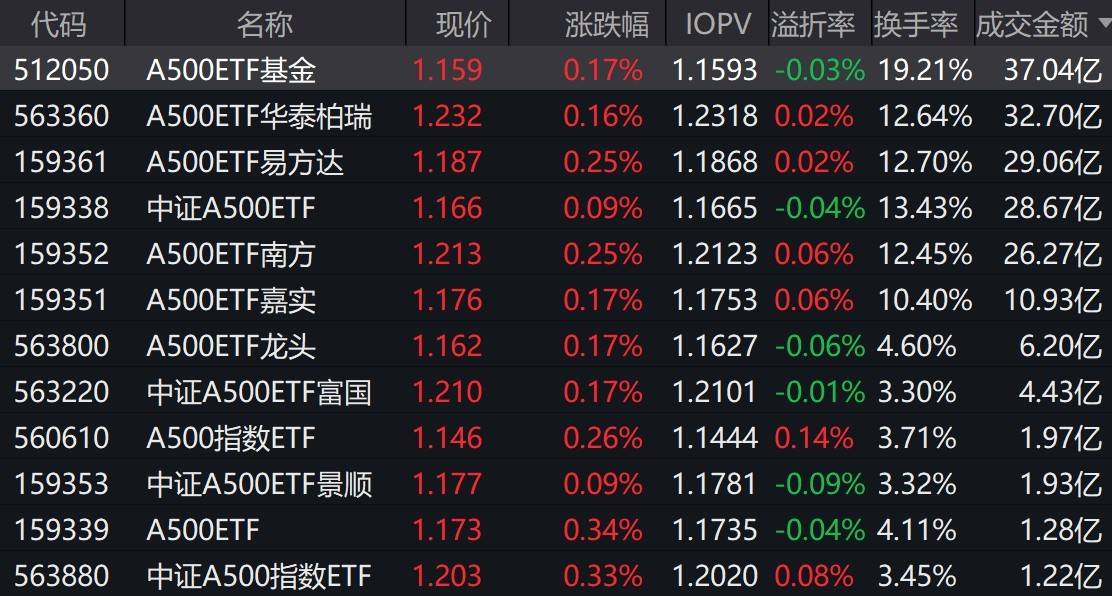
Core Viewpoint - The market opened higher but experienced a decline, with the CSI A500 index rising by 0.11%. The banking sector showed strength, while consumer sectors like tourism, food, retail, and textiles weakened. The overall market sentiment remains supported by ongoing global tech investment enthusiasm and policies promoting economic stability [1]. Market Performance - The CSI A500 index saw a slight increase of 0.11% in early trading. The banking sector performed well, while sectors related to tourism, food, retail, and textiles faced declines [1]. - As of the morning close, ETFs tracking the CSI A500 index experienced slight gains, with 12 ETFs exceeding a trading volume of 100 million yuan, and 3 surpassing 2.9 billion yuan. Specific ETFs such as A500ETF Fund, A500ETF Huatai-PB, and A500ETF E-Fund had trading volumes of 3.704 billion yuan, 3.270 billion yuan, and 2.906 billion yuan respectively [1]. ETF Trading Data - A500ETF Fund: Current price 1.159, up 0.17%, trading volume 3.704 billion yuan [2] - A500ETF Huatai-PB: Current price 1.232, up 0.16%, trading volume 3.270 billion yuan [2] - A500ETF E-Fund: Current price 1.187, up 0.25%, trading volume 2.906 billion yuan [2] - Other notable ETFs include A500ETF South, A500ETF Jias, and A500ETF Leading, with respective trading volumes of 2.627 billion yuan, 1.093 billion yuan, and 620.1 million yuan [2]. Future Outlook - Analysts suggest that the foundation for the current slow bull market remains intact, supported by factors such as sustained global tech investment enthusiasm, ongoing "anti-involution" policies, and increased household savings entering the market. There is potential for the A-share index to continue strengthening in the future [1].

【机构策略】A股市场处于震荡蓄势阶段
Zheng Quan Shi Bao Wang· 2025-11-20 01:09
Market Overview - The A-share market experienced fluctuations with sectors such as non-ferrous metals, oil and petrochemicals, national defense, beauty care, and banking showing strong gains, while sectors like comprehensive services, real estate, media, construction materials, and retail faced declines [1][1][1] - The market is currently in a consolidation phase around the 4000-point mark, with a long-term upward trend expected to continue [1][1][1] Sector Performance - Strong performance was noted in shipbuilding, precious metals, energy metals, and banking, while internet services, software development, cultural media, and electronic components lagged behind [1][1] - The market is in a critical phase for positioning for the upcoming year, with a likelihood of continued consolidation around the 4000-point level [1][1] Investor Sentiment - The stabilization of A-share indices is seen as a positive factor for short-term market confidence [1] - Despite geopolitical tensions leading to cautious funding behavior, the potential for increased market volatility remains [1] - Mid-term outlook remains optimistic due to sustained global tech investment enthusiasm, ongoing "anti-involution" policies, and increased retail investment [1][1]
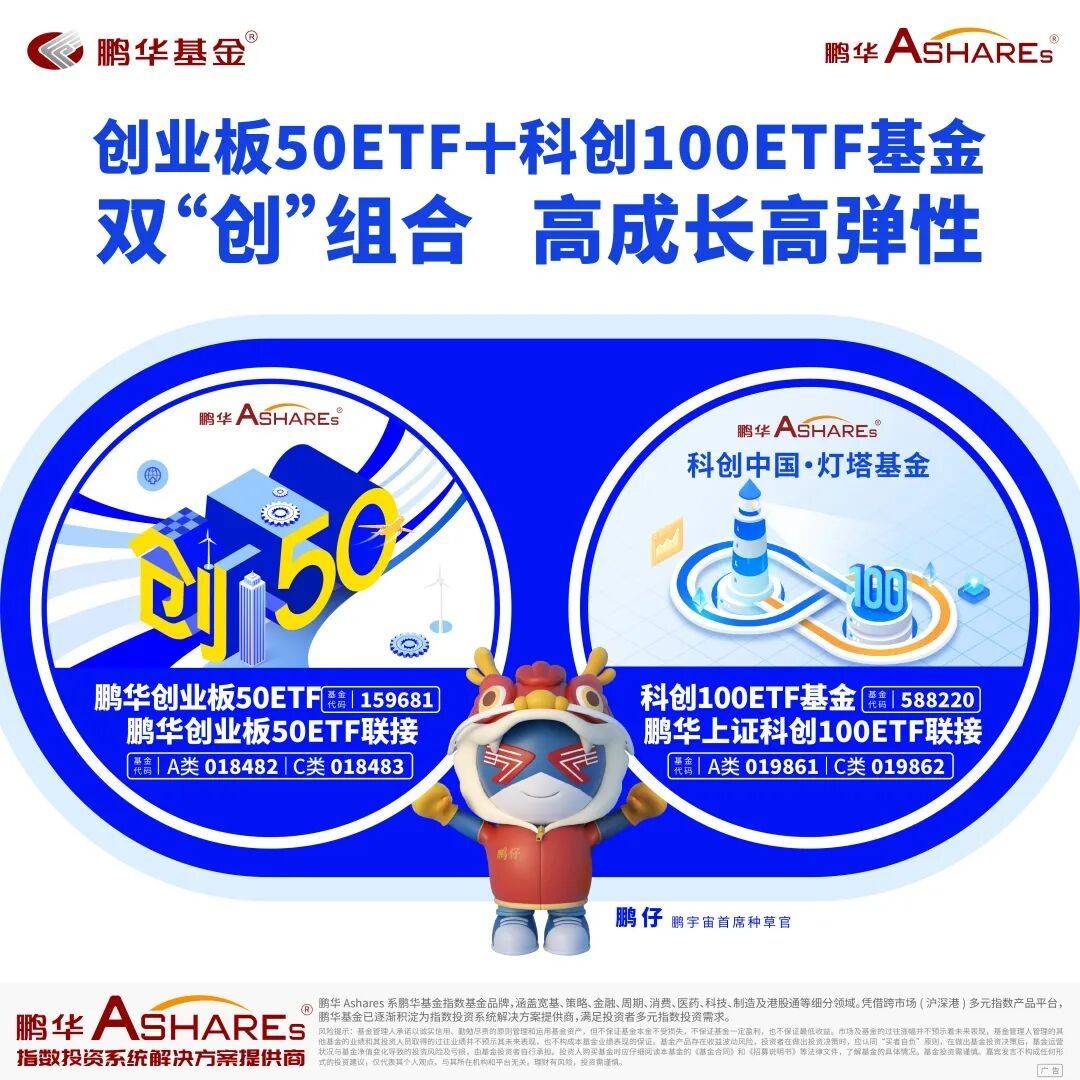
鹏华基金·科创股债ETF大厂|省心科技投资,双“创”组合动量轮动
Sou Hu Cai Jing· 2025-11-18 03:00
Core Insights - The technology sector has been the most prominent market theme this year, with rapid rotations among sub-sectors like AI computing, semiconductors, and new energy, making it challenging for ordinary investors to navigate [1] - Broad-based index funds are emerging as a better solution for ordinary investors to participate in the technology wave, offering industry-balanced allocation that diversifies individual stock risks while capturing industry trend dividends [1] Group 1: Index Characteristics - The ChiNext 50 and Sci-Tech 100 indices are highlighted as the "twin stars" of technology investment, with distinct compositions and risk profiles that complement each other [1][4] - The ChiNext 50 index represents "mature technology anchors," featuring leading companies in new energy, communications, and electronics, which have established strong competitive advantages and exhibit stable earnings [4] - In contrast, the Sci-Tech 100 index focuses on "hard technology pioneers," concentrating on sectors like semiconductors, pharmaceuticals, and high-end manufacturing, characterized by higher growth potential and volatility [4][6] Group 2: Momentum Rotation Strategy - A momentum rotation strategy is proposed, leveraging the strong performance of the ChiNext 50 and Sci-Tech 100 indices, which exhibit a "stronger gets stronger" effect typical in the technology sector [7] - Entry signals for the strategy are defined as a cumulative increase of 8% or more over the past 20 trading days for either index, with a preference for the index showing stronger momentum [7] - The strategy includes ongoing monitoring of the holding index's momentum, with a switch to the stronger index if the other surpasses it by 3 percentage points [7][8] Group 3: Strategy Performance - Historical backtesting from November 14, 2020, to November 14, 2025, shows that the momentum rotation strategy achieved a total return of 96.36%, significantly outperforming the ChiNext 50's 31.84% and the Sci-Tech 100's -0.78% [10] - The strategy also demonstrated effective risk control, with a maximum drawdown of -25.46%, compared to -63.72% for the Sci-Tech 100 index, resulting in a Sharpe ratio of 0.59, well above the benchmark's 0.21 [10] - The strategy successfully kept pace with market trends during bullish phases and avoided significant losses during market downturns by maintaining cash positions when both indices fell below the entry threshold [10]
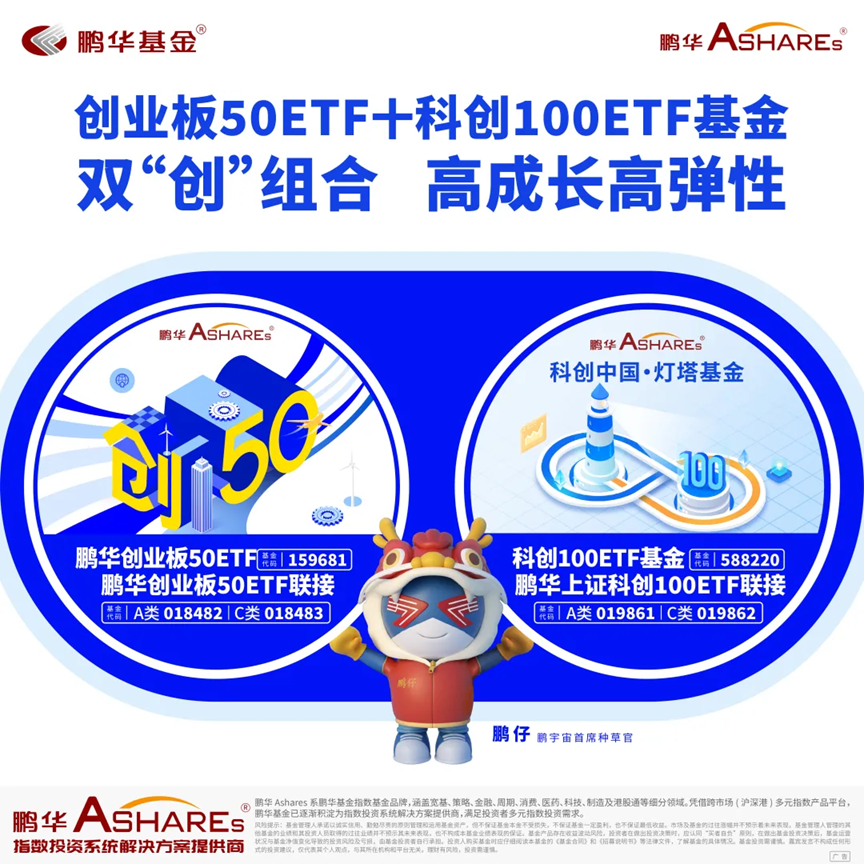
科技双雄新投法 跟着鹏华“科创股债ETF大厂”玩转双“创”组合动量轮动
Cai Fu Zai Xian· 2025-11-17 09:30
Core Insights - The technology sector has been the most prominent market theme this year, with rapid rotations among sub-sectors like AI computing, semiconductors, and renewable energy, making it challenging for ordinary investors to navigate [1] - Broad-based index funds are emerging as a better solution for ordinary investors to participate in the technology wave, offering industry-balanced allocation that diversifies individual stock risks while capturing industry trend benefits [1] Group 1: Index Characteristics - The ChiNext 50 and Sci-Tech 100 indices are highlighted as the "twin stars" of technology investment, with distinct component stock structures, industry focuses, and risk characteristics that complement each other [1][3] - The ChiNext 50 index represents "mature technology anchors," primarily consisting of leading companies in renewable energy, communications, and electronics, which have established strong competitive advantages and exhibit stable profitability [3] - In contrast, the Sci-Tech 100 index focuses on "hard technology pioneers," concentrating on sectors like semiconductors, pharmaceuticals, and high-end manufacturing, characterized by higher growth potential and greater volatility [3][4] Group 2: Momentum Rotation Strategy - A momentum rotation strategy is proposed to capitalize on technology investment opportunities, leveraging the inherent differences between the two indices [5] - Entry signals are defined as when either index achieves a cumulative gain of 8% over the past 20 trading days, with a preference for the index showing stronger momentum [7] - The strategy emphasizes disciplined and adaptive management, avoiding emotional trading and market noise, with clear rules for entry, holding, and exit [7] Group 3: Performance Metrics - Historical backtesting from November 14, 2020, to November 14, 2025, shows that the momentum rotation strategy achieved a total return of 96.36%, significantly outperforming the ChiNext 50's 31.84% and the Sci-Tech 100's -0.78% [10] - The strategy also demonstrated superior risk control, with a maximum drawdown of -25.46%, compared to the Sci-Tech 100's maximum drawdown of -63.72%, resulting in a Sharpe ratio of 0.59, well above the benchmark's 0.21 [10] - The strategy effectively tracks market trends during bullish phases and successfully avoids significant losses during market downturns by maintaining cash positions when necessary [10]
诺安基金邓心怡:做科技投资 前瞻才能获取超额收益
Zhong Guo Zheng Quan Bao· 2025-11-17 02:26
喜欢在论文中寻找产业前瞻趋势,常常为看到的技术进步而激动不已……寥寥数语,一个热衷于科技产 业投资的基金经理形象跃然纸上。化工材料专业出身,2013年开始研究布局新能源,如今逐渐聚焦科技 产业,诺安基金权益事业部副总经理、研究部总经理邓心怡正立足于人工智能(AI)浪潮开启她的投 资新征程。 近日,邓心怡在接受中国证券报记者专访时表示,"前瞻再前瞻一些"是令她觉得踏实的超额收益策略。 在产业趋势初露苗头、市场还没有充分定价前进入,能够更稳妥地获得可观回报。与此同时,"读论 文"成为她前瞻性嗅到投资机会的重要法宝。展望未来,她认为,AI有望成为科技产业浪潮中的核心驱 动力,看好该板块蕴藏的丰富投资机会。 邓心怡,曾任职于中国对外贸易信托有限公司,从事投资研究工作。2020年11月加入诺安基金,现任 权益事业部副总经理兼研究部总经理。自2022年7月6日起担任基金经理,现管理诺安稳健回报混合、诺 安平衡混合、诺安优势行业混合、诺安研究优选混合等多只产品。 读论文发现投资机会 中国证券报:可以先简单介绍下你的投资经历吗? 邓心怡:我最早是在外贸信托公司做自营投资,当时主要研究新能源、新材料、化工环保等,更多是偏 一级 ...

诺安基金邓心怡: 做科技投资 前瞻才能获取超额收益
Zhong Guo Zheng Quan Bao· 2025-11-16 20:13
Core Insights - The article highlights the investment strategy of Deng Xinyi, a fund manager at Nuoan Fund, who emphasizes the importance of early identification of investment opportunities in the technology sector, particularly in artificial intelligence (AI) [1][6]. Investment Experience - Deng Xinyi has a background in self-operated investment at a foreign trade trust company, focusing on new energy, new materials, and environmental protection, witnessing the rapid development of China's new energy vehicle industry [2]. - The transition from new energy to technology investments has been marked by a systematic understanding of the changes from internet to mobile internet, recognizing the empowerment brought by technological advancements [2]. Investment Strategy - The core investment strategy revolves around technology growth, with a focus on identifying high-growth investment targets across different industries [3][4]. - The strategy incorporates macroeconomic data tracking, industry policy analysis, and micro-level research on individual stocks to identify competitive advantages and market share [3]. Identifying Opportunities - A unique approach to identifying forward-looking investment opportunities involves reading academic papers, which can reveal technological applications and market readiness before they are fully priced in by the market [5]. - The AI sector is viewed as a significant driver of the current technology wave, comparable to the mobile internet era, with ample investment opportunities and time for strategic positioning [6]. Company Characteristics - Companies that leverage AI capabilities to transform productivity across various sectors are prioritized, especially those with strong customer data and ecosystem barriers [7]. - The distinction between "shovel-type" companies (providing tools) and application-based companies is crucial for investment focus [7]. Stock Selection - Stock selection is based on technological foundations and the ability to match industry changes, alongside valuation assessments to identify stocks with significant return potential [8]. - Continuous industry research and tracking of high-frequency data are essential for evaluating investment opportunities and risks dynamically [8]. Market Dynamics - The article discusses the challenges faced in 2023, including market pullbacks in the AI sector, prompting a reassessment of the industry's genuine demand and the manager's investment capabilities [10][11]. - The importance of distinguishing between fluctuations caused by technological changes versus pricing changes is emphasized, as this can guide strategic adjustments in investment positions [11]. Fund Management - Active equity funds are positioned as tools for investors to engage in industry investments, with advantages in timely capturing investment opportunities and flexibility in portfolio adjustments compared to passive ETFs [12].
做科技投资 前瞻才能获取超额收益
Zhong Guo Zheng Quan Bao· 2025-11-16 20:13
□本报记者 张韵 喜欢在论文中寻找产业前瞻趋势,常常为看到的技术进步而激动不已……寥寥数语,一个热衷于科技产 业投资的基金经理形象跃然纸上。化工材料专业出身,2013年开始研究布局新能源,如今逐渐聚焦科技 产业,诺安基金权益事业部副总经理、研究部总经理邓心怡正立足于人工智能(AI)浪潮开启她的投 资新征程。 近日,邓心怡在接受中国证券报记者专访时表示,"前瞻再前瞻一些"是令她觉得踏实的超额收益策略。 在产业趋势初露苗头、市场还没有充分定价前进入,能够更稳妥地获得可观回报。与此同时,"读论 文"成为她前瞻性嗅到投资机会的重要法宝。展望未来,她认为,AI有望成为科技产业浪潮中的核心驱 动力,看好该板块蕴藏的丰富投资机会。 邓心怡,曾任职于中国对外贸易信托有限公司,从事投资研究工作。2020年11月加入诺安基金,现任权 益事业部副总经理兼研究部总经理。自2022年7月6日起担任基金经理,现管理诺安稳健回报混合、诺安 平衡混合、诺安优势行业混合、诺安研究优选混合等多只产品。 读论文发现投资机会 中国证券报:可以先简单介绍下你的投资经历吗? 邓心怡:我最早是在外贸信托公司做自营投资,当时主要研究新能源、新材料、化工环保 ...
FOF基金三季度业绩爆发迎来高光时刻!专业买手资产配置能力凸显!
市值风云· 2025-11-14 10:15
Core Viewpoint - The public FOF funds have achieved remarkable performance in Q3 2025, with all funds reporting positive returns for the year, marking an unprecedented situation in the market [1][3]. Performance Highlights - The top-performing FOF product has recorded a return of nearly 70% this year, significantly outperforming many actively managed equity funds [2][5]. - The leading FOF fund, Guotai Youxuan Lianhang One-Year Holding FOF, achieved a return of 66.7%, followed by Guotai Industry Rotation Stock C at 60.3% and E Fund Gold Theme at 55.3% [3][4]. Fund Growth and Popularity - The total scale of public FOF funds increased from 165.7 billion yuan at the end of Q2 to 193.4 billion yuan by the end of Q3, with the number of funds rising from 517 to 518 [7][10]. - Some FOF products have seen their scale grow more than tenfold, indicating strong investor interest and confidence [10][12]. Investment Strategies and Trends - FOF funds have shown a significant preference for gold-themed funds, which accounted for 40% of the top ten performing FOF funds, reflecting a strategic focus on risk-averse assets amid rising geopolitical risks and fluctuating inflation expectations [5][19]. - The international gold price has been strong, surpassing $2,600 per ounce in Q3, contributing to the performance of gold-related investments [5][19]. Major Holdings and Adjustments - The top five funds held by FOFs include Hai Fudong Zhongzheng Short Bond ETF, Huazheng Gold ETF, and several other bond ETFs, indicating a strong focus on fixed-income securities [13][15]. - FOFs have increased their holdings in Huazheng Gold ETF by over 70 million shares in Q3, demonstrating a proactive approach to asset allocation [6][18]. Future Outlook - FOF fund managers are looking to balance their portfolios with a focus on technology and cyclical sectors for Q4, while maintaining a solid foundation in bond and gold investments [20][22]. - The consensus among FOF managers is to adopt a flexible and balanced investment strategy to navigate potential market volatility while seeking excess returns [22].
巴菲特退休了,股神投资科技公司最大遗憾是?丨硅谷观察
Xin Lang Ke Ji· 2025-11-14 02:20
Core Points - Warren Buffett officially announced his retirement in Berkshire Hathaway's annual shareholder letter, marking the end of an era for the legendary investor [4][6] - Buffett will pass the CEO position to Greg Abel by the end of the year while remaining as chairman [4][6] - Berkshire Hathaway's cash reserves reached a record high of $358 billion, which some analysts view as a strategic move by Buffett to empower Abel for significant acquisition decisions [6][7] - Following the retirement announcement, Berkshire Hathaway's stock price declined, reflecting a decrease in the "Buffett premium" that investors previously associated with the company's shares [6][7] Investment Philosophy - Buffett's investment philosophy emphasizes investing in companies with strong "moats," particularly in consumer goods, finance, and insurance sectors [10] - His cautious approach to technology investments stemmed from a belief that technology companies often lack predictable cash flows and competitive advantages [10][19] - Despite past hesitations, Buffett has gradually embraced technology investments, viewing certain tech companies as consumer brands with strong customer loyalty [19][23] Notable Investments - Buffett's significant investment in Apple, which he views as a consumer products company rather than a tech firm, has yielded substantial returns, making it Berkshire's most profitable investment [23][25] - The investment in Amazon was driven by the belief that it operates like a consumer goods company, with strong market dominance and customer loyalty [26] - Berkshire's investment in BYD, a Chinese battery technology company, has been highly successful, yielding over 40 times the initial investment [28][30] Market Trends and Future Outlook - Buffett has maintained a cautious stance towards the AI sector, emphasizing the importance of understanding a company's value before investing [34] - The potential for future investments in AI by Buffett's successors remains uncertain, with concerns about market bubbles and regulatory needs [34]

巴菲特退休了,股神在科技领域战绩如何?|硅谷观察
Xin Lang Ke Ji· 2025-11-13 23:32
Group 1 - Warren Buffett officially announced his retirement in the annual shareholder letter of Berkshire Hathaway, marking the end of an era for the legendary investor [4][6] - Buffett will pass the CEO position to his successor Greg Abel by the end of the year, while he will continue to serve as chairman [4][6] - Berkshire Hathaway's cash and cash equivalents reached a record high of $358 billion at the end of the third quarter, which some analysts view as a strategic choice by Buffett to empower Abel for significant acquisition decisions [6][7] Group 2 - The end of Buffett's era signifies a turning point for value investing, with his impressive track record including a compound annual return rate of 20%, double that of the S&P 500 index [8][10] - Buffett favored companies with strong "moats," such as Coca-Cola and American Express, which generated substantial returns for Berkshire Hathaway [10] - His investment philosophy, influenced by Benjamin Graham, emphasized "margin of safety" and buying undervalued stocks, leading to a cautious approach towards technology stocks [10][11] Group 3 - Buffett's reluctance to invest in technology stocks stemmed from a belief that they lacked predictable cash flows and competitive advantages, leading him to miss out on significant opportunities like IBM and Microsoft [11][13] - Despite his initial skepticism, Buffett gradually embraced technology investments, viewing certain tech companies as consumer brands with strong customer loyalty [18][23] - His successful investments in Apple and Amazon were based on their strong market positions and brand loyalty, with Apple becoming Berkshire's largest single investment [23][26] Group 4 - Buffett's investment in BYD, a leading electric vehicle manufacturer, yielded over 40 times returns, showcasing his ability to identify strong companies in emerging sectors [29][31] - Despite the success with BYD, Buffett has consistently avoided investing in Tesla, citing a lack of predictability and high valuations in the automotive industry [33] - In the current AI era, Buffett remains cautious, emphasizing the importance of buying undervalued assets and expressing concerns about the potential risks associated with AI technologies [34]