通胀粘性

Search documents
中信证券:美国宏观数据仍处在回落区间
Ge Long Hui A P P· 2025-08-29 01:33
Group 1 - The core viewpoint of the article indicates that while the overseas macroeconomic environment remains resilient, it faces challenges such as economic downturn, persistent inflation, and constraints from incremental policies, leading to a slight dovish shift in monetary policy [1] Group 2 - In the United States, macro data is observed to be in a downturn phase, with economic activities showing signs of early overextension, and inflation beginning to impact consumption and residents' lives, suggesting a significant economic slowdown in the second half of the year [1] - The Eurozone shows some improvement in economic sentiment, but remains at a low point due to tariff disruptions from the United States [1] - Australia's economy is less affected by tariffs compared to the Eurozone, with domestic consumption supporting its economic stability [1] - Japan's economy continues to face high inflation issues, while South Korea's monetary policy is easing, although the short-term effects of tax cuts may not meet expectations [1]

最新一周加密货币永续合约动态:XBIT策略在波动中显优势
Sou Hu Cai Jing· 2025-08-20 13:47
Core Insights - The global cryptocurrency market is regaining investor attention despite a slight pullback in Bitcoin, indicating strong buying power as funds continue to flow in [1][4] - The recent U.S. economic data, particularly inflation concerns and interest rate expectations, adds uncertainty to the perpetual contract market [1][3] - Ethereum has shown strong performance with a weekly increase of 5.22%, indicating a shift in capital flow from Bitcoin to the Ethereum ecosystem [1][4] Market Performance - Bitcoin opened at $119,309.37 and closed at $117,488.60, reflecting a decline of 1.53% with a volatility of 6.43% and increased trading volume [1] - The total capital inflow into the cryptocurrency market reached $19.8 billion over the week, with stablecoins contributing $6.145 billion and Ethereum spot ETFs also seeing inflows of $2.394 billion [4] Economic Indicators - The U.S. July CPI rose by 2.7% year-on-year, aligning with expectations, while PPI data exceeded expectations with a monthly increase of 0.9% and a yearly increase of 3.3%, raising concerns about persistent inflation [3] - Market expectations for a 50 basis point rate cut in September have been largely dismissed, with a 90% probability still favoring a 25 basis point cut [3] Perpetual Contracts Market - The perpetual contracts market is experiencing significant trading volume increases, with traders using these contracts to hedge against spot market volatility [4][5] - The unique design of perpetual contracts on decentralized platforms like XBIT is providing good liquidity depth amid market fluctuations [4][7] Investor Behavior - Professional traders are adjusting their risk exposure through cryptocurrency perpetual contracts, reflecting a cautious yet optimistic market sentiment [5][9] - The participation of institutional investors in the perpetual contracts market has recently increased, indicating growing confidence in these financial instruments [7] Future Considerations - Key factors to monitor include the Federal Reserve's decisions in the upcoming September meeting, subsequent inflation data, and the flow of funds into the cryptocurrency market, particularly from institutional investors [8][9] - The importance of selecting a reliable trading platform is emphasized, with XBIT providing features that enhance user control over assets and risk management [8][11]


美联储降息存疑 通胀粘性或致零次行动
Jin Tou Wang· 2025-08-11 04:22
Core Viewpoint - The article discusses the skepticism surrounding the Federal Reserve's potential interest rate cuts this year, with a strong emphasis on persistent inflation concerns and the impact of upcoming appointments to the Federal Reserve Board [1]. Group 1: Federal Reserve's Interest Rate Outlook - The most likely scenario is that the Federal Reserve will only cut rates once this year, with the possibility of no cuts being even greater [1]. - The Federal Reserve has maintained a consistent communication strategy and is exercising caution in its decision-making process [1]. - The appointment of a new Federal Reserve governor by President Trump could alter the voting dynamics within the Federal Reserve [1]. Group 2: Inflation Concerns - The core reason for skepticism about rate cuts is the persistent issue of inflation, which the Federal Reserve has repeatedly highlighted [1]. - Despite previously downplaying the impact of employment data, the Federal Reserve's recent stance appears to be shifting, although significant deterioration in the job market is needed to justify rate cuts [1]. - There are concerns that inflation may remain high or even worsen, which could complicate the Federal Reserve's policy decisions if rate cuts are implemented under such conditions [1]. Group 3: Market Indicators - The current dollar index is reported at 98.07, reflecting a decline of 0.20% from an opening price of 98.27 [1]. - The dollar index has faced resistance at the 98.50 level after breaking through daily support last week, indicating potential for further upward movement if it stabilizes [1].
机构:仍不认为美联储今年会降息 通胀粘性仍是关键问题
Sou Hu Cai Jing· 2025-08-06 03:36
Core Viewpoint - The Chief Investment Officer of SWBC, Chris Brigati, remains skeptical about the Federal Reserve's potential interest rate cuts this year, suggesting that only one cut is likely, or even none at all [1] Group 1: Federal Reserve's Stance - The Federal Reserve maintains a consistent communication strategy and approaches decision-making with caution and patience [1] - The upcoming opportunity for Trump to appoint a new Federal Reserve governor may alter the voting member distribution within the Fed [1] Group 2: Inflation Concerns - Brigati's skepticism regarding interest rate cuts is primarily due to persistent inflationary pressures, referred to as "sticky inflation" [1] - The Federal Reserve has repeatedly emphasized its concern over sticky inflation, which remains a critical factor in their decision-making [1] Group 3: Employment Data and Rate Cuts - Although the Fed previously downplayed the impact of employment data, there seems to be a recent shift in their stance [1] - Without clear signs of deterioration in the labor market, any potential interest rate cuts are expected to be limited [1] Group 4: Economic Indicators - Currently, the only available indicator for reference is the latest non-farm payroll data, which is seen as insufficient [1] - There are concerns that inflation may remain elevated or even worsen, which could complicate the Fed's policy decisions if rate cuts are implemented under such conditions [1]
通胀粘性担忧升温,交易员紧盯通胀数据判断9月降息前景
Hua Er Jie Jian Wen· 2025-07-31 14:08
Group 1 - The core viewpoint indicates that if the upcoming PCE price index shows persistent inflation, market expectations for maintaining high interest rates for a longer period may solidify [1][2] - Economists predict that the core PCE month-on-month rate will rise from 0.2% to 0.3% [1][2] - Following the Federal Reserve's decision to maintain interest rates, market sentiment shifted, with the probability of a rate cut in September dropping from 80% to 40% [2] Group 2 - The Federal Reserve's recent policy stance was anticipated, with Barclays Bank's U.S. interest rate strategy head stating that the market should focus more on the delayed start of rate cuts, expecting the first cut to occur in December [5] - Despite pressure from President Trump to lower borrowing costs, Powell emphasized that the conditions for a rate cut are not currently met due to a strong labor market and high inflation [5] - Long-term inflation expectations have risen approximately 20 basis points to 2.50% since April, as indicated by swap contracts [5] Group 3 - The impact of increased tariffs adds uncertainty to the inflation outlook, with businesses starting to pass on tariff-related costs to consumers [6] - Powell suggested that the Fed views the price increases from tariffs as potentially temporary, which may influence their decision-making [6] - The complexity of the inflation path is prompting some investors to adopt defensive strategies, such as increasing holdings in Treasury Inflation-Protected Securities (TIPS) [6]
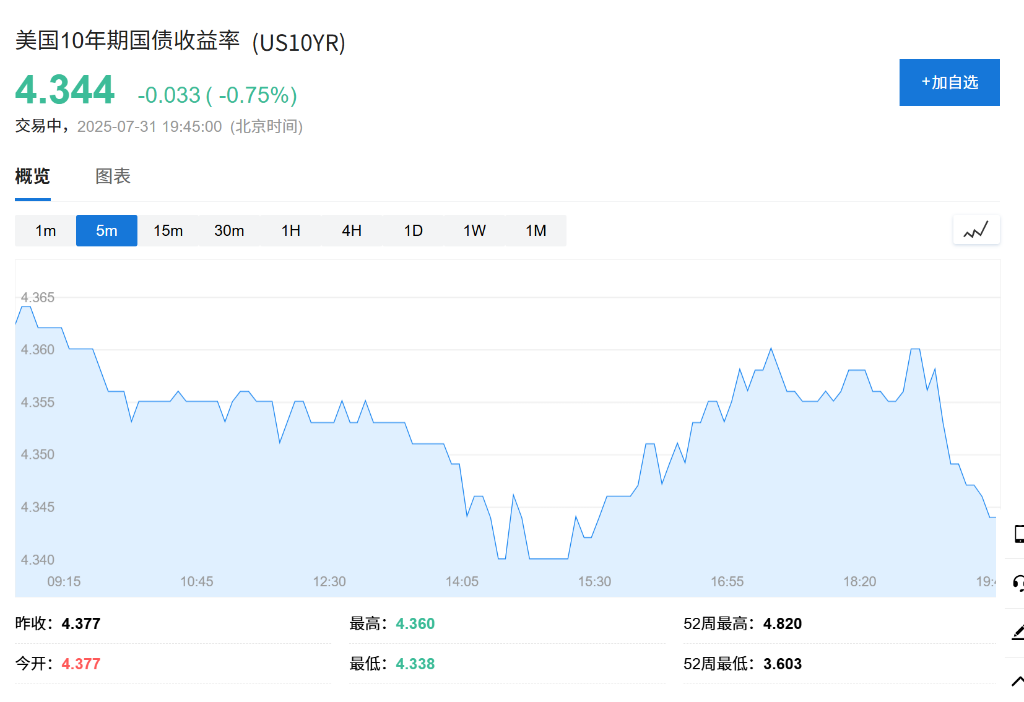
通胀粘性担忧升温 交易员紧盯通胀数据判断9月降息前景
Hua Er Jie Jian Wen· 2025-07-31 12:19
Group 1 - The Federal Reserve's recent decision to maintain interest rates has shifted market expectations, with a significant reduction in the probability of a rate cut in September from 80% to 40% [1] - The upcoming PCE price index data is crucial for assessing persistent inflation pressures, with economists predicting a rise in core PCE month-on-month from 0.2% to 0.3% [1] - Following the Fed's hawkish stance, U.S. Treasury yields experienced fluctuations, with the two-year yield rising by 7 basis points on Wednesday and then retreating by 1 basis point to 3.93% on Thursday [1] Group 2 - Barclays Bank's U.S. interest rate strategy head indicated that the market should focus on the delayed possibility of rate cuts, with the first expected cut not occurring until December [2] - Despite pressure from President Trump to lower borrowing costs, Fed Chair Powell emphasized that current labor market conditions and inflation levels do not warrant a rate cut [2] - Long-term inflation expectations have risen approximately 20 basis points to 2.50% since April, indicating persistent inflation concerns in the market [2] Group 3 - The impact of increased tariffs adds uncertainty to inflation forecasts, as companies begin to pass on tariff-related costs to consumers [3] - Powell suggested that the Fed views tariff-induced price increases as potentially temporary, which may influence future monetary policy decisions [3] - The demand for inflation-protected securities (TIPS) is rising among investors, reflecting a growing concern over inflation risks in the current economic environment [3]
通胀粘性担忧升温,交易员紧盯通胀数据以判断9月降息前景
Hua Er Jie Jian Wen· 2025-07-31 11:53
Group 1 - The Federal Reserve has signaled a potential delay in interest rate cuts, shifting market focus to upcoming inflation data [1] - Following the Fed's decision to maintain interest rates, market sentiment reversed, with the probability of a rate cut in September dropping from 80% to 40% [1] - Economists expect the core PCE monthly rate to rise from 0.2% to 0.3%, indicating persistent inflation risks [1] Group 2 - Barclays Bank anticipated a hawkish outcome from the Fed meeting, with expectations for the first rate cut pushed to December [5] - Despite pressure from President Trump to lower borrowing costs, Fed Chair Powell emphasized that current economic conditions do not warrant a rate cut [5] - Long-term inflation expectations have risen by approximately 20 basis points to 2.50% since April [5] Group 3 - The impact of increased tariffs adds uncertainty to inflation forecasts, as companies begin to pass on tariff-related costs to consumers [6] - Powell indicated that the Fed views tariff-induced price increases as potentially temporary, which may influence their decision-making [6] - Investors are increasingly seeking to hedge against inflation risks, as evidenced by the increased allocation to Treasury Inflation-Protected Securities (TIPS) [6]
汇率双周报 | 政治漩涡中的“弱势”日元?(申万宏观·赵伟团队)
赵伟宏观探索· 2025-07-28 12:45
Group 1 - The article discusses the divergence between the Japanese stock market and the yen, highlighting that while the Nikkei 225 index has approached historical highs, the yen has depreciated significantly [3][9][71] - Since June, the Nikkei 225 has surged by 9.2%, with foreign capital inflows totaling $5.11 billion, while the yen has weakened by 2.4% during the same period [3][9][71] - The article notes that this divergence is not uncommon in Japan, as currency depreciation can improve corporate earnings, particularly for companies with significant overseas revenue [18][71] Group 2 - The article identifies low inflation expectations and a cooling of interest rate hike predictions as key factors contributing to the yen's weakness [32][72] - Japan's core CPI has been influenced more by imported factors, and inflation has consistently fallen short of expectations, leading to a reduction in market expectations for interest rate hikes from 0.7 times to 0.6 times per year [32][72] - The article also mentions that unsuccessful trade negotiations between the US and Japan, along with political turmoil from recent Senate elections, have exacerbated the yen's weakness [4][41][72] Group 3 - Following the recent trade agreement between the US and Japan, market expectations for a Bank of Japan interest rate hike in October have increased from 42.1% to 68.1% [5][51][72] - However, the article warns that insufficient inflation persistence may still hinder significant interest rate increases by the Bank of Japan [5][51][72] - The focus moving forward will be on the upcoming leadership election within the ruling Liberal Democratic Party and potential fiscal expansion, which could lead to concerns about a "debt and currency double whammy" [58][72]

汇率双周报 | 政治漩涡中的“弱势”日元?(申万宏观·赵伟团队)
申万宏源宏观· 2025-07-27 10:43
Group 1 - The article discusses the divergence between the Japanese stock market and the yen, highlighting that while the Nikkei 225 index has approached historical highs, the yen has depreciated significantly [3][9][71] - Since June, the Nikkei 225 has surged by 9.2%, with foreign capital inflows totaling $5.11 billion, while the yen has weakened by 2.4% during the same period [3][9][71] - The article notes that this divergence is not uncommon in Japan, as currency depreciation can improve corporate earnings, particularly for companies with significant overseas revenue [18][71] Group 2 - The article identifies low inflation expectations and a cooling of interest rate hike expectations as key factors contributing to the yen's weakness [32][72] - Japan's core CPI has been influenced more by imported factors, and inflation has consistently fallen short of expectations, leading to a reduction in market expectations for interest rate hikes from 0.7 times to 0.6 times per year [32][72] - The article also mentions that unsuccessful trade negotiations between the US and Japan, along with political turmoil from recent Senate elections, have exacerbated the yen's weakness [4][41][72] Group 3 - Following the recent trade agreement between the US and Japan, market expectations for a Bank of Japan interest rate hike in October have increased from 42.1% to 68.1% [5][50][51] - However, the article warns that insufficient inflation persistence may still hinder significant interest rate hikes by the Bank of Japan [5][50][51] - The focus moving forward will be on the upcoming leadership election within the ruling Liberal Democratic Party and potential fiscal expansion, which could lead to concerns about a "debt and currency double whammy" [5][58][80]


凯德北京投资基金管理有限公司:美联储官员警示通胀粘性风险
Sou Hu Cai Jing· 2025-07-06 12:27
Group 1 - The President of the Atlanta Federal Reserve, Bostic, emphasizes the need for patience in monetary policy amidst a resilient macroeconomic backdrop, suggesting that recent strong employment data supports this view [1][5] - Bostic highlights the unique nature of current price pressures, indicating that cost increases from trade policy adjustments may gradually permeate over the next twelve months, potentially leading to a more persistent inflation environment [3] - There is a notable division among Federal Reserve policymakers regarding interest rate paths, with some officials expecting at least two rate cuts this year while others advocate for maintaining current rates throughout the year [3][5] Group 2 - Recent employment data shows stronger-than-expected job growth and a slight decrease in unemployment, reinforcing Bostic's assertion that the labor market has not shown signs of deterioration [5] - Bostic warns about the implications of rising public debt, suggesting that increasing debt servicing costs could crowd out other economic activities and have substantial impacts on prices and employment in the future [5] - In the face of policy uncertainty, Bostic advocates for a cautious approach, indicating that the Federal Reserve should wait for clearer conditions before making decisions, which has led to a high probability of maintaining current rates in July [7]