马太效应

Search documents
创投市场的「贫富分化」:头部 3% 的公司拿走市场一半资金
Sou Hu Cai Jing· 2026-01-07 20:11
Core Insights - The Chinese primary market is experiencing a significant "Matthew Effect," where less than 5% of leading companies attract over half of the market's funding, while more than 75% of companies compete for less than one-sixth of the funds [2][4] - This funding distribution has evolved from the traditional "80/20 rule" to a more extreme "90/10 rule," indicating a severe imbalance in capital allocation [2][4] Funding Distribution - 75.9% of companies received less than 100 million yuan, collectively securing only 15.67% of the total market funds, approximately 130 billion yuan [4] - In contrast, only 3.22% of companies, around 245 firms, that raised between 500 million to over 1 billion yuan, captured 51.14% of total funding, exceeding 420 billion yuan [4] - Companies that raised over 1 billion yuan, making up just 1.43% of the total, acquired 40.48% of the funds, approximately 330 billion yuan, highlighting that each top-tier company received over 140 times the investment of those with less than 100 million yuan [4] Dominance of State-Owned Enterprises - State-owned enterprises (SOEs) are leading large financing rounds, with all five companies that raised over 10 billion yuan in 2025 being SOE-related [5][7] - Notable examples include State Grid's subsidiary, which raised 36.5 billion yuan, and China Ping An's life insurance arm, which secured 20 billion yuan [5][6] - These five companies collectively raised nearly 91.4 billion yuan, accounting for 11% of the total financing in the year [5] Structural Issues in the Market - Despite an overall recovery in the primary market, with a monthly average of 755 transactions and a year-on-year increase of 27.7%, the concentration of funding remains a structural issue [9] - The growth in transaction numbers does not equate to balanced capital distribution, as larger funds are increasingly directed towards a few leading companies, particularly those with SOE backgrounds [9][10] Future Outlook - The trend of "90/10" funding distribution is expected to persist in the short term, with cautious investment strategies from institutions and a continued dominance of state capital [10] - Long-term concerns include the risk of excessive differentiation, which could stifle innovation and reduce market diversity if smaller companies do not receive adequate support [11][12] - A more balanced investment ecosystem is needed, where large funds continue to support strategic projects while also providing necessary resources for smaller and early-stage companies [12]


财经连线 | 协作机器人“三杰”的岔路口
Da Zhong Ri Bao· 2026-01-07 09:25
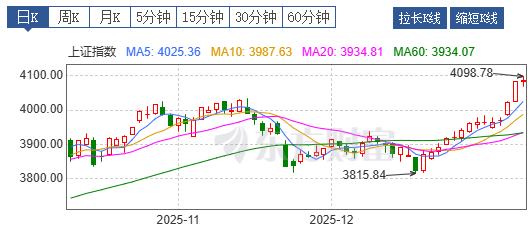
Core Viewpoint - The A-share market has shown resilience, with the Shanghai Composite Index closing at 4085.77 points, nearing 4100 points, while various industry sectors experienced mixed performance, particularly in the robotics sector, which is facing challenges and transformations [1][3]. Company and Industry Summary - The robotics industry in 2025 saw significant media attention, particularly in humanoid robots, despite ongoing market skepticism. IPO activities remained high, indicating sustained capital interest [3]. - The collaborative robot sector is at a critical transformation point, with key players like JAKA, Yujin, and Aobo facing operational and market challenges [3]. - JAKA's IPO application was officially terminated after over two years of attempts, marking a significant setback for the company, which aimed to be the first collaborative robot stock in A-shares [4][5]. - JAKA's IPO journey was fraught with complications, including multiple suspensions due to financial data issues, ultimately leading to the cancellation of its review meeting just before it was scheduled [6]. - Concerns regarding JAKA's operational capabilities were highlighted, with revenue growth overshadowed by significant fluctuations in net profit, including a loss of 19.97 million yuan in the first half of 2025 [6][7]. - JAKA's latest prospectus indicated a reduction in fundraising goals and production capacity, reflecting a downward adjustment in its market strategy [7]. - In contrast, Yujin Technology successfully transitioned to the Hong Kong market, becoming the first collaborative robot stock, with a strong market debut and significant revenue growth [10][12]. - Yujin's revenue for the first half of 2025 reached 153 million yuan, a 27.1% increase year-on-year, although it still reported a net loss [14]. - Aobo's path to market has been complicated by failed asset restructuring attempts, leading to a significant drop in stock price following the announcement of the termination of its restructuring plans [18]. - The collaborative robot market in China is projected to grow significantly, with domestic manufacturers increasing their market share, while competition intensifies, leading to a "Matthew effect" where stronger companies thrive and weaker ones exit the market [19].

汽车行业年度策略报告:汽车行业2026年十大趋势及投资策略-20260105
Guoyuan Securities· 2026-01-05 13:43
Core Insights - The report highlights that the Chinese automotive industry is entering the mid-to-late stage of the electric and intelligent transformation, characterized by the coexistence of traditional fuel vehicles, electric intelligent vehicles, and future industries represented by autonomous driving. This necessitates a layered and structured investment approach based on the different stages of these industry curves [2][3]. Trend Summaries Trend 1: Scrap Gap Provides Long-term Space, Trade-in Policies Expected to Normalize - The Chinese automotive market has stabilized at an annual sales level of 31 million units, with a substantial vehicle ownership base of 350 million units, laying the groundwork for future updates. The annual scrappage volume is still significantly lower than new car sales, leading to an expanding replacement gap. The "trade-in" policy is expected to evolve from a temporary stimulus to a normalized tool, enhancing the precision of policies to support domestic demand and industrial production [2][13][27]. Trend 2: New Forces Drive China's Automotive Exports to a New Structural Upgrade Stage - China's automotive exports have entered a high-growth phase, achieving several-fold growth over four years. The export structure has undergone profound changes, with a significant increase in the penetration of new energy vehicles. New force car manufacturers are enhancing China's brand premium and technological image in the global market through high-value product exports [2][30][34]. Trend 3: "Mass Market Pure Electric + High-end Range Extender" Trend Continues to Deepen - With the penetration rate of new energy vehicles surpassing 50%, market demand is showing structural differentiation. In the mass market under 200,000 yuan, the 800V high-voltage platform significantly improves charging efficiency, driving pure electric growth to outpace plug-in hybrids and range extenders. In the high-end market above 300,000 yuan, the "large battery long-range range extender" remains the mainstream solution for full-size SUVs/MPVs [2][3]. Trend 4: The "Late Mass Market" Phase Will Continue to Strengthen the Matthew Effect - The industry is transitioning from the "early mass market" to the "late mass market" phase, where consumers prioritize brand endorsement, after-sales support, and residual value certainty. This pragmatic user base favors mature brands and ecosystem capabilities, leading to a concentration of market resources towards leading technology firms [2][3]. Trend 5: Focus on State-owned Enterprises for Opportunities Around "Certainty + Cost-effectiveness" - Regulatory bodies are intensifying the separate assessment and market value management of state-owned enterprises' new energy businesses, driving resources towards electric intelligence. Major automotive groups are restructuring to shorten development cycles, accelerating the integration of intelligent configurations into mainstream price segments [2][3]. Trend 6: Growth of New Energy Heavy and Light Trucks Enters Acceleration Phase - The electrification of commercial vehicles has crossed a critical point, entering a self-driven growth phase. The total cost of ownership (TCO) for heavy trucks has dropped to a recovery period of 1.5-2 years, accelerating the replacement of fuel vehicles. The light truck sector is also maturing, with urban delivery electrification fully established [3][6]. Trend 7: High-perception Intelligent Cockpit Configurations Will Reshape Purchase Decisions - Intelligent cockpits have become a default configuration in new energy vehicles, with the importance of intelligent features in purchase decisions rising to the forefront. Consumers are focusing on visual and perceptible components, making HUDs, large LCD screens, and intelligent seating core differentiation battlegrounds [3][6]. Trend 8: Intelligent Driving Accelerates Along "End-to-End" and "Equal Rights" Paths - The intelligent driving architecture is transitioning to an "end-to-end" model, enhancing efficiency across the perception and decision-making chain. The continued acceleration of L3 policies provides opportunities for leading manufacturers to compete and iterate rapidly in high-level intelligent driving [3][6]. Trend 9: Three Major Autonomous Driving Commercialization Scenarios Approaching Explosive Growth - Robotaxi, mining autonomous driving, and unmanned logistics vehicles are moving from pilot projects to mass production. The cost advantages of unmanned logistics vehicles are becoming increasingly evident, with sales curves showing signs of exponential growth [3][6]. Trend 10: Embodied Intelligence Enters Pre-production Phase, Releasing a Second Growth Curve for the Automotive Manufacturing Industry - Humanoid robots are transitioning from hardware-driven to intelligent dual-core driven, with the automotive supply chain naturally adapting to this field. The synergy between embodied intelligence and the automotive industry is expected to create dual dividends in performance and valuation [3][6].



公募基金这一年:变革与竞争重塑行业格局丨刻度2025
Sou Hu Cai Jing· 2025-12-31 10:48
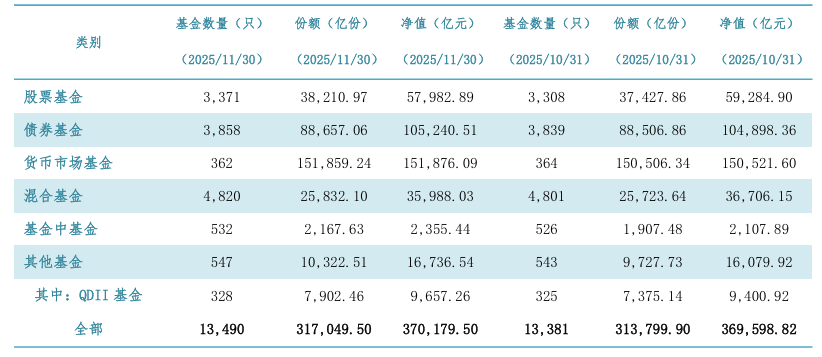
Core Insights - The public fund industry in China is experiencing a positive year in 2025, with a stable recovery in the equity market, new highs in overseas indices, and significant increases in commodity prices like gold [1][3][5] - However, the industry is also facing challenges such as increasing competition, new regulations, and a proliferation of similar products [1][2][11] Fund Performance and Market Trends - As of November 2025, the total net asset value of public funds reached a record high of 37.02 trillion yuan, with all categories of funds showing a month-on-month increase [3][4] - The majority of funds have achieved positive returns in 2025, with 11,369 out of 11,952 funds reporting gains, and nearly 100 funds doubling their net value [5] - The equity market saw strong performance, with 28 out of 31 industry indices recording positive returns, marking the highest record since 2019 [5] - The ETF market has also seen rapid growth, with total assets surpassing 6 trillion yuan, a 61% increase from the beginning of the year [5][10] Active vs. Passive Fund Management - Active equity funds have shown a recovery, with the Wande偏股混合型基金指数 yielding 33.99%, slightly outperforming the passive index [6][8] - Notably, the Yongying Technology Select Mixed Fund achieved an impressive annual return of nearly 240%, setting a record for the highest single-year return in China's public fund history [8][10] Competitive Landscape - The competitive landscape in the public fund industry is intensifying, with a clearer head-tail effect emerging. Over 30 institutions manage less than 10 billion yuan, while only a few dominate the market with over 2 trillion yuan [11][12] - The ETF market is particularly competitive, with over 35 similar products in the market, leading to a "Matthew effect" where larger firms continue to gain market share [12] Regulatory Changes - 2025 is marked as a transformative year for public funds, with new regulations aimed at enhancing the quality of fund management and shifting focus from scale to investor returns [14][15] - The new regulations include stricter guidelines on performance benchmarks, management compensation, and sales practices, aiming to improve transparency and accountability in the industry [14][15][16]
又见首席跳槽 于明明加盟东吴证券
Xin Lang Cai Jing· 2025-12-31 08:01
Group 1 - The core viewpoint of the article highlights the frequent talent movement within the brokerage research industry in 2025, with significant changes in personnel across various firms [1][5] - Yu Mingming, the former deputy director of the research institute at Xinda Securities, has joined Dongwu Securities as the head of quantitative investment, indicating a trend of high-profile analysts changing firms [1][5] - By the end of 2025, over 300 analysts changed their professional institutions, involving more than 60 brokerages, with 220 analysts transferring in the first half of the year alone [4][8] Group 2 - The total number of registered analysts in the industry surpassed 6,162 by September 2025, marking a historical high, which contrasts with the ongoing talent flow [4][8] - Notable changes in core talent include at least 14 chief economists from various brokerages, such as the transfer of Xun Yugen from Guotai Junan to Guoxin Securities, reflecting significant shifts in leadership roles [4][9] - The movement of analysts is driven by factors such as brokerage mergers leading to job overlaps, adjustments in business positioning, differences in compensation mechanisms, and career development opportunities [3][4] Group 3 - The phenomenon of "team migration" is prevalent, with over 25 top analysts from popular sectors like consumption, new energy, and TMT changing platforms, indicating a trend of collective movement within teams [9] - The overall analysis of 2025 suggests that the talent flow is a manifestation of the "Matthew effect" due to declining commission rates, as well as a necessary transition from traditional sell-side services to integrated research and comprehensive financial services [4][9] - Xinda Securities has established a three-tier research system covering 25 core industries, focusing on key sectors aligned with national industrial upgrading trends, and is advancing the integration of research and investment [3][7]



2025年新基发行数量与效率双升 2026年首日24只新基金面世
Cai Jing Wang· 2025-12-31 07:33
Core Insights - The public fund issuance market in 2025 experienced significant growth, with a total of 1,552 new public fund products established, marking a 35.87% increase from 2024 and reaching a four-year high in issuance numbers [1] - The average subscription period for new funds decreased to 16.41 days from 22.61 days in the previous year, indicating heightened market enthusiasm [1] - The equity market's favorable conditions laid a solid foundation for this growth, with 1,109 new equity funds accounting for 71.41% of the total new funds [1] Fund Types - Among the new funds, stock funds were the primary contributors, with 835 stock funds issued, representing 53.77% of the total, while 274 mixed equity funds accounted for 17.64% [1] - The trend towards passive investment has become a core driver, with the introduction of a fast-track approval process for ETFs, allowing for registration within five working days [1] ETF Market - A total of 358 new ETFs were established in 2025, with an issuance volume of 2,581.66 billion units, both figures setting historical records and surpassing the total issuance of the previous two years [1] - Stock ETFs were the mainstay, with 319 stock ETFs issued, totaling 1,629.16 billion units, which constituted 89.1% of the total ETF issuance [2] Institutional Participation - The market concentration for new fund issuance was high, with 133 institutions participating, and 24 of them issuing more than 20 products each [2] - Leading institutions included E Fund with 69 new products, followed by China Universal Fund and Huaxia Fund with 64 and 61 products respectively, focusing on equity and index sectors [2] Market Dynamics - The continuous allocation of long-term funds has strengthened the liquidity and scale advantages of leading ETFs, creating a "Matthew Effect" that attracts more follow-on investments [2] - The introduction of innovative products, such as FOFs, saw explosive growth with 88 new issuances, more than doubling from 2024, and various innovative ETFs catering to diverse investor needs [2] REITs Market - The public REITs market in 2025 witnessed a surge in subscription enthusiasm, with some offerings experiencing subscription multiples in the hundreds, such as 320 times for a commercial REIT and 340 times for a clean energy REIT [3] - By the end of 2025, the domestic public REITs market had 79 products with a total issuance scale exceeding 210 billion yuan, establishing itself as the largest REITs market in Asia and the second largest globally [3] Future Outlook - The fund issuance market for 2026 is set to commence, with 39 new funds expected in the first week, predominantly focusing on equity and FOF funds, with technology sectors being a key area of interest [4]
清理明显加速 基金公司批量清理第三方平台
Zhong Guo Jing Ji Wang· 2025-12-29 07:10
Core Viewpoint - The fund sales market is experiencing a significant shift, with fund companies increasingly cleaning up smaller or risk-prone third-party sales institutions while investing more in stronger, leading institutions [1][2]. Group 1: Fund Company Actions - Since March, many fund companies have begun to eliminate smaller or risk-exposed third-party sales institutions, with a noticeable acceleration in this process by August [1]. - On August 19, Guangfa Fund announced the suspension of seven third-party sales institutions from handling various fund-related transactions, including subscription and conversion [1]. - Other fund companies, such as Zheshang Fund and Debang Fund, have also halted business with specific third-party institutions due to their limited sales capabilities and associated risks [1]. Group 2: Market Dynamics - The trend of "the rich get richer and the poor get poorer" is evident in the third-party sales sector, with major internet platforms like Alipay and WeChat Wallet seeing significant growth in fund sales [2]. - Alipay has reached 600 million users, while Tencent's WeChat Wallet has over 200 million users, indicating a shift towards internet channels for fund purchases [2]. - The total fund sales volume for Tian Tian Fund in the first half of the year reached 568.36 billion yuan, showcasing the dominance of internet platforms in the market [2]. Group 3: New Fund Issuance Strategies - Fund companies are increasingly leveraging the internet to launch new funds, with a growing willingness to issue funds through online platforms [3]. - Notable examples include Penghua Fund, which saw a new fund reach close to its fundraising cap in just three days, achieving a scale three times larger than similar products offered through traditional channels [3]. - The new fund from China Europe Fund, managed by star manager Ge Lan, raised 8 billion yuan through an internet platform, attracting over 1 million participants [3].
贺岁档电影票房创近八年新高
Zheng Quan Ri Bao· 2025-12-28 16:11
Group 1 - The total box office for the 2025 New Year film season has surpassed 5 billion yuan, marking the highest figure for the same period in nearly eight years [1] - Over 70 films, both domestic and foreign, were released during this period, showcasing a diverse range of genres including history, suspense, documentary, fantasy, and public welfare [1] - The animated film "Zootopia 2" is set to break 4 billion yuan in box office revenue, dominating the New Year season and setting multiple historical records for imported films in the Chinese market [1] Group 2 - The box office structure for the New Year season in 2025 is notably different from previous years, with "Zootopia 2" accounting for approximately 80% of the total revenue, a phenomenon not seen in prior years [2] - The overall box office for the year has reached 51.5 billion yuan, with the performance of the upcoming New Year and Spring Festival seasons expected to impact next year's market results [2] - Several listed companies, including Zhejiang Huace Film & Television, Tianjin Maoyan Weiying Cultural Media, and Wanda Film, are set to compete in the 2026 New Year film market, with strong expectations for the film industry [2]


私募2025“三变”
Shang Hai Zheng Quan Bao· 2025-12-28 14:50
Core Insights - The private equity industry in China is undergoing significant changes in 2025, characterized by a shift in market dynamics, regulatory improvements, and evolving competitive landscapes [2][15]. Group 1: Changes in Scale - The private equity industry has entered a new era with a management scale reaching 22 trillion yuan, and over 110 private equity firms managing over 10 billion yuan [2][15]. - The number of private equity securities investment funds registered in 2025 has surged to 12,239, a 95.07% increase from 6,274 in 2024, with stock strategy funds being the dominant category [5][18]. - Average returns for private equity securities investment funds have exceeded 20% in 2025, with stock strategy funds achieving over 27% [4][18]. Group 2: Changes in Ecology - The industry is witnessing a cleansing process, with 1,193 private fund managers deregistered in 2025, indicating a move towards a healthier compliance ecosystem [8][21]. - The exit of "bad money" from the market has been accelerated by regulatory policies, leading to improved operational standards and transparency among surviving firms [20][21]. - The influx of professional talent into the private equity sector has been notable, with 54 new fund managers registered in 2025, a 10.2% increase from 2024 [22][23]. Group 3: Changes in Competitive Landscape - The number of billion-yuan private equity firms has increased to 113, with a notable rise in quantitative firms, reflecting a shift towards a more competitive environment [11][24]. - The competition is evolving from short-term performance to a comprehensive assessment of capabilities, including talent, governance, and technology [12][24][25]. - Smaller private equity firms are exploring differentiated strategies, focusing on "boutique" approaches that prioritize compliance and specific investor needs rather than aggressive expansion [25].

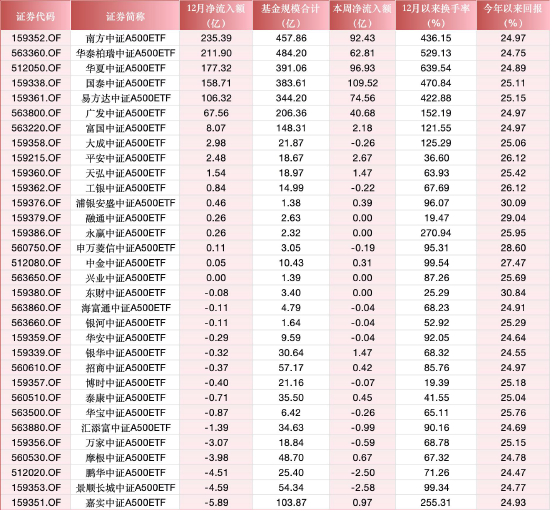
A500ETF市场加速洗牌:南方、华泰柏瑞中证A500ETF12月净流入超200亿,嘉实、景顺长城、鹏华逆势流出超4亿
Xin Lang Cai Jing· 2025-12-26 10:22
Core Insights - The A500 ETF market is experiencing a significant influx of funds, with total market size surpassing 296.7 billion yuan and net inflow of 94.756 billion yuan in December alone, indicating a strong capital absorption effect [1][6] - The net inflow is primarily concentrated in a few leading products, with the top five A500 ETFs exceeding 30 billion yuan in size, showcasing a trend of capital concentration towards top management firms [1][6] Fund Inflows and Outflows - The top A500 ETFs by net inflow in December include: - Southern A500 ETF: 23.539 billion yuan, total size 45.786 billion yuan - Huatai-PB A500 ETF: 21.190 billion yuan, total size 48.420 billion yuan - Huaxia A500 ETF: 17.732 billion yuan, total size 39.106 billion yuan - Guotai A500 ETF: 15.871 billion yuan, total size 38.361 billion yuan - E Fund A500 ETF: 10.632 billion yuan, total size 34.420 billion yuan - Conversely, 15 A500 ETFs experienced net outflows, with notable outflows from: - Jingshun Great Wall A500 ETF: -4.59 billion yuan - Penghua A500 ETF: -4.51 billion yuan - Jiashi A500 ETF: -5.89 billion yuan [2][3][7] Trading Activity and Performance - The trading activity of leading products has increased significantly, with Huaxia A500 ETF achieving a turnover rate of 639.54% in December, while other leading products also exceeded 400% [4][8] - Year-to-date returns for A500 ETFs are relatively balanced, with most products yielding returns between 24% and 26%, although some with net outflows, like Dongcai A500 ETF and Puyin Ansheng A500 ETF, reported returns of 30.84% and 30.09% respectively [4][8] Market Trends and Future Outlook - The recent surge in A500 ETF investments is attributed to policy changes regarding risk factors for equity investments by insurance funds and expectations of potential new ETF options in the coming year [5][10] - The trend of capital concentration towards leading ETFs is expected to continue, with firms that have comprehensive product systems and strong marketing capabilities likely to strengthen their competitive advantages [10]