人民币国际化

Search documents
“中债—工行熊猫债系列指数”发布仪式在京举行
Jin Rong Shi Bao· 2025-12-25 03:36
Group 1 - The "China Bond - ICBC Panda Bond Series Index" was launched in Beijing, marking a significant development in the Panda bond market, which is crucial for the internationalization of the RMB [1] - The index reflects the overall situation of the Panda bond market and the performance of representative issuers, providing authoritative benchmarks for market participants [1] - The Central Securities Depository Company is actively involved in enhancing the pricing benchmark services for Panda bonds and other foreign bonds, contributing to the two-way opening of the bond market [1] Group 2 - The Panda bond market has seen over 100 issuers in the interbank market, with nearly 570 bonds issued, raising a total of over 960 billion RMB, indicating a diverse range of issuers across Asia, Europe, Africa, and America [1] - The "China Bond - ICBC Panda Bond AAA Index" and "China Bond - ICBC Panda Bond 30 Index" are designed to cover high credit quality, liquid, and investable Panda bond varieties, enhancing price discovery efficiency in the market [2] - The release of the index is expected to facilitate asset allocation and performance comparison for domestic and international investors, promoting the use of RMB across borders [2]
银行业助力谱写中国式现代化海南篇章
Jin Rong Shi Bao· 2025-12-25 03:09
Core Viewpoint - The official launch of the Hainan Free Trade Port's full island closure on December 18 marks a significant step in China's commitment to high-level opening-up and the construction of an open world economy, presenting new development opportunities across various industries [1] Group 1: Support for Hainan's Full Island Closure - The full island closure operation is a foundational project for the Hainan Free Trade Port, with the National Development Bank's Hainan branch actively supporting infrastructure and logistics projects to ensure smooth implementation [2] - The bank has facilitated financing for major infrastructure projects, including upgrades to key ports and logistics hubs, ensuring that all ten "second-tier ports" pass national acceptance [2] - The Hainan branch of the National Development Bank prioritizes infrastructure service as its primary business initiative, engaging in significant projects aligned with national and provincial planning [2] Group 2: Growth of Cross-Border Financial Services - Post-closure, the convenience of cross-border capital flow is expected to significantly increase, with banks exploring new opportunities in cross-border trade settlement and offshore financial services [3] - Agricultural Bank of China has launched multifunctional free trade accounts to facilitate cross-border capital flow for quality enterprises in Hainan, establishing a comprehensive financial account service system [3] - The bank aims to enhance services for domestic and foreign enterprises investing in Hainan through collaborative mechanisms across various regions [3] Group 3: Financial Innovations and Support for Key Industries - Minsheng Bank's Haikou branch is actively engaging with cross-border financial reform policies, implementing innovative services such as cross-border asset transfers and QDLP pilot programs [4] - The financial sector is focusing on supporting Hainan's four leading industries and key areas to drive high-quality economic development [5] - Citic Bank's Haikou branch is committed to enhancing financial services for local enterprises, including innovative financing solutions for agricultural research and technology sectors [6]


三重浪潮驱动提速,人民币国际化深度演进
Xin Hua Cai Jing· 2025-12-25 02:13
Core Insights - The internationalization of the Renminbi (RMB) is accelerating, with a 14.0% year-on-year increase in cross-border RMB payments in the first half of the year, making it the second-largest trade financing currency and the third-largest payment currency globally [1] - The inclusion of RMB in the International Air Transport Association's (IATA) clearing system marks a significant milestone in the functional recognition of RMB in international financial clearing [1] - The transformation of RMB from a payment tool to an operational currency is evident, particularly among European companies deeply engaged in the Chinese market [2] Group 1: RMB's Role in Global Trade - RMB is increasingly embedded in global industrial division and multinational corporate operations, transitioning from a foreign exchange currency to an operational currency for European enterprises [2] - The local procurement, production, and sales cycles established by companies like Volkswagen and BMW in China create a natural demand for RMB as a key currency for pricing, settlement, and asset-liability management [2] Group 2: Corporate Adoption of RMB - The core motivation for multinational companies to adopt RMB has shifted from merely saving on exchange costs to enhancing risk management and optimizing global liquidity structures [3] - By integrating RMB into their internal settlement systems as a functional currency, companies achieve valuable natural hedging against financial risks from exchange rate fluctuations [3] Group 3: Institutional and Market Developments - The RMB internationalization process has made significant progress in institutional frameworks and market product innovation, transitioning from a regional payment method to a global trading and reserve network [4] - The establishment of offshore RMB market cooperation in bilateral mechanisms indicates a shift from spontaneous market behavior to coordinated policy efforts [4] Group 4: Global Currency System Diversification - The diversification of the global currency system, driven by changes in the global economic landscape and geopolitical factors, presents a "window of opportunity" for RMB [5] - A report indicates that 59% of sovereign institutions plan to increase their holdings of Chinese assets over the next five years, with North American sovereign funds showing a 73% willingness to invest [5] Group 5: Central Bank Perspectives - For central banks like the European Central Bank and the German Central Bank, the rationale for allocating RMB assets lies in achieving diversification of reserve assets [6] - RMB government bonds exhibit low correlation with Western assets, providing strategic hedging value and independent attributes in investment portfolios [6]

抛弃美元!俄罗斯驻华大使:俄中几乎完全用卢布人民币结算!人民币凭啥成“硬通货”?
Sou Hu Cai Jing· 2025-12-24 16:00
Group 1 - The core message is that China and Russia have established a bilateral settlement system that relies almost entirely on their own currencies, the yuan and the ruble, effectively sidelining the US dollar in their trade transactions [1][3]. - China has been Russia's largest trading partner for 15 consecutive years, with trade volume reaching $244.819 billion in 2024, and the proportion of trade settled in local currencies has surged from 20% in 2020 to 99.1% [3]. - Both countries have created independent payment channels, with Russian banks joining China's Cross-Border Interbank Payment System (CIPS) and Chinese banks participating in Russia's System for Transfer of Financial Messages (SPFS), eliminating reliance on the Western-controlled SWIFT system [3]. Group 2 - The decision to bypass the dollar is driven by the adverse effects of Western sanctions on Russia, which have restricted its access to dollar assets and payment systems, prompting the need for alternative solutions [5]. - For Chinese companies, settling in local currencies reduces exchange rate risk and transaction costs, with one mechanical export company reporting a 20% reduction in payment cycles and a 15% decrease in costs by using rubles and yuan [5]. - The shift in currency usage is seen as a significant challenge to the dollar's dominance, with the percentage of global oil trade settled in dollars dropping from 80% to 72%, and countries like India and Saudi Arabia increasingly using the yuan for oil transactions [9]. Group 3 - The arrangement provides a "double insurance" for trade between China and Russia, allowing Russia to use yuan earned from energy exports to purchase Chinese goods and issue yuan-denominated bonds, creating a closed loop of "earning yuan - using yuan" [8]. - The yuan has become Russia's second-largest reserve currency after gold, comprising 60% of the National Welfare Fund, and Moscow is emerging as a major offshore yuan trading hub [8]. - This development is part of a broader trend towards currency diversification, promoting a multipolar currency system that offers countries more options in trade, rather than establishing a new currency hegemony [9][11].

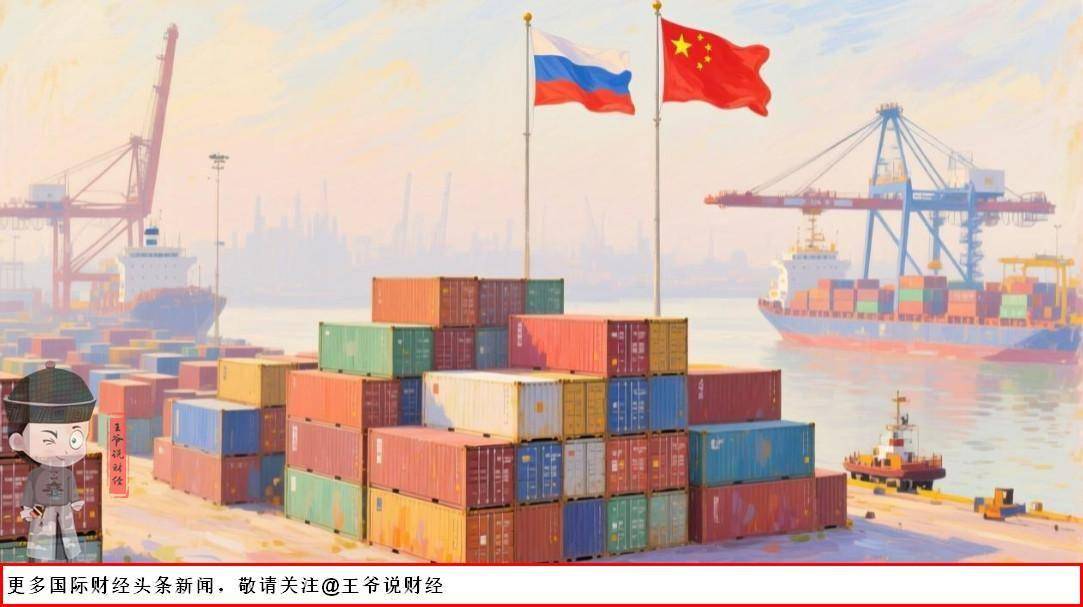
【财经分析】三重浪潮驱动提速 人民币国际化深度演进
Xin Hua Cai Jing· 2025-12-24 14:43
Core Viewpoint - The internationalization of the Renminbi (RMB) is accelerating, with significant growth in cross-border payments and recognition in global financial systems, marking a pivotal shift in its role in international trade and finance [1][2][4]. Group 1: RMB's Role in Global Trade - The RMB has become the second-largest trade financing currency and the third-largest payment currency globally, with a 14.0% year-on-year increase in cross-border payments in the first half of the year [1]. - The International Air Transport Association (IATA) has officially included the RMB in its clearing system, indicating a growing functional recognition of the currency in international financial infrastructure [1][4]. Group 2: RMB as an Operational Currency - The RMB is transitioning from a mere payment tool to an operational currency for multinational corporations, particularly in high-end manufacturing sectors, as companies establish local supply chains and financing mechanisms [2]. - Major European companies, such as Volkswagen and BMW, are increasingly using the RMB for local procurement, production, and sales, creating a stable demand for the currency [2]. Group 3: Risk Management and Liquidity - Multinational corporations are adopting the RMB not only to save on exchange costs but also for risk management and optimizing global liquidity structures, effectively using it as a functional currency [3]. - This shift is seen as part of the RMB's third upward cycle, supported by China's economic fundamentals and its transition from a capital-importing to a capital-exporting country [3]. Group 4: Institutional and Market Developments - The RMB's internationalization is supported by institutional frameworks and market innovations, with significant progress in offshore RMB market cooperation being recognized in bilateral policy agendas [4]. - The China Bank Frankfurt branch has become the first RMB clearing bank in the Eurozone, facilitating substantial RMB clearing volumes and enhancing cross-border economic flows [4]. Group 5: Diversification of the Global Currency System - The diversification of the global currency system, driven by geopolitical factors, presents a "window of opportunity" for the RMB, with a significant percentage of sovereign institutions planning to increase their holdings in Chinese assets [5][6]. - The RMB is viewed as a strategic asset for central banks, offering low correlation with Western assets, thus providing a hedge in investment portfolios [6].
专访刘世锦:打造强大的货币与资本市场,为创新和消费架桥
21世纪经济报道· 2025-12-24 14:10
Core Viewpoint - The article emphasizes that China's economy is expected to demonstrate strong resilience and vitality, with major economic indicators aligning with expectations, and the total economic output projected to reach around 140 trillion yuan by 2025 [1]. Group 1: Economic Advantages - China possesses three major economic advantages: the potential for catching up, the new technology revolution focused on digital and green technologies, and the advantage of a super-large market economy [4][5]. - The "catching up potential" indicates that China has a growth potential of at least 20,000 USD per capita GDP to reach the level of developed countries, primarily driven by the upgrading of consumption structure and the transformation of traditional industries [5][6]. - The super-large market economy advantage includes a significant consumer base, with 400 million middle-income individuals and the potential for 800-900 million individuals transitioning to middle-income status, which can significantly expand the consumer market [6][7]. Group 2: Economic Growth Drivers - The current economic growth in China is shifting from being driven by investment and exports to being driven by innovation and consumption [8][9]. - The focus on becoming a manufacturing powerhouse, a consumer powerhouse, and a financial powerhouse is essential for sustaining economic growth and enhancing the quality of development [9][10]. - A strong capital market and robust currency are crucial for bridging the gap between manufacturing and consumption, facilitating the necessary financial support for these sectors [10][11]. Group 3: Financial Market Development - The capital market is expected to play a pivotal role in selecting projects that are marketable, profitable, and have controllable risks, thereby improving resource allocation efficiency [10][11]. - The transition to a modern capital market system is necessary as China enters a phase of innovation-driven economic growth, with more funds expected to flow into capital markets rather than traditional banking [10][12]. - A strong currency is identified as a key indicator of a financial powerhouse, with the potential for the renminbi to become more internationally recognized as China's manufacturing and trade capabilities grow [12][13].

大宗商品圆桌对话:2026黄金“逢低买入”逻辑不变、白银正抢跑通胀风险、明年最大风险点在美国市场|Alpha峰会
Hua Er Jie Jian Wen· 2025-12-24 04:17
Group 1 - The global geopolitical uncertainties persist, and the logic of buying gold on dips remains unchanged for next year, with potential pullbacks expected to be around 10%-15% from recent highs [1][4][20] - Factors that could lead to a pullback in gold prices include overly optimistic economic trends and a de-escalation of geopolitical tensions, but such pullbacks are viewed as buying opportunities [1][4][20] - The copper market is expected to experience a bull narrative in the first half of the year, driven by significant visible inventory in the U.S. and anticipated stockpiling in China post-Spring Festival, rather than economic recovery [4][20] Group 2 - The U.S. market may experience significant volatility next year, which could impact all asset classes, including commodities, presenting potential buying opportunities during downturns [2][24] - The focus for 2026 will be on sectors where supply growth stabilizes after rapid capacity expansion, particularly in the chemical industry, where price responses may lag behind company valuations [16][18] - The long-term outlook suggests that inflation will persist due to rising logistics costs from barrier trade, indicating potential opportunities in commodities [36][37] Group 3 - The influence of the Federal Reserve is expected to weaken, with fiscal policy becoming more dominant, and the dollar's credibility may be at risk, potentially leading to a drop in the dollar index to the 70-80 range [1][5][24] - The AI sector's heavy investment may not guarantee productivity gains, and if the anticipated economic recovery does not materialize, it could lead to systemic valuation declines in traditional industries [5][24][45] - The commodity market is likely to see speculative inventory accumulation when prices drop significantly, increasing the correlation between inventory levels and price movements [41][24] Group 4 - The geopolitical landscape is expected to remain competitive, with countries vying for technological and industrial supremacy, which may lead to ongoing tensions [30][31] - China's food security has improved significantly, reducing reliance on imports, which may mitigate the impact of geopolitical threats on agricultural prices [33] - The internationalization of the renminbi is anticipated to accelerate, with potential implications for commodity pricing and trade dynamics [34][36]
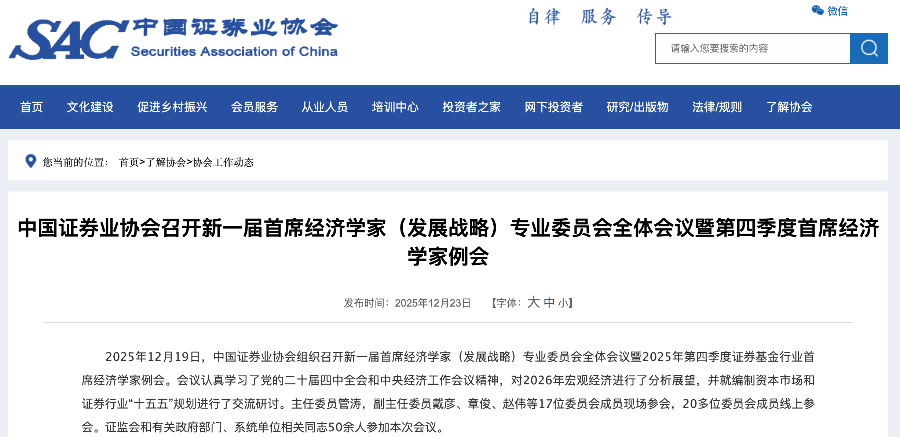
解析股市叙事国家队!管涛挂帅、戴彦“破例”,少壮派筑理论引擎
2 1 Shi Ji Jing Ji Bao Dao· 2025-12-24 04:05
Group 1 - The core viewpoint of the news is the establishment of a newly adjusted Chief Economist Committee by the China Securities Association, aimed at contributing professional insights for the "14th Five-Year Plan" of the capital market [1][2][11] - The committee consists of over 40 top experts from the securities and fund industry, indicating a significant integration of industry intellectual resources [1][2] - The committee's structure has been upgraded, with the addition of positions such as Secretary-General and Advisors, reflecting a shift towards a more professional and diverse team [1][5][8] Group 2 - The committee's first meeting focused on two main missions: providing recommendations for the "14th Five-Year Plan" and enhancing the narrative around the Chinese stock market [2][12][13] - Key topics discussed included "RMB internationalization" and "increasing household consumption rates," which are crucial for the planning process [2][12] - The committee aims to serve as both a policy think tank and a voice for rational market expectations, contributing to the high-quality development of the capital market [2][12][13] Group 3 - The new committee features a diverse membership, including individuals holding significant administrative roles, which indicates a growing emphasis on the role of chief economists in leadership positions [9][10] - The committee's leadership includes prominent figures such as Guan Tao from Bank of China International as the Chairman and Dai Yan from Dongfang Caifu as the Vice Chairman [8][9] - The restructuring of the committee is seen as a response to the evolving complexities of the capital market, aiming to stabilize expectations and guide public discourse [13]
工行新加坡分行积极落实JCBC合作成果 实现数字人民币个人钱包境外充值创新试点
Xin Hua Cai Jing· 2025-12-24 03:07
(文章来源:新华财经) 工行新加坡分行作为集团首家海外营业机构和新加坡人民币清算行,在中新建交35周年之际,将继续秉 持国际视野和专业匠心,在人民币国际化等方面不断开拓创新,为中新全方位高质量的前瞻性伙伴关系 贡献金融力量。 新华财经新加坡12月24日电(记者刘春涛)在中国人民银行数字货币研究所和新加坡金融管理局的共同 指导下,工行新加坡分行在总行支持下积极落实今年中新双边合作联合委员会(JCBC)宣布的数字人 民币合作成果,于近日成功开展数字人民币个人钱包境外充值的创新试点,为数字人民币消费再添新场 景,持续深化两国数字人民币合作。 此次试点是工行新加坡分行继实现数字人民币进出口贸易境内结算试点后,在数字人民币领域的又一重 要创新实践。新加坡游客仅需在数字人民币客户端注册钱包,便可通过工行新加坡分行个人手机银行, 使用在工行新加坡分行开立的账户完成数字人民币充值,在中国境内实现交通出行、旅游购物、餐饮住 宿等场景的便捷支付。 ...


中国信保上海分公司: 发挥政策性金融独特作用 助力上海“五个中心”联动建设
Jin Rong Shi Bao· 2025-12-24 02:47
Core Viewpoint - The China Export & Credit Insurance Corporation (Sinosure) plays a crucial role in supporting China's international trade by providing financial tools backed by national credit and fiscal resources, significantly contributing to the country's export growth and risk management strategies [1][2][7]. Group 1: Financial Support and Services - During the 14th Five-Year Plan period, Sinosure's Shanghai branch supported over $265 billion in foreign trade exports and investments, paying out claims of 2.219 billion yuan and helping companies reduce losses by nearly 3.6 billion yuan [1]. - In 2025, Sinosure's Shanghai branch actively participated in local government initiatives to stabilize foreign trade, introducing innovative services such as "安心接单保" and "参展速查宝," which helped develop 13,000 new overseas buyers, a 25.7% increase year-on-year [2]. - The "沪贸批次贷" financing model was launched to provide proactive credit to small and micro foreign trade enterprises, with 1.1 trillion yuan in credit limits pushed to over 30,000 companies [3]. Group 2: Support for Technological Innovation - Sinosure's Shanghai branch focuses on supporting key industries, particularly in technology innovation, by providing tailored insurance solutions that integrate into companies' risk management systems [4]. - The branch has significantly aided Shanghai United Imaging Healthcare Co., Ltd. in expanding its international market presence, particularly in North America, Europe, and Asia-Pacific, through personalized insurance plans [4]. Group 3: Cross-Border Financial Services - Sinosure has become an essential tool for promoting the internationalization of the renminbi and enhancing cross-border financial service convenience, as highlighted in the Shanghai International Financial Center's action plan [7]. - The company successfully facilitated a financing structure for HuanTai Energy Co., Ltd. for a wind power project in Kazakhstan, providing 95% coverage for political and commercial risks, thus enabling financing without credit guarantees [8]. Group 4: Shipping and Maritime Financing - In the first 11 months of the year, Shanghai port handled 50.56 million TEUs, a 6.7% increase year-on-year, supported by Sinosure's financing solutions for shipping projects [10]. - Sinosure has played a pivotal role in financing significant shipping projects, including the delivery of a methanol dual-fuel container ship for CMA CGM and financing arrangements for an $11 billion LNG dual-fuel container fleet for Hapag-Lloyd [11]. Group 5: Future Directions - Sinosure aims to enhance its role in supporting Shanghai's high-level opening-up and economic center status by providing innovative and targeted insurance support, contributing to the development of a modernized Shanghai [12].