
通胀预期

Search documents
欧洲央行按兵不动释放积极信号
Jing Ji Ri Bao· 2025-09-19 22:15
Core Viewpoint - The European Central Bank (ECB) has not provided explicit guidance on future interest rate cuts but has released positive signals regarding economic fundamentals, inflation expectations, and financial markets, indirectly raising expectations that the "rate-cutting cycle is nearing its end" [1][4] Economic Activity Outlook - In September, the ECB noted continued growth in manufacturing and services, emphasizing that previous rate cuts and government fiscal policies have created positive momentum for the economy [2] - The ECB believes that rate cuts will further stimulate consumption and investment, with government spending on infrastructure and defense expected to support investment in the Eurozone [2] External Economic Environment - The ECB has shifted its stance on external risks, indicating that while trade tensions and a strong euro may suppress growth in the short term, these negative impacts are expected to dissipate by 2026 [2][3] - The recent trade agreement between the US and EU is anticipated to reduce uncertainty, leading the ECB to view the risks to Eurozone economic growth as more balanced [2] Inflation Outlook - ECB President Lagarde stated that the factors driving inflation are dissipating, leading to a more stable inflation outlook, with current inflation around 2%, close to the medium-term target [3][4] - The ECB's latest forecasts indicate an upward revision for 2025 and 2026 inflation rates, with projections of 2.1% for 2025 and 1.7% for 2026, while the 2027 forecast was slightly lowered to 1.9% [3] Monetary Policy Stance - The ECB maintains that despite inflation being below target, there is no need to alter monetary policy due to "minor deviations" [4] - The ECB has signaled a commitment to maintaining current interest rates and will continue to adopt a "data-dependent, meeting-by-meeting" approach to determine appropriate monetary policy [4] Market Stability - The ECB has reassured markets regarding the stability of the Eurozone sovereign bond market, indicating that it has the necessary tools to address risks if market conditions deteriorate [4][5] - Despite a reduction in the likelihood of rate cuts, some institutions still believe that the ECB may adopt a more dovish stance if certain factors arise [4][6] Risks and Considerations - Potential risks include financial market volatility and unexpected changes in external monetary policies, particularly if the Federal Reserve adopts a more aggressive rate-cutting stance [5][6] - The ECB is currently more optimistic about external conditions and internal momentum, which supports its decision to maintain the current monetary policy stance [5][6]
日本央行维持利率不变,启动ETF减持,每年抛售规模达3300亿日元
Sou Hu Cai Jing· 2025-09-19 04:27
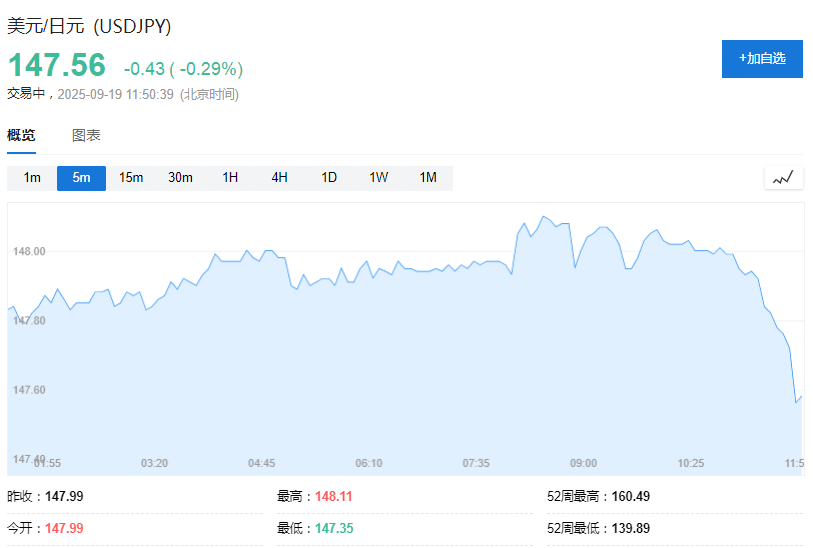
Group 1 - The Bank of Japan decided to maintain the benchmark interest rate at 0.5%, aligning with market expectations, indicating a moderate recovery in the Japanese economy with stable trends in exports and production [2] - The core CPI inflation, excluding fresh food, is expected to remain subdued due to economic slowdown, despite a gradual decline in the impact of rising food prices [2] - There were two dissenting votes for a rate hike, suggesting a shift in sentiment regarding inflation risks, with calls to raise the rate by 25 basis points to 0.75% [3] Group 2 - The Bank of Japan announced plans to begin selling its ETF and J-REIT holdings, with an annual target of approximately 330 billion yen for ETFs and 5 billion yen for J-REITs [4] - The central bank's ETF holdings have reached 35 trillion yen since it began purchasing ETFs in 2010, particularly increasing after the monetary easing in 2013 [5] - Following the announcement, the market reacted with a decline in the USD/JPY exchange rate and a rise in the 10-year Japanese government bond yield by 4 basis points to 1.635% [6][9]

日本央行声明全文:维持利率不变,两委员提议加息25个基点
Jin Shi Shu Ju· 2025-09-19 04:01
Group 1 - The Bank of Japan decided to maintain the benchmark interest rate at 0.5% for the fifth consecutive meeting, aligning with market expectations [1][2] - The central bank will begin selling its holdings of ETFs and J-REITs, with the sale scale expected to be roughly equivalent to the scale of stock purchases from financial institutions [2] - Japan's economy is showing moderate recovery overall, but certain sectors remain weak, influenced by trade policies and tariffs, particularly from the U.S. [2][3] Group 2 - Private consumption remains resilient due to improvements in employment and income, despite consumer confidence being affected by rising prices [3] - The Consumer Price Index (CPI), excluding fresh food, has maintained a year-on-year increase in the range of 2.5% to 3.0%, with inflation expectations rising moderately [3] - Future economic growth in Japan may slow down due to external trade policies and declining corporate profits, although a loose financial environment may provide support [3][4]
日本两年期国债收益率飙升至2008年以来最高,市场静候央行利率决议
智通财经网· 2025-09-19 03:26
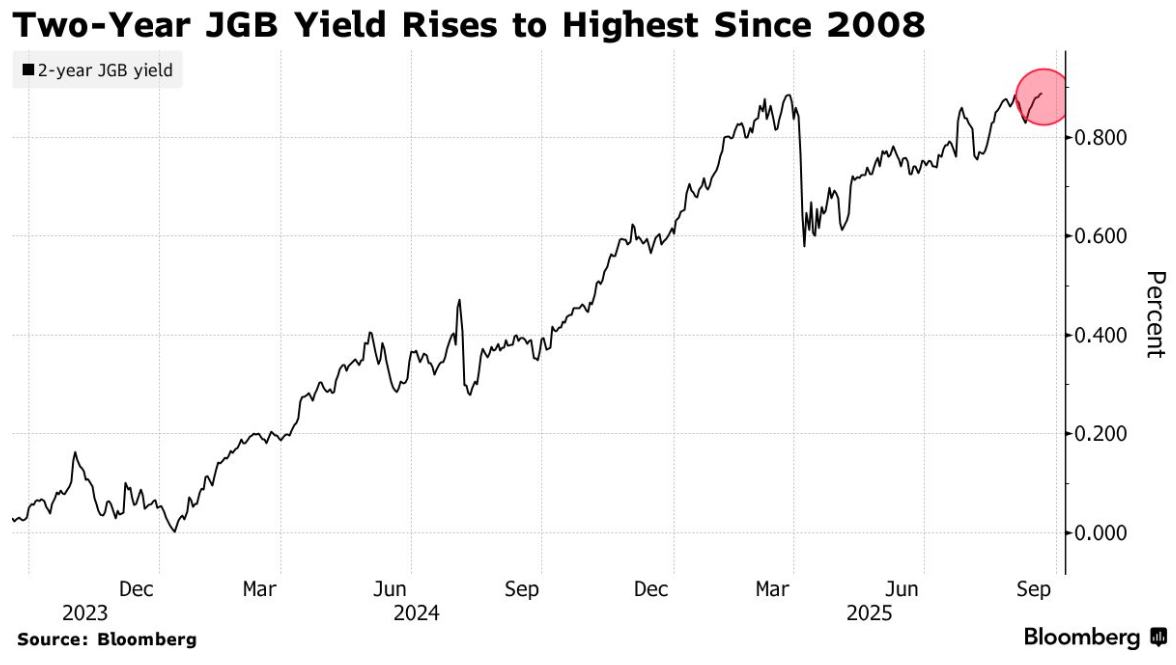
Group 1 - Japanese two-year government bond prices have fallen, pushing yields to the highest level since 2008, following the trend of U.S. Treasuries ahead of the Bank of Japan's policy meeting [1] - The two-year yield rose by 0.5 basis points to 0.885%, influenced by U.S. employment data that raised doubts about further rate cuts by the Federal Reserve this year [1] - Chief strategist Kazuhiko Sano from Tokai Tokyo Securities indicated that the sell-off may also stem from traders betting on a hawkish stance ahead of the press conference by Bank of Japan Governor Kazuo Ueda, despite expectations of a cautious approach [1] Group 2 - The yield increase occurred just before the Bank of Japan's policy meeting, with expectations that the central bank will maintain interest rates, while focusing on clues regarding potential actions in September or December [3] - Both short-term and long-term yields have risen due to heightened inflation concerns, as the Japanese government faces pressure to increase spending and reduce taxes [3] - Despite political risks from tariff policy uncertainties and Prime Minister Shigeru Ishiba's resignation announcement, insiders suggest that the Bank of Japan officials believe there may still be a possibility of raising the benchmark rate again this year [3]
货币政策预期博弈游戏或刚开始
Qi Huo Ri Bao Wang· 2025-09-19 00:46
Core Viewpoint - The Federal Reserve has restarted interest rate cuts, lowering the federal funds rate target range by 25 basis points to 4.00%-4.25%, marking the first rate cut of the year, driven by weak economic data and easing inflation pressures [1][2] Economic Conditions - The Fed's decision reflects a recognition of the deteriorating labor market, with employment growth slowing and unemployment rates rising, which has become a significant factor in the rate cut [3] - Despite the rate cut, the Fed's actions are seen as lagging behind the European Central Bank, and inflation remains a core constraint on further rate reductions, with upward adjustments in inflation expectations for the next two years [3][4] Real Estate Market - The U.S. real estate market is showing signs of cooling, with weak demand and low existing home sales, which directly impacts monetary policy decisions [4] Political Influences - Political uncertainties may influence the pace of rate cuts, but the Fed's independence is expected to maintain a gradual adjustment policy, despite external pressures from political figures [5][6] - The internal decision-making dynamics within the Fed reveal complexities, with notable divisions among members regarding the extent and timing of future rate cuts [5][6]
短期市场利多出尽铜价或维持区间震荡
Zhong Guo Zheng Quan Bao· 2025-09-18 20:24
Group 1: Copper Price Trends - Recent copper prices have shown a volatile upward trend, with LME copper prices nearing $10,200 per ton and Shanghai copper futures reaching a new high of 81,530 yuan per ton since March [1] - After hitting these highs, both LME and Shanghai copper prices experienced a pullback, with latest prices reported at $9,957 per ton and 79,620 yuan per ton respectively [1] Group 2: Impact of Federal Reserve Policies - The Federal Reserve's recent decision to initiate its first rate cut of the year aligns with market expectations, leading to a temporary state of market saturation for copper prices [2] - The key factor influencing copper prices is not just the rate cut itself, but the reasons behind it and the anticipated future rate path [2] - A stable economic environment in the U.S. combined with improved expectations for Fed rate cuts could benefit copper prices [2][3] Group 3: Supply and Demand Dynamics - Current supply dynamics show that while copper mining output is growing slowly, smelting capacity is expanding, leading to profit shifts towards the mining sector [3] - Demand for copper has not fully rebounded, with downstream companies primarily focused on depleting existing inventories, despite tight supply conditions [3] - The copper market is currently characterized by a tight balance between supply and demand, with supply constraints due to maintenance periods in smelting operations [3] Group 4: Long-term Outlook - Long-term potential for copper prices remains positive, driven by mining factors and a general upward trend in price levels [4][5] - The current economic cycle suggests that if signals of economic recovery emerge, demand for copper could significantly increase [5] - However, potential oversupply could arise if certain mines, such as the Panama copper mine, resume operations, reversing the current supply shortage [5]
美联储降息后怎么投?重磅解读来了!
Zhong Guo Ji Jin Bao· 2025-09-18 11:59
Core Viewpoint - The Federal Reserve has resumed its rate-cutting cycle, lowering the federal funds rate by 25 basis points to a target range of 4% to 4.25%, with expectations of further cuts by the end of the year [1] Group 1: Future Rate Cuts - Barclays' chief U.S. economist anticipates two more rate cuts of 25 basis points each in October and December [2] - ICBC International expects a total of 75 basis points in rate cuts by the end of the year, citing a shift in focus towards the labor market [2] - HSBC predicts potential rate cuts in December and March, with an increased risk of multiple cuts if labor market data worsens [3] Group 2: Economic Signals - The FOMC's economic projections indicate a lower rate path than previously expected, with three rate cuts anticipated this year [5] - The voting dynamics within the FOMC showed unexpected support for the majority opinion, despite prior dissenting views [5][6] - The Fed's statement reflects a hawkish tone, acknowledging rising inflation while recognizing increased risks in the labor market [6] Group 3: Global Financial Market Impact - Continued rate cuts by the Fed are expected to accelerate global asset repricing, favoring physical assets and precious metals [8] - HSBC emphasizes the importance of diversified asset allocation across regions and sectors to enhance portfolio resilience [8] - The decline in interest rates is projected to alleviate corporate financing pressures and support earnings expectations in the U.S. equity market [9] Group 4: Emerging Markets Impact - The Fed's easing policy is anticipated to provide more operational space for the People's Bank of China to support economic growth and stabilize the yuan [10] - HSBC maintains a positive outlook on emerging market equities, particularly in Asia, due to favorable conditions stemming from a weaker dollar [10] - The expectation of a weaker dollar may lead to accelerated capital flows into emerging markets, benefiting countries with manufacturing and resource exports [10][11] Group 5: Gold Market Outlook - Despite a negative short-term reaction in gold and silver markets post-Fed meeting, the long-term outlook remains positive due to expected lower U.S. rates and a weaker dollar [12] - HSBC continues to favor gold as a hedge against global policy and economic uncertainties, advocating for a broader asset allocation strategy [13] - The backdrop of declining interest rates and rising risk premiums is expected to provide support for gold prices [13]
纽约联储前官员:关税或许只是“一次性影响”|全球财经连线
2 1 Shi Ji Jing Ji Bao Dao· 2025-09-18 08:05
(原标题:纽约联储前官员:关税或许只是"一次性影响"|全球财经连线) 南方财经记者 施诗、杨雨莱 纽约联储前信贷风险主管理查德·罗伯茨(Richard Roberts)接受南方财经记者采访时表示,从数据来看, 关税已对美国通胀形成推升效应,并呈现出典型的"滞胀"特征:通胀走高而经济放缓。 不过,他也指出,关税上调所带来的冲击大概率仅是一次性的价格跳升,并不会演变为持续性的通胀螺 旋。 关税的影响仍未定论。罗伯茨补充说,判断关税是否会进一步推高通胀,可以观察市场参与者的通胀预 期。目前长期通胀预期依然偏高且小幅上行,因此关税对通胀的影响仍需密切关注。 据新华社报道,美国联邦储备委员会17日结束为期两天的货币政策会议,宣布将联邦基金利率目标区间 下调25个基点到4.00%至4.25%之间。这是美联储2025年第一次降息,也是继2024年三次降息后再次降 息。 市场普遍担忧,美国的关税政策可能推高通胀,这也成为影响美联储未来是否进一步降息的关键变量之 一。 ...
2025年9月美联储议息会议点评:美联储开启预防式降息周期
GUOTAI HAITONG SECURITIES· 2025-09-18 07:20
——2025 年 9 月美联储议息会议点评 本报告导读: 宏 观 研 究 美联储开启预防式降息周期 [Table_Authors] 汪浩(分析师) 2025 年 9 月美联储议息会议降息 25BP 基本符合预期,新一轮预防式降息周期正式 开启,预计年内仍有两次降息,但长期降息节奏仍旧偏缓。预计预防式降息周期下, 后续美债利率下行放缓,美股仍有持续支撑,美元指数先下后震荡。 投资要点: 宏观研究 /[Table_Date] 2025.09.18 | | 0755-23976659 | | --- | --- | | | wanghao8@gtht.com | | 登记编号 | S0880521120002 | | | 梁中华(分析师) | | | 021-23219820 | | | liangzhonghua@gtht.com | | 登记编号 | S0880525040019 | [Table_Report] 相关报告 收支有待提振 2025.09.17 美国就业:是否有失速风险 2025.09.15 总量需加力,结构有亮点 2025.09.15 信贷与货币:分化延续 2025.09.12 "存款搬家":如 ...
新财观 | 规则之外,预期之内——泰勒规则失效下的美联储货币政策抉择
Xin Hua Cai Jing· 2025-09-18 06:13
Core Viewpoint - The Federal Reserve has initiated its first interest rate cut of 2025, lowering the benchmark rate by 25 basis points to a range of 4.00%-4.25%, driven by economic slowdown and a weakening labor market, despite inflation not yet reaching the 2% target [1][2][3] Monetary Policy Outlook - The focus of the Federal Reserve's policy may shift further towards the labor market in Q4 2025, with a potential acceleration in the pace of rate cuts due to expanding fiscal deficits and increased political intervention [2][6] - A total of 75 basis points in rate cuts is anticipated throughout 2025, with the Fed maintaining a gradual and cautious approach to avoid overly aggressive easing that could destabilize inflation expectations [2][6] Labor Market Analysis - The labor market shows signs of significant weakness, with a downward revision of 911,000 jobs added over the past year, resulting in an average monthly addition of only 70,000 jobs, far below the previously estimated 147,000 [3] - The unemployment rate has risen to 4.3%, the highest level since 2021, indicating reduced hiring intentions and insufficient job growth momentum [3] Taylor Rule and Monetary Policy - The Taylor Rule, historically a key guideline for monetary policy, has become less effective, as evidenced by the Fed's deviation from its recommendations during economic crises [4][5] - In the current context, a weaker response to inflation may be more appropriate, as strict adherence to the Taylor Rule could exacerbate economic downturn risks [4][5] Central Bank Credibility - The credibility of the central bank is crucial for its ability to deviate from the Taylor Rule, as a central bank with strong credibility can better manage supply shocks and achieve a balance between price stability and growth [5][6] - The Fed's long-standing credibility allows for potential rate cuts even when inflation remains elevated, as maintaining high rates could lead to increased economic downturn risks [5][6] Global Asset Repricing - The continuation of rate cuts by the Fed is expected to accelerate the global asset repricing process, benefiting physical assets and precious metals such as energy, metals, real estate, and gold [6] - A weaker dollar may lead to accelerated capital flows, providing relative advantages to emerging markets benefiting from manufacturing shifts and resource exports [6]