先进封装

Search documents
大基金“进退有序”:减持回笼资金,聚焦半导体核心环节助力产业升级
Huan Qiu Wang· 2025-08-17 02:55
Group 1 - The National Integrated Circuit Industry Investment Fund (referred to as "Big Fund") has accelerated its investment recovery pace since August, with multiple semiconductor companies announcing reduction plans [1][3] - In 2023, the Big Fund has planned or implemented reductions in 8 semiconductor listed companies, with only Baiwei Storage involving the second phase of reduction, while others are from the first phase [1][3] - The reduction scale has expanded this year, with companies like Tongfu Microelectronics and others entering the reduction period, and the amount reduced from Tongfu Microelectronics exceeding 700 million yuan, with over 70% of the reduction completed [3] Group 2 - The Big Fund's operational logic shows a clear stratification, with the first phase fund accelerating exits from mature fields to support subsequent investments, while the second and third phases focus on strategic core areas [3] - The Big Fund's "orderly entry and exit" reflects its dual goals of market-oriented operations and strategic support, aiming for a virtuous cycle through capital exit while continuously investing in key technologies [3] - The third phase of the Big Fund has a registered capital of 344 billion yuan, with future investments expected to strengthen the domestic semiconductor ecosystem in areas like AI chips and advanced packaging [3]

又一巨头,发力先进封装
半导体行业观察· 2025-08-16 03:38
Core Viewpoint - Samsung Electronics has signed a $16.5 billion chip foundry deal with Tesla, which boosts market confidence and offers a glimmer of hope for its long-struggling foundry business [2][5]. Group 1: Foundry Business Challenges - Samsung has faced significant challenges in the foundry sector, particularly in advanced process technology, where it initially struggled with yield issues in its 3nm process, leading to a loss of high-end customer orders to TSMC [2][5]. - Market research indicates that TSMC's global foundry market share reached 67.6% in Q1 2025, while Samsung's share dropped from 8.1% to 7.7% [2]. - Samsung has postponed the mass production of its 1.4nm process from 2027 to 2029, highlighting difficulties in expanding its advanced process market [2]. Group 2: Advanced Packaging Strategy - In response to challenges in the foundry market, Samsung is focusing on advanced packaging technology as a strategic path to breakthrough, planning to invest $7 billion in a new advanced chip packaging factory in the U.S. [3][5]. - The new packaging factory aims to address the current gap in high-end packaging technology in the U.S., where 90% of advanced packaging capacity is concentrated in Asia [5][6]. - This factory will be a key part of Samsung's integrated "design-manufacture-package" model, aiming to provide comprehensive services from chip design to product delivery [5][6]. Group 3: Market Positioning and Collaboration - The recent Tesla order significantly boosts Samsung's market confidence and supports its plans for further investment in the U.S. market [5][6]. - Samsung's strategy includes establishing local packaging facilities to meet the urgent demand for localized production, especially in light of U.S. tariffs [6]. - The advanced packaging market is projected to grow from $34.5 billion in 2023 to $80 billion by 2032, providing a strong incentive for Samsung to enhance its capabilities [9]. Group 4: Technological Innovations - Samsung is advancing its System on Panel (SoP) technology to challenge TSMC's System on Wafer (SoW) dominance, focusing on larger panel sizes for better integration of AI chips [10][11]. - The company is also investing in glass substrate technology, aiming for a 2028 rollout to replace traditional silicon substrates, which could lower costs and improve performance [16][17]. - Samsung's Fan-Out Packaging (FOPKG) technology is designed to meet the demands of mobile AI chips, achieving significant improvements in production efficiency and thermal management [19][20]. Group 5: Competitive Landscape - Samsung's advanced packaging efforts are seen as a direct challenge to TSMC's market leadership, with the company aiming to close the gap in high-end packaging capabilities [9][10]. - The establishment of a research center in Yokohama, Japan, with a $1.7 million investment, underscores Samsung's commitment to enhancing its technological prowess in advanced packaging [8]. - The competitive landscape in advanced packaging is intensifying, with Samsung's initiatives expected to reshape the global semiconductor industry [46].

佰维存储(688525):Q2营收强劲增长,持续关注晶圆级先进封装进展
ZHONGTAI SECURITIES· 2025-08-15 11:37
Investment Rating - The report maintains a "Buy" rating for the company [4][11]. Core Views - The company is positioned as a leader in storage solutions and is enhancing its layout in advanced wafer-level packaging [4]. - The company has shown strong revenue growth in Q2 2025, with a year-on-year increase of 38% and a quarter-on-quarter increase of 54% [5][6]. - The company is expected to benefit from rising storage prices, with significant price increases projected for various memory products in Q3 2025 [8]. - The company is focusing on high-end product development and has a strong R&D investment strategy, which is expected to enhance its competitive edge [11]. Financial Summary - Total shares outstanding: 461.27 million [2] - Circulating shares: 317.30 million [2] - Market price: 64.07 CNY [2] - Market capitalization: 29,553.29 million CNY [2] - Revenue forecast for 2023A: 3,591 million CNY, with a growth rate of 20% [4]. - Projected revenue for 2024A: 6,695 million CNY, with a growth rate of 86% [4]. - Projected net profit for 2025E: 461 million CNY, with a growth rate of 186% [4]. - Projected EPS for 2025E: 1.00 CNY [4]. - Projected P/E ratio for 2025E: 64.2 [4]. Market and Industry Analysis - The company has a strong market position in embedded storage, PC storage, automotive-grade storage, and enterprise storage, ranking among the top domestic storage manufacturers [8]. - The company is implementing a one-stop solution for storage and wafer-level advanced packaging, which is expected to enhance its competitiveness in the market [10]. - The company has successfully launched its first domestically developed main control chip, which is expected to cater to various applications, including smart wearables and automotive [10].

芯碁微装股价上涨3.54% 筹划港股上市推进全球化布局
Jin Rong Jie· 2025-08-15 10:09
Group 1 - The stock price of Chipbond Microelectronics is reported at 135.95 yuan, an increase of 4.65 yuan, or 3.54% from the previous trading day. The intraday high reached 138.30 yuan, while the low was 128.15 yuan, with a trading volume of 933 million yuan and a turnover rate of 5.28% [1] - Chipbond Microelectronics operates in the specialized equipment sector, focusing on micro-nano direct writing lithography technology. The company's products are applied in AI chip manufacturing, advanced packaging, and new energy vehicle electronics, and it is accelerating its expansion in domestic and international markets [1] - For 2024, the company expects revenue of 954 million yuan, representing a year-on-year growth of 15.09%. In the first quarter of 2025, the net profit is projected to be 51.87 million yuan, reflecting a year-on-year increase of 30.45% [1] Group 2 - On August 13, Chipbond Microelectronics announced plans to issue H-shares and list on the main board of the Hong Kong Stock Exchange to deepen its global strategic layout. The company has appointed Ernst & Young Hong Kong as the auditing firm, and related work is in progress, but specific details are yet to be determined, and the success of the listing remains uncertain [1] - On August 15, the main funds of Chipbond Microelectronics experienced a net outflow of 50.10 million yuan, accounting for 0.28% of the circulating market value. Over the past five days, the cumulative net outflow of main funds reached 141 million yuan, representing 0.79% of the circulating market value [1]

全球科技业绩快报:AMAT3Q25
Haitong Securities International· 2025-08-15 09:35
Investment Rating - The report assigns an "Outperform" rating for the company, indicating an expected total return over the next 12-18 months that exceeds the relevant market benchmark by more than 10% [19]. Core Insights - In Q3 FY2025, Applied Materials reported total revenue of $7.3 billion, an 8% year-over-year increase, surpassing market expectations [8][9]. - The semiconductor systems segment generated $5.43 billion in revenue, up 10% year-over-year, driven by investments in expanding Gate-All-Around (GAA) node capacity [9][10]. - The company anticipates a decline in revenue for Q4 FY2025 due to uncertainties in the Chinese market, projecting total revenue guidance of $6.7 billion ± $500 million [8][11]. - AI-driven technology innovations are reshaping semiconductor roadmaps, with a focus on advanced packaging and materials science, which is expected to double the packaging business revenue to over $3 billion annually in the coming years [10][12]. Summary by Sections Financial Performance - Total revenue for Q3 FY2025 reached $7.3 billion, exceeding the consensus estimate of $7.21 billion, with a GAAP gross margin of 48.9% [8][9]. - Non-GAAP earnings per share increased by 17% year-over-year to $2.48, surpassing the consensus of $2.36 [8][9]. Business Segments - The semiconductor systems business saw a revenue increase of 10% year-over-year, primarily due to investments in GAA technology, while DRAM business outperformed expectations with significant growth in AI-related investments [9][10]. - Global Applied Services (AGS) revenue was $1.6 billion, a 1% increase year-over-year, with core services growing approximately 10% [9][10]. Market Trends - The transition from FinFET to GAA technology is expected to increase revenue opportunities by 30% for equivalent fab capacity, with market share gains anticipated as new technologies are adopted [12]. - The company is increasing investments in the U.S., planning over $200 million for a new advanced component manufacturing facility in Arizona [11][12]. Future Outlook - The Chinese market is expected to continue its decline, with revenue projected to drop 15-20% in the coming quarters compared to 2024 [11][12]. - The company aims to enhance its market position in DRAM and advanced packaging, targeting significant revenue growth driven by AI demand [10][12].

半导体板块全线走强,A股成交额突破两万亿元,数字经济ETF涨2.43%
Zheng Quan Zhi Xing· 2025-08-14 03:50
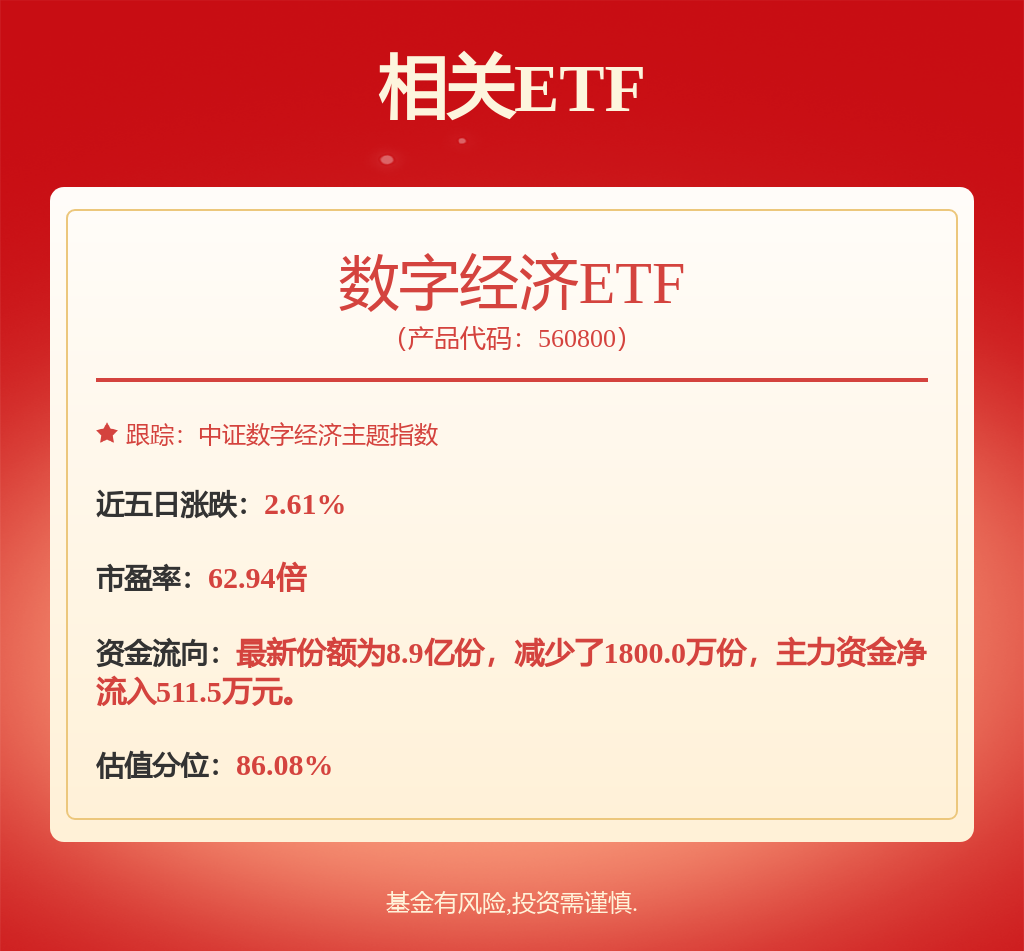
Group 1 - The digital economy sector is experiencing significant growth, with the digital economy ETF (560800) rising by 2.43% and key stocks like Cambricon increasing by 12.28% [1] - The A-share market is seeing an influx of new capital, with the Shanghai Composite Index closing at 3683.46 points, marking a new high since December 2021, and total trading volume exceeding 2 trillion yuan [1] - The semiconductor sector is showing strong performance, driven by profound changes in the computing power industry, with innovations such as liquid cooling technology and advanced packaging gaining traction [1] Group 2 - CICC expresses optimism about the ongoing market rally, suggesting that the A-share market in 2023 resembles an "enhanced version of 2013," with small-cap and growth styles outperforming [2] - The China Securities Digital Economy Theme Index (931582) includes core stocks in the digital economy sector, aligning with high-quality development goals and showcasing the potential of self-controlled industrial chains [2] - Investors are encouraged to consider the Pengyang Digital Economy ETF (560800) and its associated funds for exposure to the digital economy's long-term growth [2]
国产先进封装机遇凸显!芯片ETF上涨2.75%,海光信息上涨8.35%
Sou Hu Cai Jing· 2025-08-14 02:18
Group 1 - The A-share market showed mixed performance on August 14, with the Shanghai Composite Index rising by 0.43%, driven by gains in the real estate, non-bank financial, and food and beverage sectors, while defense and comprehensive sectors lagged behind [1] - The semiconductor sector, particularly chip technology stocks, performed strongly, with the Chip ETF (159995.SZ) increasing by 2.75% and notable individual stock performances including Haiguang Information up by 8.35% and Cambrian up by 7.21% [1] - TSMC projected that the global semiconductor market will reach a size of $1 trillion by 2030, with AI leading a new growth cycle, and HPC/AI terminal markets expected to account for 45% of the semiconductor market by that year [1] Group 2 - Guosheng Securities highlighted the opportunities in the domestic advanced packaging supply chain, noting that advanced packaging technology is driving an upgrade in the global testing and packaging industry, particularly due to strong demand from HPC and AI [1] - The domestic integrated circuit manufacturing and packaging processes have seen continuous breakthroughs and improvements in technology levels, with local equipment and material suppliers accelerating product development and customer integration [1] - The Chip ETF (159995) tracks the Guozheng Chip Index, which includes 30 leading companies in the A-share chip industry across materials, equipment, design, manufacturing, packaging, and testing, such as SMIC and Cambrian [2]




【公告全知道】光模块+英伟达+华为海思+芯片+光伏!公司在光模块、CPO封装领域已经量产出货
财联社· 2025-08-13 15:40
Group 1 - The article highlights the importance of weekly announcements from Sunday to Thursday, which include significant stock market events such as suspensions, shareholding changes, investment wins, acquisitions, earnings reports, unlocks, and high transfers, marked in red for easy identification [1] - A company has achieved mass production and shipment in the optical module and CPO packaging fields, collaborating deeply with Nvidia on 1.6T optical module process development [1] - Another company is involved in high-performance chips with multiple projects undergoing sampling and validation, focusing on optical modules, glass substrates, advanced packaging, and storage chips in partnership with Huawei [1] Group 2 - A company plans to invest 300 million yuan in a project for aerospace composite materials high-performance fiber preforms, which encompasses military applications, large aircraft, solid-state batteries, robotics, controllable nuclear fusion, and third-generation semiconductors [1]

“明战”先进封装,芯片厂商加码布局
2 1 Shi Ji Jing Ji Bao Dao· 2025-08-13 10:29
Group 1: Industry Developments - Advanced packaging technology is becoming crucial for extending Moore's Law, as traditional scaling methods face limitations due to rising costs in processes below 7nm [1][4] - The demand for advanced packaging is driven by high-performance computing, AI, data centers, autonomous driving, smartphones, and 5G communications [4][5] - Major global players like TSMC, Intel, and Samsung are prioritizing advanced packaging as a strategic focus [3][4] Group 2: Company Activities - Zhizheng Co., Ltd. plans to acquire Advanced Assembly Materials International Limited, a leading semiconductor lead frame supplier, through a significant asset swap and fundraising [1] - Huada Technology announced the establishment of a wholly-owned subsidiary for advanced packaging, indicating a trend among domestic chip companies to invest in this area [1][3] - Qizhong Technology aims to raise up to 850 million yuan for advanced packaging projects, while Baiwei Storage completed a private placement to fund its advanced packaging manufacturing expansion [3] Group 3: Equipment Demand - The shift towards advanced packaging is creating new demands for semiconductor equipment, with companies like ASMPT reporting a 50% year-on-year increase in orders for advanced packaging equipment [5] - The performance of advanced packaging equipment is critical, especially in complex scenarios like multi-layer stacking and hybrid bonding [5][6] - Domestic companies are striving to catch up, with projections of significant revenue growth for firms like Tuojing Technology, which anticipates a 52% to 58% increase in revenue by Q2 2025 [6]
帝尔激光(300776.SZ):2025年TGV有新增订单,市场以中试线为主
Ge Long Hui· 2025-08-13 08:17
Group 1 - The core viewpoint of the article indicates that Dier Laser (300776.SZ) has announced new orders for TGV in 2025, primarily focused on pilot lines [1] - The technology is applicable in advanced packaging and new display industries [1]