
可再生能源

Search documents
光大环境(00257.HK)拟成立合营企业以投资及建设乌兹别克斯坦境内的垃圾发电项目
Ge Long Hui· 2025-10-16 12:52
Core Viewpoint - The announcement indicates that Everbright Environment (00257.HK) is expanding its renewable energy portfolio in Central Asia by establishing joint ventures for waste-to-energy projects in Uzbekistan, aligning with its international strategy to meet the growing demand for waste-to-energy solutions [1] Group 1: Joint Venture Formation - The company has signed a shareholder agreement with Maxsus and China Railway 17th Bureau Group to establish joint ventures, Project Company A and Project Company B, for waste-to-energy projects in Uzbekistan [1] - Project Company A and Project Company B will be located in the Fergana and Namangan regions of Uzbekistan, respectively [1] Group 2: Strategic Expansion - The formation of these joint ventures marks a strategic expansion of the company's renewable energy business in the Central Asian region [1] - This initiative aligns with the company's strategy to develop renewable energy infrastructure in emerging markets and capitalize on the increasing demand for waste-to-energy solutions [1] Group 3: Market Position and Shareholder Returns - The board believes that this expansion will help solidify the company's market position [1] - The company anticipates that this move will provide sustainable returns for its shareholders [1]
AI基建浪潮涌向澳洲:英伟达联手Firmus,29亿美元建数据中心
Hua Er Jie Jian Wen· 2025-10-16 08:12
Core Insights - Nvidia is partnering with Australian startup Firmus Technologies to build a large-scale renewable energy-driven AI data center cluster in Australia, marking an expansion of the global AI infrastructure race into the Southern Hemisphere [1][2] - The initial investment for "Project Southgate" is AUD 4.5 billion (approximately USD 2.9 billion), with the first two data centers under construction in Melbourne and Tasmania, expected to be operational by April [1][2] - The long-term vision includes expanding the project to utilize 1.6 GW of power by 2028, with total investments reaching AUD 73.3 billion, which will support the development of 5.1 GW of new wind, solar, and hydroelectric capacity [1][2] Investment and Expansion Plans - The first phase of the project will deploy 150 MW of power capacity, with the initial investment focused entirely on renewable energy infrastructure [2] - The project aims to reshape Australia's electricity supply landscape, as the anticipated renewable energy capacity will account for about 5% of the country's total installed capacity [2]

可再生能源发展迎来制度性突破,碳中和ETF泰康(560560)盘中涨超1%,阳光电源领涨超6%
Xin Lang Cai Jing· 2025-10-16 06:23
Core Viewpoint - The recent policy changes by the National Development and Reform Commission (NDRC) in China are expected to significantly boost the renewable energy sector, particularly in hydrogen and ammonia production, while the carbon-neutral ETF is showing strong performance driven by key stocks in the clean energy space [1][2][4]. Group 1: Policy Changes and Market Impact - The NDRC's new draft policy includes mandatory assessments for renewable energy non-electric consumption, marking a shift towards multi-energy collaborative consumption [2]. - The policy aims to create a structured market space by setting non-electric consumption targets for provinces and key energy-consuming enterprises, enhancing the long-term outlook for the industry [2]. Group 2: Performance of Carbon Neutral ETF - The carbon-neutral ETF, 泰康 (560560), has seen a significant increase in scale, growing by 164.20 million yuan over the past year, ranking first among comparable funds [1]. - The ETF tracks the 中证内地低碳经济主题指数, which reflects the performance of companies involved in clean energy generation, energy conversion and storage, and waste management [4]. Group 3: Key Companies in the Sector - 宁德时代 (CATL) leads globally in energy storage battery shipments and has secured a major order for a 19GWh storage project in the UAE [3][4]. - 阳光电源 (Sungrow) is a leader in the global solar inverter market and is expanding its storage systems into emerging markets [3][4]. - 亿纬锂能 (EVE Energy) is experiencing high demand for its energy storage batteries, indicating a supply shortage [3][4]. - 隆基绿能 (LONGi Green Energy) is the largest manufacturer of monocrystalline silicon wafers and solar components, continuously improving its solar cell efficiency [3][4]. - 通威股份 (Tongwei) is a leading supplier of high-purity silicon and solar cells, with significant cost and technology advantages [3][4]. Group 4: Industry Trends - The wind power industry is showing a recovery trend, with total revenue increasing by 29.35% year-on-year and net profit rising by 16.19% in the first half of 2025 [2]. - The tower segment is benefiting from concentrated offshore project deliveries, with revenue and net profit growth of 59.13% and 43.60% respectively [2].

光伏产业或将再迎反内卷新政,光伏ETF(159857)冲击四连阳,近1周涨幅同类居首!
Sou Hu Cai Jing· 2025-10-16 05:36
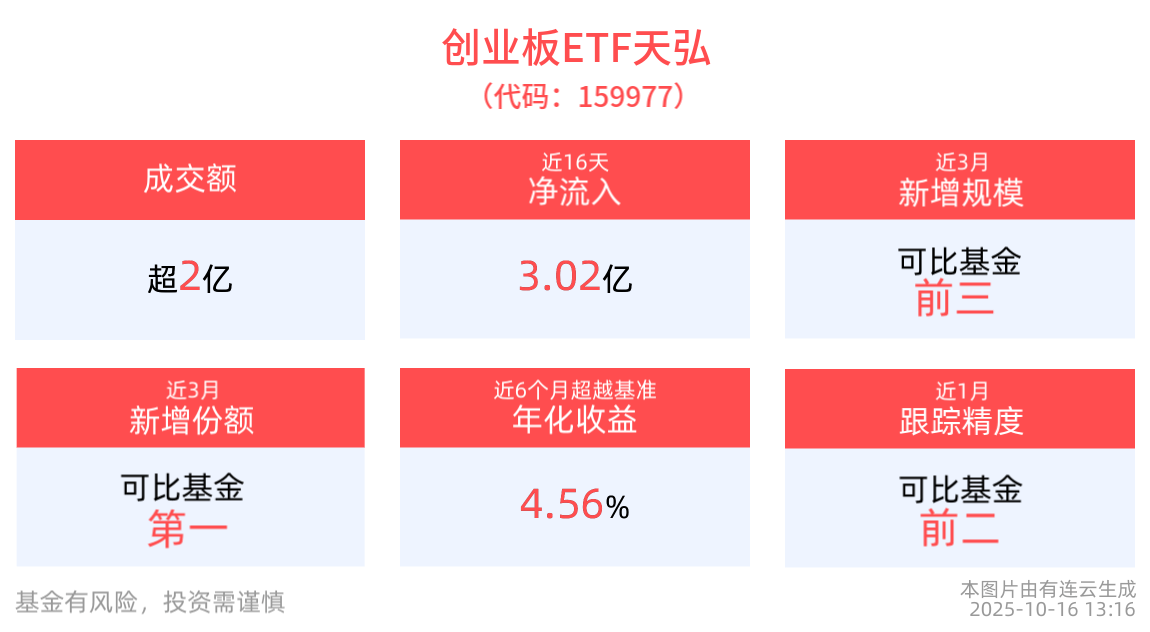
Group 1 - The core viewpoint of the news highlights the performance of the photovoltaic ETF (159857) and the entrepreneurial board ETF Tianhong (159977), indicating significant growth and investor interest in these funds [3][4]. - As of October 15, the photovoltaic ETF (159857) has seen a weekly increase of 0.49%, with a notable trading volume of 1.79 billion yuan and a net inflow of 6.36 million yuan [3]. - The photovoltaic ETF (159857) has achieved a one-year scale growth of 706 million yuan, reflecting strong market demand [3]. Group 2 - The entrepreneurial board ETF Tianhong (159977) has experienced a scale growth of 797 million yuan over the past three months, with a significant increase in share volume [4]. - The latest net inflow for the entrepreneurial board ETF Tianhong (159977) is 6.19 million yuan, contributing to a total inflow of 302 million yuan over the last 16 trading days [4]. - The photovoltaic ETF (159857) closely tracks the CSI Photovoltaic Industry Index, which includes representative companies across the photovoltaic industry chain [4]. Group 3 - Recent reports indicate that regulatory authorities may soon release a document to strengthen photovoltaic capacity control, aiming to balance supply and demand in the industry [4]. - The National Development and Reform Commission has issued a draft on renewable energy consumption targets, which aligns with global climate change initiatives and aims to enhance green energy consumption [5].



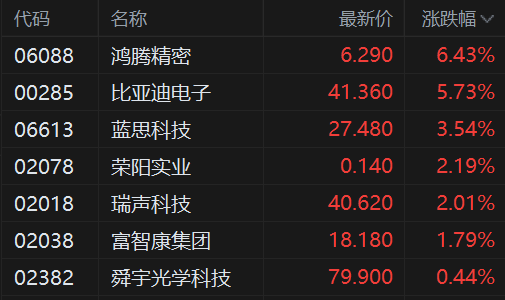
港股异动丨苹果概念股多数上涨 瑞声科技涨2% 苹果将续加大在华投资
Ge Long Hui· 2025-10-16 03:37
Core Viewpoint - Apple-related stocks showed active performance, with significant gains observed in several companies following a meeting between Apple's CEO Tim Cook and China's Minister of Industry and Information Technology, Li Lecheng, discussing Apple's business development in China and cooperation in the electronics sector [1] Group 1: Stock Performance - Hon Teng Precision increased by 6.4% [1] - BYD Electronics rose nearly 6% [1] - Lens Technology gained 3.5% [1] - AAC Technologies saw a 2% increase [1] - FIH Mobile and Sunny Optical also experienced upward movement [1] Group 2: Corporate Developments - Tim Cook emphasized Apple's commitment to increasing investment in China and enhancing cooperation for mutual benefits [1] - Sabih Khan, the new COO, visited China for the first time to engage with the "Apple supply chain" [1] - Apple reported that over 90% of its manufacturing in China now utilizes renewable energy, with more than 100 suppliers contributing to this achievement [1]

券商晨会精华 | 建议关注风电和光伏产业链标的
智通财经网· 2025-10-16 00:35
Market Overview - The market rebounded yesterday, with the Shanghai Composite Index rising over 1% to return above 3900 points, and the ChiNext Index increasing over 2% [1] - The total trading volume in the Shanghai and Shenzhen markets was 2.07 trillion, a decrease of 503.4 billion compared to the previous trading day [1] - By the end of the trading session, the Shanghai Composite Index rose by 1.22%, the Shenzhen Component Index by 1.73%, and the ChiNext Index by 2.36% [1] Financial Data Analysis - CICC commented on September financial data, noting that new credit increased year-on-year but was less than expected; however, after adjusting for debt replacement effects, credit may not be as weak as the data suggests [2] - M1 growth significantly exceeded market expectations, indicating a mild policy push, with policy financial tools beginning to take effect [2] - The reasonable growth of financial aggregate indicators will still rely on increased fiscal policy support moving forward [2] Renewable Energy Sector - Huatai Securities recommended focusing on the wind power and photovoltaic industry chains following the National Development and Reform Commission's issuance of a draft implementation plan for renewable energy consumption targets [3] - The new mechanism aligns with the "whole economy" emission reduction approach from the September UN Climate Change Summit and aims to enhance green electricity connections and trading [3] - Key beneficiaries may include leading wind turbine manufacturers, offshore wind projects, low-cost silicon materials, and high-efficiency batteries/components [3] Robotics Sector - CITIC Construction Investment highlighted a positive outlook for the humanoid robotics sector in the fourth quarter, viewing it as a critical period for the anticipated changes and mass production of Tesla's third-generation Optimus [4] - The domestic supply chain is expected to see continuous news releases regarding capital operations, order shipments, and application scenarios in Q4 [4] - The firm remains optimistic about the sector, recommending investments in the T chain and faster-growing segments such as sensors, dexterous hands, and specialized applications [4]
国际金融市场早知道:10月16日
Xin Hua Cai Jing· 2025-10-16 00:34
Core Insights - The Federal Reserve's "Beige Book" indicates that tariffs have contributed to rising prices in the U.S. economy [1] - U.S. ETFs are experiencing unprecedented inflows, with over $1 trillion in assets added this year, marking the fastest pace in history [2] - The IMF warns that global public debt is projected to exceed 100% of GDP by 2029, posing risks to financial stability [2] Economic Indicators - The New York Fed's manufacturing index rose significantly by 19.4 points to 10.7 in October, surpassing market expectations of -1.4 [2] - The Federal Reserve officials suggest that recent trade tensions have increased economic uncertainty, leading to a stronger case for interest rate cuts [1][2] Market Performance - The Dow Jones Industrial Average fell by 17.15 points to 46,253.31, a decrease of 0.04%, while the S&P 500 rose by 26.75 points to 6,671.06, an increase of 0.40% [5] - COMEX gold futures increased by 1.48% to $4,224.90 per ounce, and silver futures rose by 3.76% to $52.53 per ounce [5] Currency Movements - The U.S. dollar index decreased by 0.25%, closing at 98.794, with fluctuations in various currency pairs noted [6] - The onshore Chinese yuan appreciated against the U.S. dollar, closing at 7.1239, up 172 basis points from the previous day [6]
库克“无惧特朗普”,承诺将加大在华投资
Guan Cha Zhe Wang· 2025-10-15 23:51
Group 1 - The core message of the meeting between Apple's CEO Tim Cook and China's Minister of Industry and Information Technology, Li Lecheng, is the commitment to strengthen cooperation in the electronic information sector and Apple's continued investment in China despite ongoing US-China trade tensions [1][2]. - Apple has announced a new investment fund of 720 million RMB aimed at expanding its renewable energy capacity in China, contributing to its goal of achieving 100% renewable energy usage in its supply chain by 2030 [2][3]. - A new "China Renewable Energy Infrastructure Fund" led by Apple's suppliers, with a total scale of 1 billion RMB, aims to add 1 million MWh of clean electricity to China's power grid by 2030 [3]. Group 2 - Compared to other US companies like Nvidia and Qualcomm, Apple has been less affected by the US-China trade war, maintaining a cautious approach while still committing to investments in China [2]. - The meeting emphasized the importance of US companies in stabilizing US-China relations and promoting pragmatic cooperation, with a focus on collaborative innovation with Chinese enterprises [3][5].
美国能源部和陆军公布新计划,旨在三年内在国内军事基地部署商用微反应堆
Sou Hu Cai Jing· 2025-10-15 13:48
Technology Strategy - The U.S. Department of Energy and Army announced a plan to deploy commercial micro-reactors at domestic military bases within three years, aiming to enhance nuclear infrastructure for energy and defense [3] - The U.S. Department of Energy has consolidated six specific advisory committees into a single Scientific Advisory Committee Office to adapt to the evolving scientific landscape [3] Information - Broadcom launched a new network chip, Thor Ultra, designed to support large-scale AI computing systems, doubling the bandwidth compared to its predecessor, with expectations for the AI chip market to reach $60 billion to $90 billion by 2027 [4] - OpenAI and Broadcom entered a strategic partnership to design and deploy a total of 10 gigawatts of custom AI chips, with the first systems expected to be operational by late 2026 [4] Energy - Google plans to invest $15 billion in building its first AI center in India, which will include powerful AI infrastructure and data center capacity, marking the largest data center hub outside the U.S. [5] - Apple is expanding its renewable energy projects in Europe, supporting 650 megawatts of renewable energy projects to reduce its carbon footprint [10] - India and Canada signed a new cooperation framework focusing on energy, committing to increase bilateral trade in natural gas and liquefied petroleum gas [11] - Shell made a final investment decision on the HI gas project offshore Nigeria, expected to produce 350 million standard cubic feet of gas per day by 2030 [16] Aerospace - Boeing is developing a next-generation single-aisle aircraft to replace the 737 MAX, which has faced operational challenges since its launch [17] - The U.S. and South Korea are collaborating to develop and produce the Gray Eagle drone, with plans for the first flight in 2027 [18] - SpaceX successfully completed the 11th test flight of its Starship spacecraft, validating several key technologies for future missions [21] Advanced Manufacturing - The Canadian government is funding Qubic to develop advanced quantum amplifier technology, which aims to address thermal challenges in quantum computing [24]


亨鑫科技(01085.HK)附属获2亿元政策性贷款 用于补充光热发电项目的资本金需求
Ge Long Hui· 2025-10-15 12:58
Core Viewpoint - Hengxin Technology (01085.HK) announced that its indirectly held subsidiary, Zhejiang Zhongguang New Energy Technology Co., Ltd., signed a loan agreement for RMB 200 million with Jin Yin New Policy Financial Instruments Co., Ltd. to support the capital requirements of a 350MW solar thermal power project in Delingha, Qinghai Province [1][1][1] Group 1 - The loan is managed by the China Export-Import Bank's Zhejiang branch and is specifically allocated for the capital needs of the Qinghai Zhongkong Solar Power Co., Ltd., which will undertake the project [1][1] - The project, utilizing tower-type solar thermal technology, is expected to provide stable and reliable clean electricity to the Qinghai power grid, serving as an important demonstration project for building a new power system [1][1][1] - The board believes that the loan will supplement the project's capital, ensuring its smooth implementation and aligning with the company's strategy of deepening its involvement in renewable energy [1][1][1] Group 2 - The project is anticipated to generate stable long-term revenue, enhancing the company's market reputation and competitiveness in the solar thermal power sector [1][1] - The terms of the loan are considered normal commercial terms and are in the best interests of the company and its shareholders [1][1]