
成本控制

Search documents
申万宏源香港发盈喜,预期中期综合除税后溢利5500万港元至6500万港元 同比扭亏为盈
Zhi Tong Cai Jing· 2025-07-30 12:16
Core Viewpoint - The company expects a significant turnaround in its financial performance, projecting an unaudited consolidated profit after tax of between HKD 55 million and HKD 65 million for the six months ending June 30, 2025, compared to a loss of HKD 37 million in the same period last year [1] Financial Performance - The projected profit represents a substantial improvement from the previous year's loss, indicating a recovery in the company's financial health [1] - The company has effectively capitalized on market opportunities, leading to a notable increase in core business revenues, including institutional services, trading, wealth management, and corporate financing [1] Strategic Management - The company has optimized asset allocation and prudently managed market risk exposure, contributing to the enhanced financial results [1] - Active control of operating costs has also played a crucial role in driving profit growth for the first half of 2025 [1]

威力传动(300904) - 2025年7月30日投资者关系活动记录表
2025-07-30 08:50
Group 1: Company Overview - Weili Transmission was established in 2003 in Yinchuan, with over 1,000 employees and specializes in the R&D, production, and sales of wind power gearboxes and related products [1] - The company has become a key supplier for major domestic wind power enterprises and has entered the qualified supplier lists of international companies such as Siemens-Gamesa and Adani [1] Group 2: Funding for Smart Factory - The funding for the construction of the smart factory for gearboxes will primarily come from self-owned funds, bank loans, and secondary market refinancing, with a planned credit limit of up to 3 billion yuan [2] - The company plans to raise up to 600 million yuan through a private placement of A-shares to support the smart factory and working capital [2] Group 3: R&D Investment and Cost Control - R&D expenses for 2023 were approximately 42.56 million yuan, with a projected increase of 20.65% to 51.35 million yuan in 2024, totaling 126.11 million yuan over the last three years [2] - The company focuses on optimizing the internal structure of gearboxes to reduce material costs and improve production efficiency through technological innovation and process improvements [2][3] Group 4: Market Outlook and Industry Barriers - The global wind power installed capacity is expected to grow, with an estimated addition of 981 GW from 2025 to 2030, driving demand for wind power gearboxes [4] - The Chinese market is projected to add 86 GW in 2024, a year-on-year increase of 11%, significantly outpacing global growth [4] - Industry barriers include high technical requirements, significant capital investment, stringent supplier qualifications, and the need for a strong brand reputation [3][4]

苏试试验(300416):业绩好于预期,经营现金流显著增长
HTSC· 2025-07-30 03:59
Investment Rating - The report maintains a "Buy" rating for the company with a target price of RMB 20.10, up from the previous RMB 19.95 [4][6]. Core Insights - The company reported better-than-expected performance in its half-year results for 2025, with revenue of RMB 999 million (up 8.1% year-on-year) and net profit attributable to shareholders of RMB 117 million (up 14.2% year-on-year) [1]. - The company is expected to benefit from a favorable industry environment and a sufficient order backlog, leading to continuous growth in performance from 2025 to 2027 [1][2]. Summary by Sections Financial Performance - In the first half of 2025, the company achieved revenue of RMB 999 million, with a year-on-year growth of 8.1%. The net profit attributable to shareholders was RMB 117 million, reflecting a year-on-year increase of 14.2% [1]. - The second quarter of 2025 saw revenue of RMB 561 million, representing a year-on-year increase of 18.4% and a quarter-on-quarter increase of 30.8% [1]. Revenue Breakdown - The revenue from environmental testing services was RMB 487 million (up 5.8% year-on-year) with a gross margin of 55.0% (down 0.8 percentage points) [2]. - Integrated circuit testing revenue reached RMB 155 million (up 21.0% year-on-year) with a gross margin of 36.5% (down 6.4 percentage points) [2]. - Testing equipment revenue was RMB 310 million (up 6.3% year-on-year) with a gross margin of 26.6% (down 4.7 percentage points) [2]. Cash Flow and Capital Expenditure - The company's net operating cash flow for the first half of 2025 was RMB 99 million, an increase of 29.3% year-on-year, attributed to improved collection mechanisms [3]. - Capital expenditure was RMB 217 million, a decrease of 7.5% year-on-year, mainly due to reduced equipment purchases [3]. Profit Forecast - The report maintains profit forecasts for 2025-2027, estimating net profits attributable to shareholders of RMB 289 million, RMB 357 million, and RMB 429 million respectively [4]. - The expected compound annual growth rate (CAGR) for net profit from 2023 to 2027 is projected at 23%, which is higher than the average of comparable service companies at 21% [4].

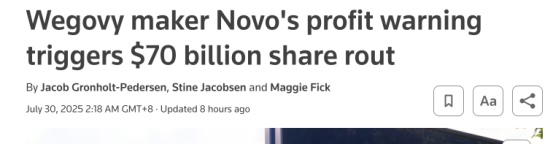
诺和诺德因减肥药销售放缓大幅下调业绩预期 并更换首席执行官
Huan Qiu Wang· 2025-07-30 03:21
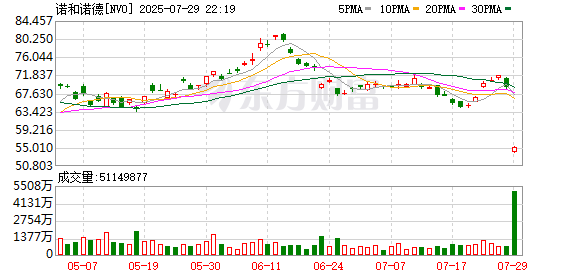
诺和诺德表示,将按固定汇率计算的全年销售增长预期从13%-21%下调至8%-14%,营业利润增长预期 从16%-24%下调至10%-16%。受此消息影响,公司股价当日下跌28%,市值蒸发约930亿美元。美国存 托凭证(ADR)收盘下跌21.81%,报53.94美元。 公司称,减肥药Wegovy在现金支付渠道的渗透率低于预期,主要受到"不安全且非法的大规模仿制 药"冲击。同时,糖尿病药物Ozempic在美国市场面临激烈竞争。分析师此前预期诺和诺德全年销售增 长16.6%。 【环球网财经综合报道】据路透社等外媒报道,丹麦制药巨头诺和诺德公司大幅下调全年财务预期,并 任命国际业务负责人Maziar Mike Doustdar为新任首席执行官,接替现任CEO。 此外,Maziar Mike Doustdar将于8月7日正式接任CEO。他在随后的电话会议中表示,公司将更加关注 成本控制,重建绩效文化。"我们需要侧重于更少的事,并且要把它做得更好。" ...


丰茂股份20250728
2025-07-30 02:32
Summary of Conference Call Notes Company and Industry Overview - The conference call discusses **Fengmao Co., Ltd.**, focusing on its **new transmission systems** and their applications in various sectors including **home, education, healthcare, and chemical cold transport** [2][4]. Key Points and Arguments 1. **Advantages of New Transmission Systems**: The new transmission systems exhibit advantages such as lightweight design, low noise, and maintenance-free features, making them superior to traditional gear transmissions in specific scenarios [2][4]. 2. **Performance in High-Temperature Environments**: There are concerns regarding the limitations of rubber materials in high-temperature environments, which need to be addressed [2][4]. 3. **Belt Transmission Solutions**: The company has effectively resolved slippage issues in motorcycle and automotive applications through optimized formulations and materials, establishing reliability for high-load scenarios, which lays the groundwork for applications in robotics [2][4][6]. 4. **Product Development Focus**: The current focus is on optimizing application scenarios, particularly enhancing performance in high-temperature environments, and customizing improvements for sectors like healthcare and education [2][4][10]. 5. **Cost Control Strategies**: Cost control is primarily driven by improving production efficiency at scale, with raw material costs and R&D expenses being relatively fixed. Manufacturing costs are the main influencing factor [2][13]. 6. **Michelin Business Performance**: The Michelin business is performing strongly in overseas markets, with revenue expectations for 2025 projected to be in the tens of millions, and plans to expand into the North American market [2][21]. 7. **Sealing and Transmission Systems Development**: The sealing systems are performing well through collaborations with companies like Zhongdali and Lidi, while transmission systems are undergoing validation in multiple fields, with some projects achieving ideal results [3][4]. Additional Important Insights 1. **Market Expansion**: The company is actively engaging with clients in various regions, including Beijing and Shenzhen, and exploring applications in agriculture, home care, and firefighting [14]. 2. **Production Facilities**: A new factory in Thailand is expected to be operational by August 2025, aimed at localizing production for clients like BYD and serving Southeast Asian and European markets [4][24]. 3. **Automotive Business Trends**: The automotive business is experiencing a decline in the passenger vehicle segment but growth in commercial vehicles, with significant performance in the transmission sector [25]. 4. **Future Outlook for Robotics**: The robotics business is in the customer validation phase, with expectations for rapid entry into mass production once validation is complete [28]. This summary encapsulates the key discussions and insights from the conference call, highlighting the company's strategic focus and market dynamics.
海大集团2025年中报:业绩稳健增长,现金流及应收账款需关注
Zheng Quan Zhi Xing· 2025-07-29 22:08
Core Insights - Haida Group's 2025 mid-year report indicates a solid performance with total revenue reaching 58.831 billion yuan, a year-on-year increase of 12.5% [2] - The net profit attributable to shareholders was 2.639 billion yuan, up 24.16% year-on-year, while the net profit after deducting non-recurring items was 2.654 billion yuan, reflecting a 30.57% increase [2] Financial Performance Overview - The company's total revenue for Q2 was 33.202 billion yuan, showing a 14.0% year-on-year growth, with net profit at 1.356 billion yuan, up 7.26% [2] - The gross profit margin improved to 11.73%, an increase of 5.27% year-on-year, and the net profit margin rose to 4.71%, up 10.49% [3] Business Composition - Feed sales remain the primary revenue source, contributing 47.139 billion yuan, which accounts for 80.13% of total revenue, with a gross margin of 9.79% [4] - Agricultural product sales and trading businesses generated revenues of 9.735 billion yuan and 1.394 billion yuan, with gross margins of 20.26% and 2.41% respectively [4] - The gross margins for animal health products and other businesses were significantly higher at 49.69% and 50.85% [4] Cash Flow and Financial Health - The net cash flow from operating activities was 1.83 yuan per share, a 60.33% increase year-on-year, indicating strong cash flow management [5] - However, cash and cash equivalents decreased by 26.07% to 3.481 billion yuan, raising concerns about liquidity [5] - Accounts receivable increased by 9.42% to 4.44 billion yuan, with a concerning ratio of accounts receivable to profit at 98.59% [5] Debt and Financial Costs - Financial expenses were negative, decreasing by 30.37% due to reduced borrowing and interest expenses [6] - Interest-bearing debt was 2.605 billion yuan, down 50.26%, reflecting the company's efforts to strengthen its financial structure [6] Growth Prospects and Challenges - In the first half of 2025, the company sold 14.7 million tons of feed, a 25% year-on-year increase, with market share continuing to grow [7] - The company experienced significant growth in pig feed sales, up 43%, benefiting from the recovery in the pig farming industry [7] - Despite progress in seedling and animal health businesses, losses were recorded in poultry farming and slaughtering due to low poultry meat prices [7]

诺和诺德候任CEO:将关注公司的成本基数
Hua Er Jie Jian Wen· 2025-07-29 14:18
Core Insights - The incoming CEO Mike Doustdar emphasizes the need to focus on the company's cost base after a period of "rapid growth" [2] - The company may need to reallocate certain resources but has not yet provided specific cost-cutting measures [2] - The company possesses the best pipeline in the weight loss drug sector but acknowledges the need for improvement [2]
Eagle Materials(EXP) - 2026 Q1 - Earnings Call Transcript
2025-07-29 13:32
Financial Data and Key Metrics Changes - The company reported record first quarter revenue of $634.7 million, an increase of 4% year-over-year, primarily driven by higher cement and wallboard sales volume, as well as contributions from recently acquired aggregates businesses [4][14] - Diluted net earnings per share decreased by 5% to $3.76, attributed to lower earnings in cement due to higher operating costs, partially offset by a 3% reduction in fully diluted shares from the share buyback program [4][14] Business Line Data and Key Metrics Changes - In the heavy materials sector, revenue increased by 5%, driven by increased cement sales volume and a 21% increase in concrete and aggregates revenue. Aggregates sales volume surged by 117%, including contributions from recently acquired businesses, with organic aggregates sales volume up 29% [15] - The light materials sector saw a 1% increase in revenue, reflecting higher wallboard sales volume, but was partially offset by lower wallboard sales prices. Operating earnings in this sector decreased slightly due to lower net sales prices, despite lower input costs [16] Market Data and Key Metrics Changes - Aggregate volumes improved significantly year-over-year, aided by the integration of two recently acquired quarries and organic growth [8] - Cement volumes also improved year-over-year, marking the first quarter since December 2023 with an increase in cement sales volumes, despite weather disruptions in several markets [9] Company Strategy and Development Direction - The company continues to focus on operational improvement and sustainability initiatives, aiming to enhance its competitive advantage as a low-cost producer [5][6] - Strategic investments are being made in modernization and expansion projects, including the Laramie, Wyoming cement plant and the Duke, Oklahoma wallboard facility, with a total capital spending expectation of $475 million to $525 million for fiscal 2026 [12][17] Management's Comments on Operating Environment and Future Outlook - Management expressed cautious optimism regarding demand trends, noting stable order trends across major business lines despite macroeconomic uncertainties [8] - The company anticipates that high capacity utilization rates in the cement industry will lead to an improved pricing environment as cement sales volumes rebound [9][11] Other Important Information - The company generated operating cash flow of $137 million, reflecting improved working capital management, and repurchased 358,000 shares for $79 million during the first quarter [16][17] - The net debt to capitalization ratio remained at 46%, with a net debt to EBITDA leverage ratio of 1.6 times, indicating significant financial flexibility [18] Q&A Session Summary Question: Wallboard performance and demand drivers - Management noted that geographic positioning and trailing twelve-month volume analysis are key factors in outperforming the market, despite ongoing affordability issues in housing [20][21] Question: Cost expectations for wallboard - Natural gas prices have stabilized, and the company has sufficient natural gypsum reserves, indicating no immediate cost concerns [22][23] Question: Impact of ramp-up at new facilities - The ramp-up at the new facility has been a drag on earnings, but improvements are expected as operations stabilize [26][27] Question: Future wallboard margins - Margins are expected to have natural seasonality, but no one-time issues are anticipated moving forward [28][29] Question: Cement volume trends and regional dynamics - Cement volume trends have been consistent, driven by infrastructure spending, with no significant deviations noted across regions [34][36] Question: Outlook for wallboard volumes - Demand for wallboard is expected to remain under pressure due to housing affordability issues, but long-term prospects are viewed positively [41][42] Question: Cement pricing outlook - Management is optimistic about mid to long-term pricing potential as supply-demand dynamics tighten, although short-term price increases may be challenging [49][50]

Eagle Materials(EXP) - 2026 Q1 - Earnings Call Transcript
2025-07-29 13:30
Financial Data and Key Metrics Changes - The company reported record first quarter revenue of $634.7 million, an increase of 4% year-over-year, primarily driven by higher cement and wallboard sales volume, as well as contributions from recently acquired aggregates businesses [4][15] - Diluted net earnings per share decreased by 5% to $3.76, mainly due to lower earnings in cement from higher operating costs, partially offset by a 3% reduction in fully diluted shares due to the share buyback program [15] - Operating cash flow increased by 3% to $137 million, reflecting improved working capital management [17] Business Line Data and Key Metrics Changes - In the heavy materials sector, revenue increased by 5%, driven by increased cement sales volume and a 21% increase in concrete and aggregates revenue [16] - Aggregates sales volume surged by 117%, including contributions from recently acquired businesses, with organic aggregates sales volume up by 29% [16] - The light materials sector saw a 1% increase in revenue, reflecting higher wallboard sales volume, but was partially offset by lower wallboard sales prices [17] Market Data and Key Metrics Changes - Cement volumes improved year-over-year, marking the first quarter since December 2023 with a year-over-year increase in cement sales volumes, despite major weather disruptions [9] - Aggregate volumes improved significantly, aided by the integration of two recently acquired quarries [8] - Wallboard volumes remain subdued due to ongoing affordability challenges in the housing market, with structural constraints on adding supply in cement and wallboard [11][12] Company Strategy and Development Direction - The company continues to focus on operational improvement and sustainability initiatives, aiming to enhance its competitive advantage as a low-cost producer [5][6] - Strategic investments are being made in modernization and expansion projects, including the Laramie, Wyoming cement plant and the Duke, Oklahoma wallboard facility [13] - The company plans to continue investing in strategic projects and opportunistic share repurchases to create value [14] Management's Comments on Operating Environment and Future Outlook - Management expressed cautious optimism regarding demand trends, noting stable order trends across major business lines despite macroeconomic uncertainties [8] - The company anticipates that high capacity utilization rates in the cement industry will lead to an improved pricing environment as cement sales volumes rebound [10] - Long-term demand fundamentals are expected to favor the consumption of the company's products due to aging infrastructure and housing stock [12] Other Important Information - The company repurchased 358,000 shares for $79 million and paid a quarterly dividend, returning $87 million to shareholders during the first quarter [19] - The net debt to capitalization ratio remained at 46%, and the net debt to EBITDA leverage ratio was 1.6 times, indicating significant financial flexibility [20] Q&A Session Summary Question: Wallboard performance and demand drivers - Management noted that geographic positioning and trailing twelve-month volume analysis are key factors in outperforming the market, despite ongoing affordability issues in housing [22][23] Question: Cost dynamics in wallboard - Natural gas prices have stabilized, and the company has sufficient natural gypsum reserves, indicating no immediate cost concerns [24] Question: Joint venture operating earnings and ramp-up - Earnings were impacted by the ramp-up of a new facility and weather issues in Texas, but improvements are expected as the year progresses [27][28] Question: Cement volume cadence and regional dynamics - Cement volume demand has been consistent throughout the quarter, driven by infrastructure spending, with no significant regional deviations noted [35][38] Question: Wallboard volume outlook - Management expects wallboard demand to remain under pressure due to affordability issues, but believes the market is underbuilt in the medium to long term [41][42] Question: Cement pricing outlook - Management is optimistic about mid to long-term pricing potential as demand remains stable, but short-term pricing increases may be more challenging [49][50] Question: Wallboard pricing dynamics - Wallboard pricing has been range-bound, with expectations for similar trends until there is a meaningful increase in volume [59]
联泰控股发盈喜 预计上半年取得股东应占纯利约50万美元 同比扭亏为盈
Zhi Tong Cai Jing· 2025-07-29 10:54
Core Viewpoint - The company anticipates a significant improvement in its financial performance for the six months ending June 30, 2025, projecting a net profit of approximately $500,000 compared to a net loss of about $9.7 million in the same period of 2024 [1] Financial Performance Summary - The expected improvement in financial performance is attributed to several factors: - There will be no non-recurring general, administrative, and legal expenses related to U.S. customs laws during the period, whereas approximately $3.9 million in such expenses were incurred in the same period of 2024 [1] - The overall gross margin has improved due to the resolution of previous issues and the ongoing strict cost control measures implemented by management [1] - Financial expenses are projected to decrease from approximately $6.4 million in 2024 to about $4.8 million in the current period due to declining interest rates and strategic allocation of funds [1] Operational Environment Summary - Despite the anticipated improvement in net performance, the management believes that the overall operating environment remains highly challenging, particularly due to uncertainties arising from the U.S. reciprocal tariff policies, which have negatively impacted performance to some extent [2] - The company maintains a conservative outlook for the second half of the year, planning to take proactive measures to reduce operational risks, enhance operational efficiency, cut costs, and manage cash flow rigorously [2] - The company will continue to closely monitor market conditions and adjust business strategies as necessary [2]