适度宽松的货币政策

Search documents
冠通期货早盘速递-20251020
Guan Tong Qi Huo· 2025-10-20 01:31
Report Summary 1. Hot News - The central bank will continue a moderately loose monetary policy to ensure liquidity, support consumption and investment, and maintain financial market stability and a stable RMB exchange rate [2] - The national fiscal revenue in the first three quarters was 16.39 trillion yuan, a year-on-year increase of 0.5%, and the fiscal expenditure was 20.81 trillion yuan, a year-on-year increase of 3.1% [2] - The Shanghai Futures Exchange will adjust the price limit range and margin ratios for gold and silver futures contracts from October 21 [2] - China and the US agreed to hold a new round of economic and trade consultations soon after a video call [2] - The National Energy Administration released an opinion to promote the high - quality development of coal washing [3] 2. Sector Performance - Key sectors to watch: urea, coking coal, Shanghai silver, crude oil, PVC [4] - Night - session price changes of commodity futures main contracts: non - metallic building materials 2.87%, precious metals 32.22%, oilseeds 10.05%, soft commodities 2.63%, non - ferrous metals 20.52%, coal - coking - steel - ore 12.82%, energy 3.06%, chemicals 11.20%, grains 1.08%, agricultural and sideline products 3.55% [4] 3. Sector Position - The chart shows the five - day position changes of commodity futures sectors from October 13 to October 17 [5] 4. Performance of Major Asset Classes | Asset Class | Name | Daily Change (%) | Monthly Change (%) | Year - to - Date Change (%) | | --- | --- | --- | --- | --- | | Equity | Shanghai Composite Index | - 1.95 | - 1.11 | 14.56 | | | SSE 50 | - 1.70 | 1.01 | 10.54 | | | CSI 300 | - 2.26 | - 0.48 | 14.72 | | | CSI 500 | - 2.98 | - 2.44 | 22.54 | | | S&P 500 | 0.53 | - 0.89 | 13.30 | | | Hang Seng Index | - 2.48 | - 3.60 | 25.86 | | | German DAX | - 1.82 | 1.64 | 19.70 | | | Nikkei 225 | - 1.44 | 7.44 | 19.27 | | | FTSE 100 | - 0.86 | 0.92 | 14.46 | | Fixed - Income | 10 - year Treasury Bond Futures | 0.12 | 0.42 | - 0.58 | | | 5 - year Treasury Bond Futures | 0.07 | 0.14 | - 0.71 | | | 2 - year Treasury Bond Futures | 0.01 | 0.01 | - 0.58 | | Commodity | CRB Commodity Index | - 0.17 | - 2.25 | - 1.14 | | | WTI Crude Oil | 0.23 | - 8.15 | - 19.92 | | | London Spot Gold | - 1.73 | 12.15 | 62.01 | | | LME Copper | - 0.38 | 3.15 | 20.79 | | | Wind Commodity Index | 1.18 | 6.50 | 40.16 | | Other | US Dollar Index | 0.21 | 0.54 | - 9.15 | | | CBOE Volatility Index | - 17.90 | 55.47 | 19.77 | [6]
资讯早班车-2025-10-20-20251020
Bao Cheng Qi Huo· 2025-10-20 01:31
Industry Investment Rating - No investment rating for the industry is provided in the report. Core Views - The report offers a comprehensive overview of macro - economic data, commodity investment trends, financial news, and stock market updates. It indicates that the economy is generally stable with some positive signs, but also faces challenges such as trade uncertainties and potential risks in the financial market. The bond market is expected to be in an oscillatory pattern, while the stock market is expected to have long - term upward momentum with short - term adjustments [17][20][32]. Summary by Directory 1. Macro Data Overview - GDP in Q2 2025 had a year - on - year growth of 5.2%, slightly lower than the previous quarter. The manufacturing PMI in September was 49.8%, showing a slight improvement. The growth rate of social financing scale and M1, M2 money supply had changes, and the CPI and PPI were still in the negative range [1]. 2. Commodity Investment Reference Comprehensive - The central bank will continue to implement a moderately loose monetary policy. Sino - US economic and trade consultations are expected to resume. The US government is relaxing some tariff policies. The trading rules of gold and silver futures on the Shanghai Futures Exchange will be adjusted. Analysts expect the LPR to remain flat in October with potential for future cuts, and the US will extend the tariff credit arrangement for auto parts imports [2][3]. Metals - International precious metal futures generally declined, and the base metal market may oscillate widely. Gold has increased by over 60% this year, and there are different views on its future trend. Silver prices have also risen significantly, with a nearly 70% increase this year. Some domestic and Japanese precious metal prices have reached new highs, and some companies plan to raise prices [5][6][7]. Coal, Coke, Steel and Minerals - The National Energy Administration aims to promote the high - quality development of coal washing, and the US Treasury Secretary urges the World Bank to fund various energy sources including coal [11]. Energy and Chemicals - China has achieved multiple breakthroughs in the energy field. The new regulations on the fair opening of oil and gas pipeline networks will be implemented. India's oil imports from Russia have increased, and Egypt will freeze domestic fuel prices [12]. 3. Financial News Compilation Open Market - This week, 789.1 billion yuan of reverse repurchases will mature in the central bank's open market. On October 17, the central bank conducted 164.8 billion yuan of 7 - day reverse repurchase operations, resulting in a net withdrawal of 244.2 billion yuan on that day [16]. Important News - Sino - US economic and trade consultations are expected to resume. The US government is relaxing tariff policies, and the US president admits that high - tariff strategies are unsustainable. Analysts expect the LPR to remain flat in October. The central bank will implement a moderately loose monetary policy. The government will promote green trade and agricultural production, and the financial situation shows a stable and upward trend [17][18][20]. Bond Market Summary - The Chinese bond market strengthened, with yields of long - term bonds declining. Bond futures rose, and the inter - bank market funds were stable and loose. The bond market is affected by policy expectations and stock market fluctuations and is in an oscillatory pattern [26]. Foreign Exchange Market - The on - shore RMB against the US dollar declined, and the US dollar index rose, with most non - US currencies falling [31]. Research Report Highlights - Different securities firms have different views on the bond and stock markets. Generally, the bond market is expected to oscillate, and the stock market is expected to have long - term upward momentum with short - term adjustments [32][33]. 4. Stock Market Important News - As of October 19, 2025, the number of newly established funds this year has exceeded that of 2024, with stock - type funds reaching a 15 - year high in terms of new establishment and issuance scale. The ETF market has seen significant capital inflows, and two capital - market monetary policy tools have effectively boosted market confidence [37][38].
收益率“破一”需求仍旺盛 前八月货币基金规模增加一点二万亿
Zheng Quan Shi Bao· 2025-10-19 18:00
Core Viewpoint - Recent fee reductions by multiple public money market funds indicate a response to declining yields and competitive pressures in the market [1][2][3][4] Group 1: Fee Reductions - Yinhua Duolibao Money Market Fund announced a reduction in the custodian fee from 0.10% to 0.05% effective October 18 [1] - Hongta Hongtu Renrenbao Money Market Fund reduced its management fee from 0.30% to 0.14% on October 13 [1] - Changjiang Money Manager Money Market Fund lowered its management fee to 0.25% on the same day [1] - Tianhong Cash Manager Money Market Fund cut its management fee from 0.33% to 0.15% on October 10 [1] Group 2: Market Trends - As of October 16, over 80 money market funds had a seven-day annualized yield below 1% [2] - Despite declining yields, the total scale of money market funds in China grew to approximately 14.81 trillion yuan by the end of August, up from 13.61 trillion yuan at the end of last year, marking an increase of 1.2 trillion yuan [2] - The growth in money market fund scale is attributed to their liquidity advantages compared to bank deposits, especially amid volatility in equity markets [2] Group 3: Monetary Policy Impact - The People's Bank of China has reiterated its commitment to a moderately loose monetary policy, which has led to a downward trend in yields of money market fund investment targets such as bank deposits and short-term government bonds [3] - The recent interest rate cuts by small and medium-sized banks have made money market funds more attractive due to their flexibility and lower risk profile [3] Group 4: Industry Response - Fund managers are adopting various strategies to cope with scale pressures, including fee reductions and enhancing asset quality [3] - Fee reductions may compress profit margins for fund companies in the short term but can enhance industry professionalism and management efficiency in the long run [4] - Lower fees directly reduce investment costs for investors, which is particularly beneficial in a low-yield environment [4]
FICC周报:高位板块调整,权重托底大盘-20251019
Hua Tai Qi Huo· 2025-10-19 12:03
FICC周报 | 2025-10-19 高位板块调整,权重托底大盘 市场分析 中美高层通话。宏观方面,北京时间10月18日上午,中美经贸中方牵头人、国务院副总理何立峰与美方牵头人、 美国财政部长贝森特和贸易代表格里尔举行视频通话,双方围绕落实今年以来两国元首历次通话重要共识,就双 边经贸关系中的重要问题进行了坦诚、深入、建设性的交流,同意尽快举行新一轮中美经贸磋商。海外方面,特 朗普访谈中承认以高关税威胁中国的策略不可持续,并可能会冲击美国经济。此前,特朗普也曾在社交媒体平台 上发帖表示,美国"无意伤害中国",暗示愿在一定条件下缓和紧张局势。目前特朗普已签署行政令,自11月1日起 对进口中型和重型卡车及零部件征收25%的新关税。还称还将对进口客车征收10%的关税。 股指调整。现货市场,A股三大指数本周调整,上证指数收盘跌1.47%收于3839.76点,创业板指跌5.71%。行业方 面,板块指数跌多涨少,银行、煤炭行业涨幅超4%,电子、传媒、汽车、通信行业跌幅居前。日均成交额约为2.3 万亿元。央行行长潘功胜在出席G20财长和央行行长会议时表示,将继续实施适度宽松的货币政策,综合运用多种 货币政策工具,保证流动 ...
前三季度新增社会融资规模超30万亿元 金融支持实体力度保持稳固
Jing Ji Ri Bao· 2025-10-19 01:10
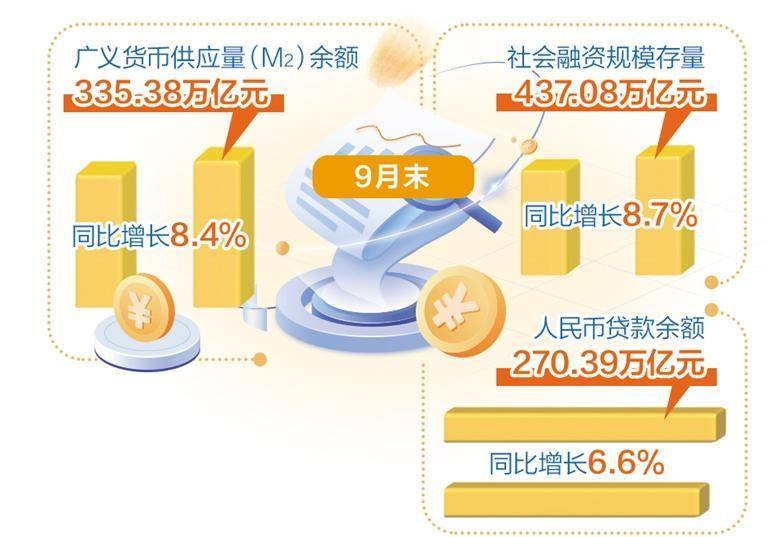
Core Insights - The financial statistics released by the People's Bank of China indicate a robust growth in social financing and a stable increase in M2 money supply, reflecting the ongoing support for the real economy through a moderately loose monetary policy [1][2] Group 1: Social Financing and M2 Growth - As of the end of September, the M2 balance reached 335.38 trillion yuan, with a year-on-year growth of 8.4%, maintaining a high growth rate despite last year's high base [2] - The total social financing stock was 437.08 trillion yuan, showing a year-on-year increase of 8.7%, which is 0.7 percentage points higher than the same period last year [2] - In the first three quarters, the incremental social financing totaled 30.09 trillion yuan, which is 4.42 trillion yuan more than the previous year [2] Group 2: Direct Financing - The acceleration in government bond issuance and the improved channels for corporate bond and equity financing have significantly contributed to direct financing, which has played a notable role in the social financing scale [2] - In the first three quarters, net financing from government bonds reached 11.46 trillion yuan, an increase of 4.28 trillion yuan year-on-year, supporting domestic demand and risk prevention [2] Group 3: Credit Structure Optimization - By the end of September, the balance of RMB loans was 270.39 trillion yuan, with a year-on-year growth of 6.6%, indicating a reasonable growth in loan scale and an optimized credit structure [3] - In the first three quarters, RMB loans increased by 14.75 trillion yuan, with household loans rising by 1.1 trillion yuan and corporate loans increasing by 13.44 trillion yuan [3] Group 4: Policy Support and Financing Costs - The comprehensive financing costs for enterprises have shown a steady decline, with the weighted average interest rate for newly issued loans around 3.1%, approximately 40 basis points lower than the same period last year [5] - The implementation of interest subsidies for personal consumption loans and service industry loans has further stimulated demand for consumer loans [5] Group 5: Economic Outlook - The internal and external environments are stabilizing, with positive changes in corporate operations, consumer spending, and trade, providing a foundation for achieving annual economic and social development goals [6] - The moderately loose monetary policy is expected to continue supporting the real economy, while fiscal policies are actively promoting consumption and improving livelihoods [6]
前三季度,新增社会融资规模超30万亿元——金融支持实体力度保持稳固
Xin Hua Wang· 2025-10-18 23:23
Core Insights - The financial statistics released by the People's Bank of China indicate a robust financial support for the real economy, driven by a moderately loose monetary policy [1] Monetary Supply and Financing - As of the end of September, the M2 balance reached 335.38 trillion yuan, with a year-on-year growth of 8.4%, maintaining a high growth rate despite last year's high base [2] - The total social financing stock was 437.08 trillion yuan, showing a year-on-year increase of 8.7%, which is 0.7 percentage points higher than the same period last year [2] - In the first three quarters, the cumulative increase in social financing amounted to 30.09 trillion yuan, which is 4.42 trillion yuan more than the previous year [2] Credit Structure and Loan Growth - By the end of September, the balance of RMB loans was 270.39 trillion yuan, reflecting a year-on-year growth of 6.6% [3] - In the first three quarters, RMB loans increased by 14.75 trillion yuan, with household loans rising by 1.1 trillion yuan and corporate loans increasing by 13.44 trillion yuan [3] - The loan structure is improving, with significant growth in medium to long-term loans for both households and enterprises, particularly in key industries like equipment manufacturing and high-tech manufacturing [3][4] Policy Support and Cost of Financing - The average interest rate for newly issued corporate loans was approximately 3.1% in September, which is about 40 basis points lower than the same period last year, indicating a stable decline in financing costs [5] - Recent policies aimed at reducing interest costs for personal consumption loans and service industry loans have further stimulated demand [5] - Adjustments in housing purchase policies in major cities have led to a rebound in personal housing loan demand, with the average interest rate for new personal housing loans also at approximately 3.1%, down about 25 basis points year-on-year [5] Economic Outlook - The internal and external environments are showing signs of stabilization and improvement, with positive changes in corporate operations, consumer spending, and trade [6] - The monetary policy is expected to continue supporting the real economy in the fourth quarter, alongside active fiscal policies and the gradual realization of previously introduced measures [6] - Long-term structural transformation and industrial upgrades in the Chinese economy are anticipated to progress steadily, leading to a more balanced supply-demand relationship in the real economy [6]
金融支持实体力度保持稳固
Sou Hu Cai Jing· 2025-10-18 22:54
Core Insights - The financial statistics released by the People's Bank of China indicate a robust support for the real economy through a moderately loose monetary policy, with significant growth in social financing and broad money supply (M2) [2][3] Group 1: Social Financing and M2 Growth - As of the end of September, the M2 balance reached 335.38 trillion yuan, reflecting a year-on-year growth of 8.4%, maintaining a high growth rate despite last year's high base [3] - The total social financing stock was 437.08 trillion yuan, with a year-on-year increase of 8.7%, which is 0.7 percentage points higher than the same period last year [3] - In the first three quarters, the incremental social financing totaled 30.09 trillion yuan, which is 4.42 trillion yuan more than the previous year [3] Group 2: Direct Financing - The acceleration in government bond issuance and improved access to corporate bond and equity financing have significantly contributed to direct financing, with government bonds playing a crucial role [3] - In the first three quarters, net financing from government bonds reached 11.46 trillion yuan, an increase of 4.28 trillion yuan year-on-year, positively impacting domestic demand and risk prevention [3] Group 3: Credit Structure Optimization - By the end of September, the balance of RMB loans was 270.39 trillion yuan, with a year-on-year growth of 6.6%, indicating a reasonable growth in loan scale [4] - In the first three quarters, RMB loans increased by 14.75 trillion yuan, with household loans rising by 1.1 trillion yuan and corporate loans increasing by 13.44 trillion yuan [4] Group 4: Policy Support and Financing Costs - The average interest rate for newly issued corporate loans was approximately 3.1% in September, down about 40 basis points from the previous year, indicating a stable decline in comprehensive financing costs for enterprises [6] - The implementation of personal consumption loan subsidies and adjustments in housing purchase policies in major cities have contributed to a recovery in personal housing loan demand [6] Group 5: Economic Outlook - The internal and external environments are showing signs of stabilization and improvement, with positive changes in corporate operations, consumer spending, and trade [7] - The monetary policy is expected to continue supporting the real economy, while fiscal policies are actively promoting consumption and improving livelihoods [7]

前三季度,新增社会融资规模超30万亿元—— 金融支持实体力度保持稳固
Jing Ji Ri Bao· 2025-10-18 22:11
Core Insights - The financial statistics released by the People's Bank of China indicate a robust financial support for the real economy, driven by a moderately loose monetary policy [1] Group 1: Monetary Supply and Financing Scale - As of the end of September, the M2 balance reached 335.38 trillion yuan, with a year-on-year growth of 8.4%, maintaining a high growth rate despite last year's high base [2] - The total social financing scale stood at 437.08 trillion yuan, with a year-on-year increase of 8.7%, which is 0.7 percentage points higher than the same period last year [2] - In the first three quarters, the incremental social financing totaled 30.09 trillion yuan, which is 4.42 trillion yuan more than the previous year [2] Group 2: Credit Structure Optimization - By the end of September, the balance of RMB loans was 270.39 trillion yuan, reflecting a year-on-year growth of 6.6% [3] - In the first three quarters, RMB loans increased by 14.75 trillion yuan, with household loans rising by 1.1 trillion yuan and corporate loans increasing by 13.44 trillion yuan [3] - The growth in corporate loans was supported by a significant increase in medium to long-term loans, particularly in key sectors like equipment manufacturing and high-tech manufacturing [3] Group 3: Policy and Cost of Financing - The average interest rate for newly issued corporate loans in September was approximately 3.1%, which is about 40 basis points lower than the same period last year [5] - The implementation of interest subsidies for personal consumption loans and service industry loans has further stimulated demand for consumer loans [5] - Recent adjustments in housing purchase policies in major cities have led to a rebound in personal housing loan demand, with the average interest rate for new personal housing loans also at about 3.1%, down 25 basis points year-on-year [5] Group 4: Economic Outlook - The internal and external environments are showing signs of stabilization and improvement, with positive changes in corporate operations, consumer spending, and trade [6] - The moderately loose monetary policy is expected to continue supporting the real economy, while fiscal policies are actively being implemented to enhance consumption and improve livelihoods [6] - Long-term structural transformation and industrial upgrades in the Chinese economy are anticipated to progress steadily, leading to a more balanced supply-demand relationship [6]
从9月份金融统计数据透视中国经济发展“亮点” 回升向好步伐坚定
Yang Shi Wang· 2025-10-16 06:45
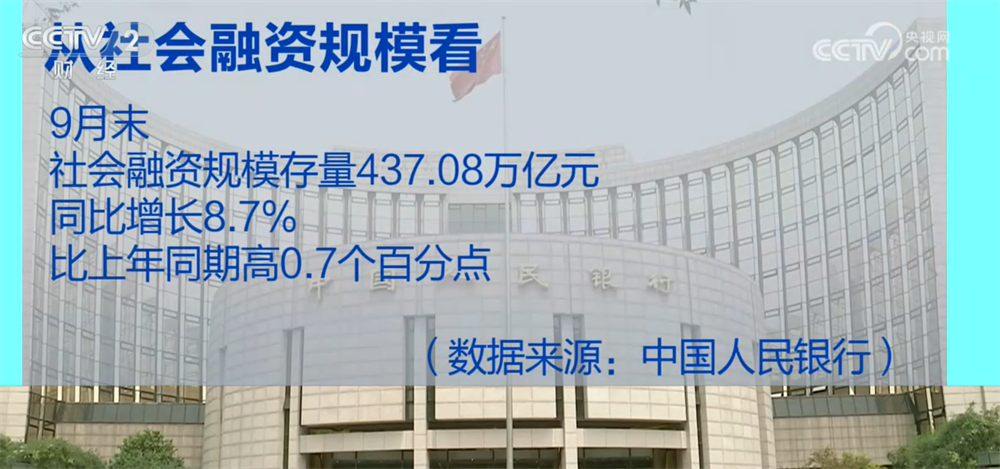
Core Insights - The People's Bank of China reported that the growth rates of broad money supply and social financing remained high in September, creating a favorable monetary environment for economic recovery [1][3] Monetary Supply and Financing - As of the end of September, the total social financing stock was 437.08 trillion yuan, reflecting a year-on-year growth of 8.7%, which is 0.7 percentage points higher than the same period last year [1] - The broad money supply reached 335.38 trillion yuan, with a year-on-year increase of 8.4%, surpassing the previous year's growth by 1.5 percentage points [3] Credit and Interest Rates - The RMB loan balance stood at 270.39 trillion yuan at the end of September, showing a year-on-year growth of 6.6% [3] - The weighted average interest rate for newly issued corporate loans was approximately 3.1%, down about 40 basis points from the previous year, while the rate for personal housing loans was also around 3.1%, lower by about 25 basis points year-on-year [5] Credit Structure and Demand - The balance of inclusive small and micro loans was 36.09 trillion yuan, with a year-on-year increase of 12.2%, and medium to long-term loans in the manufacturing sector reached 15.02 trillion yuan, growing by 8.2% [7] - The implementation of consumer credit interest subsidy policies has led to a rebound in household credit demand, with the effects of previously introduced consumption-boosting measures gradually becoming evident [9]
9月贷款利率持续保持低位水平 实体经济的融资需求满足度较高
Yang Shi Xin Wen· 2025-10-16 03:32
Core Viewpoint - The central bank's data indicates that loan interest rates have remained low throughout the year, leading to a high level of satisfaction regarding the financing needs of the real economy [1] Group 1: Loan Interest Rates - In September, the average interest rate for new corporate loans was approximately 3.1%, which is about 40 basis points lower than the same period last year [1] - The average interest rate for new personal housing loans was also around 3.1%, down about 25 basis points compared to the previous year [1] - The sustained low level of loan interest rates is attributed to the ongoing moderately loose monetary policy [1] Group 2: Monetary Policy Impact - The effects of a series of monetary policies, including reserve requirement ratio cuts and interest rate reductions, are becoming increasingly evident [1] - The low loan interest rates are contributing to a stable decrease in corporate financing costs, creating a favorable monetary and financial environment for the development of the real economy [1]