
逆周期调节

Search documents
中金 • 全球研究 | 泰国:下半年或需加强逆周期调节
中金点睛· 2025-09-02 23:37
Macroeconomic Overview - Thailand's real GDP grew by 2.8% year-on-year in Q2 2025, surpassing Bloomberg's consensus estimate of 2.4% and up from 2.3% in Q2 2024, although it slowed from 3.2% in Q1 2025 [2][8] - The National Economic and Social Development Council adjusted the full-year growth forecast to 1.8-2.3%, up from the previous range of 1.3-2.3%, maintaining cautious optimism amid global uncertainties [2][8] - Key growth drivers include strong export performance, with Q2 exports up 12.2% year-on-year, and a rebound in private investment, which grew by 4.1% [8][10] Policy Response - Thailand faces multiple pressures including political friction, border conflicts, trade risks, and natural disasters, which pose challenges to growth [3][21] - The Constitutional Court's ruling on former Prime Minister Prayuth Chan-o-cha's actions may delay key initiatives like the digital wallet plan [21][22] - Strong foreign direct investment (FDI) activity, with a record 1,063 approved projects worth $18.7 billion in H1 2025, signals positive investment sentiment [22][23] Trade Dynamics - Thailand's exports grew by 14.8% year-on-year in Q2 2025, continuing a five-quarter growth streak, driven by strong demand for electronics [4][30] - The U.S. imposed a 19% tariff on Thai goods, which may pressure export-oriented businesses in the second half of 2025 [4][30] - Thailand is actively seeking to diversify its trade relationships, achieving key milestones such as gaining BRICS partner status and enhancing ties with the European Free Trade Association [4][31][32] Tourism Sector - The tourism sector showed signs of weakness, with foreign visitor numbers down 12.2% year-on-year in Q2 2025, primarily due to safety concerns and regional competition [5][38] - The Thai government announced a stimulus package of 10 billion baht (approximately $300 million) to promote tourism and improve attractions [5][39] - Long-haul tourists are expected to increase, potentially driving tourism revenue to $46.4 billion in 2025, up from $39.7 billion in 2024 [5][39] Capital Markets - The SET index rose by 3% in the past month, reflecting improved market sentiment, although it remains down 6.9% year-to-date [6][49] - The forward P/E ratios for 2025 and 2026 are projected at 14.0x and 13.1x, respectively, indicating a valuation below historical averages [6][49] - Investment strategies should focus on high-dividend financial stocks, electronic and electric vehicle manufacturing, fintech innovation, and energy transition [6][50]


直击中信金融资产中期业绩会:盈利超61亿 向行业标杆目标迈进
2 1 Shi Ji Jing Ji Bao Dao· 2025-09-02 11:38
Core Insights - The company reported strong financial performance for the first half of 2025, with total revenue exceeding 40 billion yuan, a year-on-year increase of 21.1%, and a net profit of 6.168 billion yuan, up 15.7% [2][3] - The annualized return on equity (ROE) reached 21.1%, indicating sustained profitability and industry leadership [2][3] - The management emphasized a significant transformation in the company's operations, focusing on enhancing core competitiveness and integrating business strategies with national priorities [2][7] Financial Performance - As of June 30, 2025, the company's total assets amounted to 1,010.933 billion yuan, with a net profit margin reflecting a robust growth trajectory [3] - The company increased its core business investments significantly, with new investments totaling 87.9 billion yuan, 1.4 times that of the previous year [3] - Cost control measures led to a reduction in business and management expenses by 24.6% and 13.2% respectively, showcasing effective cost management [3] Asset Quality and Risk Management - The company improved its asset quality, with a provisioning coverage ratio of 270%, an increase of 44 percentage points from the previous year [3][4] - The company implemented a "clear old and control new" strategy, resulting in a 62.6% decrease in the scale of new credit risk assets [4] Core Business Competitiveness - The company's core business in non-performing asset management showed remarkable performance, with new acquisitions of non-performing loans valued at 125.2 billion yuan [5][6] - The company achieved a significant increase in revenue from its asset disposal operations, with a year-on-year growth of 180.8% [6] Strategic Alignment with National Goals - The company has integrated its business development with national strategies, particularly in real estate risk mitigation, having invested in 93 real estate relief projects totaling 55.9 billion yuan [7][8] - The company actively supports various sectors, including green finance and technology finance, with investments exceeding 2.6 billion yuan in green projects and nearly 10 billion yuan in strategic emerging industries [8] Future Aspirations - The company aims to become an industry benchmark by 2024, with a focus on enhancing its core business capabilities in non-performing asset management [9][10] - The management outlined a five-dimensional approach to establish a leading recognition system in the industry, emphasizing the importance of understanding macroeconomic trends, market demands, and regulatory frameworks [10]
内需动能进一步修复需要“反内卷”政策强力出手
Sou Hu Cai Jing· 2025-09-02 05:26
Core Viewpoint - Insufficient effective demand, weak terminal consumption, and low corporate investment willingness continue to suppress the price recovery space, indicating a significant gap from the annual inflation target of 2% [1] Group 1: Economic Conditions - The persistent low level of prices reflects the current weakness in domestic demand recovery, suggesting that policy measures need to further enhance counter-cyclical adjustments to boost overall demand [1] - The implementation of "anti-involution" policies in the second half of the year is expected to increase fiscal support, underpin investment, and enhance consumption policies [1] Group 2: Policy Measures - The National Development and Reform Commission has announced the arrangement of over 300 billion yuan to support the third batch of "two heavy" project lists within the year, indicating a proactive fiscal policy stance [1] - The potential expansion of policy financial tools may positively impact manufacturing investment, while moderately loose monetary policy also has room for adjustment, with interest rate cuts and reserve requirement ratio reductions becoming feasible [1] Group 3: Future Expectations - The further issuance of "national subsidies" is anticipated to boost retail growth rates, with expected reserve increment policies including government debt limits, central bank profit remittances, and the introduction of quasi-fiscal tools [1]
中国东方近5年累计新增投放制造业项目122个
Xin Lang Cai Jing· 2025-09-01 05:57
Group 1 - The core viewpoint is that China Orient Asset Management has invested over 45 billion yuan in 122 manufacturing projects in the past five years, focusing on high-quality development needs in the manufacturing sector [1][2] - China Orient utilizes various business models such as non-performing asset acquisition and market-oriented debt-to-equity swaps to provide comprehensive financial services throughout different stages of manufacturing enterprises [1] - The company has established a special fund to support the investment in new production capacity for Zhonghang Lithium Battery, helping the company reduce its financial liabilities and accelerate innovation [1] Group 2 - China Orient plans to focus on three main tasks: resolving financial risks, serving the real economy, and deepening financial reform, while emphasizing support for high-quality development in the manufacturing sector [2] - The company aims to optimize financial service models and actively participate in revitalizing existing assets across various fields, including technology finance, green finance, inclusive finance, pension finance, and digital finance [2]
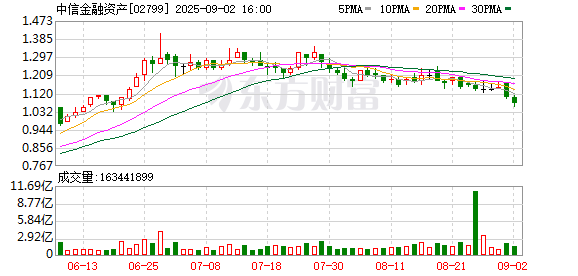
中信金融资产发布中期业绩 股东应占利润61.68亿元 同比增加15.66%
Zhi Tong Cai Jing· 2025-08-29 11:37
Core Viewpoint - CITIC Financial Assets (02799) reported a total revenue of RMB 31.136 billion for the first half of 2025, reflecting a year-on-year increase of 2.91% and a net profit attributable to shareholders of RMB 6.168 billion, up 15.66% [1] Group 1 - The company aims to enhance its operational quality significantly by 2025 and establish itself as an industry benchmark within five years [1] - Under the leadership of CITIC Group's Party Committee, the company is committed to implementing central financial work directives and actively serving national strategies [1] - The company focuses on improving asset quality, increasing revenue, managing cash flow, reducing non-performing assets, promoting reforms, and strengthening core competencies [1] Group 2 - In the first half of 2025, the company achieved total revenue of RMB 40.221 billion, representing a year-on-year growth of 21.1% [1] - The net profit attributable to shareholders for the same period was RMB 6.168 billion, with a year-on-year increase of 15.7%, and a 27.5% increase when excluding the impact of the leasing company [1] - The annualized average return on equity reached 21.1%, an increase of 2.7 percentage points compared to 2024, while the annualized average return on assets was 1.1%, up 0.35 percentage points from 2024 [1] - The basic earnings per share stood at RMB 0.066, indicating a continuous improvement in profitability [1]
贷款市场报价利率连续3个月不变
Jing Ji Ri Bao· 2025-08-26 22:01
Core Viewpoint - The People's Bank of China (PBOC) has maintained the Loan Prime Rate (LPR) for both 1-year and 5-year terms at 3% and 3.5% respectively for three consecutive months, aligning with market expectations [1]. Group 1: Monetary Policy and LPR - The stability of the LPR is attributed to the current monetary policy framework, where the 7-day reverse repurchase rate serves as the new pricing anchor, enhancing the coordination among various interest rates [1]. - Since May, after a rate cut, the recent stabilization of policy rates has kept the pricing basis for LPR unchanged [1]. - The continuous maintenance of the LPR reflects a strong macroeconomic performance in the first half of the year, reducing the necessity for immediate downward adjustments [1]. Group 2: Historical Context and Future Outlook - Since 2020, the PBOC has implemented 12 reserve requirement ratio cuts and 9 policy rate reductions, leading to a decrease of 115 basis points for the 1-year LPR and 130 basis points for the 5-year LPR [2]. - The PBOC's recent report indicates that the effects of counter-cyclical monetary policy have been significant, with stable financial growth and low social financing costs [2]. - The report emphasizes the need for a moderately loose monetary policy moving forward, ensuring liquidity remains abundant and aligns with economic growth and price expectations [2]. Group 3: Policy Implementation and Economic Coordination - The report retains the term "moderately loose," indicating continued support for credit stability and domestic demand, while focusing on the effective implementation of existing policies [3]. - Structural policies are expected to precisely target financing costs, avoiding idle funds, and responding to trends of accelerating deposits and moderate price increases [3]. - Future policy measures will require close monitoring of the transmission effects and actual outcomes to enhance flexibility and maximize policy impact [3].
股债跷跷板依然主导,关注长端债券机会
Ning Zheng Qi Huo· 2025-08-25 11:48
Group 1: Report Industry Investment Rating - The industry investment rating is "oscillating bearish, pay attention to the stock-bond seesaw" [5] Group 2: Core Viewpoints of the Report - The stock-bond seesaw remains the dominant factor, and attention should be paid to long-term bond opportunities. The main policy tone in the second half of the year is a proactive fiscal policy and a moderately loose monetary policy. Although counter-cyclical adjustments such as promoting consumption and major project construction may continue to be introduced, the incremental policies exceeding market expectations may be limited. Liquidity is expected to be loose, which may intensify stock market fluctuations and short-term bond market volatility, making short-term bond market operations more difficult. The supply-demand contradiction in the long-term bond market may be more prominent, with more obvious negative factors [2][3][4] Group 3: Summary by Relevant Catalogs Chapter 1: Market Review - The stock-bond seesaw logic has led the long-term bond market to effectively break below the 60-day moving average, and this logic may continue to dominate the bond market. However, in the context of loose liquidity, this logic becomes less obvious, making market operations difficult. The Politburo meeting in July set the policy tone for the second half of the year, and the stock-bond seesaw remains the main logic in the bond market [10] Chapter 2: Overview of Important News - The central bank will implement a moderately loose monetary policy in the next stage and maintain ample liquidity. In August, the central bank will conduct a 6000 billion yuan MLF operation, with a net investment of 3000 billion yuan, and a 3000 billion yuan outright reverse repurchase net investment, resulting in a total net investment of 6000 billion yuan in medium-term liquidity for the month. A new policy-based financial instrument worth 500 billion yuan will be launched, focusing on emerging industries and infrastructure. The central bank has increased the re-lending quota for supporting agriculture and small businesses by 100 billion yuan. In July, China's total goods trade import and export value reached 3.91 trillion yuan, a year-on-year increase of 6.7%. In July, M2 increased by about 8.8% year-on-year, M1 by about 5.6%, and M0 by about 11.8% [13][15] Chapter 3: Analysis of Important Influencing Factors 3.1 Economic Fundamentals - In July, China's official manufacturing PMI was 49.3, a month-on-month decrease of 0.4 percentage points, and the comprehensive PMI output index was 50.2, a decrease of 0.5 percentage points. The official non-manufacturing PMI was 50.1, a month-on-month decrease of 0.4 percentage points. China's Q2 GDP increased by 5.2% year-on-year and 1.1% quarter-on-quarter, both exceeding expectations. In July, the total goods trade import and export value reached 3.91 trillion yuan, a year-on-year increase of 6.7%. Although the economic data shows certain resilience, the economic downward pressure has increased, and counter-cyclical adjustments need to be continuously strengthened [16] 3.2 Policy Aspect - At the end of July, the broad money M2 balance was 329.94 trillion yuan, a year-on-year increase of 8.8%. The narrow money M1 balance was 111.06 trillion yuan, a year-on-year increase of 5.6%. The difference between M2 and M1 growth rates was 3.2%, narrowing slightly. The social financing stock reached 431.26 trillion yuan, a 9% increase from July last year, with a slight increase of 0.1 percentage point in the growth rate. The new social financing in the month was 1.16 trillion yuan, 389.3 billion yuan more than last year, mainly driven by government bond issuance [18] 3.3 Capital Aspect - Since July 25, DR007 has been continuously declining, and the cost of funds has decreased. The central bank will implement a moderately loose monetary policy in the next stage. A potential interest rate cut by the Federal Reserve in the second half of the year may further open up space for domestic monetary policy easing, but the adjustment of monetary policy still depends on domestic demand. According to the Politburo meeting in July, the liquidity in the second half of the year will likely remain moderately loose, and the probability of an unexpectedly loose monetary policy is low [18] 3.4 Supply and Demand Aspect - The National Development and Reform Commission will allocate the third batch of funds for consumer goods trade-in in July this year and formulate a monthly and weekly usage plan for national subsidy funds. The support from the ultra-long-term special treasury bond funds for equipment renewal this year is 200 billion yuan, with the first batch of about 173 billion yuan already allocated to about 7,500 projects in 16 fields. The issuance of special bonds has also accelerated recently [21] 3.5 Sentiment Aspect - The stock-bond ratio has broken through the short-term shock range and declined, indicating that the market pays more attention to the stock market than the bond market, and the market risk appetite has increased. Recently, the stock-bond ratio has slightly decreased but is still in a high range compared to the previous period. Short-term bonds are more affected by the capital aspect, while long-term bonds are more significantly affected by the stock-bond seesaw [23] Chapter 4: Market Outlook and Investment Strategy - The central bank will implement a moderately loose monetary policy in the next stage, and loose liquidity may be the main policy tone in the second half of the year. Loose liquidity combined with the expectation of a rising stock market may intensify stock market fluctuations and short-term bond market volatility. The stock-bond seesaw logic remains the main logic, and the logic of long-term bonds is relatively clear, so it is recommended to pay attention [26]
中信金融资产:预计上半年归母净利润 同比增长约12.5%至16.3%
Jin Rong Shi Bao· 2025-08-21 02:46
Core Viewpoint - CITIC Financial Assets announced preliminary mid-term financial data, projecting a net profit attributable to shareholders of approximately RMB 6 billion to 6.2 billion for the first half of 2025, representing a year-on-year growth of about 12.5% to 16.3% [1] Financial Performance - The expected net profit growth, excluding the impact of the leasing company's off-balance sheet, is approximately 23.9% to 28.2% compared to the same period last year [1] - The company has strengthened its main business capabilities and continued to support the real economy, leading to sustained growth in operating performance [1] Strategic Initiatives - CITIC Financial Assets is actively implementing central financial work directives, focusing on financial rescue and counter-cyclical adjustments, while also seizing national policy opportunities [1] - The company has increased its main business investments, particularly in business revitalization and equity business, resulting in significant growth in main business income [1] Risk Management - The company has deepened its comprehensive risk management system, enhancing asset quality, with current provisions for asset impairment losses and non-performing assets amounting to approximately RMB 21.8 billion [1] - Future risk resilience is expected to improve as the company continues to strengthen its financing capabilities and innovate financing tools, with a year-on-year decrease in financing costs [1] Future Outlook - In the second half of the year, CITIC Financial Assets aims to enhance operational quality and efficiency, striving to become a benchmark in the non-performing asset industry while better serving national strategies and the real economy [1]
LPR连续3个月不变,年内或有下调空间
Zheng Quan Ri Bao· 2025-08-21 00:15
本报记者 刘 琪 8月20日,新一期LPR(贷款市场报价利率)出炉。中国人民银行(以下简称"央行")授权全国银行间 同业拆借中心公布,8月20日,1年期LPR为3.0%,5年期以上LPR为3.5%。 本月两个期限品种LPR较前月均维持不变,符合市场预期。在新的货币政策框架下,7天期逆回购利率 作为主要政策利率,成为LPR新的"定价锚",并通过强化各利率间协同,逐步疏通由短及长的利率传导 关系。自5月份降息之后,近期政策利率保持稳定,使得LPR报价的定价基础未变。 从净息差来看,商业银行依然承压,也使得LPR下调受限。国家金融监督管理总局数据显示,截至今年 二季度末,商业银行净息差为1.42%,较一季度下降0.01个百分点。 "虽然5月份存款利率有较大幅度下调,对稳定净息差起到较好作用,但贷款利率下行趋势不改,商业银 行稳定净息差的压力持续显现。"民生银行首席经济学家温彬对《证券日报》记者表示,综合考虑资 金、风险、运营、资本、税收等成本的相对刚性,在政策利率未降的情况下,LPR报价单独下调的空间 和动力不足。 截至目前,LPR已经连续3个月"按兵不动"。东方金诚首席宏观分析师王青认为,这主要源于上半年宏 观经 ...
受银行净息差等影响,LPR连续三个月不变
Shang Hai Zheng Quan Bao· 2025-08-21 00:08
◎记者 张琼斯 8月20日,最新一期贷款市场报价利率(LPR)出炉。中国人民银行授权全国银行间同业拆借中心公 布:1年期LPR为3.0%,5年期以上LPR为3.5%。两个期限LPR连续三个月"按兵不动"。 LPR保持不变,符合市场预期。东方金诚首席宏观分析师王青表示,政策利率7天期逆回购操作利率保 持稳定,意味着当月LPR的定价基础没有变化;受"反内卷"牵动市场预期等影响,近期市场利率有所上 行,在商业银行净息差处于历史最低点的背景下,报价行缺乏主动下调LPR报价加点的动力。 金融监管总局数据显示,2025年二季度,商业银行净息差进一步降至1.42%。"随着银行持续向实体经 济减费让利,息差缩窄压力不断增大。"招联首席研究员、上海金融与发展实验室副主任董希淼表示, 目前无论是企业贷款利率还是个人贷款利率都处于低位,降低LPR并非当务之急。而且,随着市场利率 不断降低,降息的边际效应也在下降。 董希淼认为,下一步推动社会综合融资成本下降,并非只有降低LPR这一种途径。未来降低综合融资成 本,可从降低抵押担保费、中介服务费等非利息成本着手。 "LPR连续三个月保持不动,主要缘于上半年宏观经济稳中偏强,短期内通过引 ...
