AI泡沫

Search documents
直线飙涨!人工智能重磅消息传来!
天天基金网· 2025-11-23 03:10
Core Insights - The article discusses the evolving landscape of the AI sector, particularly focusing on Google's advancements with its Gemini 3 model, which is seen as a significant competitor to OpenAI's offerings [3][12]. Group 1: Google's AI Strategy - Google Cloud's AI infrastructure head, Amin Vahdat, stated that Google must double its computing capacity every six months, aiming for a 1000-fold increase in the next 4-5 years [4][6]. - Vahdat emphasized that the competition in AI infrastructure is the most critical and expensive part of the AI race, highlighting the need for more reliable, high-performance, and scalable infrastructure [6][10]. - Google has raised its capital expenditure forecast for 2025 to between $91 billion and $93 billion, indicating a significant investment in AI capabilities [7]. Group 2: Market Position and Competition - Analysts believe that Google's Gemini 3 is weakening OpenAI's leading position in the AI market, with expectations that Gemini could capture market share due to Google's scale and industry standing [12]. - Gemini 3 Pro has shown significant improvements in multi-modal processing capabilities, outperforming competitors like GPT-5.1 and Claude 4.5 in various benchmarks [12][13]. - Google claims that its Gemini applications have 650 million monthly active users, while OpenAI's ChatGPT has 800 million weekly active users, indicating a narrowing user gap [13]. Group 3: Financial Implications and Concerns - The total capital expenditure of major AI players, including Google, Microsoft, Amazon, and Meta, is projected to reach $380 billion this year [8]. - OpenAI's aggressive investment strategy, planning to spend over $1.4 trillion on AI data center construction in the coming years, raises concerns about sustaining high valuations amid intense competition [14]. - The article reflects on the broader market concerns regarding an "AI bubble," questioning the sustainability of current high valuations in light of potential revenue growth suppression due to fierce competition [14].



AI泡沫破灭谁能幸存?七巨头中Alphabet(GOOGL.US)和苹果(AAPL.US)或“笑到最后”
智通财经网· 2025-11-23 03:10
Core Insights - Major tech companies, led by the "Big Seven" in the US stock market, are engaged in an intense AI arms race, significantly increasing capital expenditures to build AI infrastructure and seize opportunities in the industrial revolution [1][2] - Despite concerns over an AI bubble, two companies, Alphabet and Apple, have shown resilience, with their stock prices increasing during a broader tech sell-off [1][2] Group 1: Company Performance - Alphabet and Apple are the only two companies among the "Big Seven" that have seen stock price increases of 6.6% and 0.4% respectively in the past month, indicating their potential to weather an AI bubble burst [2][3] - Google's AI product Gemini has gained traction, particularly with the recent launches of Gemini 3 and Nano Banana Pro, contributing to its stock performance [2][4] - Apple's conservative capital spending strategy has been validated as a means to mitigate concerns over excessive AI expenditures [2][3] Group 2: Market Dynamics - The Nasdaq Composite Index has dropped 6.1% since early November, reflecting widespread investor anxiety over excessive AI spending [2] - Concerns about AI-related capital expenditures have intensified following the third-quarter earnings season, despite Nvidia's strong financial results [2][4] - The market's reaction to Alphabet's increased AI spending forecast for 2025, raised from $85 billion to between $91 billion and $93 billion, suggests investor confidence in its AI performance [3][4] Group 3: Competitive Landscape - Google has successfully alleviated investor fears regarding AI's impact on its search business, positioning Gemini as a strong competitor to ChatGPT [4][5] - In contrast, Meta's stock has declined by 8.3% following its CEO's announcement to accelerate AI investments, raising concerns about the company's lack of a clear AI strategy [4][5] - Analysts suggest that large-scale cloud service providers like Google are better prepared to navigate potential downturns in the AI sector [4][5] Group 4: Future Outlook - If the AI bubble bursts, smaller players may be eliminated, while larger companies like Google and Apple could benefit from reduced competition and lower spending demands [5][6] - The influx of capital into AI infrastructure could dwindle if returns on investment do not materialize, leading to a significant drop in the value of data center assets [5][6] - The current sell-off hints at potential losers, particularly hardware suppliers like Nvidia, who may face reduced orders if AI demand declines [6]

直线飙涨!人工智能,重磅传来!
证券时报· 2025-11-23 03:06
Core Insights - Google aims to double its computing capacity every six months, targeting a 1000-fold increase in the next 4-5 years [5][6] - The release of the AI model Gemini 3 has significantly boosted Google's stock price, with a weekly increase of over 8% [1][5] - Analysts believe Gemini 3 has surpassed OpenAI's GPT-5.1, indicating a shift in the AI competitive landscape [3][8] Group 1: Google's AI Strategy - Amin Vahdat emphasized that AI infrastructure competition is the most critical and expensive part of the AI race [5] - Google plans to invest significantly in capital expenditures, with projections for 2025 between $91 billion and $93 billion, and a notable increase expected in 2026 [5][6] - Google Cloud's revenue grew by 34% year-over-year, reaching over $15 billion, but could have been higher with more computing power [6] Group 2: Competitive Landscape - Analysts suggest that Gemini 3 is weakening OpenAI's previous dominance in the AI sector, with potential market share shifts [8][9] - Gemini 3 Pro has shown significant improvements in multi-modal processing capabilities, outperforming both its predecessor and competitors in various benchmarks [8] - The user base gap is narrowing, with Gemini applications reaching 650 million monthly active users compared to OpenAI's 800 million weekly active users [9] Group 3: OpenAI's Response - OpenAI is reportedly planning to invest over $1.4 trillion in AI data center construction over the next few years [10] - This aggressive capital expenditure strategy raises concerns about sustaining high valuations amid intense competition [11]


直线飙涨!人工智能,重磅传来!
Zheng Quan Shi Bao Wang· 2025-11-23 00:15
Core Insights - The competitive landscape in the AI sector is shifting, with Google's Gemini 3 model reportedly surpassing OpenAI's GPT-5.1, indicating a potential decline in OpenAI's previously dominant position [1][7]. Group 1: Google's AI Infrastructure Goals - Google Cloud's AI infrastructure head, Amin Vahdat, stated that the company must "double its computing capacity every six months," aiming for a "1000x capability increase" over the next 4-5 years [2][6]. - Vahdat emphasized that the competition in AI infrastructure is the most critical and expensive part of the AI race, focusing on building more reliable, high-performance, and scalable infrastructure rather than merely increasing spending [2][5]. Group 2: Financial Performance and Capital Expenditure - Following a better-than-expected Q3 earnings report, Alphabet raised its capital expenditure forecast for the second time this year, projecting capital spending between $91 billion and $93 billion for 2025, with "significant growth" expected in 2026 [3]. - The total capital expenditure for major AI players, including Google, Microsoft, Amazon, and Meta, is projected to reach $380 billion this year [4]. Group 3: Competitive Dynamics - Analysts believe that Google's Gemini 3 is weakening OpenAI's lead in the AI space, with market strategist Mike O'Rourke suggesting that Google's scale and industry position could allow Gemini to capture market share from OpenAI [7]. - The Gemini 3 Pro model has shown significant improvements in multi-modal processing capabilities, outperforming both its predecessor and competitors like GPT-5.1 and Claude 4.5 in various benchmarks [8]. - Google claims that its Gemini application has 650 million monthly active users, while OpenAI's ChatGPT reportedly has 800 million weekly active users, indicating a narrowing user gap [8]. Group 4: Investment and Market Concerns - OpenAI's aggressive investment strategy, planning to spend over $1.4 trillion on AI data center construction in the coming years, raises concerns about the sustainability of its high valuation amid fierce competition [9]. - The current market environment has led to increased uncertainty regarding OpenAI's valuation, as investors grapple with the potential for suppressed revenue growth due to intense competition [9].
直线飙涨!人工智能,重磅传来!
券商中国· 2025-11-22 23:33
Core Insights - The article discusses the changing landscape of the AI sector in the U.S., highlighting Google's ambitious plans to enhance its AI infrastructure and capabilities significantly over the next few years [1]. Group 1: Google's AI Strategy - Google Cloud's AI infrastructure head, Amin Vahdat, stated that Google must "double its computing capacity every six months," aiming for a "1000x capability increase" in the next 4-5 years [6][9]. - Vahdat emphasized that the competition in AI infrastructure is the most critical and expensive part of the AI race, focusing on building more reliable, high-performance, and scalable infrastructure [6][9]. - Following Alphabet's better-than-expected Q3 earnings report, the company raised its capital expenditure forecast for 2025 to between $91 billion and $93 billion, with significant growth expected in 2026 [6][7]. Group 2: Competitive Landscape - Analysts believe that Google's Gemini 3 model is surpassing OpenAI's recently released GPT-5.1 model, indicating a shift in the competitive dynamics of the AI market [4][10]. - Gemini 3 Pro has shown significant advantages in multimodal processing capabilities, outperforming competitors in various benchmark tests [10]. - Google claims that its Gemini applications have 650 million monthly active users, while OpenAI's ChatGPT has reached 800 million weekly active users, indicating a narrowing user gap [11]. Group 3: Investment and Market Implications - The total capital expenditure of major AI players, including Google, Microsoft, Amazon, and Meta, is projected to reach $380 billion this year [7]. - OpenAI's aggressive investment strategy, planning to spend over $1.4 trillion on AI data center construction in the coming years, may create uncertainty in the private market [12]. - The intense competition could hinder potential revenue growth for OpenAI, making it increasingly difficult to justify its high valuation amidst concerns of an "AI bubble" [13].

激辩“AI泡沫论”!达利欧、“大空头”齐发声
Shang Hai Zheng Quan Bao· 2025-11-22 13:47
近日,关于人工智能(AI)"泡沫论"的激辩愈演愈烈。尽管英伟达公布了全面超出预期的财报,但美股主要股指周四冲高回落表明,市场对于"AI泡沫"的 担忧似乎短期内无法消散。就在华尔街"大空头"发文抨击"AI泡沫"之际,桥水基金创始人达利欧发声表示,人工智能确实存在泡沫,但还没到泡沫破裂的 时候。 近日,英伟达公布2026财年第三财季的业绩数据,营业收入570亿美元,同比大涨62%;净利润为319亿美元,同比大涨65%,双双远超市场预期。公司还 对四季度给出650亿美元的高增长财务指引。尽管英伟达交出了出色的"成绩单",但近段时间以来,市场关于人工智能的投资热潮是否已催生泡沫的争论 却愈演愈烈。强劲的业绩数据与市场弥漫的谨慎情绪形成了鲜明对比。 英伟达股价在财报发布后,连续两日下跌。截至11月21日,英伟达股价11月以来下跌11.66%。 | 导出图形 区间统计 前复权 ~ 到价提醒 | 神奇九转 | | 英伟达 | | 178.880 | -1.760 | | --- | --- | --- | --- | --- | --- | --- | | ↑ MA30:110.242 ↑ MA60:65.266 ↑ | ...


和讯投顾魏玉根:多个利好出现,周一A股或要反弹
Sou Hu Cai Jing· 2025-11-22 13:16
11月22日,和讯投顾魏玉根称,周一A股或要反弹。原因如下:美股出现曙光,三大指数反弹且盘中力 度大,a50涨0.7%,金融指数三倍做多等也在涨,中国相关资产涨势不错,起了好头。美国科技股中, 虽担忧AI泡沫,但很多在反弹上涨,如谷歌携手苹果上涨,英伟达盘中稍有回落,甲骨文跌幅较大, 不过问题不大。美联储呵护市场,三把手称12月或降息,数据也给予支撑,虽部分数据未达预期,但市 场押注加息概率此前降至33%,现重回50%以上,投行态度转变快。金属市场金银铜铝多有反弹或跌幅 收窄,白银收长下引线,显示探底后或反弹。 ...
美股惊魂一周,纳指创4月来最大三周跌幅,华尔街现在很焦虑!
美股IPO· 2025-11-22 10:19
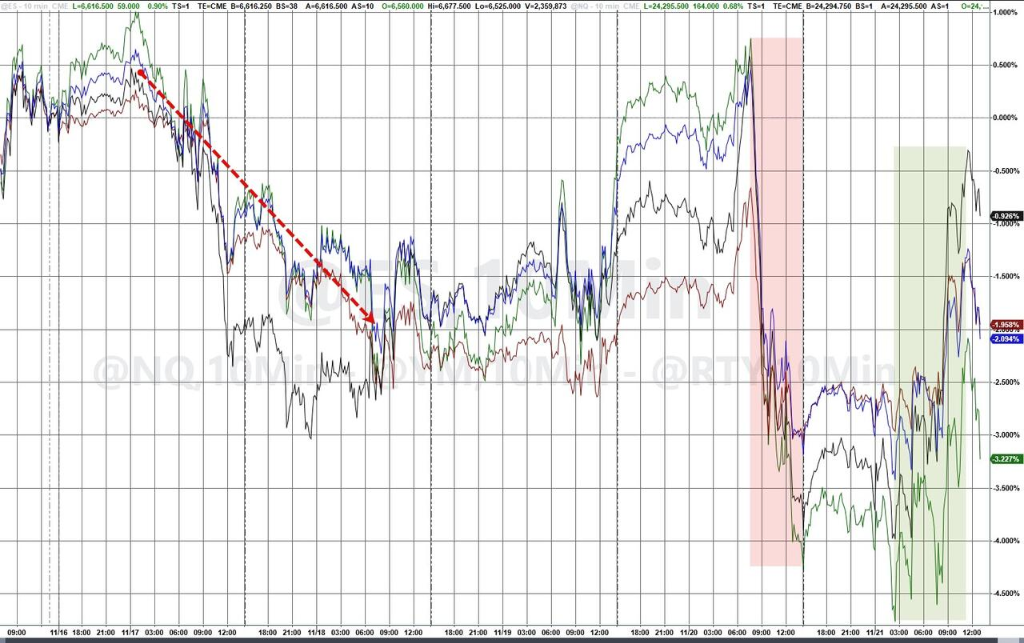
Core Viewpoint - Concerns over the AI bubble, economic slowdown, and profit-taking pressures have led to significant volatility in the U.S. stock market, with investors worried about potential future fluctuations [1][3]. Market Performance - The S&P 500 index fell nearly 2% this week, with a cumulative decline of 3.5% since November [2]. - The Nasdaq Composite, heavily weighted in tech stocks, dropped over 6% in November, marking its largest three-week decline since April [2]. Stock Movements - Momentum stocks faced severe losses, with Robinhood's market value evaporating by about 25% this month, Coinbase's stock plummeting by 30%, and Palantir down approximately 23% [4]. - Goldman Sachs' basket of high-beta momentum stocks fell nearly 15% from its peak, representing the worst week for momentum performance since November 2022 [5]. AI Sector Concerns - Investors are particularly anxious about companies heavily invested in AI, with the Global X Artificial Intelligence & Technology ETF down about 10% this month, and an ETF tracking the seven tech giants declining approximately 6.6% since the end of October [6]. Nvidia's Earnings Impact - Nvidia's earnings report initially led to a surge in stock prices, but a subsequent sharp decline resulted in a nearly 3% drop to $180.98, marking a 7% intraday decline and dragging the S&P 500 down by about 3% [7]. Private Credit and Crypto Market Influence - The private credit market is gaining attention, with concerns arising from the sudden collapse of First Brands, highlighting the impact of a loose credit environment [10]. - Investors are facing challenges with companies that borrowed at low rates but now must refinance at significantly higher rates [11]. Bitcoin and Market Dynamics - Bitcoin's price fell to $80,553, down over 30% from its October peak of $126,000, raising questions about the broader impact of the crypto market on the stock market and economy [11][13]. - The correlation between cryptocurrency and traditional stocks is becoming more pronounced, with forced liquidations in crypto affecting stock sales [14]. Leverage and Year-End Profit-Taking - Market volatility is attributed to high leverage and the impulse for year-end profit-taking, with brokerage account financing reaching a historic high of $1.1 trillion by the end of October [15]. - Over-leveraged market participants are selling tech stocks when forced to liquidate crypto positions, exacerbating market fluctuations [16]. Investor Sentiment - Despite the volatility, some investors remain calm, with the S&P 500 only 4.2% below its all-time high, indicating a wait-and-see approach among those not heavily concentrated in AI or crypto [17].

美股惊魂一周,纳指创4月来最大三周跌幅,华尔街现在很焦虑
Hua Er Jie Jian Wen· 2025-11-22 07:17
AI泡沫破裂的担忧、经济放缓的预期以及获利回吐的压力正在市场上交织碰撞,导致本周美股出现数月来最剧烈的盘中波动。"谁也没想到会这 样",投资者对未来可能出现的更大波动感到担忧。 本周标普500指数下跌近2%,尽管周五有所反弹,但11月以来累计跌幅仍达3.5%。科技股权重较大的纳斯达克综合指数11月已下滑超过6%,并创 下了自4月以来的最大三周跌幅。 (美股基准股指本周走势) 动量股本周遭受重挫,Robinhood本月市值蒸发约四分之一,Coinbase股价暴跌30%,Palantir下跌约23%。高盛的一篮子高贝塔动量股较昨日高点 暴跌近15%。这是自2022年11月以来动量表现最差的一周。 (高盛高贝塔组合较昨日高点暴跌14.7%) 对人工智能公司押下重注的投资者焦虑最为严重。追踪AI股票的Global X人工智能与科技ETF本月下跌约10%,而追踪科技七巨头的ETF自10月底 以来下跌约6.6%。 英伟达业绩引发的意外抛售 本周三美股收盘后,几乎所有华尔街人士都预期英伟达的强劲财报将推动股市上涨。事态的确如此开始,但随后急转直下。 华尔街见闻提及,无论从哪个角度来看,英伟达的财报和评论都是积极的。但正如高 ...
连续挨揍,这周心态有点崩!全球“黑五”杀跌后,美股深V反弹,美联储降息大消息!这一轮大跌应该怎么扛?
雪球· 2025-11-22 05:24
Market Overview - The global market experienced a significant downturn, referred to as "Black Friday," with major indices like the NASDAQ dropping by 5% at one point and closing down 2.15% [13][16] - A-shares also faced severe declines, with the ChiNext Index falling by 4.02%, the Shenzhen Component Index down 3.41%, and the Shanghai Composite Index down 2.45%, marking a new low in market sentiment [6][16] Sector Performance - The semiconductor sector saw a decline of over 4%, while the battery sector dropped more than 7%, and energy metals fell by over 9% [9][10] - Notably, over 5,000 stocks experienced declines, indicating widespread market distress [6] Global Economic Factors - The recent drop in markets is attributed to uncertainties surrounding the Federal Reserve's interest rate decisions and ongoing debates about the "AI bubble," compounded by significant disturbances in the Japanese bond market [30][31] - Japan's new stimulus measures raised concerns about increasing government debt, leading to a spike in long-term bond yields, which could affect global capital flows [30] Recovery Signals - Following the downturn, U.S. markets showed signs of recovery with a strong rebound, as the probability of a 25 basis point rate cut by the Federal Reserve in December surged from 39% to nearly 70% [28] - Key comments from Federal Reserve officials indicated a potential for rate cuts, which helped restore some market confidence [28] Investment Strategies - Investors are advised to be cautious and avoid common pitfalls such as excessive leverage, chasing high prices, concentrated holdings, and failing to set stop-loss orders [33][34] - The importance of diversification in investment portfolios is emphasized to mitigate risks associated with individual stock volatility [35]