
低估值

Search documents
银行ETF指数(512730)涨超1.1%,农行15连阳累涨近25%
Xin Lang Cai Jing· 2025-10-23 02:16
Group 1 - The China Securities Banking Index (399986) has shown a strong increase of 1.17%, with notable gains from Postal Savings Bank (4.19%), Industrial Bank (2.06%), and Minsheng Bank (1.98%) [1] - Agricultural Bank has experienced a significant rally, achieving a 25% increase since September 25, with a total market capitalization approaching 2.9 trillion [1] - According to Everbright Securities, the banking sector's "high dividend, low valuation" characteristics are becoming more prominent, suggesting a potential reallocation opportunity in the sector [1] Group 2 - As of September 30, 2025, the top ten weighted stocks in the China Securities Banking Index account for 64.6% of the index, including major banks such as China Merchants Bank and Industrial Bank [2]






四季度银行&保险业投资展望
2025-10-22 14:56
Summary of Key Points from the Conference Call Industry Overview - The conference call focuses on the banking and insurance sectors, specifically discussing the performance and outlook of listed banks and insurance companies in China for the fourth quarter of 2025 and beyond. Banking Sector Insights 1. **Performance Metrics**: In Q3, listed banks reported a revenue growth rate of approximately 1% and a profit growth rate of about 1.5%. Net interest income decreased by 0.5 percentage points year-on-year, while fee income grew by around 5% [1][3]. 2. **Valuation and Dividend Yield**: As of October 20, the A-share banks' price-to-book (PB) ratio returned to 0.71, and H-share banks' PB was at 0.5. The average dividend yield for A-shares rose to 4.2%, while H-shares reached 5%, highlighting their strong investment appeal due to high dividends and low valuations [1][4]. 3. **Long-term Capital Inflows**: Long-term funds such as insurance companies and asset management companies have been increasing their holdings in quality listed banks, reflecting a demand for high-yield assets amid a slowing macroeconomic environment [1][5]. 4. **Credit Growth and Asset Quality**: As of September, loans grew by 6.6% year-on-year, with social financing growth at 8.7%. The overall non-performing loan (NPL) ratio for listed banks was stable at 1.23%, with a provision coverage ratio exceeding 230% [2][3]. 5. **Market Conditions**: The expectation of interest rate cuts by the Federal Reserve and declining U.S. Treasury yields are anticipated to enhance liquidity in the Hong Kong market, benefiting high-dividend bank stocks [1][6]. Investment Opportunities in Banking 1. **Positive Factors for Q4**: Six supportive factors for bank stocks in Q4 include improved valuation and dividend yield, resilient fundamentals, enhanced defensive attributes amid market volatility, and historical performance trends showing strong returns in late Q4 and early Q1 [4][5]. 2. **Investment Recommendations**: Focus on large banks with stable fundamentals and good dividend yields, as well as high-quality regional banks with strong economic resilience [6]. Insurance Sector Insights 1. **Performance Expectations**: Three listed insurance companies reported significant Q3 earnings growth, with estimates ranging from 40% to 72% year-on-year. This growth is attributed to policy support and improved performance from both sides of the insurance payment process [7][8]. 2. **Market Recovery**: The market's outlook for insurance companies has shifted from concern to recovery, with expectations of exceeding previous performance benchmarks [7]. 3. **Investment Strategy**: Short-term recommendations include pure life insurance stocks with high elasticity, such as Xinhua and Guo Life, while long-term recommendations focus on companies like China Pacific Insurance, which benefit from stable earnings and improved underwriting conditions [10]. Additional Insights - The overall sentiment in the banking sector is optimistic, with expectations of stable performance and potential for recovery in the insurance sector driven by favorable market conditions and policy support [6][9].
银行板块逆势走强,银行ETF易方达(516310)受资金关注
Sou Hu Cai Jing· 2025-10-22 11:52
Group 1 - The banking sector has shown resilience, with the China Securities Banking Index rising by 1.0%, while other financial indices have declined [1] - The E Fund Bank ETF (516310) has attracted over 1 billion yuan in capital over the past seven trading days, indicating strong investor interest [1] - Everbright Securities highlights that the banking sector's characteristics of "high dividend and low valuation" are becoming more apparent, suggesting a potential reallocation opportunity [1] Group 2 - The banking sector's fundamentals are strong, with Q3 performance expected to slightly exceed that of H1, providing stable support for annual performance [1] - The banking index reflects the overall performance of 42 major bank stocks in A-shares, with a current price-to-book ratio of 0.7 times [4] - The non-banking financial index has decreased by 0.5%, with a price-to-book ratio of 1.6 times [5]

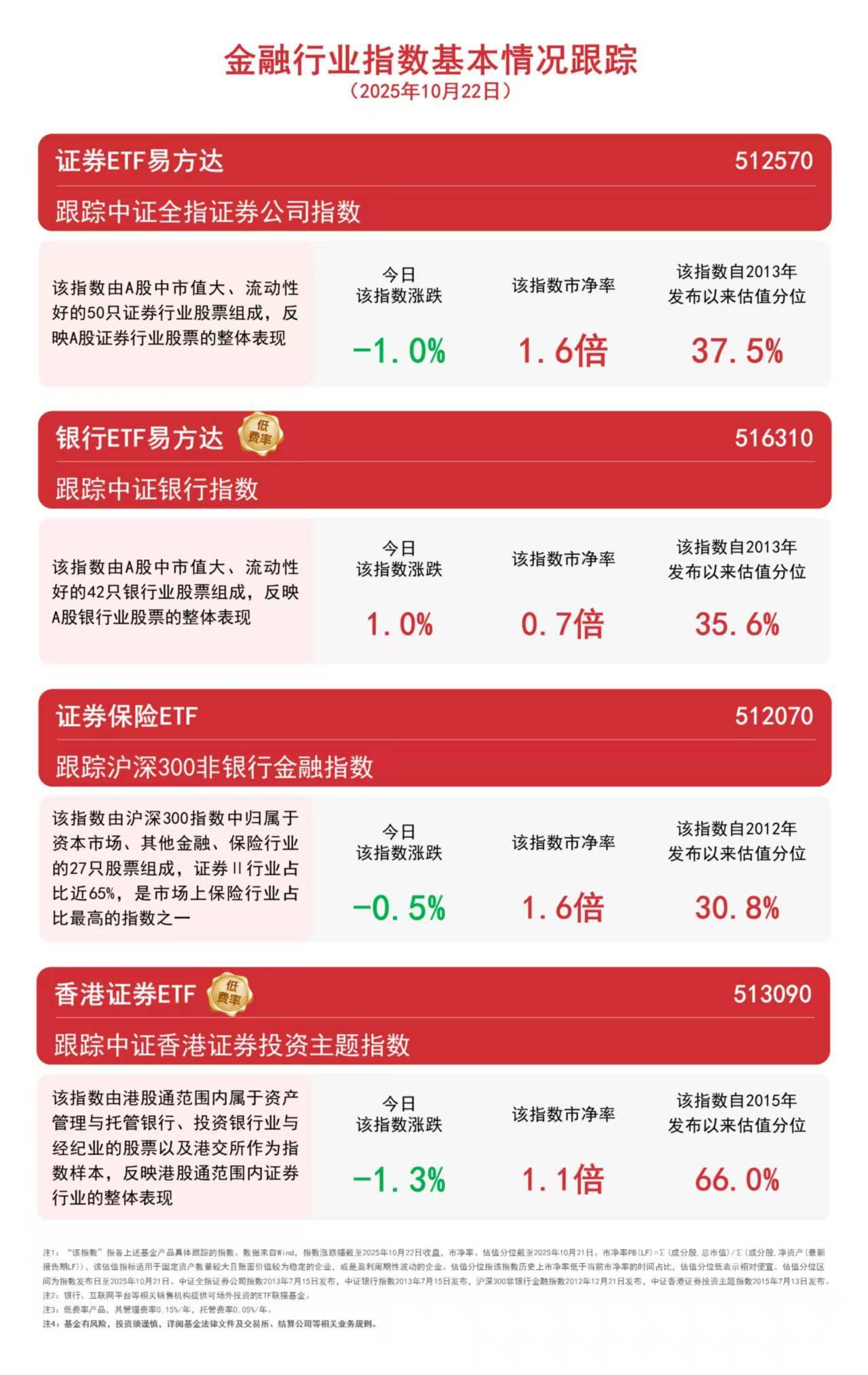
重要信号,银行向上逼近“牛熊分界线”!双百亿银行ETF(512800)逆市10连阳,农行涨2.6%再创新高!
Xin Lang Ji Jin· 2025-10-22 11:43
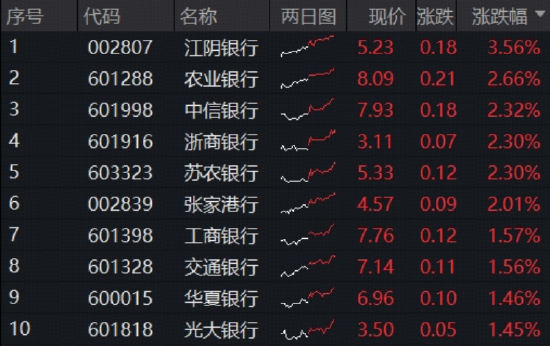
Group 1 - The core viewpoint of the articles highlights the strong performance of the banking sector in the A-share market, with 39 out of 42 bank stocks rising, including Agricultural Bank of China achieving a 14-day consecutive increase, reaching a historical high [1][4] - Jiangyin Bank saw a rise of over 3%, while other banks like CITIC Bank, Zheshang Bank, and others also reported gains exceeding 2% [1][2] - The banking ETF (512800) experienced a significant inflow of funds, with a total of 5.987 billion yuan accumulated in the last 10 days, indicating strong investor interest [4][5] Group 2 - The banking sector is characterized by high dividend yields and low valuations, with the China Securities Banking Index's price-to-book ratio (PB) at 0.71, placing it in the lower range of the past decade [3][4] - The sector's defensive attributes are becoming more attractive to investors amid rising market uncertainties, presenting a potential opportunity for allocation [3][4] - Historical data suggests that the banking sector tends to perform well at the end of the year, with a 70% probability of absolute returns in November-December and an 80% probability in January [4]



14连阳稳坐A股市值王,谁在买“银伟达”?
Ge Long Hui· 2025-10-22 07:57
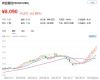
Core Viewpoint - The A-share banking sector is experiencing significant gains, with Agricultural Bank of China (ABC) leading the charge, achieving a historical high in stock price and strong performance in the market [1][2][6]. Group 1: Stock Performance - Agricultural Bank's A-share price has risen over 58% year-to-date, reaching a total market capitalization of 2.83 trillion yuan, surpassing Industrial and Commercial Bank of China (ICBC) at 2.77 trillion yuan [6]. - ABC's stock price reached 8.09 yuan per share, marking a 14-day consecutive increase, while its Hong Kong shares also hit a record high with a 10-day consecutive rise [2][6]. Group 2: Dividend Yield - ABC maintains a stable and high dividend yield, which is a key attraction for long-term capital allocation. The dividend yields over the past five years were 5.79%, 6.30%, 7.11%, 6.10%, and 4.32%, significantly higher than the 10-year government bond yield of approximately 2.5% [9][10]. - The total cash dividend for 2024 is projected to reach 772.25 billion yuan, providing predictable cash flow for insurance funds [12]. Group 3: Financial Performance - In the first half of 2025, ABC reported operating income of 369.94 billion yuan, a year-on-year increase of 0.8%, and a net profit attributable to shareholders of 139.51 billion yuan, up 2.7%, making it the only major bank to achieve positive net profit growth [13]. - For the full year of 2024, ABC is expected to achieve a net profit of 282.7 billion yuan, with a year-on-year growth of 4.8% [14]. Group 4: Investment Interest - ABC has seen increased investment from insurance funds, with significant shareholding increases by Ping An Insurance, which raised its stake to over 20% by October 2025 [15][19]. - The main drivers of ABC's stock price increase are long-term institutional investors, including social security and insurance funds, attracted by its high dividend yield and low non-performing loan ratio of 1.2% [16]. Group 5: Market Outlook - The banking sector is expected to benefit from declining deposit costs and stable growth in intermediary business income, enhancing the attractiveness of bank stocks for long-term investors [17]. - Analysts suggest focusing on state-owned banks with strong fundamentals and high dividend yields, as well as regional banks with resilient economic performance and favorable valuations [18].
金融ETF(510230)盘中涨超0.5%,银行板块或迎机会窗口
Mei Ri Jing Ji Xin Wen· 2025-10-22 06:36
Core Viewpoint - The banking sector has shown weak performance since the third quarter, but after a phase of adjustment, the characteristics of "high dividend and low valuation" have re-emerged, indicating a potential reallocation opportunity for bank stocks [1] Summary by Relevant Categories Market Performance - The banking sector's valuation is supported by several positive factors, suggesting that it may experience a reallocation opportunity [1] - The resilience of the banking sector's fundamentals is strong, with third-quarter performance expected to slightly exceed that of the first half of the year, providing stable support for annual performance [1] Financial Index - The Financial ETF (510230) tracks the 180 Financial Index (000018), which selects representative securities from banks, insurance, and securities companies to reflect the overall performance of the financial industry [1] - The 180 Financial Index focuses on large-cap blue-chip style allocation and serves as an important indicator for measuring financial market dynamics [1]

外资唱多A股,北向资金持仓市值增超3800亿
21世纪经济报道· 2025-10-16 15:16
Core Viewpoint - Northbound capital has shown a positive trend towards A-shares, with significant increases in holdings and a focus on technology growth and high-dividend assets [1][6][7]. Group 1: Northbound Capital Holdings - As of the end of Q3, Northbound capital held A-shares worth 2.58 trillion yuan, marking an increase of over 380 billion yuan year-to-date, with continuous growth for three consecutive quarters [3][4]. - The top five industries by Northbound capital holdings are: Electric Equipment (443.80 billion yuan), Electronics (391.53 billion yuan), Pharmaceutical Biology (183.94 billion yuan), Banking (173.69 billion yuan), and Food & Beverage (162.31 billion yuan) [3][4]. - In Q3, Northbound capital increased holdings in nine industries, with the Electronics sector seeing the largest increase of 1.82 billion shares, followed by Basic Chemicals (370 million shares) and Automotive (287 million shares) [3][4]. Group 2: Industry Trends and Foreign Investment - Northbound capital reduced holdings in 22 industries, with the largest decreases in Banking (6.97 billion shares), Construction Decoration (2.31 billion shares), and Non-Bank Financials (2.04 billion shares) [4]. - Foreign investment in Chinese stocks has rebounded, with a net inflow of 4.6 billion USD in September, the highest since November 2024, and a total of 18 billion USD net inflow in the first nine months of 2025 [6][7]. - Major global asset management firms have expressed optimism about the A-share market, with Goldman Sachs predicting an 8% potential upside for A-shares over the next 12 months [7][8]. Group 3: Focus on Technology Stocks - The attractiveness of Chinese technology stocks is increasing, with strong fundamentals and favorable management teams noted as key factors [8]. - The Chinese government's macro policies and rapid development in high-tech sectors are boosting market confidence, with AI technology driving traditional manufacturing towards "China R&D" [8]. - Foreign capital is particularly drawn to A-shares due to economic recovery, low valuations, and policy support, indicating a trend of increasing foreign investment in the Chinese stock market [8].

基金研究周报:双创板块迎调整,价值风格显韧性(10.6-10.10)
Wind万得· 2025-10-11 22:33
Market Overview - The A-share market showed resilience despite a divergence between growth and value styles, with the ChiNext index falling by 3.86% and the CSI 300 index rising by 0.37% [2] - The value style, represented by the CSI Dividend Index, performed well, increasing by 1.79%, indicating a preference for high dividend and low valuation stocks amid rising overseas uncertainties [2] - The average weekly increase for Wind's first-level industry was 0.15%, with 55% of sectors yielding positive returns, particularly in non-ferrous metals, coal, and steel, which rose by 4.44%, 4.41%, and 4.18% respectively [2] Fund Issuance and Performance - A total of 4 funds were issued last week, including 2 equity funds, 1 bond fund, and 1 FOF fund, with total issuance of 1.13 billion units [3][4] - The Wind All Fund Index decreased by 0.62%, with the ordinary equity fund index down by 1.58% and the mixed equity fund index down by 1.52% [3][7] Global Asset Review - Global equity markets experienced significant divergence, with major U.S. indices declining due to supply chain issues and government shutdowns, while Asian markets showed mixed results [4] - Gold prices reached a historical high, surpassing $4000 per ounce, while energy commodities showed weaker performance [4][5] Domestic Fund Market Review - The average weekly increase for Wind's first-level industry was 0.15%, with the public utility sector leading with a 3.69% increase, reflecting demand for stable cash flow and low valuation amid uncertainty [13] - The healthcare sector saw a decline of 1.21% for the week and 3.22% over the past month, attributed to internal sector differentiation and short-term sentiment [13] Bond Market Review - The bond market showed mixed performance, with long-term government bonds underperforming while mid-term bonds remained stable [15] - The 10-year government bond yield was recorded at 1.846%, reflecting a slight decrease of 1 basis point from the previous week [17]

跨境投资洞察系列之二:中国香港股票市场特征与投资者结构分析
Ping An Securities· 2025-10-10 10:33
Market Overview - Hong Kong's stock market has become deeply "localized" and "new economy-oriented," characterized by "low valuation" and "high dividend" features[3] - As of July 2025, mainland enterprises account for 57% of the total number of listed companies and 81% of the total market capitalization in Hong Kong[11] Market Structure - The main board of the Hong Kong Stock Exchange dominates with 2,337 listed companies and a total market capitalization of 44.82 trillion HKD, while the growth enterprise market has 314 companies with a market cap of 0.07 trillion HKD[10] - The market is highly concentrated, with 69.43% of companies having a market cap between 0-20 billion HKD, contributing only 1.80% to total market capitalization[42] Valuation Characteristics - As of August 15, 2025, the Hang Seng Index has a price-to-earnings (P/E) ratio of 11.52 and a price-to-book (P/B) ratio of 1.20, both lower than major global indices[49] - The average valuation premium of A-shares over H-shares is approximately 55%, with most dual-listed companies showing significant price differences[52] Shareholder Returns - The dividend yield of the Hang Seng Index has remained stable between 3%-5% since 2020, outperforming major markets like the US and Japan[64] - Annual cash dividends in the Hong Kong market have steadily increased from under 700 billion HKD in 2015 to over 1.2 trillion HKD in 2024[68] Investor Structure - The investor base in Hong Kong is highly internationalized, with foreign investors contributing 41% of total trading volume, and institutional investors accounting for 57%[79] - The market has seen a significant shift, with the market share of mainland funds through the Stock Connect program rising to 12.29% by July 2025[81] Southbound Capital - Cumulative net inflows from southbound funds have reached 4.60 trillion HKD as of August 2025, significantly impacting market liquidity and asset pricing[94] - The proportion of southbound funds in the Hong Kong market has increased, with their trading volume accounting for nearly 50% of total market transactions in 2025[96]
2025年国庆假期出行创新高,交通运输ETF(159666)逆势走强
Mei Ri Jing Ji Xin Wen· 2025-10-10 02:40
Core Viewpoint - The A-share market experienced a collective decline on October 10, 2025, with over 2,300 stocks falling, while the transportation sector showed resilience with a notable increase in passenger flow during the National Day holiday [1] Market Performance - A-share indices opened lower, with significant declines across various sectors, particularly in electronics, power equipment, and computing, while coal, textiles, building materials, and non-bank financials led the gains [1] - The Transportation ETF (159666) was the only fund tracking the CSI Transportation Index, rising by 0.6%, with key holdings such as Dongguan Holdings increasing over 5% [1] Passenger Flow Data - The National Day and Mid-Autumn Festival holiday saw a record high in cross-regional passenger flow, totaling 2.433 billion trips over eight days, averaging a year-on-year increase of 6.3% and a 30.8% increase compared to 2019 [1] - Breakdown of passenger transport volume included: - Rail: 154 million trips (+2.6% YoY) - Road: 2.248 billion trips (+6.6% YoY) - Civil Aviation: 19.14 million trips (+3.3% YoY) - Water Transport: 11.66 million trips (+4.1% YoY) [1] Sector Characteristics - Companies within the transportation sector are characterized by high dividends, low valuations, and stable performance, encompassing logistics, railways, highways, shipping ports, and airports, reflecting the overall performance of listed companies in the A-share transportation industry [1]