
美元

Search documents
热点思考 | 美元的“十字路口”——“流动性笔记”系列之五(申万宏观·赵伟团队)
申万宏源证券上海北京西路营业部· 2025-10-14 03:29
Core Viewpoint - The article discusses the current state of the US dollar, highlighting its pivotal position in global liquidity and the potential implications for financial markets and economies [2] Group 1: Dollar's Current Status - The US dollar is at a critical juncture, influenced by various macroeconomic factors including interest rates and inflation [2] - Recent data indicates that the dollar's strength has fluctuated, with a notable increase in demand for dollar-denominated assets [2] Group 2: Liquidity and Market Implications - The liquidity conditions in the US are tightening, which may lead to increased volatility in financial markets [2] - The article emphasizes the importance of monitoring Federal Reserve policies, as changes could significantly impact the dollar's value and global liquidity [2] Group 3: Future Outlook - Analysts predict that the dollar may face challenges ahead, particularly if inflation persists and the Fed continues to adjust interest rates [2] - The potential for a shift in global capital flows is highlighted, as investors reassess their positions in response to changing dollar dynamics [2]


花旗:美汇指数3个月预测为96.61,2026年美元或收复失地
Ge Long Hui A P P· 2025-10-10 02:21
Group 1 - The core viewpoint of the report indicates that the US dollar index is forecasted to be 96.61 in three months and 101.84 in the next 6 to 12 months, with expectations for the dollar to recover by 2026 [1] - The report anticipates that the upcoming US midterm elections will lead to more support for economic growth policies, including deregulation, early tax cuts, and delayed spending cuts, which should bolster expectations for a rebound in US economic growth [1] - Strong growth in artificial intelligence and capital expenditures, along with the easing of tariff uncertainties, are also expected to support the positive outlook for the US economy [1]
美股要瑟瑟发抖?戴蒙给市场“当头一棒”:未来6个月到2年 小心严重回调!
Zhi Tong Cai Jing· 2025-10-10 02:21
Group 1 - Jamie Dimon, CEO of JPMorgan Chase, warns of a significant risk of a major correction in the U.S. stock market within the next 6 months to 2 years, citing increased uncertainty due to geopolitical tensions, fiscal spending policies, and global militarization trends [1] - Dimon emphasizes that the current level of uncertainty should be significantly higher than normal, particularly highlighting the overheating risk in the U.S. stock market [1] - While Dimon is optimistic about the potential of artificial intelligence (AI) as a genuine technological innovation, he cautions against the excessive hype and blind investment in the sector, suggesting that some of the funds flowing into AI may ultimately be wasted [1] Group 2 - Dimon refutes the notion that rising cryptocurrency and gold prices indicate a loss of confidence in the U.S. dollar and American economic leadership, stating that investors have merely increased their doubts, but the dollar remains the best global currency [2] - He advises investors to consider reducing their exposure to dollar-denominated assets, as their current portfolio may be overly concentrated in this area [2] - Dimon previously expressed cautious views on the U.S. economic outlook, highlighting the long-term impacts of tariff policies, immigration issues, geopolitical situations, and tax and spending policies under Trump, which remain uncertain [2]

荷兰国际:美元具有韧性但风险偏向下行
Sou Hu Cai Jing· 2025-10-06 08:13
Core Viewpoint - The U.S. dollar remains resilient but faces downside risks due to the lack of progress on the government shutdown issue, which will delay the release of official economic data [1] Group 1: Economic Indicators - The upcoming release of the Federal Reserve meeting minutes will be closely monitored by investors for insights into Chairman Powell's cautious stance on potential interest rate cuts [1] - The risk sentiment appears slightly dovish, which may lead to negative reactions for the U.S. dollar [1]

Dollar falls on U.S. government shutdown, now on pace for worst annual decline in 22 years
CNBC· 2025-10-01 13:19
Group 1 - The dollar maintained significant gains following better-than-expected U.S. economic data, which reduced expectations for further easing by the Federal Reserve this year [1] - The dollar index decreased by 0.2%, trading at 97.61, marking a 10% decline for 2025, which would represent the largest annual loss for the U.S. currency since 2003, when it fell by 14.6% [2] - The U.S. government experienced a shutdown after the Senate failed to pass a short-term funding bill, with Democrats advocating for the extension of enhanced Obamacare tax credits, while President Trump threatened benefit cuts if no agreement was reached [3]
美元或将面临双重压力 白银多头力量复苏
Jin Tou Wang· 2025-09-24 07:18
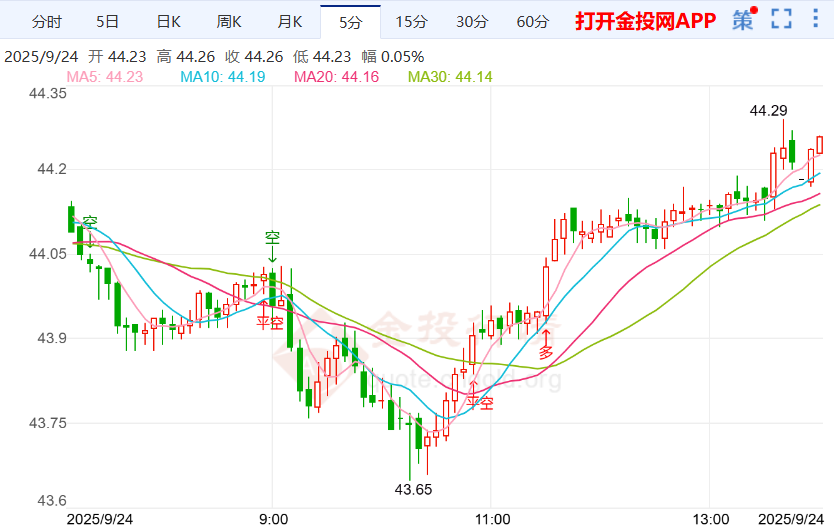
Group 1 - International silver is currently trading above $44.13, with a recent price of $44.25, reflecting a 0.61% increase [1] - The highest price reached today was $44.30, while the lowest was $43.64, indicating a bullish short-term trend for silver [1][4] Group 2 - President Trump criticized Walmart in May for passing tariff costs to consumers, setting a precedent for U.S. businesses [3] - Most tariff costs are currently borne by companies, but consumers may soon face these costs, potentially impacting consumer spending [3] - The U.S. economy is showing signs of fatigue, with growth slowing to half of last year's rate and employment stagnating [3] - Inflation risks are accumulating for consumers, and significant price increases by companies could provoke discontent from the Trump administration [3] - Michael Pearce from Oxford Economics noted that the burden of tariffs on the economy is increasing, with the most significant impact on consumers still to come [3] - The dollar may face dual pressures: short-term support if inflation exceeds expectations, but long-term weakness due to tariffs undermining consumer spending and economic growth [3] Group 3 - After three consecutive days of gains, the bullish momentum in silver has been released, with a focus on potential price adjustments [4] - Key support levels for silver are at $43.70 and $43.40, while resistance levels are at $44.40 and $44.70 [4]
X @外汇交易员
外汇交易员· 2025-09-24 01:12
Market Intervention - Chinese state-owned banks are selling RMB in the spot market to curb its recent appreciation [1] - These banks are also using swaps to hedge their positions [1] - Banks have been increasing their purchases of USD spot in recent months [1] Swap Market Dynamics - Onshore RMB/USD 12-month swap points are at their lowest negative value since 2022, indicating rising costs for forward USD positions [1] - Onshore RMB swap points have exceeded offshore RMB swap points in recent weeks, with the difference reaching its highest level since 2013, suggesting strong onshore demand for USD [1]
东部战区发声!
证券时报· 2025-09-06 15:04
Core Viewpoint - The article discusses the recent military activities in the Taiwan Strait involving Canadian and Australian naval vessels, emphasizing China's response to these provocations and its commitment to safeguarding national sovereignty and regional stability [1]. Group 1 - On September 6, Canadian "Quebec" frigate and Australian "Brisbane" destroyer transited the Taiwan Strait, which was perceived as provocative actions [1]. - The Eastern Theater Command of the People's Liberation Army monitored and responded effectively to the passage of these foreign vessels [1]. - The actions of Canada and Australia are described as sending incorrect signals and increasing security risks in the region [1].

美债的“近忧”和“远虑”
2025-09-03 14:46
Summary of Key Points from Conference Call Industry Overview - The discussion primarily revolves around the U.S. Treasury bond market and its implications for the domestic economy, particularly in relation to the Chinese market and currency dynamics. Core Insights and Arguments 1. **Impact of U.S. Treasury Rates on Currency**: Fluctuations in U.S. Treasury rates directly affect the USD/CNY exchange rate, which in turn constrains domestic monetary policy and expectations for easing [1][3][4] 2. **Shift in Investment Preferences**: There has been a notable shift of resident deposits towards wealth management products, dollar deposits, and U.S. Treasuries, leading to an expanded foreign exchange deficit and negatively impacting domestic risk assets [1][3] 3. **Attraction of A-Shares**: Since 2025, the actual yield on U.S. Treasuries has decreased due to expectations of rate cuts, making A-share dividends, which may approach 5%, more attractive compared to U.S. Treasuries yielding only 1% to 2% [1][3] 4. **Factors Influencing Treasury Rate Pricing**: U.S. Treasury rates are influenced by economic data, policy changes, and market sentiment, with significant volatility observed in 2025 due to various economic indicators and policy announcements [1][4][5] 5. **Global Economic Instability**: The current global economic environment is unstable, with significant fluctuations in U.S. Treasury and dollar markets, influenced by political events in France and Japan, as well as a reversal in global equity markets [1][6] 6. **Short-term Treasury Maturities**: In Q2 2025, $6 trillion in U.S. Treasuries are set to mature, primarily short-term bonds, which are not expected to significantly impact Treasury rates or dollar credit due to stable long-term issuance patterns [1][7] 7. **Foreign Investment Trends**: Despite concerns about foreign selling of U.S. Treasuries, data indicates that while some countries like China have sold off, major holders like Japan and the UK have increased their holdings, leading to an overall increase in non-U.S. government Treasury reserves [1][8] 8. **Fiscal Sustainability Concerns**: Long-term risks regarding U.S. fiscal sustainability are highlighted, with the potential for high borrowing to continue unless effective fiscal reforms are implemented [2][9][12] 9. **Government Spending Structure**: The U.S. government’s spending structure is deemed unhealthy, with a heavy reliance on necessary expenditures and insufficient contributions from corporate taxes, necessitating a resolution of supply-demand imbalances for sustainable development [12][14] 10. **Future Economic Outlook**: The impact of new fiscal legislation on the U.S. economy is significant, with a focus on whether the government can achieve effective fiscal consolidation or will continue to rely on high levels of borrowing [15] Other Important but Overlooked Content - The relationship between the Federal Reserve's monetary policy and Treasury rates is crucial, as short-term rates are directly influenced by Fed decisions, while long-term rates reflect market expectations of the U.S. economy [11] - The Treasury's cash management strategies, including the current balance of the Treasury General Account (TGA), are expected to have limited impact on market liquidity and Treasury rates in the near term [10]