芯片代工

Search documents
“纯代工”的格罗方德,为何盯上MIPS?
半导体行业观察· 2025-07-12 04:11
Core Viewpoint - GlobalFoundries' acquisition of MIPS is aimed at enhancing its service offerings without transitioning into an Integrated Device Manufacturer (IDM) model, focusing on providing ready-to-use computing IP to accelerate customers' product launch processes [2][4][5]. Group 1: Acquisition Purpose - The acquisition is intended to provide customers, especially those new to chip development or seeking vertical integration, with a simplified system design process through ready-to-use IP modules [4][5]. - GlobalFoundries emphasizes that it remains a pure foundry focused on helping customers create world-class products, and the acquisition will expand its capabilities to offer a more comprehensive service portfolio [4][5]. Group 2: Competitive Landscape - By offering RISC-V processor IP, GlobalFoundries may compete directly with existing IP suppliers like Andes Technology, but it believes that combining IP with its differentiated manufacturing processes will provide unique advantages to customers [4][6]. - The acquisition positions GlobalFoundries as the first foundry to offer processor IP based on the open-source RISC-V architecture, significantly enhancing its attractiveness to new market entrants [6]. Group 3: MIPS Operations - MIPS will continue to operate independently as a subsidiary of GlobalFoundries, maintaining existing customer relationships and ongoing projects without interruption [8][9]. - The strategy is to keep MIPS as an open and independent IP supplier, with no immediate changes planned for its product offerings or customer collaboration methods [9].


英特尔黯然“败走”车圈
Hua Er Jie Jian Wen· 2025-06-27 09:47
Core Viewpoint - Intel has decided to shut down its automotive business and lay off most of its employees in this division as part of a strategic refocus to cut costs, indicating a retreat from the automotive industry [2][3]. Group 1: Business Decisions - Intel's CEO, Pat Gelsinger, announced a significant restructuring plan, which includes a large-scale layoff to address declining sales and poor revenue outlook [2][3]. - The company aims to ensure a smooth transition for its clients while gradually shrinking its automotive business under the Client Computing Group [2][3]. Group 2: Financial Performance - Intel's financial report showed a 2% year-over-year decline in total revenue, with a gross margin drop of 7.3 percentage points, resulting in a net loss of $18.756 billion, compared to a profit of $20.899 billion in 2020 [2][3]. - The automotive division's revenue has not been significant enough to be reported separately, highlighting its lack of contribution to overall revenue [3]. Group 3: Market Competition - Intel's automotive business has faced intense competition from rivals like NVIDIA and Qualcomm, leading to a decline in market share for its autonomous driving subsidiary, Mobileye, which only holds 2.9% of the market [3][4]. - In the cockpit chip market, Intel captured only 2.96% of the market share last year, falling behind competitors such as Qualcomm and NXP [4]. Group 4: Strategic Shifts - The automotive market is becoming increasingly competitive, and Intel's lack of significant partnerships with major automotive manufacturers has left it marginalized [5][7]. - Despite the retreat from the automotive sector, Intel continues to invest in various automotive technology companies and retains control over Mobileye [10]. Group 5: Historical Context - Intel's initial foray into the automotive sector was driven by a decline in PC shipments and an increasing demand for chips in vehicles, leading to significant acquisitions like Mobileye in 2017 [8][9]. - The expectation was that automotive chips would become a major revenue contributor, with predictions that the automotive chip market would grow significantly by 2030 [8][9].

朱雀三号一级动力系统试车试验成功;错误率降低1000倍!微软量子计算重大技术突破,可商用丨智能制造日报
创业邦· 2025-06-21 03:02
Group 1 - Microsoft has achieved a significant breakthrough in quantum computing with the introduction of the 4D topological quantum error correction code, which reduces error rates by 1000 times compared to 2D codes, enhancing coding efficiency and error correction capabilities [1] - The first domestically built 16,000 TEU methanol dual-fuel container ship, "Zhongyuan Shipping Yangpu," has been delivered, marking three historic breakthroughs in the construction of large methanol dual-fuel container ships in China [1] - The successful ground test of the first-stage propulsion system of the Zhuque-3 reusable rocket by Blue Arrow Aerospace represents the largest and most automated test of its kind in China to date [1] Group 2 - The use of 3D printing technology in rocket engines has significantly reduced manufacturing costs from 500,000 to less than 50,000, achieving a cost reduction of 80% [1] - The global chip foundry market is undergoing a transformation, with SMIC rapidly closing the gap with Samsung Electronics, whose market share has dropped to 7.7%, while SMIC's has risen to 6% [1] - SMIC's growth is attributed to its proactive inventory strategy in response to U.S. tariffs and domestic policies, allowing it to thrive amid a market slowdown, while Samsung's decline is linked to delivery issues leading to customer loss [1]


国科微拟并购晶圆代工企业 停牌前股价“提前”大涨
Mei Ri Jing Ji Xin Wen· 2025-05-21 17:06
Core Viewpoint - Guokewi (SZ300672) announced a major asset restructuring plan, leading to a stock suspension starting May 22, 2025 [1][4]. Group 1: Stock Performance - Guokewi's stock price increased by 12.54% on May 20, 2025, and by 1.45% on May 21, 2025 [2][6]. - The total amount of large orders buying Guokewi shares was approximately 200 million yuan and 90 million yuan on May 20 and May 21, respectively, indicating significant trading activity [8]. Group 2: Asset Restructuring Details - The company signed preliminary agreements with some transaction parties on May 21, 2025, to acquire equity in a target company engaged in specialized semiconductor wafer foundry and customized chip foundry services [4]. - The specific name of the target company and the transaction price have not been disclosed, with the price to be determined based on an asset evaluation report [4]. - The transaction is expected to constitute a major asset restructuring as defined by the relevant regulations, but it will not lead to a change in the actual controller of the company [4][5]. Group 3: Market Reactions and Investor Sentiment - Some investors expressed skepticism regarding the stock price increase prior to the announcement of the asset restructuring [3][9]. - The semiconductor industry saw a slight increase on the same day as Guokewi's stock surge, with the CSI Chip Industry Index rising by only 0.38% [9].

三星代工,终于有了大客户
半导体芯闻· 2025-05-20 11:00
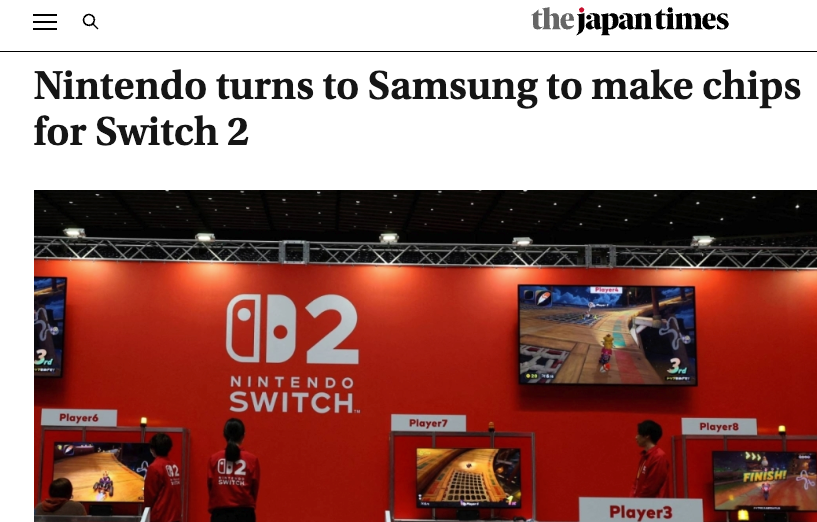
Core Viewpoint - Nintendo has turned to Samsung Electronics to assist in manufacturing the main chip for the Switch 2, aiming to boost production to exceed the expected 20 million units by March 2026 [1][2]. Group 1: Nintendo's Production and Sales Expectations - Nintendo anticipates selling 15 million units of the Switch 2 in the current fiscal year, factoring in the impact of tariffs on profits, but this figure does not account for supply constraints [2][3]. - The company has received 2.2 million pre-orders in Japan alone and has apologized for being unable to accept more pre-orders due to high demand [3]. - Nintendo's initial goal is to match the sales of the original Switch in its first 10 months, which was approximately 15 million units, indicating potential for upward revision of shipment estimates [3]. Group 2: Samsung's Role and Competitive Landscape - Samsung is utilizing its 8nm process node to manufacture custom chips designed by NVIDIA for the Switch 2, which is expected to enhance Samsung's foundry capacity utilization and business performance [1]. - This collaboration marks a significant endorsement for Samsung's foundry business, which has struggled to compete with TSMC in the semiconductor market [1][2]. - Historically, Samsung has been a key supplier for Nintendo, providing NAND flash memory and OLED screens, and has encouraged Nintendo to continue using OLED panels in future Switch 2 models [2]. Group 3: TSMC's Market Position - TSMC has been expanding its lead in the semiconductor market through continuous technological iterations and stable mass production capabilities, attracting major clients like Apple and NVIDIA [2]. - The competition between Samsung and TSMC in advanced process technology is intensifying, with both companies striving to improve the yield of 2nm processes to enhance profitability and product quality [2].
消息称三星电子获任天堂Switch 2芯片代工订单
Huan Qiu Wang· 2025-05-20 07:15
【环球网科技综合报道】5月20日消息,据日本时报报道,三星电子已正式获得任天堂新一代游戏主机Switch 2的芯 片代工订单,将基于其8纳米制程工艺生产英伟达定制的Tegra T239芯片。 尽管任天堂曾考虑台积电7nm/8nm工艺,但最终选择三星8nm制程。行业分析指出,三星在该工艺节点上的良率高 达70%~80%,且无需依赖极紫外光(EUV)设备,生产成本较台积电降低约15%~20%。此外,英伟达Ampere架构 GPU此前已适配三星8nm工艺(如RTX 30系列显卡),技术协同性进一步巩固合作基础。 据彭博社援引知情人士消息,三星的代工能力将助力任天堂在2026年3月财年内实现Switch 2销量超2000万台,较此 前1500万台的预期显著上调。分析认为,三星的产能保障使任天堂无需与其他厂商争夺台积电先进制程资源,同时 8nm工艺的成熟度亦降低了供应链风险。 此外。韩媒指出,三星正计划将5nm工艺用于Switch 2的"性能升级版",未来或推出搭载OLED屏幕的增强机型。 (青山) 根据供应链消息,Tegra T239芯片采用ARM Cortex-A78C架构的8核CPU,其中6核专为游戏优化,2核预 ...

共赢可期!任天堂携手三星“爆肝”Switch2核心芯片 剑指2000万台出货量
智通财经网· 2025-05-20 07:01
Core Viewpoint - Nintendo has partnered with Samsung to produce the core chips for the upcoming Switch 2, aiming to significantly increase production and exceed sales expectations of 20 million units by March 2026 [1][3]. Group 1: Nintendo's Strategy and Sales Expectations - Nintendo expects to ship over 20 million units of Switch 2 by March 2026, which is significantly higher than previous estimates [1]. - The company has received 2.2 million pre-orders in Japan alone, indicating strong market demand [3]. - Nintendo's president, Shuntaro Furukawa, stated that the primary goal is to match the initial sales performance of the original Switch, which sold approximately 15 million units in its first 10 months [4]. Group 2: Samsung's Role and Competitive Landscape - Samsung is utilizing 8nm technology to manufacture custom chips for Switch 2, which could enhance its chip foundry's equipment utilization and expand its business [1]. - The collaboration with Nintendo is seen as a significant recognition of Samsung's chip foundry business, which aims to become a major pillar alongside its memory business [1]. - Samsung has historically supplied NAND flash memory and OLED screens to Nintendo and is pushing for continued use of its OLED panels in future updates of Switch 2 [2]. Group 3: TSMC's Competitive Position - TSMC continues to strengthen its leading position in the chip manufacturing sector through ongoing technological upgrades and stable large-scale production, attracting major clients like Apple and Nvidia [2]. - Both TSMC and Samsung are competing fiercely in the chip manufacturing space, particularly in the race for 2nm technology to improve production yield and profitability [2].
英特尔高管坦言:客户不是很多
半导体行业观察· 2025-05-14 01:47
如果您希望可以时常见面,欢迎标星收藏哦~ 来源:本文编译自路透社,谢谢。 英特尔首席财务官戴维·津斯纳 (David Zinsner) 周二表示,英特尔使用即将推出的制造技术为外 部客户生产的处理器数量目前"并不大"。 津斯纳在摩根大通于马萨诸塞州波士顿举行的全球技术、媒体和通信会议上表示,英特尔承诺的产 量,即英特尔使用即将推出的制造技术为外部客户生产的芯片数量,目前并不大。 总部位于加州圣克拉拉的英特尔正努力成为芯片代工厂,但其18A和最新的14A芯片制造技术进展 缓慢。 然而,该公司上个月表示,已有几家客户计划为即将推出的工艺制造测试芯片。 " 我 们 拿 到 了 测 试 芯 片 , 但 有 些 客 户 最 终 放 弃 了 测 试 芯 片 …… 所 以 目 前 承 诺 的 产 量 肯 定 不 大,"Zinsner说道。 据路透社3月份报道,AI芯片领跑者英伟达和定制芯片制造商博通正在与英特尔进行制造测试。 Zinsner补充说,这家名为"代工厂"的代工厂有望在2027年某个时候实现收支平衡,并且需要外部 客户创造数十亿美元的低至中个位数收入才能实现这一目标。 在最近的 Direct Connect 代工 ...
三星代工,再失大客户?
半导体芯闻· 2025-05-06 11:08
Core Viewpoint - AMD has reportedly abandoned its 4nm orders with Samsung Foundry, likely shifting to TSMC due to Samsung's underperformance in the semiconductor industry [1][2]. Group 1: AMD's Shift in Partnerships - AMD has decided to forgo its 4nm orders with Samsung and is expected to turn to TSMC for production in the U.S. [1] - The specific reasons for this shift have not been disclosed, but it is likely linked to Samsung's poor performance and TSMC's attractive offerings [1]. - AMD's dual-sourcing strategy involved extensive collaboration with Samsung on the SF4X process, covering EPYC server CPUs, Ryzen APUs, and Radeon GPUs [1]. Group 2: Samsung's Market Position - Samsung's foundry business is struggling to gain industry recognition despite its diverse product range and substantial capacity [1]. - The exit of a major partner like AMD is a negative signal for Samsung, which needs to enhance its reputation in the chip industry [1]. - However, there are indications that companies like NVIDIA are interested in Samsung's 2nm process, suggesting potential future opportunities [2]. Group 3: TSMC's Advancements - TSMC's Arizona facility is currently mass-producing 4nm processes, and AMD is likely to enter this field following its agreement with TSMC [2]. - AMD has ordered high-end 2nm "Venice" server CPUs and is producing the Ryzen 9000 series consumer CPUs, indicating a significant shift in its collaboration with TSMC [2]. - AMD is one of the first companies to gain exclusive rights to the 2nm process, highlighting a transformative change in its partnerships [2].



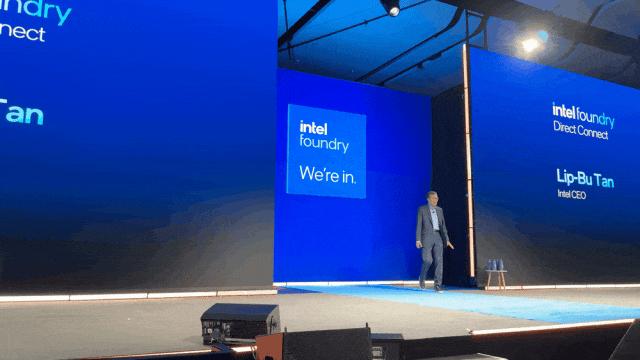
重磅:英特尔揭秘1.4nm细节,晒神秘AI芯片
3 6 Ke· 2025-04-30 03:39
Core Insights - Intel is positioning itself as a leading foundry service provider, focusing on advanced process technologies and packaging solutions to meet the demands of the AI era [1][81] - The company has unveiled its latest technology roadmap, including the upcoming Intel 18A (1.8nm) and Intel 14A (1.4nm) nodes, with plans for mass production and collaboration with major clients [3][39][41] Process Technology Developments - Intel plans to mass-produce the Intel 18A node within this year, with the first products including the Panther Lake CPU for laptops and Clearwater Forest server CPUs [5][39] - The Intel 14A and its variants are expected to enhance performance by 15-20% per watt and increase chip density by 1.3 times compared to Intel 18A [35][43] - The company has invested nearly $90 billion over the past four years, with a significant portion allocated to enhancing its front-end and back-end technology capabilities [30] Advanced Packaging Innovations - Intel has introduced a new advanced packaging roadmap featuring technologies like EMIB-T 2.5D and Foveros Direct 3D, which are touted as optimal solutions for AI applications [7][60] - The Foveros technology allows for vertical stacking of chips, improving integration density and reducing interconnect spacing [70] - New packaging solutions are being developed to meet high bandwidth memory (HBM) demands, with EMIB-T and Foveros-R expected to be available by 2027 [62][70] Ecosystem and Collaboration - Intel is actively collaborating with major EDA companies and semiconductor ecosystem partners to support the design and production of its new nodes [20][24] - The company has established a diverse and flexible global supply chain, which is considered a key strength moving forward [17] - Intel's foundry ecosystem is continuously evolving, with partnerships aimed at providing comprehensive IP, EDA, and design services [24][29] Strategic Vision and Market Positioning - Intel aims to transform its foundry business into a service-oriented company, focusing on customer trust and satisfaction [78][80] - The company is committed to adapting to the AI era by integrating advanced process technologies and packaging solutions into its offerings [11][81] - As the semiconductor market is projected to reach $1 trillion, Intel is positioning itself as a critical player in the industry, leveraging its technological advancements and partnerships [13][81]