
新型城镇化

Search documents
地产股集体飙升!
Zheng Quan Shi Bao· 2025-07-10 08:24
今日盘中,港股地产股大幅走高,龙光集团一度上涨超80%,远洋集团盘中上涨超35%,融创中国、佳 兆业集团、富力地产等多股跟随上涨。 A股市场同步共振,华夏幸福、深深房A、光大嘉宝、南山控股等多股涨停,市场情绪显著回暖。 多家房企债务重组成功 债务重组通过延长还款期限、削减债务规模,对房地产企业的短期现金流压力起到了缓解作用。东吴证 券认为,当前房地产市场销售及房企拿地尚未恢复,新增开发贷难度较大;在过往偿还债务过程中,房 企大量持有型物业已用于抵押性经营贷,且部分物业在重组方案中被用作追加抵押,现阶段可用于抵押 性经营贷的物业资源较少;近年来房企违约展期致使行业信用受损,房企信用借款等融资渠道受阻。 债务重组的作用主要在于缓解房地产公司短期现金流压力。东吴证券表示,如果公司不能够实现经营性 现金流回正,或重启融资通道,中长期偿还债务或仍有压力,因此债务重组的作用主要在于帮助房企度 过短期现金流危机,后续房地产公司仍需依靠自身实现稳定经营并逐步增长。 政策"组合拳"释放长期利好 近日,国家发展改革委城市和小城镇改革发展中心发文表示,要以"两重""两新"资金使用为抓手,加大 新型城镇化重点领域投入。 一是加大"两 ...
突然,地产股集体飙升!
证券时报· 2025-07-10 08:13
Core Viewpoint - The recent surge in Hong Kong real estate stocks is attributed to successful debt restructuring by several property companies, leading to improved market sentiment and significant price increases for major players in the sector [1][5][6]. Group 1: Market Performance - Hong Kong real estate stocks saw substantial gains, with Longfor Group rising over 80% and other companies like China Overseas Land and Investment and Sunac China also experiencing significant increases [1] - The A-share market mirrored this trend, with companies such as China Fortune Land Development and Shenzhen Metro Group hitting their daily price limits, indicating a notable recovery in market sentiment [3] Group 2: Debt Restructuring - Multiple property companies have successfully completed debt restructuring, which has accelerated the clearing of risks in the real estate sector [4][7] - Longfor Group announced the completion of a bond restructuring involving 21 bonds with a total principal balance of 21.96 billion yuan, receiving strong support from investors [6] - The restructuring plan included options such as asset swaps, cash buybacks, and debt-to-equity swaps, which were designed to alleviate short-term cash flow pressures for the companies involved [6][8] Group 3: Policy Environment - Recent government policies are expected to provide long-term benefits to the real estate market, focusing on urbanization and infrastructure development [10][11] - The National Development and Reform Commission has emphasized the need for differentiated policies to support various demographics in urban areas, which may enhance housing supply and stabilize the market [10] - Analysts predict that the upcoming year will be a critical turning point for the real estate sector, with a focus on quality housing and improved regulatory frameworks [11]


集体飙涨,原因找到了!
Zhong Guo Ji Jin Bao· 2025-07-10 07:57
【导读】金融地产猛拉!A股站上3500点 中国基金报记者泰勒 兄弟姐妹们啊,今天市场表现不错,A股午后不断冲高,不过美中不足的是,最后尾盘略有跳水! 一起看看发生了什么事情。 7月10日,市场的亮点之一是地产股午后集体爆发,华夏幸福、深深房A、光大嘉宝等多股涨停。 A股站稳3500点 7月10日,A股震荡上涨,沪指站稳3500点!截至收盘,沪指涨0.48%,深成指涨0.47%,创业板指涨0.22%。 市场共2947只个股上涨,69只个股涨停,2279只个股下跌。 | 880005 涨跌家数 | | | --- | --- | | 其中 涨停 | 69 | | 涨幅 > 7% | 102 | | 涨幅 5-7% | 69 | | 涨幅 3-5% | 195 | | 涨幅 0-3% | 2581 | | 跌幅 0-3% | 2052 | | 跌幅 3-5% | 140 | | 跌幅 5-7% | 52 | | 跌幅 > 7% | 35 | | 其中 跌停 | 14 | | 上涨家数 | 2947 | | 下跌家数 | 2279 | | 平盘停牌 | 194 | | 总品种数 | 5420 | | 总成交额 | 1 ...

突发!集体飙涨,原因找到了!
中国基金报· 2025-07-10 07:49
7月10日,A股震荡上涨, 沪指站稳3500点!截至 收盘,沪指涨0.48%,深成指涨0.47%,创业板指涨0.22%。 兄弟姐妹们啊,今天市场表现不错,A股午后不断冲高,不过美中不足的是,最后尾盘略有跳水! 一起看看发生了什么事情。 A股站稳3500点 【导读】 金融地产猛拉!A股站上3500点 中国基金报记者 泰勒 市场共 2947只个股上涨,69只个股涨停,2279只个股下跌。 式和股东回报形式,海外银行兼具高股东回报和成长性。 | 代码 | 名称 | | 涨幅% | 现价 | | --- | --- | --- | --- | --- | | 600016 | 民生银行 | R | 5.31 | 5.55 | | 601398 | 工商银行 | R | 2.93 | 8.08 | | 000001 | 平安银行 | R | 2.65 | 13.18 | | 600036 | 招商银行 | R | 2.36 | 48.24 | | 601288 | 农业银行 | R | 1.77 | 6.31 | | 200012 | 华夏银行 | R | 1.66 | 8.58 | | 601988 | 中国银行 | ...

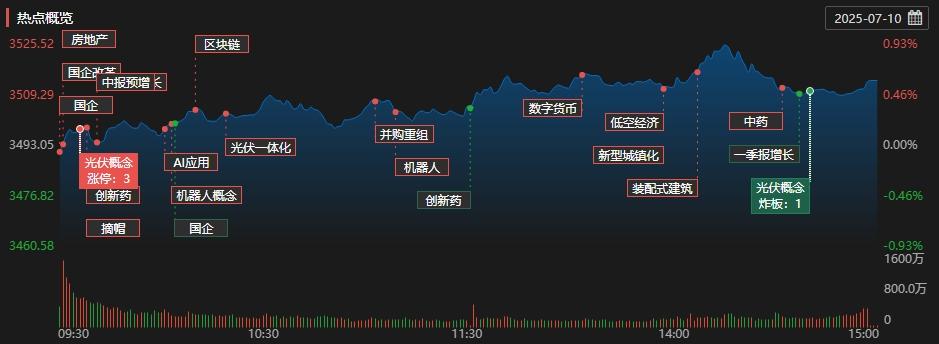
收评:沪指涨0.48%重回3500点 城镇化概念股集体爆发
Xin Hua Cai Jing· 2025-07-10 07:44
Market Performance - A-shares experienced a significant upward trend on July 10, with the Shanghai Composite Index rising by 0.48% to close above 3500 points for the first time since January 25, 2022 [1] - The Shenzhen Component Index increased by 0.47%, while the ChiNext Index rose by 0.22% [1] - Total trading volume reached 613.2 billion yuan for the Shanghai market and 881 billion yuan for the Shenzhen market [1] Sector Performance - Real estate, urbanization concept stocks, and silicon energy sectors saw substantial gains, with multiple stocks hitting the daily limit [1][2] - Major financial stocks, including the four largest banks, reached historical highs [1] - The PCB sector faced adjustments, with specific stocks experiencing significant declines [1] Institutional Insights - Market trends are expected to remain upward, with a focus on sectors such as semiconductors, consumer electronics, artificial intelligence, and low-altitude economy [3] - The cement industry is anticipated to see controlled supply and stable profitability due to recent policy changes [3] - Global capital flows are shifting, with increased investments in European stocks and outflows from U.S. equities [3] Policy Developments - The National Development and Reform Commission emphasized the importance of new urbanization, aiming for significant investments in key areas by 2035 [4] Financial Sector Updates - The China Export-Import Bank reported over 610 billion yuan in new loans to foreign trade sectors in the first half of the year, supporting small and micro foreign trade enterprises [6]
A股收评 | 地产午后冲高!龙头股四连板
智通财经网· 2025-07-10 07:15
Market Overview - A-shares exhibited resilience despite external negative influences, maintaining an upward trend with stable market sentiment, focusing on dividends and technology as main investment themes [1][10] - The market saw a significant trading volume exceeding 1.4 trillion yuan, with more stocks rising than falling [1][2] Sector Performance - Real estate and large financial sectors showed strength, with stocks like Yuhua Development and Huaxia Happiness hitting the daily limit [1] - The "anti-involution" theme continued to gain traction, with strong performances in solar energy and steel sectors, exemplified by stocks like Tuori New Energy [1] - Mid-year performance forecast stocks gained attention, with Northern Rare Earth hitting the daily limit, boosting the rare earth sector [1] Individual Stock Movements - A total of 2,947 stocks rose, while 2,279 fell, with 69 stocks hitting the daily limit and 15 stocks hitting the lower limit [2] - The Shanghai Composite Index rose by 0.48% to 3,509.68 points, with a trading volume of 613.2 billion yuan [2] Fund Flows - Major funds focused on sectors such as solar equipment, chemical pharmaceuticals, and small metals, with notable net inflows into stocks like Northern Rare Earth and Sunshine Power [3] Policy and Economic Updates - The National Development and Reform Commission emphasized increasing investment in new urbanization, targeting completion by 2035 [4] - The China Automobile Industry Association reported that new energy vehicle sales reached 6.937 million units in the first half of the year, a 40.3% year-on-year increase [5] - Shanxi Province is accelerating the construction of a new energy system and aims to become a significant energy raw material base [6] Future Outlook - Dongguan Securities anticipates continued positive sentiment in the short term, despite uncertainties regarding tariffs and economic observations [8] - Longcheng Securities noted the emergence of a new main line in the market, driven by "anti-involution" policies, creating a structural differentiation between technology and cyclical stocks [9] - Yin Hua Fund does not foresee significant upward potential for indices in the short term, as the market approaches the half-year report disclosure period [10]
7月10日涨停分析
news flash· 2025-07-10 07:11
Group 1: Solar Energy Sector - Companies like Huaguang Huaneng and Tuo Ri New Energy have shown significant stock performance, with Huaguang Huaneng achieving a 9.98% increase over six consecutive days, driven by solar and power sectors [2] - Other notable performers include Kelu Electronics and Meili Ecology, both benefiting from the solar energy trend, with increases of 10.02% and 10.03% respectively [2] - The overall trend in the solar energy sector is supported by multiple companies experiencing consecutive gains, indicating strong market interest [3] Group 2: Innovative Pharmaceuticals - The innovative pharmaceutical sector is gaining traction, with companies like Lianhuan Pharmaceutical and Kangchen Pharmaceutical seeing stock increases of 10.02% and 10.01% respectively, attributed to advancements in innovative drug development [5] - The sector is bolstered by significant clinical data disclosures and large business development deals, enhancing the international competitiveness of Chinese innovative drugs [4] - Other companies such as Hai Sike and Qidi Pharmaceutical also made notable gains, reflecting a broader positive sentiment in the innovative drug market [5][7] Group 3: Real Estate Sector - The real estate sector is experiencing renewed interest, with companies like Yuhua Development and Nanshan Holdings achieving stock increases of 9.94% and 9.88% respectively, following government initiatives to stabilize the market [8] - The Ministry of Housing and Urban-Rural Development's recent investigations and recommendations aim to boost demand and optimize supply in the real estate market [8] - New entrants like Greenland Holdings and Huaxia Happiness are also capitalizing on this trend, indicating a potential recovery in the sector [9] Group 4: Hydrogen Energy - The hydrogen energy sector is poised for growth, with companies like Chimei Group and Tianwo Technology seeing stock increases of 10.12% and 10.09% respectively, driven by supportive policies and rising demand for green hydrogen [12][14] - The report highlights that the opening rate of green hydrogen projects is expected to rise, benefiting the upstream electrolyzer industry [12] Group 5: AI Applications - The AI application sector is expanding, with companies like Jingye Da and Puliang Software achieving stock increases of 10.02% and 20.00% respectively, as educational companies launch AI products [21] - The integration of AI technology into various industries is becoming more pronounced, indicating a growing market for AI-driven solutions [21] Group 6: Financial Sector - The financial sector is showing positive momentum, with companies like Nanhua Futures and Bank of China Securities experiencing stock increases of 10.02% and 10.03% respectively, supported by a surge in new account openings and favorable market conditions [23] - The outlook for brokerage firms remains strong, with expectations of continued high growth in mid-year earnings reports [23] Group 7: Logistics and Packaging - The logistics sector is responding to regulatory changes, with companies like Shentong Express and YTO Express both achieving stock increases of 10.00% [24][25] - The emphasis on improving industry regulations and reducing competition is expected to stabilize the market [24] Group 8: Organic Silicon - The organic silicon sector is reacting to production changes, with companies like Chenguang New Materials and Hongbo New Materials seeing stock increases of 10.01% and 10.03% respectively, following the announcement of a factory closure by Dow Chemical [19][20] - The closure of significant production capacity is likely to impact supply dynamics in the organic silicon market [19]




A股收评:沪指收涨0.48%盘中续创年内新高,房地产、房屋检测板块午后集体爆发
news flash· 2025-07-10 07:03
Market Overview - The three major A-share indices collectively rose today, with the Shanghai Composite Index up 0.48%, the Shenzhen Component Index up 0.47%, and the ChiNext Index up 0.22%. The North Star 50 Index fell by 0.16% [1] - The total market turnover was 15,150 billion, a decrease of 124 billion from the previous day, with over 2,900 stocks rising [1] Sector Performance - The sectors with the highest gains included silicon energy, real estate, rare earth permanent magnets, diversified finance, and weight loss drug concept stocks [1] - The real estate and housing inspection sectors saw a significant surge in the afternoon, with stocks like China Fortune Land Development (600340) and Everbright Jiabao (600622) hitting the daily limit [1] - The silicon energy sector maintained its upward momentum, with stocks such as Jingyuntong (601908) and Morning Light New Materials (605399) also hitting the daily limit [1] - The banking sector continued to rise, with the four major banks (Industrial, Agricultural, China, and Construction Bank) reaching historical highs during the trading session [1] - The rare earth permanent magnet sector performed positively, with Northern Rare Earth (600111) hitting the daily limit after its earnings report [1] - The diversified finance sector remained strong, with Nanhua Futures (603093) achieving two consecutive limits [1] Declining Sectors - The PCB sector saw most stocks adjust downwards, with Honghe Technology (603256) hitting the daily limit down, and other stocks like Zhongjing Electronics (002579) and Yihua New Materials (301176) also experiencing significant declines [1] - The digital currency concept stocks experienced a drop towards the end of the trading session, with Jin Yi Culture (002721) hitting the daily limit down, and other stocks like Sifang Jingchuang (300468) and Jingbeifang (002987) falling sharply [1] Notable Stocks - Stocks with notable performance included: - Six consecutive limits: Huaguang Huaneng and Forest Packaging (605500) [2] - Four consecutive limits: Yudai Development (000514), Guotou Zhonglu (600962), and Sifang New Materials (605122) [3] - Three consecutive limits: Huamei Holdings (000607), Jinling Mining (000655), and Tuori New Energy (002218) [4] Hot Sectors - The top hot sectors included: - Western Development, with 10 stocks hitting the daily limit and three stocks with consecutive limits, represented by Sifang New Materials and Yudai Development [5] - Photovoltaic concept, with 9 stocks hitting the daily limit and four stocks with consecutive limits, represented by Huaguang Huaneng and Tuori New Energy [6] - E-commerce, with 9 stocks hitting the daily limit and five stocks with consecutive limits, represented by Huamei Holdings and Kuaijingtong [7] Industry Insights - In the real estate sector, the National Development and Reform Commission emphasized the importance of advancing new urbanization by 2035, focusing on high-quality development and increased investment in key areas [10] - In the silicon energy sector, multiple silicon wafer companies raised their prices by 8% to 11.7%, attributed to upstream silicon material price increases, although the downstream battery segment's acceptance of these price hikes remains uncertain [11] - In the rare earth sector, Northern Rare Earth reported an expected net profit growth of 1883% to 2015% for the first half of the year, leading to upward revisions in earnings expectations and target prices for rare earth permanent magnet stocks by various institutions [12]
突然!牛市旗手,集体躁动
Zheng Quan Shi Bao Wang· 2025-07-10 06:38
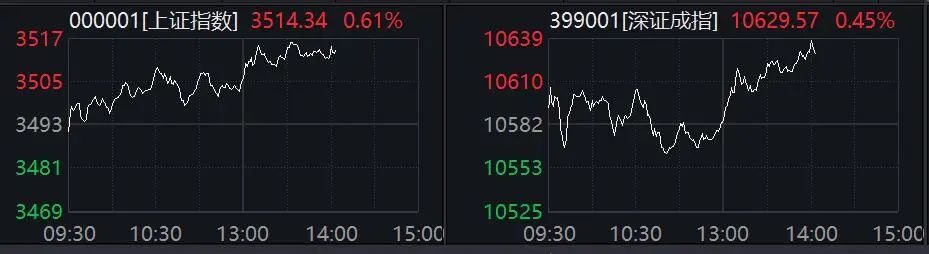
券商板块再度拉升,中银证券午后涨停,创出年内新高;红塔证券(601236)涨超5%。港股国泰君安国际午后一度涨超15%。 券商板块午后异动拉升,中银证券(601696)封于涨停。 A股午后走强,沪指一度涨超0.6%,深证成指、创业板指数均小幅上涨。 午后大金融板块持续拉升,中油资本(000617)一度涨停,走出3天2板,南华期货(603093)早盘已封涨停。 中国银河(601881)研报认为,国家"稳增长、稳股市"、"提振资本市场"的政策目标仍将持续定调板块未来走向,流动性适度宽松环境延续、资本市场环 境持续优化、投资者信心重塑等多方面因素共同推动证券板块景气度上行,中长期资金扩容预期进一步增强基本面改善预期。截至2025年7月4日,证券板 块PB估值1.35倍,处于2010年以来21.1%分位,仍然具备较高安全边际,板块配置正当时。 消息面上,国家发展改革委城市和小城镇改革发展中心近日表示,要高质量推进新型城镇化四大行动。其中,要以提升产业集群竞争力为先导,推动潜力 地区城镇化水平提升。 东海证券发布的证券行业中期策略分析称,建议把握并购重组、财富管理转型、创新牌照展业和ROE提升在内的逻辑主线,个股建议关 ...


港股内房股持续拉升,龙光集团涨超65%
news flash· 2025-07-10 06:04
Group 1 - Hong Kong property stocks have seen significant gains, with Longfor Group rising over 65%, Oceanwide Holdings increasing over 35%, and other companies like R&F Properties, Zhengrong Real Estate, Kaisa Group, and Greenland Hong Kong all rising over 10% [1] - The National Development and Reform Commission's Urban and Small Town Reform and Development Center has announced plans to increase investment in key areas of new urbanization using "two heavy" and "two new" funds [1]