
新型城镇化

Search documents
国家发改委城市和小城镇改革发展中心:以“两重”“两新”资金为抓手 加大新型城镇化重点领域投入
news flash· 2025-07-10 05:56
Core Viewpoint - The National Development and Reform Commission emphasizes the goal of achieving new urbanization by 2035, focusing on high-quality advancement through four major actions to support Chinese-style modernization [1] Group 1: Urbanization Actions - The initiative aims to enhance investment in key areas of new urbanization by leveraging "two heavy" and "two new" funding strategies [1] - Increased construction efforts will support the urbanization of agricultural transfer populations, improvement of urbanization levels in potential areas, cultivation of modern metropolitan areas, urban renewal, and enhancement of safety and resilience [1] - The plan includes addressing the needs of different generations of agricultural transfer populations through differentiated consumption policies, which will be included in the "two new" special support range [1] Group 2: Financial Strategies - Cities experiencing population inflow will be allowed to utilize ultra-long-term special government bonds and local government special bonds to enhance the recovery of idle land and acquisition of existing housing [1] - The initiative aims to continuously expand the supply of affordable housing for agricultural transfer populations [1]
晚报 | 7月10日主题前瞻
Xuan Gu Bao· 2025-07-09 14:29
Group 1: Autonomous Driving - BYD announced it has achieved L4-level smart parking capabilities and will cover all safety and loss liabilities for users of its Tian Shen Yan vehicles in smart parking scenarios [1] - CITIC Securities predicts that by 2025, the penetration rate of mid-to-high-end autonomous driving in China is expected to double, creating a market increment of 35 billion [1] - Guohai Securities notes that the commercialization of smart driving is accelerating, with increasing penetration rates expected to benefit the domain controller hardware and software supply chain [1] Group 2: Short Dramas - The short drama market in China has reached an annual scale of 300 to 350 billion, with expectations to surpass 500 billion next year [2] - The user base for micro-short dramas is projected to exceed 600 million by 2024, with the market size expected to reach 505 billion, surpassing annual box office revenue for the first time [2] - CITIC Jinshi Securities highlights a significant shift in the short drama industry towards advertising-based business models and an influx of traditional film companies [2] Group 3: 3D Printing - Researchers at the University of Texas at Austin have developed a new 3D printing technology that seamlessly integrates soft and hard material properties, opening new possibilities for prosthetics and flexible medical devices [3] - The 3D printing market in China is expected to exceed 63 billion by 2024, growing 30 times over the past decade, with projections to surpass 100 billion by 2029 [3] - The technology is seen as a transformative force in manufacturing, with applications expanding across various industries including healthcare and education [3] Group 4: Measurement and Testing - The State Administration for Market Regulation and the Ministry of Industry and Information Technology have issued a plan to support the development of new industrial productivity through measurement [4] - The demand for high-precision measurement in emerging industries such as new energy and aerospace is increasing significantly [4] - The Chinese measurement market is projected to exceed 150 billion yuan by 2025, with a compound annual growth rate of over 10% [4]



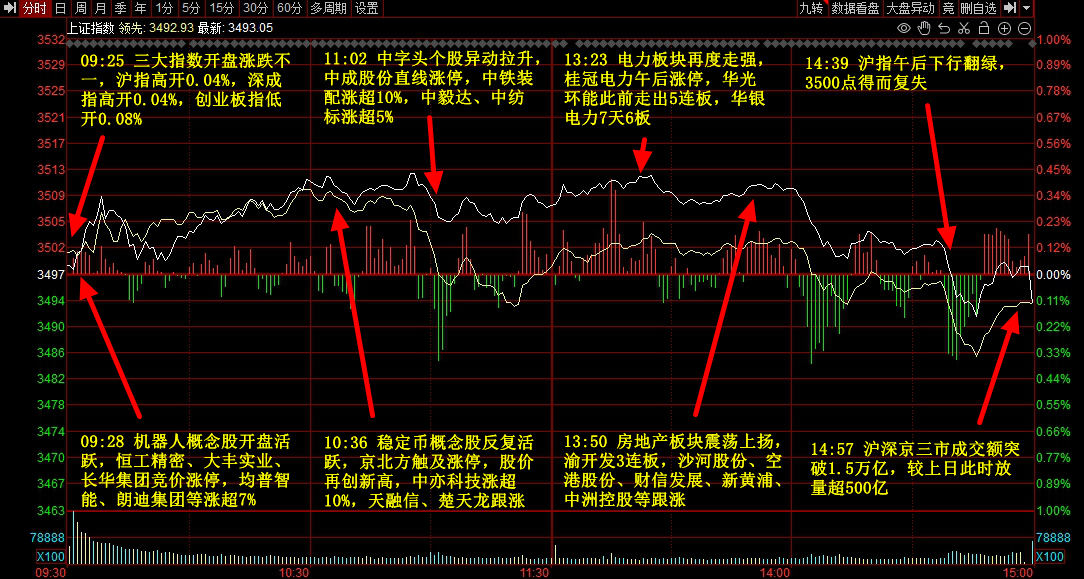
收盘丨沪指3500点得而复失,多只银行股再创历史新高
Di Yi Cai Jing· 2025-07-09 07:23
Market Overview - The A-share market saw a collective rise in the morning, followed by a slight decline in the afternoon, with the Shanghai Composite Index down 0.13% and the Shenzhen Component Index down 0.06%, while the ChiNext Index rose by 0.16% [1][2] Sector Performance - The financial sector led the gains, with multiple bank stocks reaching new highs; notable performers included Industrial and Commercial Bank of China [4] - Other sectors that performed well included childcare services, short drama games, and internet e-commerce, while new urbanization concepts and real estate stocks became active in the afternoon [4] - Conversely, sectors such as insurance, non-ferrous metals, organic silicon, and semiconductor chips experienced declines [4] Stock Highlights - Specific stocks that saw significant movement included: - Bank of China up 1.23% to 5.78 - Ping An Bank up 1.18% to 12.84 - Industrial and Commercial Bank of China up 1.16% to 7.85 [5] Capital Flow - Main capital flows indicated a net inflow into cultural media and traditional Chinese medicine sectors, while real estate and medical device sectors saw net outflows [6] - Notable individual stocks with net inflows included Kuaibao Tong and Kangmei Pharmaceutical, while Zhongyou Capital and Dongfang Wealth faced significant sell-offs [6] Institutional Insights - Jifeng Investment noted that the Shanghai Composite Index has broken through the B-wave peak, suggesting a challenge to the resistance level of 3674 points in the future [7] - Galaxy Securities indicated that after reaching 3550, the index may pull back to confirm the daily trend, while Dongfang Securities highlighted a return of global funds to the domestic market, driving index recovery [8]

江西:城乡建设“蝶变” 民生福祉“加码”
Zhong Guo Jing Ji Wang· 2025-07-07 15:14
Group 1 - In 2024, Jiangxi Province's agricultural entities achieved sales revenue of 367.2 billion yuan, a year-on-year increase of 9.9%, contributing to an increase in per capita disposable income for rural residents in poverty-stricken areas from 12,877 yuan in 2020 to 18,436 yuan in 2024, with an average annual growth rate of 9.4% [1] - Jiangxi has made significant progress in promoting new urbanization and comprehensive rural revitalization, enhancing urban-rural integration development [1] - The region is currently in a critical period of high-quality development and rapid urbanization, with many new highlights and changes in urban-rural integration [1] Group 2 - Jiangxi aims to systematically address the barriers to the urbanization of agricultural populations, with an expected annual increase of 0.85 percentage points in the urbanization rate of the permanent resident population during the 14th Five-Year Plan period [2] - The province is constructing modern counties that are vibrant, livable, and suitable for business, using county towns and characteristic small towns as key support points for urban-rural integration [2] - Since the beginning of the 14th Five-Year Plan, Jiangxi has implemented nearly 13,000 urban renewal projects with an investment exceeding 1.2 trillion yuan, significantly improving infrastructure and public service facilities [2] Group 3 - The key to rural revitalization is industrial revitalization, with Jiangxi developing characteristic industries tailored to local conditions and promoting the integration of primary, secondary, and tertiary industries [3] - The province has formed five leading industrial chains worth over 100 billion yuan each, including rice, oilseeds, fruits and vegetables, livestock, and aquaculture, along with two characteristic industrial chains worth over 10 billion yuan each, including tea and traditional Chinese medicine [3]
新型城镇化板块盘初拉升,霍普股份20cm涨停
news flash· 2025-06-27 01:39
Group 1 - The new urbanization sector saw a significant rise at the beginning of trading, with Hopu Co., Ltd. (301024) hitting a 20% limit up, and Chengbang Co., Ltd. (603316) approaching the limit up [1] - Other leading stocks included Nongshang Environment (300536), Zhongshe Consulting, and Deepwater Planning Institute (301038) [1] - The National Development and Reform Commission emphasized the importance of promoting coordinated development between urban and rural areas, advancing new urbanization, and accelerating the urbanization of agricultural transfer populations [1]


认真抓好“十项重点工作”——学习贯彻省委十一届九次全会精神之四
He Nan Ri Bao· 2025-06-26 23:35
Group 1 - The core viewpoint emphasizes the importance of practical implementation and the need for a clear focus on ten key tasks to achieve the goals set by the provincial government [1][2] - The province of Henan has achieved significant economic growth, with a GDP of 14,945.58 billion yuan in the first quarter, representing a year-on-year increase of 5.9%, surpassing the national average by 0.5 percentage points [2] - Henan's agricultural output has consistently exceeded 1,300 billion jin for eight consecutive years, contributing over 600 billion jin of raw grain and processed products annually, thus playing a crucial role in national food security [2] Group 2 - The province aims to transform from a "transport hub" to an "economic hub," leveraging its unique geographical advantages to integrate into the national unified market [2] - The next five years are seen as a critical phase for Henan's development, focusing on "two highs and four efforts," indicating substantial growth potential and opportunities for entrepreneurship [2] - The ten key tasks for the current and future periods include promoting integration into the national market, advancing education and talent development, upgrading industries, revitalizing rural areas, and enhancing ecological protection [2]
广东印发方案促进经济持续向好服务做强国内大循环 大力支持外贸转内销 筹划内贸版“广交会”
Nan Fang Ri Bao Wang Luo Ban· 2025-06-25 08:17
Group 1: Economic Support Measures - The Guangdong Province has officially issued a work plan to promote sustained economic improvement, focusing on precise support for enterprises, stabilizing employment, boosting consumption, expanding effective investment, and ensuring the safety of industrial and supply chains [1][2][3] - Specific measures include supporting e-commerce companies to establish export-to-domestic sales zones and facilitating the participation of new export enterprises in trade fairs [2][3] Group 2: Employment Stabilization - The plan emphasizes stabilizing the workforce through various methods such as salary negotiations, job rotation, and on-the-job training, with specific support for businesses hiring recent graduates and unemployed youth [4][5] - It encourages local governments to provide housing subsidies and increase housing fund loan limits to support first-time homebuyers and families with multiple children [4] Group 3: Investment Expansion - The plan aims to enhance effective investment by leveraging a coordinated project management mechanism to accelerate investment in ongoing projects and expedite the commencement of new projects [5][6] - It includes initiatives to promote the issuance and utilization of special bonds, focusing on projects with high investment efficiency and potential [6] Group 4: Resource Allocation and Innovation - The plan proposes the implementation of the "Million Talents Gather in South Guangdong" initiative to improve the market-oriented allocation of resources, enhancing the efficiency of talent, capital, technology, and data [7] - It also emphasizes the need for technological and industrial innovation, aiming to create new economic growth points through major technology projects and brand innovation [6][7]
马健:突出重点狠抓落实开创新局面
He Nan Ri Bao· 2025-06-25 01:15
"省委十一届九次全会的召开正当其时、意义重大,为当前和今后一个时期河南发展制定了路线图、时 间表和任务书,必将进一步增强全省干部群众学思想、讲协同、抓落实的政治自觉、思想自觉、行动自 觉,鼓舞全省上下坚定沿着习近平总书记指引的方向勇毅前行。"6月24日,省发展改革委党组书记、主 任马健在接受记者专访时说。 马健表示,省发展改革委将深入学习贯彻全会精神,积极发挥宏观管理和经济综合协调部门作用,统筹 兼顾、突出重点、狠抓落实,不断开创经济社会高质量发展新局面,一步一个脚印推动习近平总书记重 要讲话精神在中原大地落地生根、开花结果。 一是持续推动经济回升向好。加强宏观政策跟踪落实和预研储备,深入实施提振消费专项行动,提速推 进"两重"、中央预算内投资、地方政府专项债券等政策性资金项目建设,持续挖掘释放经济大省需求潜 力。 四是全面深化改革开放。抓好融入服务全国统一大市场建设,全面落实"五统一、一破除"任务,深入实 施营商环境优化提升行动,开展民营经济高质量发展系列行动和专项攻坚,办好郑州—吉隆坡航空"双 枢纽"合作论坛,不断增强发展动力活力。同时,高质量谋划完成我省"十五五"规划建议、规划纲要和 专项规划编制工作。 ...
大邑:培育博物馆总部经济 打造新消费场景40个以上|成都县市新城高质量发展
Sou Hu Cai Jing· 2025-06-24 14:46
Core Viewpoint - The Chengdu County Economic Development Conference emphasizes the importance of county-level economies in driving high-quality urban development, with a focus on leveraging local resources and strengths to enhance industrial and tourism sectors [1][3]. Group 1: Industrial Development - Dali County aims to strengthen its industrial park by focusing on key industries such as smart equipment and terminal manufacturing, targeting the establishment of 30 industrial projects each year with investments exceeding 100 million yuan [3]. - The county plans to create three industrial clusters with a total output value of 100 billion yuan by 2029, specifically in the automotive parts sector [3]. Group 2: Tourism and Cultural Development - Dali County is set to enhance its cultural tourism sector by developing over 40 new consumption scenarios, including winter sports and hot spring tourism, and aims to double the comprehensive tourism revenue by 2029 [3][4]. - The county will also focus on cultivating a museum headquarters economy and implement two major cultural tourism projects annually [3]. Group 3: Agricultural Development - The county is prioritizing the development of green agriculture, with plans to establish 24 high-yield demonstration areas and cultivate two billion-level industrial clusters by 2029, targeting an annual growth of over 20% in agricultural processing output [4]. Group 4: Urbanization and Infrastructure - Dali County will optimize public service resources and enhance education and healthcare levels, aiming to improve the quality of life and attract population growth [4]. - The county plans to implement urban organic renewal and develop five large commercial complexes and three characteristic blocks to create a high-quality living environment [4]. Group 5: Talent Development and Services - The county will establish a talent development hub, aiming to attract 220 political talents, 300 technical professionals, and 2,000 enterprise talents annually by 2029 [4]. - A specialized service mechanism for industrial parks will be introduced to enhance operational efficiency and support local enterprises [4].
让人与城的“双向奔赴”更美好(财经眼·为新型城镇化战略提供有力资金保障)
Ren Min Ri Bao· 2025-06-22 21:56
Core Viewpoint - The article emphasizes the importance of new urbanization as a strategy for industrial upgrading, population aggregation, and urban development, highlighting the need for effective financial policies to support this initiative [1][2]. Financial Support for New Urbanization - The government is implementing a new urbanization strategy that focuses on providing basic public services to migrant populations and enhancing financial services to help them integrate into urban life [2][4]. - Financial institutions are developing tailored products, such as "rental + loan" solutions, to address the housing needs of new citizens, thereby facilitating their transition to urban living [4][6]. Support for New Citizens - New citizens often face financial challenges when settling in urban areas, leading banks to create innovative financial products to meet their needs, such as the "Bailu Consumer Loan" from the Bank of Communications [3][4]. - As of now, 34,000 new citizens have successfully applied for the "Bailu Consumer Loan," indicating a strong demand for financial support among this demographic [3]. Entrepreneurship and Employment - The article discusses the challenges faced by small and micro enterprises, particularly in securing funding, and highlights government-backed financial products that assist these businesses [5][6]. - The central government has allocated 66.74 billion yuan in employment support funds to enhance the employment and entrepreneurship support system for new citizens [6][10]. Education for Migrant Children - Local governments are implementing policies to ensure that children of migrant workers have access to education, with financial support mechanisms in place to facilitate this [8][9]. - The Zhejiang provincial government has introduced measures to ensure that migrant children receive equal educational opportunities, including financial incentives for local governments based on the number of migrant students [9][10]. Conclusion - The article underscores the collaborative efforts between financial institutions and government bodies to support new urbanization, focusing on housing, employment, and education for migrant populations, thereby enhancing their quality of life and integration into urban settings [1][2][10].