
物理AI

Search documents
中国成全球最大工业机器人应用市场,韩媒称“应借鉴中国经验”
Huan Qiu Wang· 2025-11-04 01:00
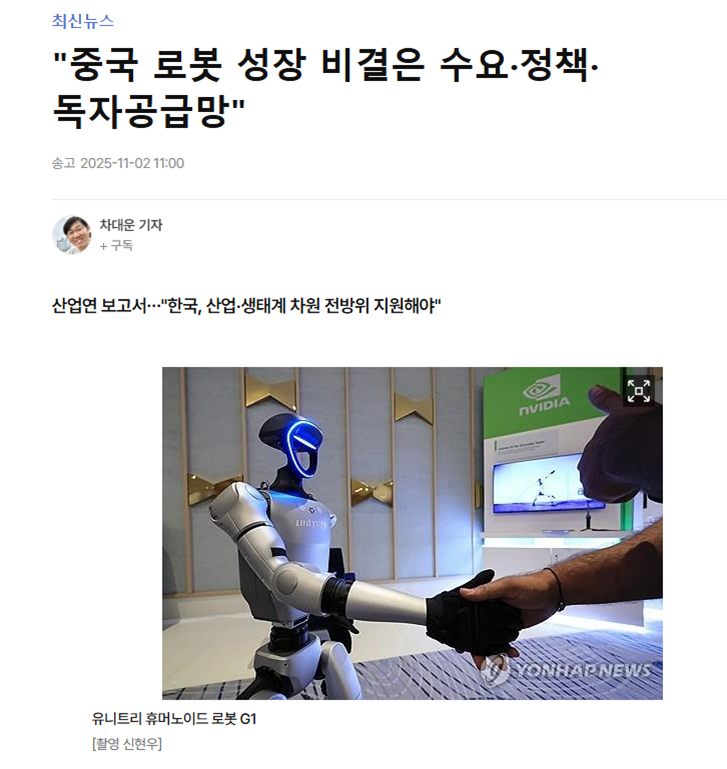
【环球网财经综合报道】据中国机械工业联合会,今年前三季度,我国机器人行业营收同比增长 29.5%。工业机器人产量达59.5万台,服务机器人产量达1350万套,均已超过2024年全年产量。 韩联社近日发文称,中国机器人产业全球领先,尤其是在工业机器人和人形机器人领域。增长动力主要 源于政策支持,以及自主供应链的构建,使关键部件自给自足,降低生产成本。 韩国产业研究院日前发布的《物理AI时代,中国机器人产业的成长与启示》报告中分析了中国机器人 产业发展战略,报告显示,中国工业机器人市场快速增长,占据了全球市场份额的大约三分之一,成为 全球最大的工业机器人应用市场。 报道还提到,韩国产业研究院提出了韩国机器人产业的应对方向,称应借鉴中国经验,确立创建需求、 产业融合和全球合作三大支柱,构建K-robot战略,并通过产业生态系统层面的支持和与跨国战略合 作,强化韩国在物理AI时代的竞争优势。 ...


上海索辰信息科技股份有限公司
Shang Hai Zheng Quan Bao· 2025-11-03 18:21
Core Viewpoint - Shanghai Suochen Information Technology Co., Ltd. plans to acquire 60% equity of Beijing Likong Yuantong Technology Co., Ltd. from ten shareholders through its wholly-owned subsidiary, Shanghai Suochen Digital Technology Co., Ltd. in cash [1][22]. Group 1: Major Asset Purchase Announcement - The company’s board of directors has approved the draft of the major asset purchase report and related proposals [1]. - The company received an inquiry letter from the Shanghai Stock Exchange regarding the major asset purchase draft and has made necessary revisions to the report [2][39]. - The revised report has been disclosed, ensuring that the transaction plan remains unaffected by the changes [2]. Group 2: Shareholder Meeting Notification - The third extraordinary general meeting of shareholders is scheduled for November 19, 2025, with both on-site and online voting options available [5][6]. - The meeting will discuss the major asset purchase report and other related proposals that have been previously approved by the board [8]. Group 3: Self-Inspection Report on Stock Trading - The company conducted a self-inspection regarding stock trading by insiders during the period leading up to the announcement of the major asset purchase [22]. - The self-inspection confirmed that the trading activities of relevant insiders did not constitute insider trading and did not pose legal obstacles to the transaction [28][30]. Group 4: Investor Communication - An investor briefing session is scheduled for November 11, 2025, to address questions regarding the major asset purchase [32]. - The session will be held online, allowing investors to submit questions in advance [33][36].

极佳视界完成新一轮亿元级A1轮融资 华为哈勃和华控基金联合领投
Zheng Quan Shi Bao Wang· 2025-11-03 11:36
Group 1 - The core viewpoint of the news is that the company, Jijiashijie, has successfully completed a new round of financing amounting to hundreds of millions, led by Huawei Hubble and Huakong Fund [1] - Jijiashijie focuses on physical AI and aims to develop "world model-driven general intelligence for the physical world," with products including GigaWorld, GigaBrain, and Maker [1] - The founder and CEO, Huang Guan, emphasizes that world models are a key and popular direction for embodied intelligence, supported by Huawei's recognition of world models as a top technology trend for 2035 [1][2] Group 2 - Huang Guan predicts that the "physical world ChatGPT moment" will arrive within 2 to 3 years, with world models addressing generalization, VLA handling task complexity, and reinforcement learning improving accuracy and reliability [2] - Jijiashijie plans to continue advancing the development of physical AI intelligent models and accelerate the commercialization of benchmark scenarios through a "smart-body-scenario" integration [2]
华为哈勃+华控基金联合领投极佳视界A1轮,引领物理AI终局路线
3 6 Ke· 2025-11-03 05:12
Core Insights - The article discusses the rapid development and investment in "world models" within the field of embodied intelligence, highlighting the emergence of a company named GigaVision that has made significant advancements in this area [3][4]. Group 1: Company Overview - GigaVision, founded in 2023, focuses on physical AI and aims to develop a "world model-driven general intelligence for the physical world" [4][10]. - The company has completed three rounds of financing in two months, indicating strong market confidence in its team, technology, and business direction [4][6]. - GigaVision's product offerings include the GigaWorld platform, GigaBrain embodied model, and Maker for general embodied ontology, representing a full-stack solution in physical AI [4][10]. Group 2: Technology and Innovations - GigaVision's world model technology addresses three major challenges in embodied intelligence: scarcity of high-quality data, the Sim2Real gap, and modeling errors in traditional simulators [11][12]. - The world model allows AI to simulate physical environments internally, enabling better decision-making in unfamiliar settings and reducing trial-and-error [7][11]. - The company claims that its GigaBrain-0 model has shown superior performance in various tasks, demonstrating robustness and better generalization compared to other methods [13][14]. Group 3: Market Trends and Collaborations - Major tech companies like Google, OpenAI, Tesla, and NVIDIA are heavily investing in world models, indicating a significant trend in the industry [3][7]. - GigaVision has established deep collaborations with various robotics innovation centers, research institutions, and cloud computing companies to create a leading data factory and embodied intelligence platform [15]. - The company aims to accelerate the application of physical AI across multiple sectors, including automotive, industrial, and service industries, by leveraging its world model technology [15].

何小鹏:汽车、机器人会越来越像人,相信“物理AI”时代会到来
2 1 Shi Ji Jing Ji Bao Dao· 2025-11-02 05:07
Core Viewpoint - The integration of physical environments and AI is expected to shape the future, leading to advancements in autonomous vehicles and robotics, enhancing everyday life [2]. Group 1 - The 15th National Games torch relay took place in Guangzhou, Shenzhen, Hong Kong, and Macau, concluding in Guangzhou [2]. - He Xiaopeng, Chairman and CEO of Xiaopeng Motors, emphasized the significance of "physical AI" in the future, indicating that various physical environments will evolve [2]. - The participation of autonomous vehicles and robots in the torch relay symbolizes the onset of the "physical AI" era, which is anticipated to improve the quality of life [2].

十五运火炬手何小鹏:科技发展像火炬,创新是火实体经济是炬
2 1 Shi Ji Jing Ji Bao Dao· 2025-11-02 04:29
"我相信就像火炬一样,科技创新可能是火,实体经济可能是炬。"何小鹏表示,相信新的时代一定会有 物理和AI的组合。所谓"物理",就是所有的物理世界的环境都会变化,比如汽车、低空飞行、机器人, 这些东西都会越来越聪明,越来越像人。这也正是无人驾驶汽车、机器人参与火炬传递的意义所在。 何小鹏相信,随着物理AI时代的到来,下个10年、下个20年,这个世界会更加美好,帮助大家的生活 变得更美好。 (文章来源:21世纪经济报道) 南方财经记者谭砚文实习生练行勇佩言广州报道 11月2日,第十五届全国运动会火炬传递广州站在海心沙收官。 "我觉得特别骄傲自豪,可以'吹牛'吹一辈子,特别兴奋。"作为收火仪式最后一棒火炬手,小鹏汽车董 事长何小鹏向南方财经记者表示,既紧张又期待,火炬传递是一个庄严的活动,需要确保万无一失,同 时也希望向市民传递快乐。为了迎接火炬传递,他最近都用椭圆机进行锻炼。 ...
黄仁勋又卖了,套现超10亿美元!
Mei Ri Jing Ji Xin Wen· 2025-11-02 01:37
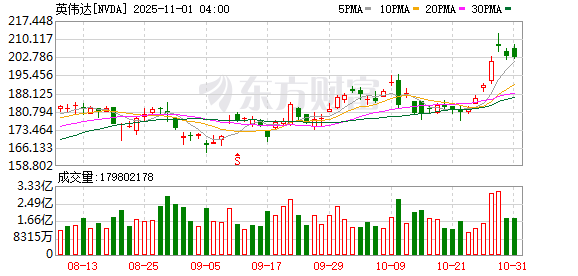
Core Insights - NVIDIA's CEO Jensen Huang sold 25,000 shares of NVIDIA stock as part of a pre-established plan, completing a strategy to sell up to 6 million shares by the end of the year [2] - Since starting the stock sales in June, Huang has cashed out over $1 billion, with the stock's value increasing by over 40% due to strong demand for AI chips [3] - NVIDIA's market capitalization surpassed $5 trillion, making it the first publicly traded company to reach this milestone, with a significant increase of $2.9 trillion in market value since April [3] Company Performance - Huang's stock sales began when the shares were valued at approximately $865 million, and the company's stock price has rebounded over 135% from its April low [3] - The company's stock has increased by 54% year-to-date, reflecting strong performance in the AI sector [3] Future Outlook - At the recent GTC conference, Huang discussed the company's advancements in AI and new partnerships, emphasizing the potential for the latest generation of chips to generate up to $500 billion in revenue over the next few quarters [4] - This revenue target significantly exceeds Wall Street's expectations, with estimates from Goldman Sachs indicating a consensus of $4.47 trillion, which is 12% lower than NVIDIA's projection [4]

小米汽车官宣:10月交付量超40000台!理想汽车、小鹏汽车、岚图汽车、零跑汽车也公布了
新华网财经· 2025-11-01 08:12
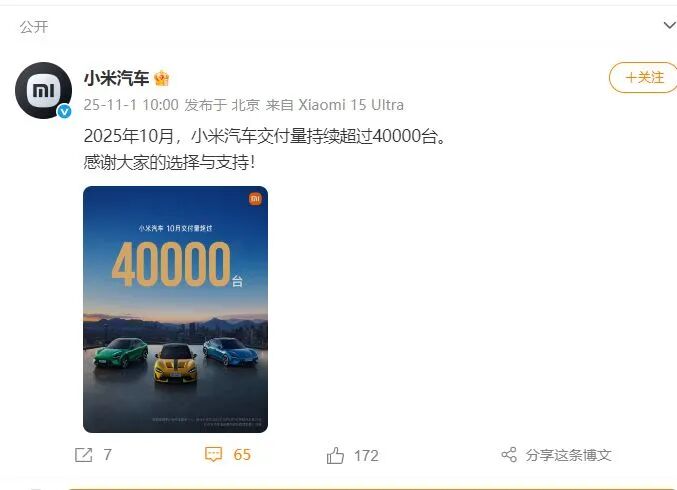
Core Insights - Multiple automotive brands, including Xiaomi, Li Auto, and XPeng, reported their October delivery figures, indicating a competitive landscape in the electric vehicle market [1][3][5][8][9]. Group 1: Company Deliveries - Xiaomi announced that its delivery volume will exceed 40,000 units by October 2025 [3]. - Li Auto delivered 31,767 vehicles in October 2025, with a cumulative delivery of 1,462,788 vehicles as of October 31, 2025. The company is addressing capacity issues due to high demand for the Li i6 model, which has over 70,000 orders [5]. - Zhiji Auto reported sales of 13,159 units in October [6]. - Leap Motor achieved total deliveries of 70,289 units in October, marking a year-on-year growth of over 84% [8]. - XPeng delivered 42,013 vehicles in October 2025, setting a new monthly record and maintaining a strong sales performance across its SUV lineup [9]. Group 2: Market Trends - Data from the China Passenger Car Association indicated that retail sales of passenger cars from October 1 to 26 totaled 1.613 million units, a year-on-year decrease of 7% [10]. - Wholesale figures for the same period reached 1.871 million units, reflecting a year-on-year decline of 1% [10].

卖爆了!小米汽车10月交付超4万台,小鹏创纪录!理想也卖疯了,“i6销售太火爆,远超预期”
Mei Ri Jing Ji Xin Wen· 2025-11-01 07:31
Core Insights - Multiple automotive brands, including Xiaomi, Li Auto, and Xpeng, reported their October delivery figures, showcasing significant growth in the electric vehicle market [1] Group 1: Xiaomi Automotive - Xiaomi Automotive announced that by October 2025, its delivery volume will consistently exceed 40,000 units [2] Group 2: Li Auto - Li Auto delivered 31,767 vehicles in October 2025, with a total cumulative delivery of 1,462,788 vehicles as of October 31, 2025 [3][4] - The launch of the Li i6 has exceeded expectations with over 70,000 orders, prompting the company to address capacity issues and accelerate delivery [4] - Li Auto is expanding its international presence, opening its first overseas retail center in Uzbekistan and planning further expansions in Central Asia, the Middle East, Europe, and the Asia-Pacific region [4] - As of October 31, 2025, Li Auto has 551 retail centers across 157 cities and 3,508 charging stations with 19,417 charging piles [4] Group 3: Other Automotive Brands - Zhiji Automotive reported sales of 13,159 units in October [6] - Lantu Automotive delivered 17,218 vehicles in October 2025, with a year-to-date cumulative growth of 82% [8] - Leap Motor announced total deliveries of 70,289 units in October, representing a year-on-year growth of over 84% [10] - Xpeng delivered 42,013 vehicles in October 2025, marking a historical monthly high and maintaining a strong sales performance in the mid-to-large pure electric sedan segment [12] - The Xpeng P7+ has accumulated over 80,000 deliveries, and the Xpeng G6 has surpassed 65,000 deliveries year-to-date, showing a nearly 60% year-on-year growth [12] - Xpeng's upcoming model, the X9 Super Range Extender, is set to be unveiled, featuring significant advancements in battery technology and range [12] Group 4: Market Overview - From October 1 to 26, 2025, the national retail market for passenger vehicles saw a decline of 7% year-on-year, with total retail sales for the year reaching 18.621 million units, a growth of 8% [15] - During the same period, wholesale figures for passenger vehicles decreased by 1% year-on-year, with a cumulative growth of 12% for the year [15]

10月小鹏汽车(09868)共交付新车42013台 同比增长76%创历史新高
智通财经网· 2025-11-01 02:33
Core Insights - Xiaopeng Motors reported a record high delivery of 42,013 vehicles in October 2025, marking a year-on-year increase of 76% and a month-on-month increase of 1% [1] - Cumulatively, from January to October 2025, Xiaopeng Motors delivered 355,209 vehicles, representing a year-on-year growth of 190% [1] - The electric vehicles delivered by Xiaopeng Motors are expected to reduce carbon emissions by over 5.56 million tons over their lifecycle, equivalent to the carbon sequestration of 91.96 million medium-sized trees over ten years [1] - The "2025 Xiaopeng Technology Day" will be held on November 5 in Guangzhou, focusing on the theme of "Emergence" and sharing breakthroughs in the field of physical AI [1]