通货膨胀

Search documents
Swiss Inflation Declines as SNB Mulls Negative Rates
WSJ· 2025-11-03 07:57
Core Insights - Consumer prices increased by 0.1% in October compared to the same month last year, which is a decrease from the 0.2% increase observed in September [1] Group 1 - The annual inflation rate for October is 0.1%, indicating a slowdown in price growth compared to the previous month [1] - The inflation rate for September was recorded at 0.2%, showing a slight decline in consumer price increases [1]


宏观经济周报-20251103
工银国际· 2025-11-03 06:20
Domestic Macro - The ICHI Composite Economic Index slightly declined from previous highs but remains near the critical zone, indicating a temporary pullback rather than a trend weakening due to high base effects post-holiday[1] - The Consumer Sentiment Index returned to the expansion zone, reflecting resilient domestic demand, with continued growth in service consumption and travel activities[1] - The Investment Sentiment Index saw a slight decline, primarily influenced by last week's significant expansion base effect[1] - The Export Sentiment Index remained stable, indicating a diversified trade structure buffering against weak external demand[1] - The Production Sentiment Index also experienced a pullback due to high base effects, with corporate orders and operational conditions returning to normal[1] Global Macro - The Federal Reserve lowered the benchmark interest rate by 25 basis points to a range of 3.75%-4.00% and announced the end of balance sheet reduction on December 1[5] - The Bank of Japan maintained its benchmark interest rate at 0.5%, with a slight increase in the economic growth forecast for the fiscal year to 0.7%[5] - The European Central Bank kept the main interest rate at 2%, citing weak economic recovery in the Eurozone due to trade and geopolitical uncertainties[6] - Eurozone GDP grew by 0.2% quarter-on-quarter in Q3, surpassing the market expectation of 0.1%, with France showing a growth of 0.5%[6] Market Focus - The ADP reported an average of approximately 14,000 new jobs added weekly in the private sector over the past four weeks, indicating a need for more timely employment data[7] - The U.S. government shutdown has caused an estimated economic loss of $18 billion, with potential GDP impacts of 1.5% to 2% if the shutdown extends beyond six to eight weeks[7]
贝森特:若不进一步降息,美国经济衰退范围或将扩大
Sou Hu Cai Jing· 2025-11-02 23:47
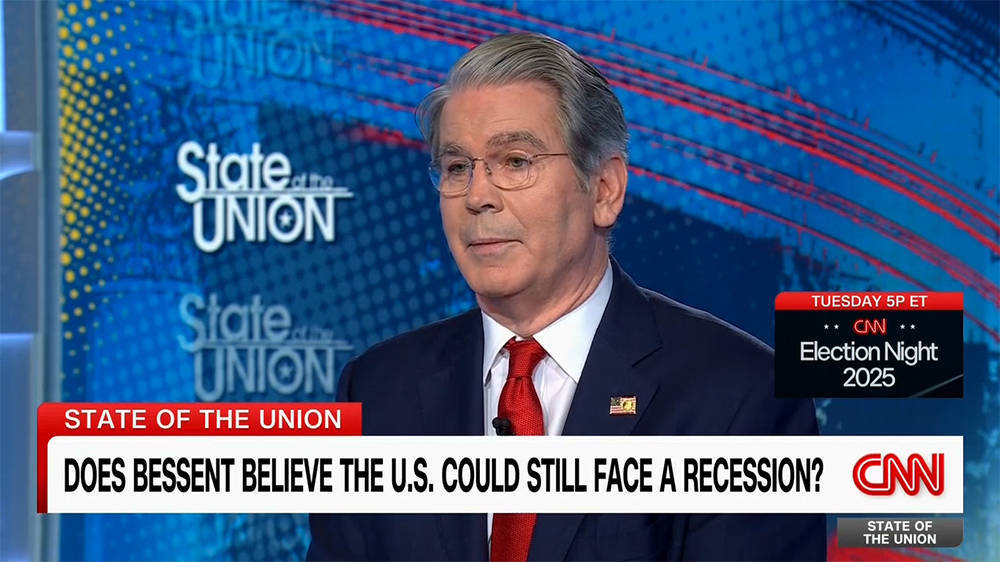
Economic Outlook - The U.S. Treasury Secretary, Bessent, indicated that certain sectors of the U.S. economy are already in recession, and if the Federal Reserve does not lower interest rates further, the scope of the recession may expand [1][3] - Bessent emphasized that the current obstacle in the real estate market is the mortgage interest rates, suggesting that a reduction in rates by the Federal Reserve could end the recession in the housing sector [1] Government Spending and Inflation - Bessent noted that the Trump administration has reduced government spending, decreasing the fiscal deficit as a percentage of GDP from 6.4% to 5.9%, which should help curb inflation [3] - A study from MIT indicated that 42% of the severe inflation in 2022 was due to excessive government spending, implying that continued spending cuts could lead to lower inflation levels [3] Federal Reserve Actions - On October 29, the Federal Reserve announced a 25 basis point interest rate cut, marking the fifth rate cut since September 2024 [3] - Federal Reserve Chairman Powell mentioned that there are differing views on the policy direction for December, indicating that further rate cuts are not guaranteed [3]
A Different Way Of Looking At The Rally In The Price Of Gold
Forbes· 2025-11-02 15:35
Core Insights - The price of gold has increased by nearly 30% over the past year as investors seek stability amid geopolitical tensions, particularly regarding the likelihood of war with Iraq [2] - Ken Fisher argues that gold is often misinterpreted as a reliable indicator of market performance, suggesting that equities have historically outperformed gold [3][4] - The historical performance of gold and equities shows that while gold has periods of significant gains, equities tend to provide higher long-term returns [7][8] Gold as an Inflation Hedge - Fisher claims that gold is not a great hedge against inflation, citing 2022 when inflation reached 40-year highs while gold experienced declines [5] - The article posits that the inflation seen in 2022 was not true inflation but rather a result of disruptions in global production, leading to higher prices without the underlying economic conditions typically associated with inflation [5] - Historical data indicates that gold's price surged during the 1970s, suggesting it can be a reliable measure of inflation during certain periods [6][9] Market Dynamics - The 2000s saw a significant increase in gold prices, closing the decade at $1,226 per ounce, representing a 360% return, while the S&P 500 declined [8] - The article suggests that gold's current price levels, while high, are relatively modest compared to previous decades, indicating a potential for stronger equity returns if the dollar were not weak [10] - The distinction between inflation measured by the Consumer Price Index (CPI) and inflation as indicated by gold prices raises concerns for investors, as gold may signal deeper economic issues [11]

钱越来越难赚的时代,理财才是你的第二份工作
Sou Hu Cai Jing· 2025-11-02 12:22
Core Insights - The article emphasizes the importance of financial literacy and management, highlighting that the ability to make money work for oneself is crucial in today's economy [1][4][6] Group 1: Financial Struggles - Many individuals work hard but still struggle financially due to inflation and rising living costs, which erode their purchasing power [1][2] - The article illustrates that even with a higher salary, individuals may still feel financially constrained due to the increasing costs of housing, education, and healthcare [1] Group 2: Importance of Financial Management - Financial management is not just for the wealthy; it is essential for everyone, especially those with lower incomes, to prevent poverty [2][3] - The article argues that financial management is about taking control of one's finances rather than engaging in speculative investments [3][4] Group 3: Systematic Approach to Investing - Successful financial management requires a systematic and disciplined approach rather than emotional reactions to market fluctuations [5] - A suggested investment framework includes emergency savings (20%), stable investments (50%), growth investments (20%), and high-risk ventures (10%) [5] Group 4: Long-term Investment Philosophy - The article stresses the value of patience in investing, noting that consistent, long-term contributions can lead to significant wealth accumulation over time [5] - It warns against the pitfalls of impulsive trading and emotional decision-making, which can lead to financial losses [5] Group 5: Financial Freedom and Psychological Well-being - Ultimately, effective financial management leads to not only financial freedom but also psychological freedom, allowing individuals to make choices without fear of financial instability [5][6] - The article concludes that financial literacy is a vital life skill that prepares individuals for future challenges [6]

每日钉一下(投资A股,能跑赢通货膨胀吗?)
银行螺丝钉· 2025-11-01 14:11
Core Viewpoint - Investing in A-shares can indeed outperform inflation over the long term, as the overall economic development of the country supports stock market growth [4][5]. Group 1: A-share Market Performance - The representative index for A-shares is the CSI All Share Index, which covers all listed companies in A-shares, providing a stronger representation compared to the Shanghai Composite Index [6]. - The CSI All Share Index started at 1000 points at the end of 2004 and is projected to reach 4750.67 points by December 31, 2024. Including dividends, the total return index is expected to rise to 6284.26 points [6]. - The historical average annualized return for A-shares over the past decade is approximately 9%-10% [8]. Group 2: Investment Strategies - Investing in stock funds can yield better returns than directly investing in A-shares, with the total return index for all A-share stock funds rising from 1164 points at the end of 2004 to 9140.39 points by December 31, 2024, resulting in an annualized return of 11%-13% [8]. - The phrase "investing in funds is better than trading stocks" reflects the higher average returns from stock funds, as they can exclude poorly performing companies [9]. - Stock funds can be categorized into two types: passive funds (index funds) and active funds, with index funds being a good entry point for individual investors due to their clear rules, low costs, and ease of management [9].

Should the Fed Be Paying More Attention to Inflation? At Least Three Central Bankers Think So
Yahoo Finance· 2025-10-31 21:13
Core Insights - The Federal Reserve is facing internal dissent regarding its decision to cut interest rates, with some officials arguing that it is too early to ease measures against inflation [2][5][6] - The Fed's dual mandate of maintaining low inflation and high employment is creating conflicting pressures, complicating its decision-making process [3][5][6] Summary by Sections Federal Reserve's Decision - Three Federal Reserve officials expressed disagreement with the Federal Open Market Committee's (FOMC) recent decision to cut the benchmark interest rate by a quarter-point [2][6] - Kansas City Fed president Jeffrey Schmid voted to keep rates steady but was outvoted [2][3] Inflation and Employment Dynamics - Inflation has been above the Fed's target of 2% for over four years, with tariffs exacerbating the situation, which would typically prompt rate hikes [4][6] - Conversely, trade wars initiated by President Trump have created uncertainty, hindering job growth and prompting the Fed to lower rates to support employment [4][6] Implications for Economic Policy - The divisions within the FOMC are making interest rate movements less predictable, as members disagree on which issue—inflation or employment—should take precedence [5][6] - Fed Chair Jerome Powell acknowledged the "strongly differing views" among FOMC participants during the recent policy meeting [5]
Dallas Fed's Logan Says Central Bank Was Wrong to Cut This Rates Week
WSJ· 2025-10-31 15:31
Core Viewpoint - Lorie Logan expressed opposition to the Federal Reserve's recent quarter-point interest-rate cut, emphasizing that the potential risks associated with a slowing job market do not warrant deviating from the primary goal of controlling inflation [1] Summary by Relevant Categories - **Interest Rate Policy** - The Federal Reserve's decision to cut interest rates by a quarter-point has been challenged by Lorie Logan, who believes that the current job market conditions do not justify such a move [1] - **Inflation Control** - Logan's stance highlights the importance of maintaining focus on inflation management, suggesting that the risks of a slowing job market should not distract from this objective [1]

美联储内部现分歧:洛根、施密德反对降息,警告通胀压力仍存
智通财经网· 2025-10-31 13:59
Core Viewpoint - The Dallas Fed President Lorie Logan and Kansas City Fed President Jeff Schmieding oppose the Federal Reserve's decision to cut interest rates this week, citing persistent high inflation as the main reason [1][2]. Group 1: Statements from Fed Officials - Logan stated that there is no need to lower interest rates this week, emphasizing that unless there is clear evidence of inflation decreasing faster than expected, it is difficult to consider another rate cut in December [2][3]. - Schmieding expressed concerns that economic growth and investment could exacerbate inflationary pressures, noting that the labor market is essentially balanced and inflation remains high [3][4]. Group 2: Monetary Policy and Economic Indicators - The Federal Reserve voted to lower the benchmark interest rate by 25 basis points, marking the second cut in two months, aimed at supporting a slowing labor market [3][4]. - Recent data from the Labor Department indicated that the annual consumer price index rose by 3% as of September, with inflation remaining above the Fed's 2% target for over four years [4]. Group 3: Future Outlook and Policy Implications - Logan supports the decision to halt the reduction of the balance sheet, suggesting that current market conditions indicate the balance sheet is nearing normal levels [2][3]. - Schmieding warned that a 25 basis point cut may have limited effects on alleviating labor market pressures, which are more likely driven by structural changes rather than monetary policy [4].
美元降息,对我们投资有什么影响?|第414期直播回放
银行螺丝钉· 2025-10-31 13:56
Core Viewpoint - The article discusses the impact of the recent interest rate cuts by the Federal Reserve on various asset classes, including U.S. stocks, bonds, and international markets, highlighting the relationship between interest rates, inflation, and economic growth [1][12][36]. Group 1: Factors Influencing Interest Rates - The primary long-term factor affecting interest rates is the economic growth rate. A slowdown in economic growth typically leads to lower interest rates [4][5]. - In the short term, inflation rates also significantly influence interest rates. High inflation often necessitates higher interest rates to control it [6][7]. Group 2: Historical Inflation Trends - U.S. stock market inflation rates surged from around 0% in 2020 to a peak of 9.1% in mid-2022, prompting the Federal Reserve to implement the most significant interest rate hikes in the last 20 years [9][10]. - As of September 2025, the Consumer Price Index (CPI) for the U.S. stock market has decreased to approximately 3% [10]. Group 3: Recent Interest Rate Cuts - The Federal Reserve initiated a new cycle of interest rate cuts in September 2024, with the first cut occurring in October 2025 [12][36]. - Following the initiation of the rate cut cycle, A-shares and Hong Kong stocks have seen significant gains, ranking among the top globally [13]. Group 4: Impact of Interest Rates on Asset Prices - Higher interest rates generally exert downward pressure on asset prices, while lower rates can lead to price increases across various asset classes, including stocks, bonds, and real estate [15]. - The U.S. stock market has experienced a 22.41% increase, while the global stock market rose by 23.01% since the onset of the rate cut cycle [19]. Group 5: Effects on Different Markets - The decline in U.S. interest rates has led to a narrowing interest rate differential between the U.S. dollar and the Chinese yuan, contributing to the appreciation of the yuan [25]. - The changes in U.S. interest rates also affect the A-share and Hong Kong markets, with the recent rate cuts leading to increased capital inflows into these markets [29][30]. Group 6: Common Questions and Answers - The benefits of interest rate cuts are often reflected in the market weeks before the actual announcement, as investors anticipate the changes [32]. - The Federal Reserve is expected to continue lowering interest rates due to significant fiscal pressures, including rising national debt and interest payments [36][38].