智能家居

Search documents
耿康铭“三次关键转型”豪赌算力 协创数据加速狂奔总资产半年翻倍
Chang Jiang Shang Bao· 2025-08-18 00:21
Core Viewpoint - The company, Xiechuang Data, is making a significant move in the computing power sector with a procurement contract worth up to 1.2 billion yuan, indicating its aggressive expansion strategy in the rapidly growing market for computing power services [1][6]. Company Overview - Founded in 2005 by founder Geng Kangming, Xiechuang Data initially focused on computer storage products and has since expanded its product line to include mobile and tablet motherboards, becoming a key player in the smart manufacturing sector [3]. - The company has shown consistent growth, with revenue increasing from 839 million yuan in 2016 to 7.41 billion yuan in 2024, and net profit rising from 30 million yuan to 692 million yuan during the same period [6]. Recent Developments - On August 15, 2023, Xiechuang Data announced plans to procure servers from multiple suppliers, with a total contract value not exceeding 1.2 billion yuan, primarily aimed at enhancing its computing power rental services [1][6]. - The company's asset scale has seen remarkable growth, increasing from 7.305 billion yuan at the end of 2024 to 15.044 billion yuan by mid-2025, reflecting a doubling in just six months [1][5]. Strategic Decisions - Geng Kangming has made three critical strategic decisions throughout his career, transitioning from computer cases to memory bars and then to storage devices and smart terminals, which have all contributed to the company's rapid growth [1][2]. - The company is actively pursuing partnerships with major clients, including Tencent, and has successfully participated in significant project bids, such as the China Unicom computing power service procurement project [5]. Market Position - Xiechuang Data's revenue is heavily reliant on its data storage devices and IoT smart terminals, which together account for over 90% of its total revenue [3]. - The company’s stock price has seen significant appreciation since its IPO, with shares reaching a peak of over 100 yuan, reflecting strong market confidence in its growth trajectory [6].

科沃斯(603486)2025年中报简析:营收净利润同比双双增长,应收账款上升
Zheng Quan Zhi Xing· 2025-08-17 16:00
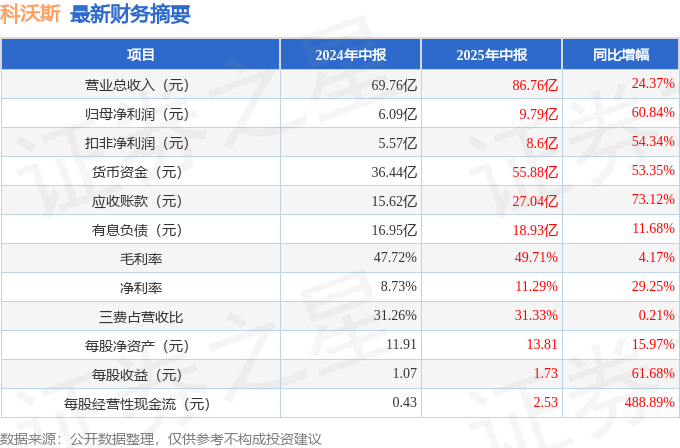
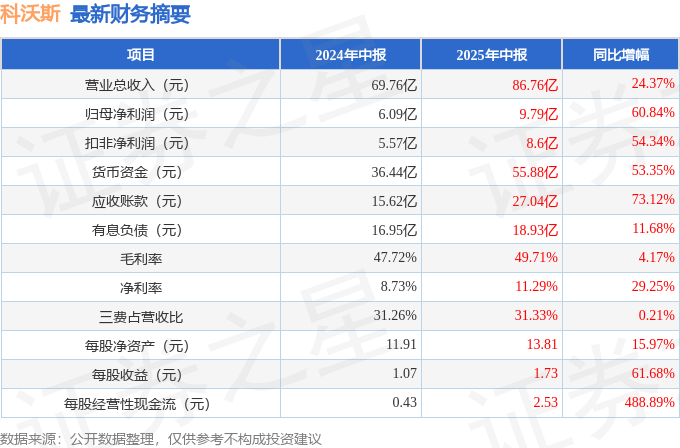
Core Insights - The company, Ecovacs (科沃斯), reported a significant increase in revenue and profit for the first half of 2025, with total revenue reaching 8.676 billion yuan, a year-on-year increase of 24.37%, and net profit attributable to shareholders at 979 million yuan, up 60.84% [1][3] Financial Performance - Total revenue for Q2 2025 was 4.818 billion yuan, reflecting a 37.58% year-on-year growth [1] - Net profit for Q2 2025 was 505 million yuan, marking a 62.19% increase compared to the same period last year [1] - The gross profit margin improved to 49.71%, up 4.17% year-on-year, while the net profit margin increased to 11.29%, a rise of 29.25% [1] - The company's total expenses (selling, administrative, and financial) amounted to 2.718 billion yuan, accounting for 31.33% of revenue, a slight increase of 0.21% year-on-year [1] - Earnings per share (EPS) rose to 1.73 yuan, a 61.68% increase from the previous year [1] Balance Sheet Highlights - Cash and cash equivalents increased to 5.588 billion yuan, a growth of 53.35% year-on-year [1] - Accounts receivable rose significantly to 2.704 billion yuan, with a year-on-year increase of 73.12% [1] - Interest-bearing debt increased to 1.893 billion yuan, reflecting an 11.68% rise [1] Market Position and Analyst Expectations - Analysts expect the company's performance for 2025 to reach 1.945 billion yuan, with an average EPS forecast of 3.38 yuan [3] - The company's return on invested capital (ROIC) was reported at 8.46%, indicating a generally average capital return rate in recent years [4] - The historical median ROIC since the company's listing is 20.96%, suggesting strong investment returns historically [4] Fund Holdings - Several funds have recently increased their holdings in Ecovacs, with notable new entries including 富国均衡优选混合 and 富国成长领航混合, indicating growing institutional interest [5]


【晶晨股份(688099.SH)】25Q2单季度营收创历史新高,Wi-Fi6等新品规模放量——跟踪报告之十(刘凯/孙啸)
光大证券研究· 2025-08-17 00:05
Core Viewpoint - The company reported strong financial performance in the first half of 2025, with significant growth in revenue and net profit, driven by the demand for smart home products and advancements in intelligent chip technology [4][5]. Financial Performance - In the first half of 2025, the company achieved revenue of 3.33 billion yuan, a year-on-year increase of 10.42%, and a net profit attributable to shareholders of 497 million yuan, up 37.12% [4]. - For Q2 2025, the company reported revenue of 1.80 billion yuan, a year-on-year growth of 9.94% and a quarter-on-quarter increase of 17.72%. The net profit for Q2 was 308 million yuan, reflecting a year-on-year increase of 31.46% and a quarter-on-quarter growth of 63.90% [4]. Product Performance - The company's smart home product sales grew over 50% year-on-year in the first half of 2025, benefiting from the rapid growth in the smart home market and increased penetration of edge intelligent technology [5]. - The W series Wi-Fi 6 chips achieved sales of over 8 million units in the first half of 2025, with Q2 sales surpassing 5 million units. The sales of Wi-Fi 6 chips in Q2 exceeded 1.5 million units, surpassing the total sales for the entire year of 2024, with a quarter-on-quarter growth of over 120% [6]. - The company’s 6nm chips, which were commercially launched in the second half of 2024, saw accelerated sales, with Q2 2025 sales exceeding 2.5 million units, bringing total sales in the first half of 2025 to over 4 million units. The company expects to sell over 10 million units of 6nm chips in 2025 [7][8].


科沃斯2025年中报简析:营收净利润同比双双增长,应收账款上升
Zheng Quan Zhi Xing· 2025-08-16 22:47
Financial Performance - The company reported a total revenue of 8.676 billion yuan for the first half of 2025, representing a year-on-year increase of 24.37% [1] - The net profit attributable to shareholders reached 979 million yuan, up 60.84% year-on-year [1] - In Q2 2025, the revenue was 4.818 billion yuan, showing a 37.58% increase compared to the same quarter last year [1] - The gross margin improved to 49.71%, an increase of 4.17% year-on-year, while the net margin rose to 11.29%, up 29.25% [1] - The company’s operating cash flow per share surged to 2.53 yuan, a remarkable increase of 488.89% year-on-year [1] Balance Sheet and Financial Ratios - Accounts receivable increased significantly, with a year-on-year growth of 73.12%, reaching 2.704 billion yuan [1] - The company’s total liabilities with interest rose to 1.893 billion yuan, an increase of 11.68% [1] - The return on invested capital (ROIC) for the previous year was 8.46%, indicating a generally average capital return rate [3] - The company’s historical median ROIC since its listing is 20.96%, suggesting good investment returns over time [3] Market Position and Investor Sentiment - Several funds have recently increased their holdings in the company, with notable entries including 富国均衡优选混合 and 富国成长领航混合 [4] - The largest fund holding the company is 富国均衡优选混合, with a scale of 4.004 billion yuan and a recent net value increase of 2.15% [4] - Analysts expect the company's performance for 2025 to reach 1.945 billion yuan, with an average earnings per share forecast of 3.38 yuan [3]
潮州陶瓷亮相喀交会,粤品北上畅通欧亚市场
Nan Fang Nong Cun Bao· 2025-08-15 14:05
Core Viewpoint - The participation of Chaozhou ceramics at the 15th Kashgar Central Asia South Asia Commodity Fair highlights the efforts to expand into the Eurasian market and strengthen trade relationships, showcasing the strength and diversity of Chaozhou's ceramic industry [2][4][30]. Group 1: Event Overview - The 15th Kashgar Central Asia South Asia Commodity Fair opened on August 15 at the Kashgar International Exhibition Center, supported by Guangdong's assistance to Xinjiang [2][3]. - Nearly 50 Chaozhou ceramic enterprises showcased their products, aiming to deepen trade cooperation with the Eurasian market [3][4]. Group 2: Product Highlights - The exhibition featured a wide range of products, including daily-use items and technologically advanced bathroom products, demonstrating the integration of tradition and modernity in Chaozhou ceramics [6][7]. - The focus was on showcasing a full range of bathroom and sanitary ware products, including toilets and bathroom cabinets, catering to diverse market needs [8][9]. Group 3: Strategic Collaborations - In April, a strategic cooperation agreement was signed between Chao'an District of Chaozhou and Kashgar City to establish a ceramic industry park, integrating manufacturing capabilities with Kashgar's geographical advantages [12][13]. - The exhibition of Chao'an bathroom products serves as a practical example of this strategic collaboration and an attempt to leverage Xinjiang as a hub for expanding into the Eurasian market [14][15]. Group 4: Market Insights - The rise of smart home technology has created a "new blue ocean" in the sanitary ceramics market, with products like smart toilets gaining popularity [17][18]. - Chaozhou's ceramics industry has a rich history of over 1,300 years and has developed a complete and mature ceramic industry chain, becoming the largest ceramic production area in China [22][23]. - Chaozhou's daily-use ceramics account for 30% of global sales, decorative ceramics for 40%, and architectural sanitary ceramics for 55% [24][25]. Group 5: Export and Cultural Adaptation - Companies like Jinrunfeng Ceramics have been exporting products to Kazakhstan and Kyrgyzstan for over a decade, tailoring designs to local preferences [26][27]. - Specific products, such as a tea set favored by Kazakh consumers, illustrate the cultural adaptation of Chaozhou ceramics in international markets [28]. Group 6: Conclusion - The participation of Chaozhou ceramics at the fair exemplifies the "Southern Products Northward, Northern Products Southward" initiative, enhancing cooperation between Guangdong and Xinjiang and facilitating quicker access to the Eurasian market [30][31][32].

石头科技上半年营收79.03亿元 同比增长78.96%
Zhong Zheng Wang· 2025-08-15 11:57
Core Viewpoint - Stone Technology (688169.SH) reported a revenue of 7.903 billion yuan for the first half of the year, representing a year-on-year growth of 78.96% [1] Group 1: Company Performance - The company aims to become a global leader in the smart home appliance sector, focusing on consumer needs and launching a range of smart cleaning products [1] - The domestic market has benefited from the "old-for-new" subsidy policy in the home appliance industry, leading to rapid revenue growth [1] - The overseas market has seen significant revenue increases due to refined channel layouts and market expansion efforts [1] Group 2: Product Insights - According to IDC's latest report, Stone Technology is expected to ship 982,000 units globally in Q1 2025 for its robotic vacuum cleaners [1] - As per data from Aowei Cloud Network, the online market share of Stone Technology's washing machines reached 13.1% in February 2025 [1] Group 3: Strategic Initiatives - The company plans to continue enhancing brand building and implementing refined marketing strategies to expand its reach among domestic and international users [1] - Stone Technology is adopting a dual-track R&D strategy to drive technological innovation and product iteration, enabling the launch of high-value-added new products [1]

石头科技(688169.SH)上半年营收暴增79% 洗地机市占率飙升至第二显增长潜力
智通财经网· 2025-08-15 10:14
Core Insights - Stone Technology (688169.SH) reported a significant revenue growth of 78.96% year-on-year, achieving 7.903 billion yuan in the first half of the year, exceeding expectations [1] - The company aims to become a global leader in smart home appliances, focusing on consumer needs and launching a range of intelligent cleaning products [1] - The introduction of innovative products such as the G30 Space robot vacuum and A30 Pro Steam washing machine has disrupted traditional pricing and market dynamics [1] Group 1: Financial Performance - In the first half of 2025, Stone Technology achieved a revenue of 7.903 billion yuan, marking a 78.96% increase compared to the same period last year [1] - The company’s overseas business revenue has significantly increased due to refined channel layouts and market expansion [1] Group 2: Product Innovation - The G30 Space robot vacuum features a five-axis folding bionic mechanical arm, enabling a transition from 2D to 3D cleaning [1] - The A30 Pro Steam washing machine is the first in the industry to offer dual-mode washing with steam and hot water [1] - The Z1 Plus washing machine is the first dual green label washing and drying machine priced under 5,000 yuan, challenging established white goods companies [1] Group 3: Market Position - According to IDC, Stone Technology maintained the top position in global vacuum cleaner shipments with a market share of 19.3%, shipping 982,000 units in Q1 2025, a 50.7% year-on-year increase [2] - The company’s vacuum cleaner shipments are primarily concentrated in China and Western Europe, accounting for over 50% of total global shipments [2] - In the washing machine segment, Stone Technology's online sales market share reached 19% by April 2025, with a year-on-year growth of 1065% [2] Group 4: Strategic Initiatives - The company plans to enhance brand building and implement refined marketing strategies to expand its reach in domestic and international markets [2] - Stone Technology is pursuing a dual-track R&D strategy to drive technological innovation and product iteration, enabling the continuous launch of high-value new products [2]
展望银发经济的结构性机遇
HTSC· 2025-08-15 05:03
Group 1: Silver Economy Growth Potential - The silver economy in China is estimated to reach approximately 70 trillion yuan (6% of GDP) by 2023 and is projected to grow to 190 trillion yuan (10% of GDP) by 2035[1] - The population aged 65 and above in China is around 220 million (15.6% of the total population) in 2023, with predictions of exceeding 380 million (30.9% of the total population) by 2050[1] - Improvements in healthcare and living standards are expected to further expand the silver economy's scale[1] Group 2: Consumption Capacity of the Elderly - The elderly population has a relatively high net asset level, benefiting from early home purchases and low debt ratios, with average annual housing price growth of about 8% from 2000 to 2020[3] - The average household size in China decreased from 3.1 people in 2010 to 2.6 people in 2020, indicating a trend towards smaller families and increased economic independence for the elderly[3] - By 2020, 55.7% of elderly individuals lived alone or with a spouse, and the reliance on family support decreased from 40.7% in 2010 to 32.7%[3] Group 3: Policy Support for Silver Economy - Since 2024, policies have been introduced to support the silver economy, focusing on supply-side adaptations and demand-side subsidies for elderly care services[4] - The government aims to enhance the supply of elderly care services and improve the infrastructure for elderly-friendly living environments[4] - There is a significant potential for expansion in elderly care facilities and services, as many urban homes lack elevators and other necessary amenities[4]
麦思智能引擎上涨2.08%,报3.93美元/股,总市值1.02亿美元
Jin Rong Jie· 2025-08-14 14:43
Core Viewpoint - MAAS has shown significant financial growth, with a focus on becoming a leading provider in smart home and enterprise services, emphasizing technology intelligence and capital investment [1] Financial Performance - As of December 31, 2024, MAAS reported total revenue of 716 million RMB, representing a year-on-year increase of 1911.86% [1] - The net profit attributable to the parent company reached 232 million RMB, marking a year-on-year growth of 798.03% [1] Company Overview - MAAS was established in 2010 and aims to enhance the quality of life for families globally [1] - The company focuses on high-quality enterprises with global investment and operational potential, targeting sectors such as asset allocation, education and study tours, cultural tourism, healthcare and elderly care, and family governance [1]
家用电器2025年中期投资策略:大家电稳健为基,小家电企稳改善
Guoxin Securities· 2025-08-14 11:23
Core Viewpoints - The home appliance sector is expected to show steady growth in domestic sales despite the diminishing effects of national subsidies, with a return to stable growth anticipated in the second half of 2025 [3][25] - The valuation of the home appliance industry remains at a low level, with the industry index PE (TTM) at 14.45X, placing it at the 39.0 percentile since 2020 [13] - The report maintains an "outperform" rating for the home appliance sector, highlighting the resilience of major appliances and the recovery of small appliances [1][3] Summary by Sections 1. Overall Market Performance - In the first half of 2025, the home appliance sector slightly underperformed the market, with the sector index down 1.2% compared to the Shanghai and Shenzhen 300 index, which remained stable [10] - The home appliance sector's valuation is at a five-year low, with significant growth in home appliance components, which saw a rise of over 17% [10][11] 2. White Goods - Domestic sales of white goods benefited from national subsidy policies, showing strong resilience, with a projected steady growth in the second half of 2025 despite a slowdown in growth rates [4][19] - Major brands like Midea, Haier, Gree, and Hisense are recommended for investment due to their strong market positions and global production capabilities [4][17] 3. Black Goods - The black goods segment, particularly televisions, is experiencing stable demand with a shift towards Mini LED technology and decreasing panel prices, which are expected to enhance profitability for leading companies [40][44] - The domestic retail volume of televisions increased by 1.8% in the first half of 2025, with retail revenue growing by 7.5% [44] 4. Kitchen Appliances - The kitchen appliance sector is seeing a recovery in demand, particularly for traditional cooking appliances, driven by national subsidies, with retail sales of range hoods and gas stoves showing significant growth [53][54] - The overall demand for kitchen appliances is expected to stabilize as the effects of national subsidies wane, with a focus on the recovery of the real estate market to support future growth [55][57] 5. Small Appliances - The small appliance market, particularly kitchen appliances, is witnessing a notable recovery, with retail sales reaching 31.9 billion yuan, a year-on-year increase of 9.3% [65] - The demand for new cleaning products, such as robotic vacuum cleaners, has surged, with sales increasing by over 40% due to national subsidies [68][66] 6. Technology Integration - Leading home appliance companies are focusing on their strengths and expanding into emerging application areas, such as smart home technology and AI products, which are expected to drive long-term growth [4][28]