新消费

Search documents
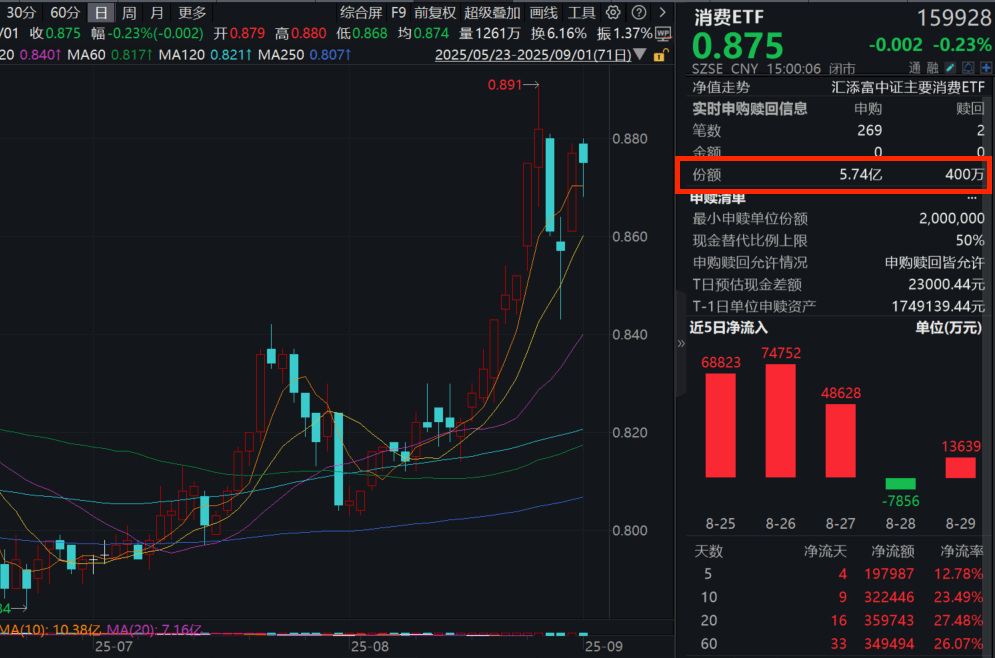
流动性支撑消费需求回暖!消费ETF(159928)微调即疯狂吸金,全天获净申购5.7亿份!机构:龙头白酒企业度过压力测试期!
Xin Lang Cai Jing· 2025-09-01 09:47
Market Overview - The market showed strong performance on September 1, with a total trading volume of 2.8 trillion yuan, and the Shanghai Composite Index rose by 0.46% [1] - The ChiNext Index increased by over 2%, and the STAR 50 Index rose by over 1%, marking a positive start for September [1] Fund Performance - The Consumption ETF (159928) experienced a slight decline of 0.23%, with a trading volume exceeding 1.1 billion yuan [1] - The fund saw a significant net subscription of 570 million units, indicating a strong demand, with a cumulative "capital absorption" of over 3.2 billion yuan in the last ten days [1] Economic Indicators - China's economic sentiment continues to expand, with the official manufacturing PMI at 49.4%, non-manufacturing PMI at 50.3%, and composite PMI at 50.5%, showing slight month-on-month increases [5] - Industries such as general equipment and aerospace are showing strong production expectations, with indices above 58% [5] Consumer Sector Insights - The consumer sector is experiencing a recovery in demand supported by liquidity, with the large consumption sector outperforming the broader market [6] - The liquor industry, particularly leading brands, has shown resilience despite market pressures, with Moutai reporting a 7% growth rate, outperforming the industry [6][7] - The China Securities White Liquor Index rose by 11.22% in August, indicating positive market feedback on liquor performance [6] Sector Differentiation - Within the consumer sector, there is a notable divergence among sub-sectors, with functional beverages and snacks showing high growth potential [7] - The dairy sector is expected to improve as raw milk prices decline, leading to a potential recovery in profitability for leading dairy companies [7] - The restaurant supply chain is stabilizing, with sectors like condiments and frozen foods beginning to recover from previous lows [7] New Consumption Trends - The consumer landscape is evolving with new demands for emotional and personalized products, particularly in categories like trendy toys and beauty products [8] - Domestic brands are leveraging innovative business models and channel efficiencies to build strong user ecosystems [8] ETF Composition - The Consumption ETF (159928) has a significant allocation to leading liquor stocks, which account for 32% of the top ten holdings, alongside major players in the agricultural and food sectors [10]







招商基金吴潇:一位均衡型选手的投资心法
2 1 Shi Ji Jing Ji Bao Dao· 2025-09-01 07:28
Group 1 - The core investment philosophy emphasizes "dynamic rebalancing" and "balanced style" to manage volatility and risk while seeking long-term returns [1][3][4] - The recent performance of funds managed by the company shows significant returns, with the招商品质发现混合 achieving 52.01% and 招商优质成长混合 (LOF) achieving 34.37% as of August 29 [1][2] - The new 招商均衡优选基金, led by the same manager, aims to continue the balanced investment approach and provide a good long-term investment experience [1][2] Group 2 - The investment strategy is built on a systematic framework that includes risk decomposition and the identification of return opportunities across various sectors [2][3] - The focus on stable cash flow companies is highlighted as essential for providing steady returns and lower downside risk in volatile markets [5][6] - Key investment themes include artificial intelligence, biomedicine, and new consumption trends, which are expected to drive growth in the coming years [5][6] Group 3 - The manager employs a rigorous risk analysis process, monitoring industry concentration, valuation levels, and expected returns to ensure dynamic rebalancing [6] - The approach to investment is described as a combination of mathematical strategy and psychological discipline, emphasizing the importance of patience and a structured framework [6]
一周新消费NO.324|Babycare官宣郭碧婷成为全新品牌代言人;喜茶上新网纹瓜瓜冰浆
新消费智库· 2025-08-31 13:04
Group 1 - The core viewpoint of the article highlights the recent product launches in the food and beverage industry, showcasing innovation and market expansion strategies by various brands [4][6][19]. Group 2 - Mixue Ice City has launched a new "Lemon Milk" series, which includes Lemon Milk Coffee and Snow King Lemon Milk, emphasizing rich and refreshing flavors [4][24]. - Want Power, a brand under Wangwang, introduced a new product "Berry Care," featuring five core ingredients aimed at health-conscious consumers [4]. - Joyoung has released a new fig and flaxseed soy milk powder, targeting female consumers with high protein and fiber content [4]. - Kirin Beverage has launched a roasted tea latte, designed for various consumption scenarios such as studying and working [5]. - Yili's Ikahuo has introduced a new health drink made from iron skin dendrobium and western ginseng, utilizing advanced preservation techniques [6]. - Menglong Ice Cream has unveiled a new glowing ice pop, appealing to health-conscious consumers with its low-calorie content [7]. - Heytea has launched a new ice drink made from a specific type of melon, highlighting unique production techniques [7]. - Nongfu Spring has introduced a new series of bottled water sourced from various locations across China [7]. - Sanofi Group has launched a new herbal tea product, focusing on light health benefits [7]. Group 3 - Babycare has announced actress Guo Biting as its new brand ambassador, launching a themed short film [8]. - Mengniu has appointed a new CFO, indicating a shift in its executive leadership [8]. - KFC has opened its first KPRO restaurant in Henan, focusing on balanced meal options [10]. - Lucky Coffee has opened its first overseas store in Malaysia, marking its global expansion [10]. Group 4 - Shibeikang has completed a nearly 100 million RMB Series B financing round, aimed at accelerating its drug development pipeline [14]. - Pure Fitness has secured $50 million in funding, indicating strong investor interest in the fitness sector [16]. - Sleep.ai has raised $5.5 million in funding, transitioning to a focus on commercialization and partnerships [17]. - Anta has announced an investment in the Korean fashion group MUSINSA, establishing a joint venture in China [17]. Group 5 - Coca-Cola has launched customized snack products for bulk retail, expanding its product offerings [19]. - Kangshifu has undergone significant management changes, indicating a strategic shift within the company [19]. - Nayuki has collaborated with a brand to launch a new beverage line, enhancing its product diversity [19]. - Ganyuan Food has introduced a new rice cake series with various flavors, focusing on quality ingredients and innovative cooking methods [19].






大涨行情下,多只基金业绩告负,什么情况?
券商中国· 2025-08-31 09:54
Core Viewpoint - The article discusses the phenomenon of fund managers "dodging the bull market" amidst a strong market rally, highlighting the challenges faced by active equity products in outperforming indices despite a high percentage of positive returns [1][4]. Group 1: Fund Performance - As of August 29, 98.48% of active equity products recorded positive returns, yet 68 funds underperformed, indicating a mismatch between fund strategies and market trends [2][4]. - The A-share and Hong Kong markets have shown significant structural characteristics, with sectors like innovative drugs, humanoid robots, and artificial intelligence performing well, while others like coal and retail have lagged [4][5]. Group 2: Investment Strategy - Funds that did not align their holdings with market hotspots faced severe "missed opportunities," with some managers adhering strictly to their investment themes, such as coal or high-dividend stocks, leading to underperformance [5][6]. - High cash positions during market uptrends can result in underperformance, as seen with several funds maintaining low positions despite rising indices [5][6]. Group 3: Future Opportunities - Analysts suggest that the previously overlooked dividend and consumer sectors may become new focal points for investment as they offer stability amidst market volatility [8][9]. - The "self-pleasing consumption" trend is gaining traction, driven by changing consumer behaviors and preferences, indicating potential growth in related markets [9][10]. Group 4: Market Dynamics - The article notes that as new high-growth stocks emerge, there may be a valuation reassessment, leading to increased market volatility [8][9]. - The current market environment is seen as suitable for dividend stocks, which can provide a safety net for investors amid fluctuations [8][9].

看好市场前景 外资持续“做多”中国资产
财联社· 2025-08-31 09:06
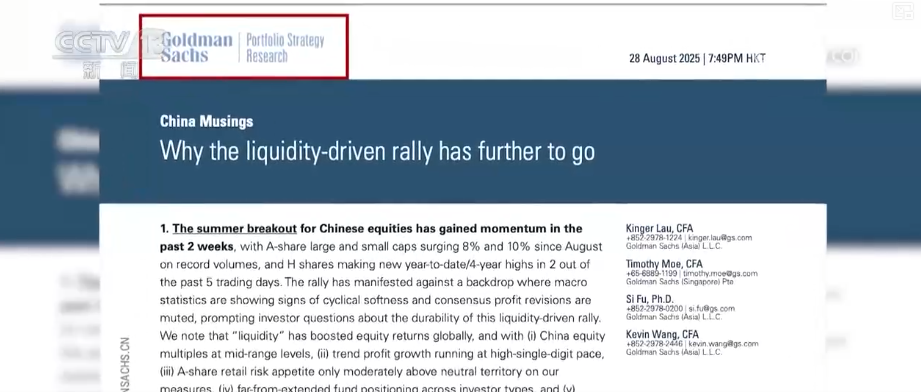
Group 1 - Multiple international investment banks have raised their forecasts for China's economic growth and shifted their asset allocation recommendations from neutral to "overweight" [1] - Goldman Sachs maintains an "overweight" stance on Chinese stocks, while Standard Chartered Bank also holds an "overweight" rating for Chinese equities in its 2025 global market outlook [1] - External factors, such as trade tensions, have been better managed by China than expected, while domestic policies aimed at stabilizing economic growth, like new birth subsidies, are also supportive [1] Group 2 - In the first half of the year, foreign capital net increased holdings in domestic stocks and funds by $10.1 billion, with significant inflows in May and June totaling $18.8 billion [2] - As of last week, foreign institutions held approximately 2.5 trillion yuan in A-shares, reflecting an 8% increase from the end of last year [2] - Foreign financial institutions are optimistic about the upcoming fourth quarter, with S&P maintaining China's sovereign credit rating at "A+" with a stable outlook [2] Group 3 - Foreign investment institutions are focusing on high-end manufacturing, technological innovation, and consumption sectors that align with China's economic transformation [3] - QFII data shows that as of August 27, QFII entered 374 new stocks in the second quarter and increased holdings in 157 stocks, primarily in chemicals, pharmaceuticals, machinery, and power equipment [3] - The steady inflow of funds indicates growing confidence in the Chinese market and a long-term investment perspective [3] Group 4 - Technology innovation is a recurring theme in reports from foreign financial institutions, highlighting China's capabilities in AI, innovative drugs, humanoid robots, and smart driving [4] - HSBC believes that policies promoting consumption will continue, and the new consumption sector will present structural growth opportunities as the purchasing power of Generation Z increases [4] Group 5 - Foreign financial institutions are intensifying their research on Chinese listed companies, focusing on AI, smart driving, humanoid robots, and emerging consumption models [5][8] - There has been a significant increase in the frequency of foreign institutional research on A-share companies, with 680 foreign institutions conducting over 5,620 surveys this year [7] - The research results often lead to actual investments, with many companies that received attention from foreign investors appearing in their heavy stock lists [8] Group 6 - Recent foreign research on A-shares has shifted from short-term to high-frequency, deep engagement, and long-term tracking [11] - Some foreign institutions have extended their research cycles on key targets to one to two years, indicating a thorough analysis of industry prospects and economic fundamentals [13]



“真金白银”投入 “创新”成高频词 | 观察·外资持续给中国经济投下信任票↓
Yang Shi Wang· 2025-08-31 05:25
Group 1 - Multiple international investment banks have raised their forecasts for China's economic growth for the year and shifted their asset allocation recommendations from neutral to "overweight" [1][3] - Goldman Sachs maintains an "overweight" stance on Chinese stocks, while Standard Chartered Bank also keeps its "overweight" rating for Chinese equities in its global market outlook for the second half of 2025 [3] - Hedge funds have rapidly increased their net purchases of Chinese stocks, with China being the largest market for net purchases by hedge funds in August [5] Group 2 - Data from the State Administration of Foreign Exchange shows that foreign capital net increased holdings of domestic stocks and funds by $10.1 billion in the first half of 2025, with significant increases in May and June [7] - Foreign financial institutions are optimistic about the upcoming fourth quarter, with S&P Global maintaining China's sovereign credit rating at "A+" with a stable outlook [9] - Foreign investors are focusing on high-end manufacturing, technological innovation, and consumption sectors that align with China's economic transformation [10] Group 3 - Qualified Foreign Institutional Investor (QFII) holdings indicate that as of August 27, QFII entered 374 new stocks in the second quarter and increased holdings in 157 stocks, primarily in chemicals, pharmaceuticals, machinery, and power equipment [12] - Technology innovation is a recurring theme in reports from foreign financial institutions, highlighting China's capabilities in AI, innovative pharmaceuticals, humanoid robots, and smart driving [13][16] - Foreign financial institutions have significantly increased their research efforts on Chinese listed companies, with 680 foreign institutions conducting over 5,620 A-share company surveys in 2025 [14][17]

行业周报:中报承压下微光渐显,业绩分化中孕育新机-20250831
KAIYUAN SECURITIES· 2025-08-31 03:32
Investment Rating - The industry investment rating is "Positive" (maintained) [1] Core Views - The food and beverage index increased by 2.1% from August 25 to August 29, ranking 7th among 28 sectors, underperforming the CSI 300 by approximately 0.6 percentage points. The snack (+10.2%), dairy (+2.7%), and liquor (+2.1%) sectors performed relatively well [4][12] - In Q2 2025, the food and beverage sector's revenue grew by 5.6% year-on-year, showing a slight recovery compared to Q1 2025 (+4.6%). However, profits declined by 2.1%, a decrease from Q1 2025 (+0.3%). The liquor sector saw a significant revenue growth decline of -5.0% in Q2 compared to +1.7% in Q1, primarily due to the impact of alcohol bans [4][12] - The report indicates a further widening of performance differentiation among companies, with leading firms like Kweichow Moutai and Haitian Flavor Industry maintaining stable growth, while some second-tier brands experienced revenue slowdowns. This reflects an increasing market share trend for leading companies amid external pressures [4][12] - The report suggests that most industries are expected to continue a recovery process in the second half of 2025, with a potential gradual upward shift in demand curves. It recommends focusing on leading companies for investment [4][12] Summary by Sections Weekly Insights - The food and beverage index increased by 2.1%, ranking 7th among sectors, and underperformed the CSI 300 by about 0.6 percentage points. The snack, dairy, and liquor sectors showed relative strength [12][13] Market Performance - The food and beverage sector's performance was below the market average, with a 2.1% increase, while snacks, dairy, and liquor sectors outperformed [12][13] Upstream Data - Some upstream raw material prices have decreased. For instance, the price of fresh milk was 3.0 CNY/kg, down 5.6% year-on-year, while pork prices were 20.0 CNY/kg, down 27.4% year-on-year [19][22] Liquor Industry News - The 29° Wuliangye "One Heart" has begun pre-sale, with a price of 399 CNY per bottle. Kweichow Moutai also launched a high-end product priced at 998 CNY per bottle [41][42] Memorandum - Attention is drawn to the shareholder meeting of Salted Fish on September 5, 2025, along with other companies holding meetings [43][47]


上市险企权益资产配置一手抓股息一手抓成长
Zhong Guo Zheng Quan Bao· 2025-08-30 16:37
Core Viewpoint - The performance of the five major listed insurance companies in A-shares for the first half of the year was significantly influenced by investment returns, with a notable shift towards equity assets in response to a low interest rate environment [1][2]. Investment Performance - All five major insurance companies reported growth in investment assets ranging from 5.1% to 8.2% compared to the beginning of the year [2]. - Among these, A-share investments were a key component, with China Pacific Insurance reporting a 26.1% increase in A-share investment assets, raising its proportion in total investment assets by 1.2 percentage points [2]. - The net profit growth rates for the major insurers were as follows: New China Life Insurance at 33.53%, China Pacific Insurance at 10.95%, China Life Insurance at 6.93%, and China People’s Insurance at 16.94%, while China Ping An experienced a decline of 8.81% [1]. Asset Allocation Strategy - In response to the pressure on fixed-income asset yields, insurance companies are increasingly diversifying their asset allocations, focusing on high-dividend equity assets [1][3]. - China Pacific Insurance reported a total investment yield of 2.3% and a comprehensive investment yield of 2.4%, both down by 0.4 and 0.6 percentage points year-on-year, primarily due to declines in the fair value of fixed-income assets [2]. - Companies are actively exploring alternative assets, including convertible bonds, bond funds, and REITs, to mitigate reinvestment risks in a low-interest environment [3]. Focus on High-Dividend Stocks - Several insurance companies have increased their allocation to OCI (Other Comprehensive Income) stocks, with China People’s Insurance reporting a 60.7% increase in OCI stock investments, outperforming the CSI 300 Dividend Index by 7.8 percentage points [3]. - High-dividend stocks are viewed as a stabilizing factor for overall investment returns, especially in a declining interest rate environment [3]. Growth and Value Investment - The goal of constructing equity investment portfolios includes ensuring stable cash flows and capturing opportunities for excess returns through the identification of growth-oriented targets [4]. - Companies like China Life Insurance and China People’s Insurance are focusing on sectors such as technology innovation, advanced manufacturing, and new consumption for their equity investments [4].



影石创新跌破1300亿市值背后
2 1 Shi Ji Jing Ji Bao Dao· 2025-08-30 05:53
Core Viewpoint - The stock price of YingShi Innovation has dropped significantly after its first financial report post-IPO, revealing concerns about its profitability despite revenue growth [2][6]. Financial Performance - YingShi Innovation reported a revenue of 3.67 billion CNY for the first half of 2025, a year-on-year increase of 51.2%, but the net profit only slightly increased by 0.3% to 520 million CNY, indicating a "revenue without profit" dilemma [2][6]. - The company's sales expenses reached 628 million CNY, a 75.46% increase year-on-year, outpacing revenue growth by 24 percentage points [4][6]. - The gross profit margin for the company was 51.2%, showing a decline compared to previous years, where it was 51.27% in 2022 and 55.90% in 2023 [6][7]. Market Position and Strategy - YingShi Innovation has a 67.2% market share in the global consumer panoramic camera market, but faces increasing competition, particularly from DJI, which has launched competing products [19][7]. - The company is investing heavily in research and development, with R&D expenses doubling to 562 million CNY, representing 15.3% of total revenue [4][6]. - The introduction of new products, such as the X5 panoramic camera and the GO Ultra series, aims to enhance market competitiveness [8][10]. Future Prospects - The company is venturing into the drone market, which is projected to have a compound annual growth rate of over 10.32%, with a market size expected to exceed 13 billion USD by 2033 [20][21]. - YingShi Innovation's drone brand "YingLing Antigravity" has begun public testing, indicating a strategic shift to capture a larger market share [20][21]. - The stock market reacted positively to the announcement of the drone venture, with the stock price experiencing significant increases [21].

影石创新跌破1300亿市值背后
21世纪经济报道· 2025-08-30 05:38
Core Viewpoint - The article discusses the financial performance and market challenges faced by YingShi Innovation, highlighting its significant revenue growth but stagnant profit margins, leading to a decline in stock price and market valuation after its first earnings report [2][5]. Financial Performance - YingShi Innovation reported a revenue of 3.67 billion CNY for the first half of 2025, a year-on-year increase of 51.2%, but the net profit only slightly increased by 0.3% to 520 million CNY, indicating a "revenue growth without profit growth" situation [2][4]. - The company's sales expenses reached 628 million CNY, a 75.46% increase year-on-year, outpacing revenue growth by 24 percentage points [4][6]. - Research and development (R&D) expenses doubled to 562 million CNY, representing 15.3% of total revenue, which is a significant increase from 11.55% in the previous year [4][6]. Market Position and Strategy - YingShi Innovation holds a 67.2% market share in the global consumer panoramic camera market, but faces increasing competition, particularly from DJI, which has launched competing products [6][7][16]. - The company is pivoting towards the drone market, launching its "YingLing Antigravity" brand, which is expected to tap into a larger market with higher growth potential [16][17]. - The anticipated growth in the consumer drone market is projected to exceed 13 billion USD by 2033, with a compound annual growth rate of over 10.32% [16][17]. Stock Market Reaction - Following the release of its first earnings report, YingShi Innovation's stock price dropped by 8.48%, resulting in a market capitalization decline from 1.411 billion CNY to below 1.3 billion CNY, losing approximately 11.9 billion CNY in market value [2][5]. - The stock had previously surged to a market cap of 1.4 billion CNY after announcing its entry into the drone market, reflecting high market expectations [17].