去美元化

Search documents
金价大幅震荡凸显全球市场多重风险
2 1 Shi Ji Jing Ji Bao Dao· 2026-02-02 22:34
Core Viewpoint - The international gold and silver markets have experienced a rare and significant decline, influenced by multiple factors including changes in margin requirements and shifts in monetary policy expectations [1][2]. Group 1: Market Reactions - On February 2, Asian stock markets faced pressure, with domestic commodity futures markets showing declines, including a drop to the limit for silver and platinum [1]. - Gold recorded its largest single-day drop in nearly 40 years, primarily triggered by the Chicago Mercantile Exchange's announcement to raise margin requirements [1]. - The nomination of Waller as the next Federal Reserve Chair by President Trump led to a reassessment of monetary policy, causing a significant rebound in the dollar and prompting investors to sell off gold and silver [1]. Group 2: Investor Behavior - The recent volatility in global markets is partly due to crowded positions, where slight disturbances can trigger chain sell-offs [2]. - The rapid increase in gold prices since the New Year attracted significant investment, but the limited market size and high leverage created vulnerabilities that led to a sharp price correction [2]. - Profit-taking by investors, following a swift price rise, has been a significant factor in the current market adjustment [2]. Group 3: Gold as an Investment - Central banks have been diversifying their foreign exchange reserves, with gold becoming a crucial hedge against dollar risk and a key reserve asset [2]. - The narrative surrounding gold is shifting, as it is increasingly viewed as a risk asset rather than merely a safe haven, especially in the context of high valuations in U.S. equities and bonds [3]. - The accumulation of macro risks in the U.S. due to prolonged loose monetary and fiscal policies is pushing gold into a historic upward cycle, supported by central bank purchases and scarcity [3].
美国“唱衰”美元影响如何
Jing Ji Ri Bao· 2026-02-02 22:12
Core Viewpoint - The U.S. government's recent tolerance for a depreciating dollar signals a shift in its attitude towards the international value of the dollar, which could exacerbate its long-term decline and reshape global financial flows [1][2]. Group 1: U.S. Government's Stance - President Trump indicated that he is not concerned about the dollar's depreciation, suggesting that he can manipulate its value, which raised concerns about potential currency manipulation [1]. - The government's stance aligns with a short-term strategy to enhance U.S. export competitiveness, consistent with Trump's "America First" economic logic [2]. Group 2: Structural Weakness of the Dollar - The dollar's current predicament stems from the erosion of its traditional support, including the independence of the Federal Reserve and the perception of U.S. Treasury bonds as risk-free [3]. - Increased government debt and the monetization of that debt have led to unprecedented doubts about the dollar's value, indicating a structural rather than cyclical decline [3]. Group 3: Changes in Global Financial Mechanisms - As the dollar enters a structurally weak phase, traditional financial transmission mechanisms will shift, leading to a more fragmented and volatile global market [4]. - Capital flows may diversify away from dollar assets towards alternative safe havens, such as gold and other major sovereign currencies, complicating monetary policy coordination among central banks [4]. Group 4: Implications for Non-Dollar Currencies - The structural weakness of the dollar does not simply benefit non-dollar currencies; major currencies like the euro and yen will face challenges in balancing capital inflows with export competitiveness [5]. - Emerging economies may experience reduced external debt pressures due to a weaker dollar, but they could also face volatility from capital flows, impacting asset prices [5]. - The U.S. government's strategy to leverage a weaker dollar for short-term economic gains risks undermining the dollar's credibility as a global public good, leading to a gradual decline in its dominance in global financial cycles [5].
杨德龙:2026年消费板块有望从“低配”转为“标配”科技股仍是投资主线之一
Xin Lang Cai Jing· 2026-02-02 19:05
Core Viewpoint - The macroeconomic recovery in China is expected in 2026, driven by policies aimed at boosting domestic demand, investment, and consumption, which will improve economic indicators and stabilize various sectors [1][2]. Economic Recovery and Investment Direction - The "three drivers" of economic growth—consumption, investment, and exports—are facing slowdowns, but policies such as trade-in programs and increased subsidies are expected to stimulate consumption [1][2]. - Infrastructure construction will be accelerated to stabilize investment growth, particularly in traditional and new infrastructure projects like data centers and charging stations [2][3]. - The consumer sector is anticipated to recover, especially in traditional consumption areas like liquor and food, as well as new consumption fields [2][4]. Capital Market Dynamics - The capital market is expected to deepen its recovery, supported by a significant amount of maturing deposits (estimated at 50 trillion yuan) that may flow into equities and bonds for better returns [3]. - The stock market has shown strong performance at the beginning of 2026, with the Shanghai Composite Index experiencing a continuous upward trend and increased trading volume [3][4]. - Various sectors, including technology, new energy, and precious metals, are expected to perform well, with a notable increase in investor confidence [3][4]. Sector-Specific Insights - The humanoid robot industry is transitioning from early development to mass production, with significant potential for commercial applications and orders in 2026 [6]. - The semiconductor industry remains a focus for policy support, with ongoing investments aimed at overcoming key technological challenges [7]. - The new energy sector, previously affected by overcapacity, is expected to see a turnaround due to government initiatives aimed at improving competition and fostering growth [8]. Long-term Trends and Strategic Assets - The competition between nations is increasingly centered around power and computing capabilities, with China holding a significant advantage in electricity generation [9]. - Precious metals like gold and silver are gaining attention as strategic assets amid global economic shifts, with potential for long-term investment despite short-term volatility [10]. - The biopharmaceutical sector is experiencing divergence, with innovative drugs showing promise for future growth, while generic drugs face challenges [10].
铜价急跌 基本面未改
Shang Hai Zheng Quan Bao· 2026-02-02 18:53
Core Viewpoint - The domestic non-ferrous metal market experienced a significant adjustment, with copper prices dropping sharply due to macroeconomic factors and profit-taking, despite the underlying fundamentals for copper remaining strong [1][2]. Group 1: Market Performance - On February 2, the main copper contract on the Shanghai Futures Exchange fell by 9.01% during the day session and continued to decline by 2.41% in the night session [1]. - The non-ferrous metal index of the China Securities Index fell by 8.02%, with the copper sector dropping by 8.32%, leading to major companies like Tongling Nonferrous Metals and Jiangxi Copper hitting their daily limit down [1]. - Analysts expect copper prices to continue a wide fluctuation pattern in the short term, but the long-term fundamentals remain unchanged, indicating potential for price increases [2]. Group 2: Supply and Demand Dynamics - The global copper supply is projected to grow at a rate of only 2% to 2.5% by 2026, while demand is expected to increase by approximately 3% due to growth in sectors like renewable energy and AI [3]. - The supply side remains tight, with limited new projects globally, and disruptions in production schedules, such as delays in the Mirador copper mine, further complicating the supply outlook [2][3]. - Demand for copper is expected to remain stable, with potential growth in the energy storage sector, particularly due to the increasing use of lithium iron phosphate batteries, which require more copper than other types [2]. Group 3: Short-term Outlook - In the short term, market risk preferences are shifting, and the demand from traditional manufacturing sectors is not showing significant seasonal patterns, leading to expectations of price corrections [5][4]. - Analysts suggest that the recent price drop may encourage downstream inventory replenishment, particularly in sectors related to green energy consumption [5]. - The upcoming implementation of new consumer subsidy policies in the home appliance sector may provide a boost to copper demand [5].
黄金冲破5000美元大关!还有人问会不会跌回460元?三大原因告诉你,时代真的变了!
Sou Hu Cai Jing· 2026-02-02 18:42
最近黄金市场简直像坐了火箭。就在刚刚过去的2026年1月,伦敦金的价格历史性地突破了每盎司5000美元的大关,甚至一度冲到 了5093美元。这个数字,让很多几年前买了黄金的人笑得合不拢嘴,也让不少一直观望的人彻底傻了眼。 可有趣的是,就在这种历史高位,居然还有人在问:未来黄金有没有可能跌回每克460元人民币?换算一下,那差不多对应每盎司 1500美元左右。这个问题,就像在问现在北京的学区房能不能跌回二十年前的价格一样。今天,我们就抛开所有复杂的图表和术 语,用最直白的话,看看黄金脚下到底踩着多厚的"地板"。 现在的黄金价格,已经不是简单由挖矿成本和首饰需求决定了。它站在了三根异常粗壮的支柱上。第一根柱子,是全球各国央 行。他们可不是我们普通老百姓,买点金条金饰图个喜庆。他们是这个星球上最大、最坚定的黄金买家。 最后,我们听听市场里那些用真金白银下注的人是怎么看的。高盛把他们对2026年底金价的预测,从4900美元调高到了5400美 元。摩根士丹利的分析师认为,黄金的上涨还没有结束,在乐观的情况下,下半年看到5700美元也不奇怪。 历史无数次证明,每逢"大炮一响",黄金就会"万两"上涨。这不是迷信,这是人性。当 ...

金价长期上涨的逻辑还在吗?
Sou Hu Cai Jing· 2026-02-02 16:37
■韩昱 《报告》显示,2025年全球黄金总需求达到5002吨,创历史新高。细分来看,投资需求的大幅攀升成为 推动2025年黄金总需求刷新历史纪录的主要驱动力。不仅是全球央行在增持黄金,私人投资者也在通过 多种渠道配置黄金资产。 1月29日,世界黄金协会发布的2025年全年《全球黄金需求趋势报告》(以下简称《报告》)显示, 2025年全球央行购金需求依然保持高位,官方机构增持863吨黄金。 可以看出,在"去美元化"持续发酵的同时,全球央行出于多元化配置等考量,黄金配置意愿仍较强,这 将成为支撑金价的主要因素之一。 其次,全球风险事件频发,黄金作为传统避险资产的风险溢价将加大。 国际地缘政治冲突、美元信用相关的金融风险等,都使得市场正在改变对全球风险的定价,即不再局限 于短期或者单次的冲突或危机,而是将相关风险视为长期存在的结构性变量,这在黄金方面形成了持续 的风险溢价。 最后,价格的形成受到供需关系的影响,黄金的总需求持续增加成为支撑金价上涨的底层逻辑。 最近,短短3个交易日内,国际金价从5500美元/盎司以上的高位,一度跌至接近4400美元/盎司水平。 同时,已有多家银行相继调整积存金相关业务,并发布风险提示 ...
全球金融市场遭遇“黑色星期一”
Qi Huo Ri Bao Wang· 2026-02-02 16:15
Market Overview - On February 2, global financial markets experienced a significant downturn, with commodities and stock markets undergoing deep corrections, particularly in precious metals and energy sectors [1][2] - The A-share and Hong Kong markets saw all major indices decline, with the Shanghai Composite Index falling by 2.48% and the Shenzhen Component Index by 2.69% [1] Commodity Market Impact - In the domestic market, several futures contracts hit the daily limit down, with the metal sector being heavily impacted; silver dropped by 17%, palladium and platinum by 16%, and gold by over 15% [1] - The energy and chemical sectors also faced pressure, with crude oil and low-sulfur fuel oil falling by over 7% [1] International Market Trends - The Hang Seng Index fell by over 2%, and the South Korean Composite Index plummeted by 5.26%, triggering a circuit breaker [2] - Precious metals experienced a sharp decline, with gold futures dropping to $4427.25 per ounce and silver futures to $71.72 per ounce, marking a cumulative drop of 40% for silver and approximately 20% for gold compared to their historical highs [2] Analysis of Market Drivers - Analysts attribute the market correction to the nomination of Kevin Warsh as the next Federal Reserve Chair, who is perceived as more hawkish, leading to concerns over liquidity risks globally [2][3] - The decline in precious metals is linked to the unwinding of "crowded trades," as market expectations for liquidity easing were significantly revised [3] Oil Market Dynamics - The sharp drop in oil prices is not only related to the Federal Reserve's policy expectations but also to a decrease in geopolitical risk premiums and an oversupply outlook [3] - The easing of tensions in the Middle East and the expectation of increased production from non-OPEC countries have contributed to the bearish sentiment in the oil market [3] Future Outlook - Despite the recent downturn, institutions express confidence in the precious metals market, viewing the price drop as a healthy technical correction [4] - Long-term strategies and low central bank gold reserves in emerging markets are expected to provide support for gold prices, while silver may also see upward momentum due to tight supply conditions [4]
金价逻辑变了吗?瑞士百达资管首席经济学家:黄金依然是最终避风港
第一财经· 2026-02-02 15:43
Core Viewpoint - The article discusses the recent volatility in gold prices, highlighting a significant drop from a peak of $5,596 per ounce to a low of $4,402, representing a 27% decline. As of the article's publication, gold is priced at $4,724 per ounce, returning to levels seen in mid-January 2023. The underlying concern is whether the fundamental reasons supporting gold's rise have changed [2][3]. Group 1: Gold Price Dynamics - The recent fluctuations in gold prices reflect a broader "valuation anxiety" in the market, questioning the sustainability of the factors driving gold's increase [3]. - Patrick Zweifel, Chief Economist at Pictet Asset Management, emphasizes that gold serves as a hedge against inflation and a diversification tool against fiat currency risks, particularly the risks associated with the U.S. dollar [3][4]. - Since 2014, there has been a noticeable trend of central banks and sovereign funds reducing their dollar holdings, with the dollar's share in global foreign exchange reserves dropping from a peak of 66% to 58% last year [3][5]. Group 2: De-dollarization Trend - The trend of "de-dollarization" began after the 2014 Crimea incident, where the U.S. first weaponized the dollar by freezing Russian assets, leading many economies to recognize the risks of holding dollars [5]. - Zweifel notes that even developed economies are reconsidering their dollar holdings, with European central banks reducing their dollar assets due to high concentration and unattractive valuations [5][6]. - Concerns over geopolitical risks have prompted central banks, including the Swiss National Bank and the German Bundesbank, to reassess the safety of storing gold reserves in the New York Federal Reserve [5][6]. Group 3: Gold as a Diversification Asset - Currently, there is no single currency that can replace the dollar, making gold a primary choice for diversification. Despite recent gains in currencies like the pound and yen, gold remains the ultimate safe haven [6]. - Private investors are also seeking diversification away from the U.S. market, often turning to gold, silver, or euros as hedges against risks [6][7]. - Zweifel asserts that the long-term fundamentals of gold are primarily driven by real interest rates, with geopolitical risk premiums contributing to current price levels that exceed traditional valuations [7]. Group 4: Future Outlook for Gold - The article suggests that the Federal Reserve may struggle to maintain complete independence in the next two to three years, which could be favorable for gold prices [7]. - Historical patterns indicate that significant bull markets in gold typically end due to major events, with currency devaluation remaining a fundamental scenario until such events occur [8].

金银大跌,资源品板块等待降波后低吸机会
Sou Hu Cai Jing· 2026-02-02 15:23
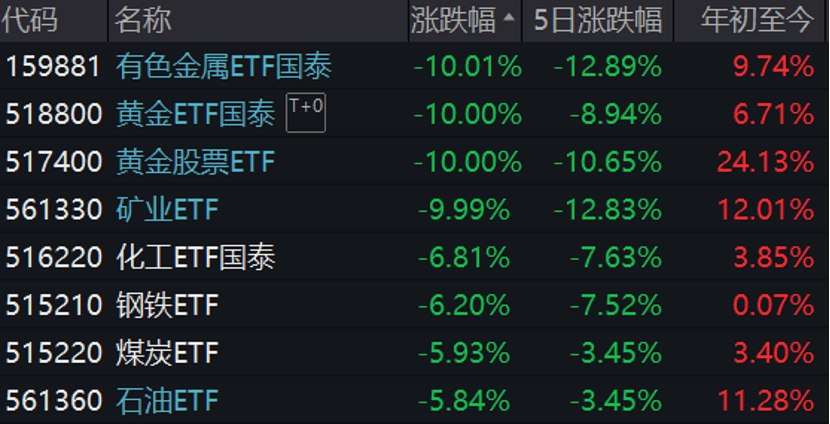
Group 1: Market Performance - The performance of various ETFs shows significant declines, with the Nonferrous Metals ETF down by 10.01% over five days and 12.89% year-to-date, while the Gold ETF is down by 10.00% over five days and 8.94% year-to-date [1] - Gold and silver prices experienced a sharp drop, with gold spot prices falling to nearly $4,400 per ounce and silver approaching $71 per ounce, marking a historic decline of 9.25% on January 31 [1] Group 2: Market Dynamics - The Chicago Mercantile Exchange raised margin requirements for metal futures, increasing gold margin from 6% to 8% and silver from 11% to 15%, which significantly impacts market liquidity and may force speculative investors to liquidate positions [4] - The recent surge in gold prices above $5,500 per ounce and silver above $120 per ounce was driven by a combination of factors, including geopolitical tensions and a shift in investor confidence towards precious metals [4] Group 3: Investment Outlook - The long-term outlook for gold remains strong, supported by monetary easing, its safe-haven status, and the trend of de-dollarization globally, despite short-term volatility [9][10] - Central banks worldwide, including China, continue to increase their gold reserves, indicating sustained demand for gold as a strategic asset [10][13] - The potential for a super cycle in commodities is anticipated, driven by economic recovery and expansionary fiscal policies, particularly in the context of the upcoming U.S. midterm elections [18]
金银价从暴涨到血洗:揭秘美联储“鹰派炸弹”引发的贵金属浩劫
Sou Hu Cai Jing· 2026-02-02 15:12
Core Viewpoint - The nomination of Kevin Warsh as the new Federal Reserve Chairman by President Trump signals a potential shift from accommodative to tightening monetary policy, leading to a rapid revaluation of "hawkish rate hike" expectations in the market [1] Group 1: Market Reaction - Following Warsh's nomination, the dollar index surged, while gold and silver prices plummeted, indicating a loss of appeal for precious metals as inflation hedges [1] - The extreme overbought signals in the gold and silver markets were evident, with gold's Relative Strength Index (RSI) exceeding 90 and silver's RSI surpassing 80, indicating a highly concentrated speculative position [2] - The announcement triggered a swift collapse of long positions, resulting in a technical sell-off where gold fell over $600 in a single day and silver dropped nearly $40, exemplifying the market's volatility [2] Group 2: Trading System Flaws - The severe market fluctuations exposed critical flaws in the precious metals trading system, with the Chicago Mercantile Exchange raising gold margin requirements to 6% four times in a month, forcing high-leverage longs to liquidate [3] - The silver market experienced particularly harsh conditions, with over 70% of daily trading volume attributed to speculative funds, leading to a liquidity crisis as algorithmic trading triggered cascading sell-offs [3] - Some investors faced significant losses due to 20x leverage, resulting in a "crash-liquidation-recrash" spiral that left them indebted to brokers [3] Group 3: Institutional Actions - The operations of international commercial banks and hedge funds revealed the underlying nature of the market turmoil, with a historical mismatch between registered silver inventories and open contracts [4] - Major institutions, including Standard Chartered and UBS, began reducing net long positions before the crash, while hedge funds utilized algorithmic trading to hedge risks and exit positions, leaving retail investors as passive liquidity providers [4] - This institutional-led "long liquidation" fundamentally altered the market dynamics and competitive landscape [4] Group 4: Long-term Outlook - Despite the short-term severe drop, the fundamental drivers supporting long-term precious metal price increases remain intact, including ongoing de-dollarization, high annual gold purchases by central banks, and unresolved geopolitical risks [5] - Analysts suggest that the current market adjustment is a necessary process to eliminate excess leverage and speculative sentiment, potentially paving the way for a healthier upward trend in gold and silver prices [5] - However, the Federal Reserve's policy direction remains a critical variable; aggressive balance sheet reduction by Warsh could suppress precious metal performance in the short term, while increasing recession risks may renew interest in gold as a safe-haven asset [5]