
美联储货币政策

Search documents
【环球财经】美联储货币政策面临多重困扰
Xin Hua She· 2025-10-30 09:04
Core Viewpoint - The Federal Reserve has lowered the federal funds rate target range by 25 basis points to between 3.75% and 4.00%, indicating uncertainty in future monetary policy due to internal divisions and external economic pressures [1][3] Group 1: Federal Reserve Actions - The Federal Reserve's recent rate cut marks the fifth reduction since September 2024, reflecting ongoing concerns about employment and inflation [1] - Market expectations for a December rate cut have dropped significantly from 90% to below 70% [2] Group 2: Economic Conditions - The U.S. labor market is showing signs of weakness, with the unemployment rate rising to 4.3% in August, the highest in nearly four years, and non-farm payrolls increasing by only 22,000, far below expectations [3][4] - Inflation remains a concern, with the personal consumption expenditure price index rising 2.7% year-over-year in August, exceeding the Fed's long-term target of 2% [4] Group 3: Internal and External Pressures - There are significant internal disagreements within the Federal Reserve regarding future rate decisions, with some members advocating for larger cuts while others prefer to maintain current rates [3] - The ongoing government shutdown has hindered the collection of key economic data, complicating the Fed's ability to assess the true state of the economy [3][4] Group 4: Relationship with the White House - The relationship between the Federal Reserve and the White House remains tense, with government officials previously pressuring the Fed for more aggressive rate cuts [5] - Concerns have been raised about the potential impact of political pressures on the Fed's independence and its ability to manage inflation effectively [6]
财经观察:美联储货币政策面临多重困扰
Sou Hu Cai Jing· 2025-10-30 07:57
Core Points - The Federal Reserve announced a 25 basis point cut in the federal funds rate target range to 3.75% to 4.00% during its recent monetary policy meeting, marking the fifth rate cut since September 2024 [1] - There is significant uncertainty surrounding future monetary policy due to internal divisions within the Federal Reserve, the government shutdown affecting key economic data, and ongoing pressures to balance employment and inflation risks [1][2] - The market's expectation for another rate cut in December has decreased from 90% to below 70% following the Fed's lack of clear guidance on future policy [1] Group 1 - Internal divisions within the Federal Reserve are evident, with differing opinions on whether to cut rates further or maintain current levels, highlighting the complexity of the decision-making process [2] - The government shutdown has halted data collection and reporting, complicating the Fed's ability to assess the true state of the economy, which Powell likened to "driving in a fog" [2] - The labor market is showing signs of weakness, with the unemployment rate rising to 4.3% in August, the highest in nearly four years, and non-farm payrolls increasing by only 22,000, significantly below expectations [2][3] Group 2 - Private sector data indicates a continued decline in job openings, with significant layoffs announced by major companies like Amazon and Target, suggesting a troubling trend in the labor market [3] - Inflation remains a concern, with the personal consumption expenditures price index rising 2.7% year-over-year in August, exceeding the Fed's long-term target of 2% [3] - The impact of tariffs has contributed to rising core personal consumption expenditures, potentially pushing inflation rates to 3% by December [3] Group 3 - The relationship between the Federal Reserve and the White House is tense, with government officials previously pressuring the Fed for more aggressive rate cuts, which may lead to further complications in policy decisions [4] - Concerns have been raised about the potential impact of political pressures on the Fed's independence and its ability to manage inflation effectively, especially with Powell's term ending in May [5]


金子或将重演2015年历史!10月29日下周开启关键窗口,务必关注
Sou Hu Cai Jing· 2025-10-30 04:50
Core Insights - The recent surge in interest in the gold market is reminiscent of the 2015 market dynamics, with various stakeholders discussing gold investment opportunities and potential market shifts around October 29 [2] Group 1: Historical Context - In 2015, the gold market experienced significant volatility influenced by policy changes and market sentiment, with a notable drop in gold prices due to expectations of a Federal Reserve interest rate hike [3] - The fourth quarter of 2015 marked a turning point for gold prices, as global economic uncertainties led to increased safe-haven demand, stabilizing prices after a substantial decline [3] Group 2: Current Market Signals - Current market signals echo those of 2015, particularly regarding Federal Reserve monetary policy, with expectations of a shift towards interest rate cuts, enhancing gold's appeal as a store of value [4] - The phenomenon of "asset scarcity" is re-emerging, with investors seeking refuge in gold amid stock and bond market volatility, as traditional hedging strategies face challenges [4] - Central banks are increasing their gold holdings, with significant purchases from countries like China, Russia, and Turkey, indicating a strategic shift towards "de-dollarization" [4] Group 3: Market Stability Factors - The current gold market benefits from stronger stability factors compared to 2015, including ongoing geopolitical tensions that are likely to sustain safe-haven demand [5] - The investor base has shifted towards long-term holdings of gold, with a growing percentage of central banks and individual investors favoring gold as a stable asset [5] Group 4: Strategic Recommendations - Different strategies are recommended for various groups in light of the upcoming key market window on October 29, with advice for consumers to consider buying during price dips and for investors to adopt a phased investment approach [6] - Investors are advised to limit gold investments to a maximum of 10% of total assets and to focus on gold ETFs or paper gold for easier liquidity [6]


凌晨!美联储降息25个基点!
新华网财经· 2025-10-30 02:05
Core Viewpoint - The Federal Reserve has lowered the federal funds rate by 25 basis points to a target range of 3.75% to 4.00%, marking the second consecutive rate cut, while also announcing the end of its balance sheet reduction plan starting December 1. However, uncertainty remains regarding future monetary policy due to a lack of economic data caused by the government shutdown, with Chairman Powell indicating that a December rate cut is not guaranteed [2][4][6]. Group 1: Federal Reserve Actions - The Federal Reserve has cut the federal funds rate by 25 basis points, aligning with market expectations [4]. - The Fed will end its balance sheet reduction plan on December 1, with reinvestments of mortgage-backed securities' principal into short-term Treasury bonds [6]. - There is a notable division within the Fed regarding future rate cuts, with some members advocating for a more aggressive approach while others prefer to maintain current rates [6][7]. Group 2: Economic Indicators and Market Reactions - Economic activity is expanding at a moderate pace, with job gains slowing and the unemployment rate slightly increasing but remaining low [5]. - Inflation has risen since earlier in the year and remains somewhat elevated, contributing to the Fed's cautious stance [5][6]. - Following Powell's comments, major assets experienced significant volatility, with the Dow Jones falling by 0.16% and the Nasdaq rising by 0.55% [9][11].

金晟富:10.30黄金过山车行情震荡洗盘!日内黄金行情分析
Sou Hu Cai Jing· 2025-10-30 01:52
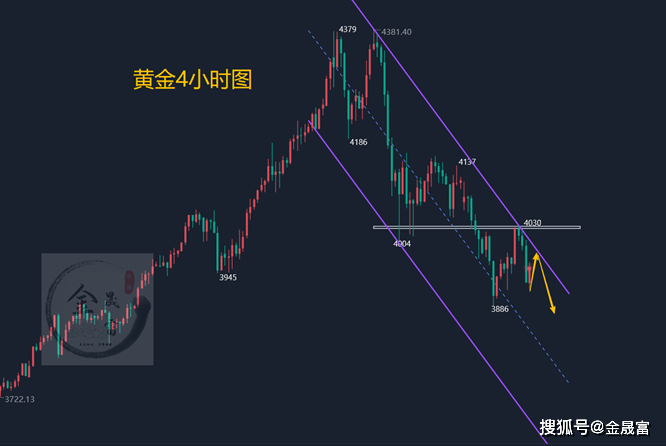
换资前言: 交易之路,并非为求人人理解而来。你做得再好,未必人人喜欢;付出再多,未必人人称道——旁人都 是盯紧盈亏结果,缺很少顾及你复盘的深夜、控险的煎熬。一样的眼有不同看法,一样的心有别样想 法,强求认同本就是自我束缚。更要清醒:交易市场不同情弱者,更不相信眼泪。做事无需人懂,尽心 尽力便好;交易不必讨喜,问心无愧即可。 近期有哪些消息面影响黄金原油走势?后市黄金多空该如何研判? 周三(10月29日)现货黄金上演了一场惊心动魄的过山车行情。亚欧盘时段,金价在避险情绪和美联储 降息预期双重推动下,一度狂飙近2%,成功站上4000美元整数关口,盘中最高触及4029.90美元/盎 司。然而好景不长,美联储如期降息25个基点,但美联储主席鲍威尔在新闻发布会上的"鹰派"表态如同 一盆冷水浇灭了多头热情,金价迅速回吐全部涨幅并转跌,最低下探3916.56美元/盎司,收报3930美元 附近,单日跌幅约0.57%。本交易日重头戏无疑是中美领导人在韩国首尔的会晤。若贸易谈判未能取得 突破性进展,或将为金价提供短期避险支撑;反之,若谈判进展乐观,叠加12月降息预期进一步降温, 金价恐面临更大下行压力。 鲍威尔在开场白中说出最重 ...
美联储偏鹰,??震荡回落
Zhong Xin Qi Huo· 2025-10-30 01:45
Report Industry Investment Rating - The precious metals market is rated as "oscillating strongly" in the short - term and is expected to benefit from the downward trend of real interest rates in the medium - term. London gold is expected to trade between $3900 - $4100 per ounce, and London silver between $48 - $52 per ounce [9] Core Viewpoints - The Fed's "rate cut + end of quantitative tightening" signals a marginal improvement in liquidity, but Powell's hawkish remarks at the press conference dampened market expectations of continuous easing. The combination of hawkish policy signals and tightened money markets leads to short - term oscillations in the precious metals market, while the medium - term outlook remains positive due to the downward trend of real interest rates [3][5][9] Summary by Related Catalogs Key Information - The Fed cut the federal funds rate target range by 25bp to 3.75% - 4.00% and will stop the balance - sheet reduction operation from December. The New York Fed will reinvest all maturing Treasury and MBS principal, keeping the balance - sheet size at about $6.6 trillion [4] - Powell signaled hawkishness, stating that a December rate cut is "far from certain". After the meeting, the market's probability of another rate cut in December dropped from nearly 100% to 64% [4] - Chinese and US leaders held a meeting in Busan, South Korea on October 30, the first face - to - face meeting since Trump returned to the White House, exchanging views on Sino - US relations and issues of common concern [4] - The Israel - Palestine conflict escalated, with Israeli military air - strikes on the Gaza Strip killing at least 100 civilians, and Hamas denying violating the cease - fire agreement [4] Price Logic - The Fed's "rate cut + end of quantitative tightening" supports gold in the short - term as nominal interest rates decline, but Powell's hawkish stance suppresses expectations of continuous easing. The passive contraction of the Fed's balance - sheet has tightened short - term liquidity, which restricts the price elasticity of gold in the short - term. However, if the money - market pressure persists, gold's hedging and liquidity - hedging functions will strengthen in the medium - term [5] - Silver oscillated and declined with gold, but its price adjustment was limited due to high financing rates in the London market and spot premiums. Industrial demand is moderately recovering, with a strong long - term outlook [5] Outlook - In November, attention should be paid to non - farm substitute data and frequent speeches by Fed officials. If employment indicators show signs of cooling and liquidity tightness persists, the probability of a December rate cut may be revised upwards. Overall, precious metals are expected to oscillate strongly in the short - term and benefit from the downward trend of real interest rates in the medium - term [6][9]
美联储再次降息25个基点 鲍威尔表态引发跳水 影响几何?
Sou Hu Cai Jing· 2025-10-30 01:35
Group 1 - The Federal Reserve announced a 25 basis point cut in the federal funds rate target range to between 3.75% and 4% on October 29, marking the fifth rate cut since September of the previous year [1] - The Fed will stop its balance sheet reduction starting December 1, 2023, ceasing the reinvestment of maturing U.S. Treasury securities [1] - Fed Chairman Jerome Powell indicated that the U.S. government shutdown is impacting economic activity and that many consumers remain dissatisfied with inflation levels [1] Group 2 - Following Powell's hawkish remarks, U.S. stock markets experienced a slight decline, with the Dow Jones down 0.16% and the S&P 500 nearly flat, while the Nasdaq rose 0.55% [2] - Large tech stocks, such as Nvidia, saw gains, with Nvidia's market capitalization exceeding $5 trillion [2] - The dollar strengthened post-announcement, while gold prices fell below $3,950 [2] Group 3 - Analysts suggest that the Fed's shift from tightening to a neutral stance may lead to 3-4 more rate cuts, but uncertainties remain due to data delays and leadership changes [3] - Market expectations for a December rate cut have been significantly adjusted, with short-term pressures on U.S. stocks and gold anticipated [3] - The overall liquidity in the U.S. market is expected to remain accommodative, supporting asset prices, despite potential challenges in the employment market and inflation levels [3]
美联储10月议息会议点评:12月还会降息吗?
GOLDEN SUN SECURITIES· 2025-10-30 01:32
Group 1: Federal Reserve Actions - The Federal Reserve lowered the federal funds rate by 25 basis points to a range of 3.75-4.0% as expected, and announced the end of balance sheet reduction on December 1[2] - Powell indicated that a rate cut in December is not guaranteed, reflecting internal divisions within the Fed[2] - The meeting saw two dissenting votes, highlighting increasing disagreements among Fed officials regarding future rate cuts[2] Group 2: Market Reactions - Following the Fed's announcement, the implied probability of a December rate cut dropped from over 90% to below 70%[3] - The yield on 10-year U.S. Treasuries rose by 9.8 basis points to 4.07%, while the U.S. dollar index increased by 0.4% to 99.16[3] - The S&P 500 index closed flat, and gold prices fell by 0.6% to $3929.7 per ounce after the meeting[3] Group 3: Economic Outlook - The Fed's stance is shifting from tightening to a neutral position, with potential for 3-4 more rate cuts before reaching a terminal rate[4] - Economic indicators suggest that the U.S. economy may be stabilizing, with employment potentially nearing a recovery point[4] - The impact of tariffs on inflation is expected to persist, influencing future monetary policy decisions[4] Group 4: Risks and Considerations - There is significant uncertainty regarding the actual space and pace of future rate cuts due to data delays and leadership changes within the Fed[4] - If the market's expectation of a December rate cut is not met, short-term adjustments in U.S. stocks and gold may occur[4] - Long-term expectations for rate cuts through 2026 remain rational, suggesting limited future impact once short-term adjustments are made[4]
“美联储通讯社”:鲍威尔发布会“罕见强硬”凸显美联储“内乱”,12月降息“远非确定”
Hua Er Jie Jian Wen· 2025-10-30 00:19
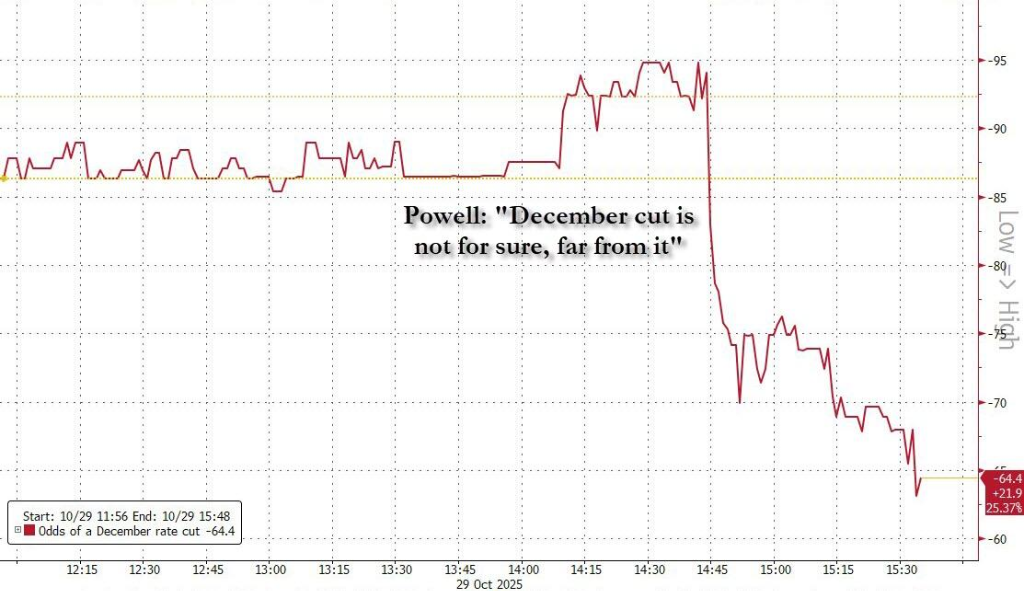
Core Viewpoint - The Federal Reserve's recent interest rate cut was accompanied by hawkish signals from Chairman Powell, dampening market expectations for further cuts by year-end [1][5] Group 1: Interest Rate Decision - The Federal Reserve lowered the benchmark interest rate by 25 basis points, bringing the federal funds rate target range to 3.75% to 4%, the lowest level in three years [1] - Powell refuted the market's belief that a December rate cut was certain, stating that this outlook was "far from guaranteed" [1][5] - Following Powell's comments, the probability of a December rate cut plummeted from 95% to 65%, impacting major indices negatively [1] Group 2: Internal Disagreements - The latest rate decision passed with a vote of 10 in favor and 2 against, revealing significant internal divisions within the committee [4] - Kansas City Fed President Jeffrey Schmid voted against the cut, favoring a hold on rates, while Fed Governor Stephen Miran advocated for a larger cut of 50 basis points [4] - Powell acknowledged a "growing chorus" of officials questioning the need for further easing, indicating a shift in sentiment among decision-makers [4] Group 3: Economic Data Uncertainty - The government shutdown has led to a lack of economic data, increasing uncertainty around future rate decisions [6][7] - Powell noted that missing data could lead to "very high uncertainty" regarding the economic outlook, complicating decision-making [6] - The absence of key labor market indicators has hindered officials' ability to resolve their differences [6] Group 4: Inflation and Employment Dynamics - The core debate within the Fed revolves around balancing inflation control with addressing economic slowdown [9] - Some officials are wary of excessive rate cuts that could overheat the economy and sustain inflation above the 2% target [9] - Recent labor reports indicate a sharp slowdown in job growth, with average monthly additions around 29,000, significantly lower than the previous year's average of 82,000 [9]
凌晨2:35,准时跳水,全球靴子落地
凤凰网财经· 2025-10-30 00:16
Core Viewpoint - The article discusses the recent performance of the U.S. stock market, particularly the mixed results of major indices following comments from Federal Reserve Chairman Jerome Powell regarding future interest rate cuts and economic conditions [1][2][3]. Group 1: Federal Reserve Actions - The Federal Reserve announced a 25 basis point cut in the federal funds rate, bringing it to a target range of 3.75% to 4.00%, marking the first consecutive rate cuts in a year [3]. - Powell indicated that a further rate cut in December is not guaranteed, highlighting uncertainty in the Fed's future policy direction [3][14]. - Economic activity is expanding at a moderate pace, with GDP growth in the first half of the year at 1.6%, down from 2.4% the previous year [5]. Group 2: Labor Market and Economic Indicators - The labor market appears to be cooling, with a notable slowdown in job growth since the beginning of the year, attributed to factors such as reduced immigration and declining labor force participation [6][8]. - Despite the delay in official employment data, evidence suggests that layoffs and hiring remain at low levels, although perceptions of job opportunities are declining [7]. - The overall economic activity growth may be slightly better than expected, driven by stronger consumer spending, while investment in equipment and intangible assets continues to grow [6]. Group 3: Inflation and Price Pressures - Inflation has significantly decreased from mid-2022 but remains slightly above the Fed's long-term target of 2%, with the overall PCE price index rising by 2.8% over the past 12 months [9][10]. - Higher tariffs are contributing to price increases in certain goods, leading to upward pressure on overall inflation [11][12]. - Powell noted that while short-term inflation risks are skewed upward, the risks to employment are skewed downward, creating a challenging economic environment [13].
