人工智能(AI)

Search documents
“降息大门关闭!”美联储,预期突变!美国重磅数据出炉!
券商中国· 2026-01-09 23:38
Group 1: Federal Reserve and Employment Data - The U.S. non-farm payrolls increased by 50,000 in December, below the expected 65,000, and the unemployment rate was 4.4%, lower than the anticipated 4.5% [2][3] - The December employment report diminished market expectations for a Federal Reserve rate cut in January, with the probability of a 25 basis point cut dropping to 5% [2][4] - The average monthly job growth in the private sector for 2025 was 61,000, marking the weakest growth since 2003 [3] Group 2: Market Reactions and Predictions - Following the employment data, traders largely removed bets on a rate cut in January, maintaining predictions for two rate cuts in 2026, with the first expected around mid-year [3][4] - Analysts suggest that the Federal Reserve's decision on future rate cuts will depend on the unemployment rate trends in the coming months [4] Group 3: Nuclear Power Sector Developments - U.S. stock indices rose, with significant gains in nuclear power stocks, including Vistra, which surged over 10% [5][6] - Meta announced agreements with Vistra, Oklo, and TerraPower for nuclear power supply, potentially providing over 6 gigawatts of capacity, enough to power approximately 5 million homes [6][7] - The agreements are expected to fund the expansion of Ohio's nuclear plants and extend their operational licenses, with some licenses valid until 2047 [7]



千亿化工巨头,66亿甩卖业务,转身加码特种高分子
DT新材料· 2026-01-09 16:06
Core Viewpoint - SABIC is strategically divesting its European petrochemical and engineering thermoplastic businesses to focus on high-margin markets and products, enhancing its capital allocation and free cash flow [2][3]. Group 1: Strategic Transactions - SABIC announced the sale of its European petrochemical business to AEQUITA for $500 million, which includes various products and facilities across Europe [2]. - The engineering thermoplastic business in the Americas and Europe is being sold to Mutares for $450 million, covering multiple production sites [3]. - These transactions are part of SABIC's asset optimization plan initiated in 2022, aimed at reallocating capital to higher-return areas [3]. Group 2: Product Development and Expansion - SABIC has launched several new high-performance polymer products, including a series of fluorine-free SILTEM™ resins and flame-retardant materials suitable for various applications [4]. - The company is expanding its production capacity, particularly in Asia and the Middle East, with significant projects like the MTBE plant in Saudi Arabia, which has a capacity of 1 million tons [5]. - A new expansion plan for specialty low oligomers based on PPE technology is set to meet the growing demand for high-performance PCBs, supporting AI and 5G applications [6][7]. Group 3: Market Trends and Demand - The demand for high-performance electronic resins is surging, driven by the growth of AI and high-end PC industries, prompting major players to expand production [8]. - SABIC is a leading supplier of electronic-grade PPO resins, with a projected global demand of 4,926 tons by 2025 [8].

热点问答丨美消费电子展上演讲嘉宾如何谈AI
Xin Hua She· 2026-01-09 14:03
Group 1: AI Development Trends - The 2026 CES highlighted the evolution of AI from cloud-based virtual systems to physical applications in real-world scenarios [1] - AI's next phase includes breakthroughs in computing power, with a need to increase global computing capacity by 100 times in the coming years to support widespread AI adoption [2] - The concept of "Physical AI" is emerging, focusing on AI systems that not only understand but also interact with the physical world, with applications in autonomous driving and industrial automation [3] Group 2: Computing Power and Infrastructure - The current global AI user base exceeds 1 billion and is expected to surpass 5 billion, necessitating significant advancements in computing capabilities [2] - Companies like NVIDIA are developing integrated AI computing platforms, such as the "Vera Rubin" system, which includes six chips designed to enhance model training efficiency and reduce inference costs [2] - The industry is shifting towards a full-stack collaborative design approach, integrating chips, networks, and storage to create comprehensive AI solutions [2] Group 3: Intelligent Agents and Personalization - The year is anticipated to be significant for "proactive intelligent agents," which can autonomously perform tasks and understand complex goals, moving beyond traditional reactive AI [4] - Lenovo introduced its first personal super intelligent agent, Lenovo Qira, which connects various devices and supports context awareness and user preference prediction [5] - The integration of personal, enterprise, and public intelligence through hybrid AI is seen as a key pathway for personalized and diverse AI development [5]

美国12月就业增长放缓 为招聘疲软的一年年画上句号
Xin Lang Cai Jing· 2026-01-09 13:51
专题:美国12月非农略低于预期 美国劳工部周五公布,12月经季节性调整后新增就业人数50000人,失业率降至4.4%。 这一新增就业人数低于接受调查的经济学家预期的73000人,也弱于11月经修正后的新增56000人。 12月的就业报告是几个月来首份能清晰反映劳动力市场状况的报告,此前创纪录时长的政府停摆导致政 府机构停止数据收集工作长达六周,并推迟了许多主要经济指标的发布。 周五的报告为2025年画上了句号,在这一年里,劳动力需求明显放缓,公司收紧了招聘。2025年,就业 创造步履维艰,薪资增长降温,失业率上升。2025年的大部分就业创造都集中在两个行业:教育和医疗 服务。 2025年对美国经济来说是不寻常的一年。美国总统特朗普1月份上任后,其政府采取行动大幅削减联邦 政府雇员数量,并限制进入美国和在美国工作的移民数量。白宫还在春季宣布对进口商品征收全面关 税,扰乱了金融市场。 但尽管美国就业市场一直疲软,经济一直在稳步增长,虽然第一季度出现短暂波折。在有数据可查的最 近一个季度(即第三季度),得益于强劲的消费者支出和对人工智能(AI)领域的稳健商业投资,国 内生产总值(GDP)创下两年来最快增速。作为衡量 ...
计算机行业周报:AI领域进展持续,商业化加速-20260109
Shanghai Securities· 2026-01-09 13:42
Investment Rating - The industry investment rating is "Hold" [1] Core Insights - The AI sector continues to progress with accelerated commercialization, highlighted by significant acquisitions and funding rounds in the industry [4][6] - The computer industry index outperformed major indices, indicating a positive trend in the sector [2] Summary by Relevant Sections Market Overview - During the past week (December 29 - January 2), the Shanghai Composite Index rose by 0.13%, while the ChiNext Index fell by 1.25%. The CSI 300 Index decreased by 0.59%. The computer (Shenwan) index increased by 1.16%, outperforming the Shanghai Composite Index by 1.03 percentage points, the ChiNext Index by 2.41 percentage points, and the CSI 300 Index by 1.74 percentage points, ranking sixth among all industries [2] AI Sector Developments - Meta announced a multi-billion dollar acquisition of the Chinese company Butterfly Effect, which developed the AI application Manus. Manus has processed over 147 trillion tokens and created over 80 million virtual computers since its launch [4] - The company Moonlight has completed a $500 million Series C financing round, significantly oversubscribed, with cash reserves exceeding 10 billion yuan. The company reported a monthly user growth of over 170% for its K2 model [4] - DeepSeek introduced a more efficient AI development method, aiming to enhance scalability while reducing computational and energy requirements for advanced AI systems [4] IPO Activity - MiniMax has initiated its IPO process, planning to issue approximately 25.39 million shares at a price range of 151 to 165 HKD per share, with an estimated valuation between 46.12 billion and 50.40 billion HKD. The company focuses on consumer-facing AI applications, with over 70% of its revenue coming from this segment [4] - Baidu's Kunlun Chip has submitted a listing application to the Hong Kong Stock Exchange, with plans to expand its capabilities significantly [5]

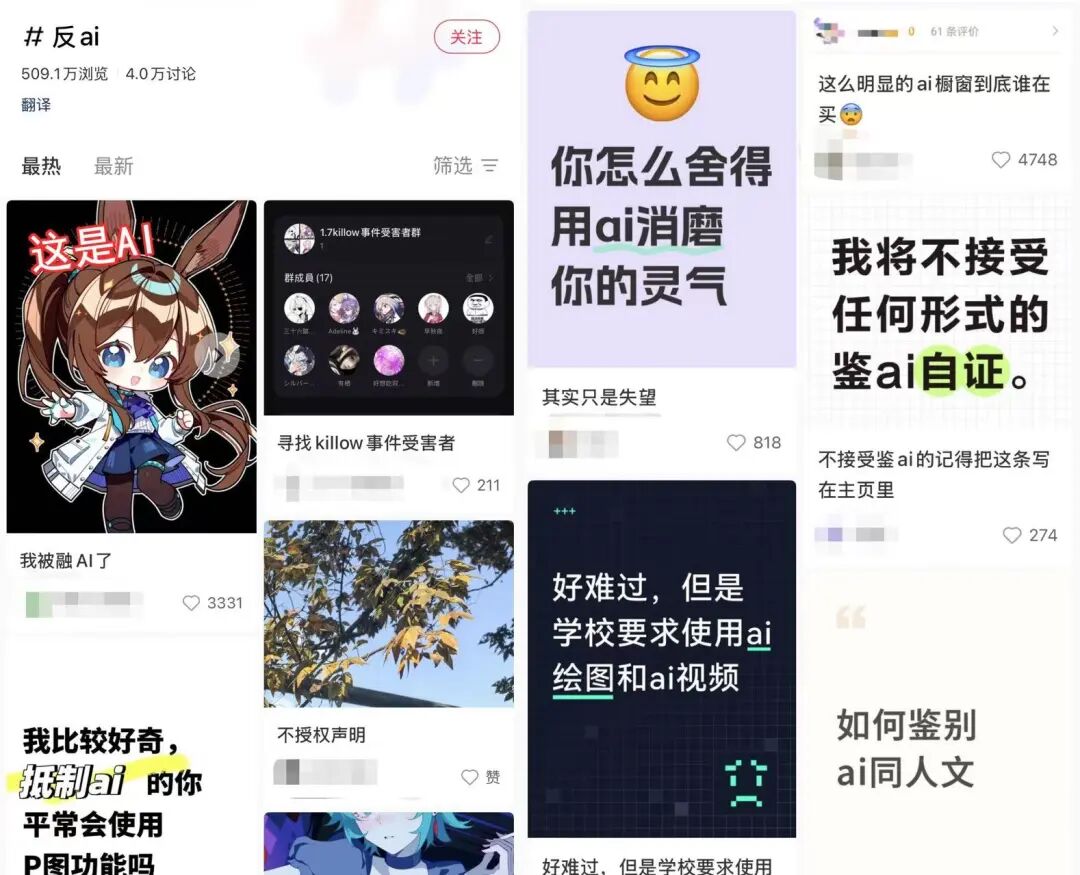
对抗AI的人
虎嗅APP· 2026-01-09 13:31
Core Viewpoint - The rapid advancement of AI has transformed it from a novel concept to an integral part of daily life, leading to both efficiency gains and significant challenges in authenticity and creativity [4][5]. Group 1: AI's Impact on Content Creation - AI has infiltrated various creative fields, with reports indicating that up to 50% of content on platforms like Reddit has been affected by AI [4]. - The rise of AI-generated content has led to a dramatic increase in the number of new works, with platforms like Tomato Novel seeing new book releases jump from 400 in 2023 to 5,606 in 2024 [7]. - The proliferation of AI content has sparked a backlash among creators, with hashtags like 反ai gaining significant traction, indicating a growing movement against AI's influence [8]. Group 2: Personal Stories of Creators - Creators like 韩艺秋 express deep disappointment over the use of AI in writing, feeling that it undermines the authenticity of human expression [7]. - Illustrators and artists, such as 小寒, have faced job losses and reduced income due to AI's encroachment, with many positions now requiring proficiency in AI tools [9][11]. - The emotional toll of AI's impact is evident, with some creators experiencing severe mental health challenges as they navigate a landscape increasingly dominated by AI [12]. Group 3: The Struggle for Authenticity - Many creators are actively seeking ways to distinguish their work from AI-generated content, employing various strategies to maintain their artistic integrity [17][18]. - The challenge of being compared to AI-generated works has led to a crisis of confidence among creators, with some feeling compelled to abandon their craft altogether [19]. - Despite the overwhelming presence of AI, some individuals are finding success by leveraging their unique human experiences and emotions in their creative processes [24].

破局2.5万亿!中国并购市场:存量洗牌下的产业重构与科技突围
Zhong Guo Jing Ying Bao· 2026-01-09 12:53
Core Insights - The Chinese M&A market experienced significant growth in 2025, with a total of 8,151 disclosed transactions and a transaction volume of approximately 25,894 billion yuan, representing a year-on-year increase of about 16.12% [1] - The recovery of the M&A market is attributed to a combination of policy, industry, and capital resonance, marking a shift in China's economic development from "quantity increase" to "quality improvement" [1][3] - The trend indicates a transition in the regulatory framework from "fatherly" control to a "market-friendly" service model, significantly reducing institutional transaction costs and enhancing market vitality [1][3] Regional Distribution - Beijing led the M&A market with a transaction volume of 10,930 billion yuan, up 48.59% year-on-year; Shanghai followed with 6,092 billion yuan, down 14.92%; and Guangdong ranked third with 4,593 billion yuan, down 17.89% [2] - There were 28 M&A events exceeding 100 billion yuan, with notable transactions including China Shenhua's acquisition of Guoyuan Power at 1,335.98 billion yuan, and CICC's mergers with Dongxing Securities and Xinda Securities at 1,142.75 billion yuan [2] Industry Distribution - The industrial sector led M&A activity with a transaction volume of 7,605 billion yuan, up 11.67% year-on-year; the real estate sector saw a remarkable increase of 549.36% to 4,443 billion yuan; and the information technology sector reached 2,855 billion yuan, up 35.84% [2][3] - The significant growth in the real estate sector is attributed to necessary asset-liability restructuring, with many transactions aimed at project clearance and risk mitigation [3] M&A Trends and Strategies - The industrial sector's M&A activity reflects a shift from "spreading out" to "stepping up," focusing on enhancing supply chain resilience and precision [3][4] - Horizontal integration M&A events accounted for 5,966 billion yuan, representing 22.70% of total transaction volume, indicating a deep structural phase of "stock reshuffling" across various industries [4] - Companies are increasingly pursuing "structural power" through horizontal mergers, aiming to establish stronger competitive barriers and enhance management efficiency and technological innovation [4] Future Outlook - In 2026, two key areas of focus are expected: strategic acquisitions in hard technology industries, particularly in semiconductors and industrial software, and professional integration led by state-owned enterprises in sectors like new energy and high-end equipment [5] - Cross-border M&A in the high-tech sector is anticipated to gain momentum as Chinese companies seek to acquire advanced technologies and talent globally, enhancing their position in the global tech supply chain [5][6]




丰疆智能拟港股上市 中国证监会要求补充说明股权架构搭建合规性等
Zhi Tong Cai Jing· 2026-01-09 12:50
Core Viewpoint - The China Securities Regulatory Commission (CSRC) has requested additional documentation from FJD Inc. regarding compliance with regulations related to its overseas listing application, particularly focusing on its equity structure and reverse mergers [1][2]. Group 1: Regulatory Compliance Requirements - FJD Inc. is required to clarify the compliance of its equity structure and reverse mergers, including whether shareholders holding over 5% have completed necessary foreign exchange registrations and whether domestic institutional shareholders have followed outbound investment regulations [2]. - The company must provide details on the establishment of its equity structure, including changes in capital and shareholder composition, and confirm the legality of these changes through legal opinions [3]. - The CSRC has requested information on the operational status of FJD's domestic entities, including necessary qualifications for its business activities in advertising, autonomous driving, and telecommunications [3]. Group 2: Financial and Operational Transparency - FJD Inc. must disclose the specific uses of raised funds, including the proportion allocated for domestic versus overseas projects, and the approval processes followed for these uses [4]. - The company is required to explain its equity incentive plans, including the structure, personnel involved, and the reasons for using a trust structure for these incentives [4]. - The company needs to clarify its business model, particularly its applications of AI, and the rationale for submitting its filing through Shenzhen Fengjiang Management Co., Ltd. [5]. Group 3: Market Position and Growth - FJD Inc. is recognized as a global leader in the agricultural robotics market, being the third-largest supplier of agricultural automatic navigation systems and the second-largest supplier of aftermarket kits, with market shares of approximately 8.5% and 16.9% respectively for 2024 [5].
大摩:中国在AI竞赛中拥有独特优势,阿里是“最佳赋能者”,腾讯具“最高2C变现潜力”
硬AI· 2026-01-09 12:29
Core Insights - Morgan Stanley highlights that China's AI industry is adopting a unique path by utilizing an "open model" strategy to counter the global "closed" systems, accelerating monetization at the application level [2][3] - The report indicates that major Chinese platforms like Alibaba and Tencent are leveraging their cloud computing capabilities and private data advantages to transform AI technology into high-return commercial value, shifting the capital market's focus from computing power speculation to application-based pricing logic [2][4] Market Trends - Morgan Stanley notes a structural shift in the market, with China capturing a significant share of the global state-of-the-art (SOTA) models, accounting for half of the top 10 as of January 8 [3] - The total addressable market (TAM) for cloud AI in China is projected to reach $50 billion by 2027, indicating a strengthening resilience in the domestic computing supply chain [3] Investment Focus - Investors should focus on the monetization capabilities and ecological barriers at the application level rather than just the infrastructure arms race [4] - Alibaba is identified as the "best enabler" of AI development in China due to its integration of cloud computing and model capabilities, while Tencent is noted for having the highest consumer-facing (2C) monetization potential and high return on investment (ROI) [4][12] Application Landscape - The Chinese market is witnessing a unique landscape where "super applications" evolve alongside the explosion of "AI native applications" [6] - WeChat is emphasized as a pioneer AI agent with significant potential, boasting 1.1 billion monthly active users (MAU) and high user engagement metrics, which provide fertile ground for AI integration [6][8] Competitive Dynamics - ByteDance's Doubao, Baidu's Wenxin Yiyan, and Alibaba's Quark and Yuanbao are rapidly competing for user engagement, evolving from simple chatbots to more complex AI assistants [8] - The enterprise (2B) sector is also experiencing a quiet transformation, with strong intentions for deploying generative AI (GenAI) across various industries, including advertising, healthcare, and finance [10][11] Company Differentiation - Alibaba is positioned as the "best AI enabler" due to its robust infrastructure and integration across various business scenarios, while Tencent is recognized for its high consumer monetization potential through its WeChat ecosystem [12] - ByteDance is characterized as a "full-stack AI leader," with comprehensive coverage from foundational engines to various AI applications, while Baidu faces challenges in its core advertising business due to AI search transformations [12]



对抗AI的人
3 6 Ke· 2026-01-09 11:20
Core Viewpoint - The rapid advancement of AI has transformed it from a novel concept to an omnipresent element in daily life, leading to both increased efficiency and significant negative impacts on various creative industries [1][2]. Group 1: Impact on Creative Industries - Reddit reported the deletion of over 40 million pieces of spam and false content, with estimates suggesting that up to 50% of content in large communities may be AI-influenced [1]. - The influx of AI-generated content has led to a crisis in creative expression, with writers, musicians, and artists feeling pressured to adapt or compete with AI [1][6]. - The number of new web novels surged dramatically, with 5,606 new titles launched in March 2024 compared to just 400 in the same month of 2023, indicating a significant rise in AI-generated literature [3][4]. Group 2: Personal Experiences and Reactions - Creators like Han Yiqiu express deep disappointment over the use of AI in writing, feeling that it undermines genuine human expression and creativity [3][12]. - Many artists, such as Xiao Han, have faced job losses or reduced opportunities due to AI's encroachment into their fields, leading to feelings of despair and thoughts of changing careers [6][7]. - The rise of AI-generated content has led to a decline in the perceived value of human-created works, with creators feeling the need to prove their authenticity [12][14]. Group 3: Adaptation and Resistance - Some individuals are attempting to find ways to coexist with AI, recognizing that complete resistance may not be feasible [16][17]. - Xiao Han's success in creating a popular comic series demonstrates that human creativity can still thrive in the face of AI competition by focusing on emotional depth and complex storytelling [18][20]. - The ongoing debate about the role of AI in creative industries highlights the need for a balance between leveraging AI's capabilities and preserving the authenticity of human expression [8][11].