AI芯片

Search documents
中信证券:国产算力份额有望加速提升
Zheng Quan Shi Bao· 2025-09-19 01:17
Group 1 - Huawei announced the development roadmap for its Ascend series, planning to launch multiple chips including Ascend 950PR, 950DT, 960, and 970 between Q1 2026 and Q4 2028 [1] - The company is developing large-scale supernodes such as Atlas 950 SuperCluster and Atlas 960 SuperCluster, expected to support 8192 and 15488 cards, respectively, with launches planned for Q4 2027 and Q4 2028 [1] - Huawei introduced the world's first computing supernode with a maximum of 16 nodes and 48TB memory, expected to be launched in Q1 2026 [1] Group 2 - CITIC Securities emphasized that advanced process capacity is fundamental for domestic computing power, with the iteration and expansion of advanced processes being crucial for the continuous product iteration and volume of Ascend [2] - The acceleration of domestic computing power shipments, represented by Ascend, is expected to drive increased demand for advanced processes, leading to a potential rise in domestic computing power market share [2] - The company is expected to lead the domestic AI chip development with annual iterations of Ascend, focusing on the differentiation and cost-effectiveness of domestic computing power as a breakthrough path [2]

中国服务业企业500强发布,华为公布AI芯片发展路线 | 财经日日评
吴晓波频道· 2025-09-19 00:30
Group 1: Federal Reserve and Economic Policy - The Federal Reserve announced a 25 basis point rate cut, lowering the target range from 4.25%-4.5% to 4.00%-4.25%, marking the first rate cut of the year after a total reduction of 125 basis points since last September [2][3] - The Fed's statement highlighted a slowdown in job growth and a slight increase in the unemployment rate, indicating a cautious approach to future rate cuts amid rising inflation [2][3] - Fed Chair Powell faces a challenging decision between maintaining higher rates to curb inflation or cutting rates to support the job market, with the current economic indicators suggesting a need for preventive measures [2][3] Group 2: Immigration and Service Industry Growth - From January to August, the number of visa-free foreign entrants to China increased by 52.1% year-on-year, with a total of 15.89 million foreign visitors [4][5] - The Chinese government is optimizing visa policies to attract more foreign visitors, which is expected to stimulate consumption and boost the service industry [4][5] - The 2025 China Service Industry Top 500 report revealed a total revenue of 51.1 trillion yuan, with an average revenue per company exceeding 1 billion yuan, indicating strong growth in the service sector [6][7] Group 3: AI Chip Development - Huawei announced a three-year roadmap for its Ascend AI chip series, with plans to release four new chips between 2026 and 2028, emphasizing the use of self-developed high-bandwidth memory [8][9] - The development of AI chips is seen as a strategic move to reduce reliance on foreign technology, with other Chinese companies like Alibaba and Baidu also accelerating their AI chip research [8][9] - The DeepSeek team's research on a new language model was published in Nature, showcasing advancements in AI training methodologies and contributing to the global AI landscape [10][11] Group 4: International Market Expansion - Didi and Meituan are investing heavily in the Brazilian food delivery market, with Didi planning to invest 2 billion reais and Meituan committing 1 billion USD over five years [12][13] - The competitive landscape in Brazil's food delivery market is intensifying, with both companies facing challenges from local giants like iFood [12][13] - The entry of Chinese companies into the Brazilian market reflects a broader strategy to capture opportunities in Latin America, despite the challenges of local competition [12][13] Group 5: Digital Asset Regulation - The SEC has simplified the approval process for digital asset ETFs, reducing the timeline from 240 days to a maximum of 75 days, signaling a shift towards a more favorable regulatory environment for digital assets [14][15] - This regulatory change aims to promote innovation while maintaining oversight, as the U.S. seeks to catch up with other financial hubs that have embraced digital currencies [14][15] - The SEC's decision reflects a broader trend of increasing acceptance of digital assets within the U.S. financial system, potentially reshaping the competitive landscape for digital asset products [14][15]


英伟达入股英特尔 未释代工单 业界解读有助赢得特朗普政府好感
Jing Ji Ri Bao· 2025-09-18 23:56
双方结盟对于英伟达的对手未必是好事。德森资本管理公司创办人安德森说,对AMD而言,两大厂结 盟,将让AMD在数据中心和客户市场面对竞争压力。 彭博前专栏作家高灿鸣(Tim Culpan)预测,AMD将跟进入股英特尔,苹果也许正在考虑。对IC设计 业者来说,此举不是为了投资,而是要保护资金。英伟达和AMD出口芯片到中国大陆,会被美国政府 抽成15%。倘若能让特朗普政府放弃抽成,拿出50亿美元或许是更有成本效益的做法,苹果可能看法相 同。 至于双方合作对台积电(2330)的影响,Vital Knowledge公司指出,英伟达未承诺对英特尔晶圆代工部 门单独下单,至少目前如此,此点极为重要,合作案不该视为台积利空。 英特尔执行长陈立武在社群媒体上秀出与英伟达执行长黄仁勋的合照,展示合作决心,产品方面,双方 共同开发客制化数据中心与PC产品,包括英特尔为英伟达打造数据中心所需客制化x86 CPU,在个人运 算方面,英特尔将推出整合英伟达RTX GPU芯片的x86系统单芯片。不过这项合作实际能否在CPU或晶 圆代工部分抢到英特尔竞争对手的订单或市占率,还得看英特尔的技术进程与制造量产能力,能不能走 出当前艰难处境。 英 ...


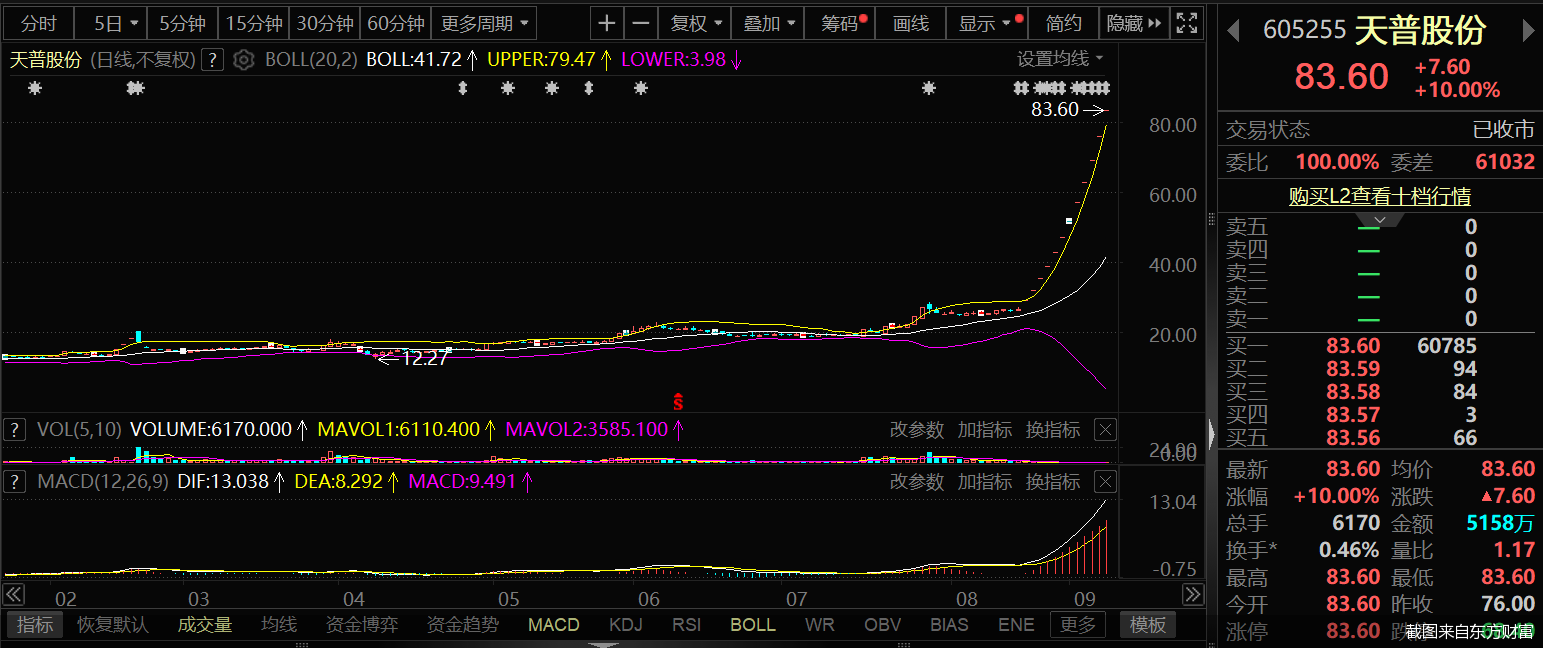
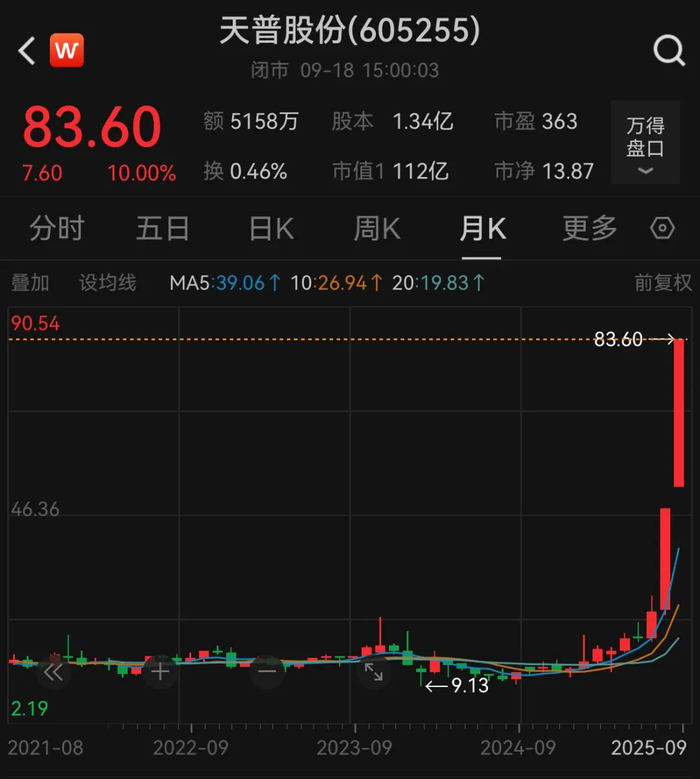
易主消息催生12连板,天普股份股价狂欢背后
Bei Jing Shang Bao· 2025-09-18 14:24
以股份转让完成为前提,中昊芯英、海南芯繁企业管理合伙企业(有限合伙)(以下简称"海南芯繁")和方东晖拟向天普股份控股股东天普控股增资,分别 增资6.19亿元、3.95亿元、5.07亿元。本次增资后,中昊芯英、海南芯繁、方东晖、尤建义分别持有30.52%、19.49%、24.99%、25%天普控股股权。本次权 益变更后,上市公司控股股东仍为天普控股,实际控制人将由尤建义变更为杨龚轶凡。 值得一提的是,本次增资协议触发全面要约义务,中昊芯英应先履行全面要约义务后方可履行上述《增资协议》,中昊芯英向除尤建义、天普控股、方东晖 外的所有公众股东持有的上市公司全部无限售条件流通股发出全面要约。 对于本次筹划让出天普股份控制权的原因,天普股份提及,实控人尤建义目前62岁,体力精力有限,无力推动上市公司转型升级,尤建义的子女均长期在国 外,不愿接班经营上市公司。因此,上市公司急需引入新实控人,推动上市公司高质量发展。本次交易完成后,尤建义仍会继续参与上市公司的经营管理, 保证上市公司平稳发展和过渡。 连续两度停牌核查,仍未阻挡投资者的炒作热情,9月18日,天普股份(605255)再度"一"字涨停,斩获12连板。当日晚间,上 ...

华为公布AI芯片路线图!
国芯网· 2025-09-18 13:35
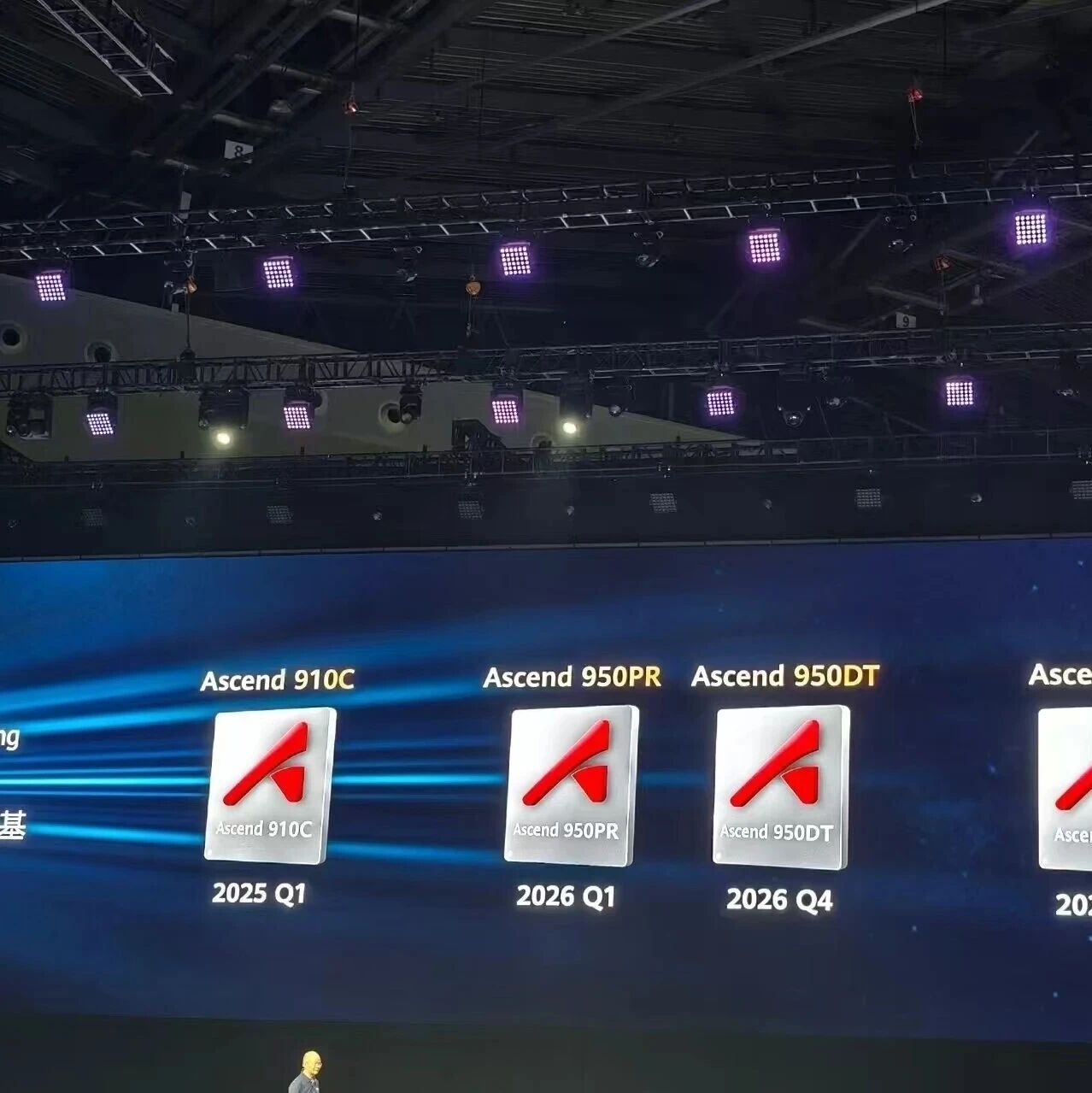
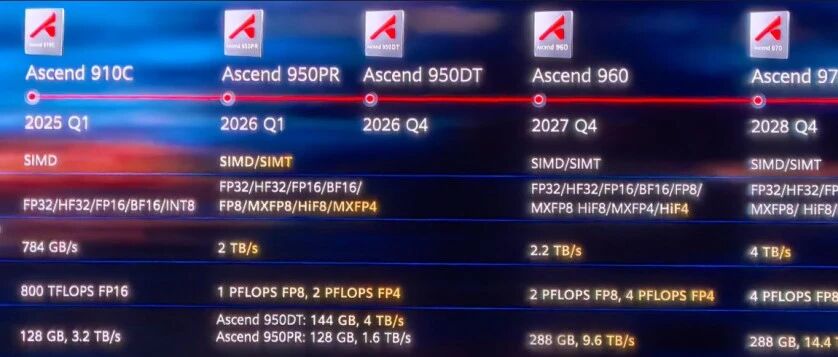
Core Viewpoint - Huawei announced its product roadmap for the Ascend AI chips, planning to release four new models from 2026 to 2028, with the first model featuring self-developed HBM technology [1][3]. Group 1: Product Roadmap - The roadmap includes the release of Ascend 950PR in Q1 2026, Ascend 950DT in Q4 2026, Ascend 960 in Q4 2027, and Ascend 970 in Q4 2028 [1]. - The Ascend 950PR and 950DT will utilize SIMD/SIMT microarchitecture, achieving performance of 1PFLOPS (FP8) and 2PFLOPS (FP4) respectively [4]. Group 2: Technical Specifications - The Ascend 910C chip has a computing power of 800TFLOPS, with a memory bandwidth of 784GB/s and HBM capacity of 128GB [3]. - In comparison, NVIDIA's latest Blackwell B300 chip has a computing power of approximately 3840TFLOPS and features 288GB HBM3e with a bandwidth of 8TB/s [4]. Group 3: Competitive Landscape - Huawei's chips are designed as NPU (Neural Processing Unit) for AI tasks, contrasting with NVIDIA's general-purpose GPU architecture [3]. - Despite U.S. sanctions limiting Huawei's access to TSMC for chip production, the company claims to leverage over 30 years of experience in interconnecting devices to enhance its computing capabilities [4].
光模块需求量和出货量
傅里叶的猫· 2025-09-18 11:15
Core Viewpoint - Huawei has launched new supernode products, significantly enhancing computing power and interconnect bandwidth, positioning itself as a leader in the AI chip industry [6][7][8]. Group 1: Huawei's New Products - The Atlas 950 supernode, based on the Ascend 950DT chip, supports 8192 Ascend 950DT chips, achieving a total computing power of 8E FLOPS for FP8 and 16E FLOPS for FP4, with an interconnect bandwidth of 16PB/s [7]. - The Atlas 960 supernode, based on the Ascend 960 chip, can support up to 15488 cards, with a total computing power of 30E FLOPS for FP8 and 60E FLOPS for FP4, and an interconnect bandwidth of 34PB/s [8]. - The Atlas 950 supernode is set to launch in Q4 2026, while the Atlas 960 is expected in Q4 2027, both significantly outperforming competitors like NVIDIA's upcoming products [7][8]. Group 2: Market Demand for Optical Modules - The demand for optical modules is projected to increase, with estimates for 2026 indicating a need for 3000-3200 million units, driven by major companies like Microsoft and NVIDIA [12]. - The 800G optical module market is expected to exceed expectations, particularly due to Microsoft's procurement strategies [12]. - The ratio of GPUs to optical modules varies by company, with NVIDIA at 1:3-1:4.5 and Google at approximately 1:14, indicating a growing need for optical modules in the industry [17]. Group 3: Key Suppliers and Market Dynamics - Major suppliers for optical modules include companies like 旭创 (Acacia), 菲尼萨 (Finisar), and 新易盛 (NewEase), with varying market shares across different clients [18]. - For 2026, the optimistic demand for 800G and 1.6T optical modules could reach nearly 50 million units, highlighting a potential supply gap [16]. - The competitive landscape shows that 旭创 is a dominant supplier for Google, while 新易盛 holds significant shares with AWS [18].
三维存算一体3D-CIM,破解AI芯片产业困局!
半导体芯闻· 2025-09-18 10:42
Core Viewpoint - The AI industry is experiencing explosive growth in computing power demand, with a projected global smart computing power gap of 35% by 2025, highlighting the critical role of AI chips in the technology competition landscape [2][3]. Group 1: AI Chip Market Dynamics - The demand for AI computing power is driven by large model parameters expanding at a rate of 10 times per year, particularly in key applications like autonomous driving and smart healthcare [2]. - The domestic AI chip industry faces challenges such as technological bottlenecks, limitations of traditional architectures, and insufficient ecosystems, necessitating the development of a self-controlled AI chip ecosystem [2][3]. Group 2: RISC-V Architecture and Its Significance - The RISC-V architecture is emerging as a crucial breakthrough due to its open-source and scalable nature, enabling the construction of a self-controlled hardware and software ecosystem for domestic AI chips [2][3]. - The RISC-V computing architecture is being integrated into high-performance computing, enhancing inference efficiency and energy efficiency compared to traditional architectures [2][3]. Group 3: Industry Forum and Standardization - The RISC-V Storage-Compute Integration Industry Forum was held on September 9, 2025, marking a significant step in breaking traditional computing architecture bottlenecks and establishing a self-controlled AI chip ecosystem in China [3][5]. - The forum aimed to establish a standardized roadmap for "RISC-V + Storage-Compute Integration" technology to support domestic chips in addressing large model computing challenges [5]. Group 4: Technical Challenges and Solutions - The AI chip industry faces three major challenges: hardware bottlenecks, ecological barriers, and architectural limitations, with the need for innovative technologies to address the growing computing power demands [9][10]. - The report emphasizes the importance of a new architecture and an open-source self-controlled ecosystem to overcome these challenges, proposing a three-dimensional storage-compute integration (3D-CIM) approach [10][12]. Group 5: Innovations in Storage-Compute Integration - The 3D-CIM approach integrates SRAM storage and computing, significantly improving computing efficiency and energy density, with potential energy efficiency improvements of 5-10 times compared to traditional digital circuits [12][15]. - The architecture supports various data formats and is designed to meet the full range of AI model requirements, although it still faces challenges in computational completeness and software ecosystem development [13][14]. Group 6: Strategic Implications and Future Outlook - The 3D-CIM technology is expected to empower the AI industry across various applications, from edge AI models to cloud computing, and aims to provide a self-controlled chip solution for China's AI model industry [16][18]. - The integration of RISC-V architecture with storage-compute technology is seen as a pathway to overcome international technological restrictions and enhance domestic chip capabilities [17][18].
12连板,天普股份再涨停,老板曝卖公司原因:子女不愿接班
2 1 Shi Ji Jing Ji Bao Dao· 2025-09-18 10:36
Core Viewpoint - Tianpu Co., Ltd. (605255.SH) has experienced a significant stock price surge, reaching a total market value of 11.2 billion yuan, with a cumulative increase of over 213% since August 22, following a resumption of trading after a suspension for stock price volatility [1][3]. Group 1: Stock Performance and Trading Resumption - Tianpu Co., Ltd. resumed trading on September 18 after a suspension due to abnormal stock trading fluctuations, achieving a daily limit increase [1][3]. - The stock has recorded 12 consecutive daily limit increases since August 22, with a total increase exceeding 213% [1][3]. Group 2: Insider Trading Investigation - An investigation revealed that four insiders engaged in stock trading between February 14 and August 14, with all profits returned to the company [3][4]. - The insiders included the spouse of the financial director and other related parties, with one individual making frequent trades and earning 59,900 yuan [4]. Group 3: Share Transfer and Control Change - The stock price surge began after an announcement on August 21 regarding a share transfer of 10.75% from Tianpu Holdings to Zhonghao Xinying, which would result in a change of actual control [4][5]. - Zhonghao Xinying is noted for its expertise in AI chip technology and has a valuation exceeding 4 billion yuan as of mid-2023 [4]. Group 4: Future Business Direction - Despite market expectations for asset injection post-acquisition, Tianpu Co., Ltd. clarified that there are no plans for significant changes to its main business in the next 12 months [5]. - The current actual controller, You Jianyi, stated the intention to transfer control to introduce new capabilities for company transformation, as he is unable to manage the company due to personal reasons [5].
四名内幕知情人提前交易!12连板天普股份突生变故:交易存终止风险
第一财经· 2025-09-18 10:29
Core Viewpoint - Tianpu Co., Ltd. has resumed trading with a significant stock price increase, marking a 12-day consecutive rise, following the announcement of a major acquisition by Zhonghao Xinying Technology Co., Ltd. [3] Summary by Sections Acquisition Details - Zhonghao Xinying plans to invest 1.36 billion yuan to gain control of Tianpu Co., Ltd., aiming to shift the company's focus from traditional fuel vehicles to the new energy vehicle sector [3][6] - Tianpu Co., Ltd. has denied any asset injection plans related to this acquisition, asserting that the transaction does not constitute a backdoor listing [5][6] Financial Analysis - Zhonghao Xinying has reported consecutive losses, with net profits of -42.98 million yuan in 2022, 81.33 million yuan in 2023, and 88.91 million yuan in 2024, along with a loss of 143.7 million yuan in the first half of 2025, failing to meet the main board's backdoor listing standards [7] - The acquisition may require up to 804 million yuan in additional funding, while Zhonghao Xinying's available funds are only 1.051 billion yuan after recent financing [6][7] Stock Performance - Tianpu Co., Ltd.'s stock has surged by 572% in 2023, rising from 12.44 yuan to 83.6 yuan, with significant price movements noted around key dates [8] - The stock experienced a notable increase following the acquisition announcement, leading to concerns about potential insider trading, although the company claims that transactions by insiders occurred before the acquisition information was known [8][9]

四名内幕知情人提前交易!12连板天普股份突生变故:交易存终止风险
Di Yi Cai Jing· 2025-09-18 10:25
Core Viewpoint - Tianpu Co., Ltd. has resumed trading with a significant stock price increase, raising questions about the acquisition by Zhonghao Xinying Technology Co., Ltd. and its implications for the company's future direction in the electric vehicle sector [2][3]. Group 1: Acquisition Details - Zhonghao Xinying plans to invest 1.36 billion yuan to gain control of Tianpu Co., Ltd., with the intention of shifting the company's focus from traditional fuel vehicles to electric vehicles [2][3]. - Tianpu Co., Ltd. has denied any asset injection plans related to the acquisition, asserting that the transaction does not constitute a backdoor listing [3][5]. - The acquisition is seen as a strategic move to leverage Tianpu's automotive resources and industry qualifications, despite the significant financial strain on Zhonghao Xinying [3][4]. Group 2: Financial Concerns - Zhonghao Xinying's financial situation is precarious, with reported losses of 42.98 million yuan in 2022 and projected losses of 143.7 million yuan in the first half of 2025, which raises concerns about its ability to meet the financial requirements for the acquisition [5][6]. - The company has a potential liability of up to 1.731 billion yuan due to performance-based agreements, which could complicate the acquisition process [5][6]. Group 3: Market Reactions and Regulatory Scrutiny - Tianpu Co., Ltd. has experienced a dramatic stock price increase of 572% this year, leading to regulatory scrutiny regarding potential insider trading [7][8]. - The company has conducted an internal review and found that four individuals with insider information engaged in stock trading prior to the announcement of the control change, but they claim this does not constitute insider trading [7].