居民消费价格指数(CPI)

Search documents
同比上涨0.8%
中国基金报· 2026-01-09 02:26
Core Viewpoint - In December 2025, the national consumer price index (CPI) increased by 0.8% year-on-year, with urban areas rising by 0.9% and rural areas by 0.6% [2][4]. Group 1: Year-on-Year Price Changes - In December, the prices of food, tobacco, and alcohol rose by 0.8%, contributing approximately 0.24 percentage points to the CPI [5]. - Fresh vegetable prices surged by 18.2%, impacting the CPI by about 0.39 percentage points, while fresh fruit prices increased by 4.4%, contributing 0.09 percentage points [5]. - Prices for eggs decreased by 12.7%, negatively affecting the CPI by 0.09 percentage points, and pork prices fell by 14.6%, contributing a decline of 0.20 percentage points [5]. - Other categories showed mixed results, with healthcare prices rising by 1.8% and clothing prices by 1.7%, while transportation and housing prices fell by 2.6% and 0.2%, respectively [5]. Group 2: Month-on-Month Price Changes - In December, food, tobacco, and alcohol prices increased by 0.2%, contributing approximately 0.05 percentage points to the CPI [7]. - Fresh fruit prices rose by 2.6%, impacting the CPI by 0.05 percentage points, while fresh vegetable prices increased by 0.8%, contributing 0.02 percentage points [7]. - Prices for other categories showed four increases, two stable, and one decrease, with other goods and services rising by 2.8% and living goods and services by 0.4% [7]. Group 3: Overall CPI Performance - The overall CPI for 2025 remained unchanged compared to the previous year [4]. - The CPI for urban areas increased by 0.1%, while rural areas saw a decline of 0.2% [9]. - Food prices decreased by 1.5% year-on-year, while non-food prices increased by 0.4% [9].


国家统计局:2025年12月份CPI同比上涨0.8% 环比上涨0.2%
智通财经网· 2026-01-09 01:43
Core Insights - In December 2025, the national consumer price index (CPI) increased by 0.8% year-on-year, with urban areas rising by 0.9% and rural areas by 0.6% [1][2] - The overall CPI for the year 2025 remained unchanged compared to the previous year [2] Price Changes by Category - Food and tobacco prices rose by 0.8% year-on-year, contributing approximately 0.24 percentage points to the CPI increase [4] - Fresh vegetable prices surged by 18.2%, impacting the CPI by about 0.39 percentage points, while fresh fruit prices increased by 4.4%, contributing 0.09 percentage points [4] - Prices for aquatic products rose by 1.6%, adding 0.03 percentage points to the CPI, whereas egg prices fell by 12.7%, reducing the CPI by 0.09 percentage points [4] - Meat prices decreased by 6.1%, with pork prices specifically dropping by 14.6%, leading to a CPI reduction of 0.20 percentage points [4] - Other categories showed mixed results, with healthcare prices increasing by 1.8% and clothing prices by 1.7%, while transportation and housing prices fell by 2.6% and 0.2%, respectively [4] Month-on-Month Price Changes - In December, the CPI rose by 0.2% month-on-month, with urban and rural areas both increasing by 0.2% [2][8] - Food prices increased by 0.3% month-on-month, while non-food prices rose by 0.1% [8] - The prices of other goods and services saw varied changes, with other supplies and services rising by 2.8% and healthcare by 0.1%, while housing prices decreased by 0.1% [6][8]
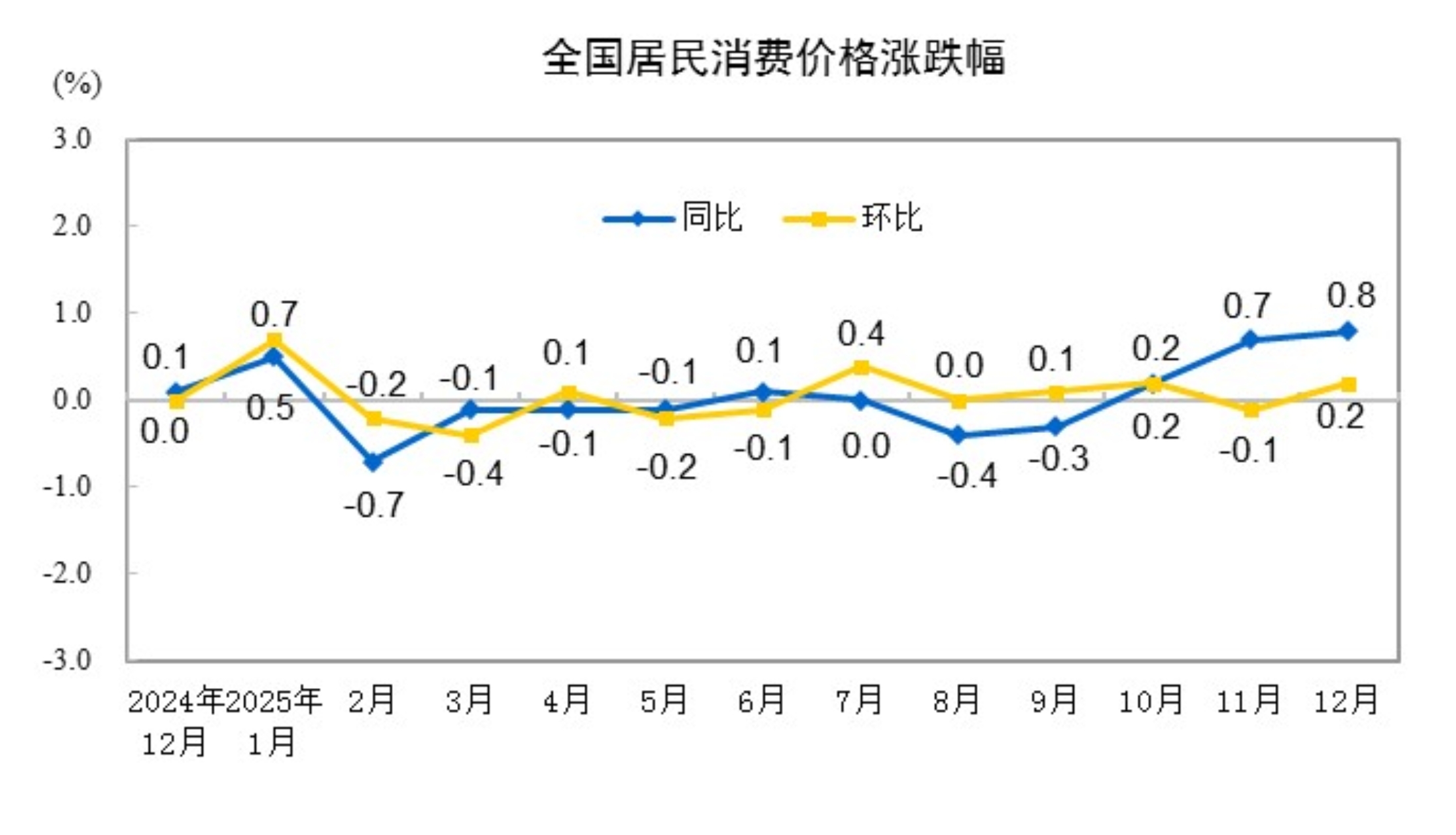
2025年12月份居民消费价格同比上涨0.8%
Guo Jia Tong Ji Ju· 2026-01-09 01:33
Core Insights - In December 2025, the national consumer price index (CPI) increased by 0.8% year-on-year, with urban areas rising by 0.9% and rural areas by 0.6% [1][8] - Food prices rose by 1.1% year-on-year, while non-food prices increased by 0.8% [1] - The overall CPI remained unchanged for the entire year of 2025 [1] Year-on-Year Price Changes - In December, the prices of food, tobacco, and alcohol increased by 0.8% year-on-year, contributing approximately 0.24 percentage points to the CPI [3] - Fresh vegetable prices surged by 18.2%, impacting the CPI by approximately 0.39 percentage points [3] - Prices for fresh fruits rose by 4.4%, contributing about 0.09 percentage points to the CPI [3] - Prices for eggs decreased by 12.7%, negatively affecting the CPI by about 0.09 percentage points [3] - Pork prices fell by 14.6%, leading to a 0.20 percentage point decline in the CPI [3] Month-on-Month Price Changes - In December, food, tobacco, and alcohol prices increased by 0.2% month-on-month, contributing approximately 0.05 percentage points to the CPI [6] - Fresh fruit prices rose by 2.6%, impacting the CPI by about 0.05 percentage points [6] - Prices for fresh vegetables increased by 0.8%, contributing approximately 0.02 percentage points to the CPI [6] - Prices for meat products decreased by 0.8%, negatively affecting the CPI by about 0.02 percentage points [6] Detailed Price Category Analysis - The CPI for food and tobacco increased by 0.2% month-on-month, while the year-on-year change was 0.8% [8] - The price of fresh vegetables increased by 0.8% month-on-month but saw a significant year-on-year increase of 18.2% [8] - The price of pork decreased by 1.7% month-on-month and saw a year-on-year decline of 14.6% [8] - Prices for other categories such as clothing and education services showed slight increases, while transportation and communication prices remained stable [8]
11月全市CPI同比上涨0.3% 鸡蛋价格同比下跌超两成
Zhen Jiang Ri Bao· 2025-12-29 23:38
环比方面,八大类商品及服务价格"一涨七跌"。其中,其他用品及服务价格上涨1.6%;教育文化娱 乐价格下跌1.2%,交通通信价格下跌1.1%,衣着价格下跌0.5%,食品烟酒价格下跌0.4%,居住价格下 跌0.1%,医疗保健价格下跌0.1%,生活用品及服务价格下跌0.1%。食品中,鲜果价格上涨5.2%,食用 动物油价格上涨2.9%,羊肉价格上涨1.2%;鲜菌价格下跌12.1%,淡水鱼价格下跌5.8%,鲜菜价格下跌 3.5%,鸡蛋价格下跌3.3%,猪肉价格下跌2.8%。(王阳 记者 陈志奎) 统计调查显示,八大类商品及服务价格同比"四涨四跌"。其中,其他用品及服务价格上涨18.8%, 衣着价格上涨4.4%,生活用品及服务价格上涨3.3%,教育文化娱乐价格上涨1.2%;医疗保健价格下跌 3.5%,交通通信价格下跌1.6%,食品烟酒价格下跌0.6%,居住价格下跌0.3%。食品中,鲜菜价格上涨 13.9%,鲜菌价格上涨12.4%,淡水鱼价格上涨6.4%;鸡蛋价格下跌21.1%,猪肉价格下跌15.5%,虾蟹 类价格下跌7.3%,鲜果价格下跌6.9%,食用动物油价格下跌6.7%。 记者近日从国家统计局镇江调查队获悉,11月份 ...
【宏观经济】一周要闻回顾(2025年12月10日-12月16日)
乘联分会· 2025-12-16 08:39
Consumer Price Index (CPI) Overview - In November 2025, the national consumer price index (CPI) increased by 0.7% year-on-year, with urban areas rising by 0.7% and rural areas by 0.4% [3] - Food prices rose by 0.2%, while non-food prices increased by 0.8% [3] - The average CPI from January to November remained flat compared to the previous year [3] Price Changes in November - Year-on-year, food, tobacco, and alcohol prices increased by 0.3%, contributing approximately 0.09 percentage points to the CPI [4] - Fresh vegetable prices surged by 14.5%, impacting the CPI by about 0.31 percentage points [4] - Pork prices fell by 15.0%, leading to a decrease in CPI by approximately 0.21 percentage points [4] Month-on-Month Price Changes - In November, the CPI decreased by 0.1% month-on-month, with urban areas also declining by 0.1% [3] - Food prices increased by 0.5% month-on-month, while non-food prices decreased by 0.2% [3] - Among various categories, other goods and services prices rose by 14.2%, while transportation and communication prices fell by 2.3% [4][5] Industrial Production - In November 2025, the industrial added value for large-scale enterprises grew by 4.8% year-on-year, with a month-on-month increase of 0.44% [7] - The mining sector saw a 6.3% increase, while manufacturing and electricity, heat, gas, and water production and supply grew by 4.6% and 4.3%, respectively [7] - Among 41 major industries, 30 reported year-on-year growth in added value [7] Retail Sales Performance - The total retail sales of consumer goods reached 43,898 billion yuan in November, marking a 1.3% year-on-year increase [10] - Retail sales excluding automobiles grew by 2.5% [10] - Online retail sales from January to November amounted to 144,582 billion yuan, reflecting a 9.1% year-on-year increase [12] Fixed Asset Investment Trends - From January to November 2025, fixed asset investment (excluding rural households) totaled 444,035 billion yuan, a decrease of 2.6% year-on-year [15] - The investment in the primary industry rose by 2.7%, while the secondary industry saw a 3.9% increase [15] - Infrastructure investment in the tertiary sector declined by 1.1% [15]

11月份北京CPI同比上涨0.6%,PPI同比下降1.3%
Bei Jing Shang Bao· 2025-12-16 02:50
Economic Overview - In November, Beijing's consumer price index (CPI) increased by 0.6% year-on-year, with the growth rate expanding by 0.5 percentage points compared to the previous month, while it decreased by 0.2% month-on-month [1] - From January to November, the CPI in Beijing decreased by 0.3% year-on-year, with the decline rate consistent with that of the first ten months [1] Price Changes - Food prices fell by 2.4%, while non-food prices rose by 0.1% [1] - Consumer goods prices decreased by 0.5%, and service prices remained stable [1] - Among the eight categories of goods and services that constitute the CPI, four categories saw price increases while four experienced declines [1] Specific Price Movements - Prices for other goods and services, living goods and services, clothing, and housing rose by 12.1%, 1.9%, 0.2%, and 0.1% year-on-year, respectively [1] - Conversely, transportation and communication, food and tobacco, education and cultural entertainment, and medical care prices fell by 2.2%, 1.5%, 1.2%, and 0.5% year-on-year, respectively [1] Industrial Price Trends - In November, the producer price index (PPI) for industrial producers decreased by 1.3% year-on-year, with the decline rate narrowing by 0.1 percentage points compared to the previous month, and a month-on-month decrease of 0.2% [1] - The purchasing price index also saw a year-on-year decline of 1.7%, with the decline rate narrowing by 0.3 percentage points compared to the previous month, and a month-on-month decrease of 0.1% [1] - From January to November, both the PPI and purchasing prices decreased by 1.7% year-on-year, with the decline rates remaining consistent with those of the first ten months [1]
11月份核心CPI同比上涨1.2%!创2024年3月以来新高
Zheng Quan Shi Bao Wang· 2025-12-15 05:16
Group 1 - In November, the Consumer Price Index (CPI) increased by 0.7% year-on-year, with the growth rate expanding by 0.5 percentage points compared to the previous month, marking the highest increase since March 2024 [2] - The core CPI, excluding food and energy prices, rose by 1.2% year-on-year, maintaining a growth rate above 1% for three consecutive months [3] - The Producer Price Index (PPI) decreased by 2.2% year-on-year, with the decline rate widening by 0.1 percentage points compared to the previous month, influenced by a high comparison base from the previous year [4] Group 2 - Food prices contributed to the CPI increase, with fresh vegetable prices rising by 14.5% year-on-year after a nine-month decline, significantly impacting the CPI [2] - The prices of coal mining and washing, photovoltaic equipment manufacturing, and lithium-ion battery manufacturing have shown a narrowing decline in year-on-year prices, indicating the effectiveness of measures against "involution" competition [4][5] - Emerging industries are driving price increases in related sectors, with prices for external storage devices and components rising by 13.9% year-on-year, and integrated circuit manufacturing prices increasing by 1.7% [4][5]
国家统计局:价格最近两个月出现了一些积极变化
Xin Jing Bao· 2025-12-15 03:37
Core Viewpoint - The overall market prices in China have been operating at low levels this year, but recent measures to promote reasonable price recovery have started to show positive changes in the last two months [1] Group 1: Consumer Price Index (CPI) Trends - In November, the Consumer Price Index (CPI) increased by 0.7% year-on-year, marking the highest year-on-year increase of the year and a 0.5 percentage point rise from the previous month [1] - The core CPI, excluding food and energy, rose by 1.2% year-on-year, continuing a trend of over 1% growth for three consecutive months since May [1] Group 2: Factors Influencing Price Changes - The increase in consumer prices is primarily attributed to the rebound in food prices, rising industrial consumer goods prices, and stable service prices [1] - Food prices saw a significant increase, with fresh vegetable prices rising by 14.5% year-on-year in November, marking the first increase after nine months of decline [1] - Industrial consumer goods prices rose due to expanded consumption policies, with household appliance prices increasing by 4.9% year-on-year [1] - Although prices for travel-related services experienced seasonal declines, the overall stability in service prices is supported by the growing demand for high-quality living [1]
国信期货有色(镍)周报:弱势震荡,成本定价-20251214
Guo Xin Qi Huo· 2025-12-13 23:30
2 基本面分析 研究所 弱势震荡,成本定价 ——国信期货有色(镍)周报 2025年12月14日 研究所 目 录 CONTENTS 1 行情回顾 3 后市展望 研究所 Part1 第一部分 行情回顾 1.1 行情回顾——期货主力合约价格走势 研究所 0.00 50,000.00 100,000.00 150,000.00 200,000.00 250,000.00 300,000.00 2020/12/31 2021/02/28 2021/04/30 2021/06/30 2021/08/31 2021/10/31 2021/12/31 2022/02/28 2022/04/30 2022/06/30 2022/08/31 2022/10/31 2022/12/31 2023/02/28 2023/04/30 2023/06/30 2023/08/31 2023/10/31 2023/12/31 2024/02/29 2024/04/30 2024/06/30 2024/08/31 2024/10/31 2024/12/31 2025/02/28 2025/04/30 2025/06/30 2025/08/31 ...
下周一,重要预告!
券商中国· 2025-12-12 07:31
Economic Overview - The State Council Information Office will hold a press conference on December 15, 2025, to discuss the national economic operation for November 2025, presented by Fu Linghui, spokesperson of the National Bureau of Statistics [1] Consumer and Producer Price Index - In November, the Consumer Price Index (CPI) increased by 0.7% year-on-year, with the growth rate expanding; the core CPI, excluding food and energy, rose by 1.2%, maintaining a growth rate above 1% for three consecutive months [3] - The Producer Price Index (PPI) saw a month-on-month increase of 0.1%, marking two consecutive months of growth; however, it decreased by 2.2% year-on-year, with the decline rate widening by 0.1 percentage points compared to the previous month [3] - Notably, the effects of comprehensive rectification of "involution-style" competition are becoming evident, as industries such as coal mining, photovoltaic equipment manufacturing, and lithium-ion battery manufacturing have experienced a narrowing of year-on-year price declines for several months [3] - The price trends in certain industries reflect the rapid development of emerging industries and the effective release of consumer potential [3]