
移动互联网

Search documents
北纬科技股价跌5.12%,华夏基金旗下1只基金位居十大流通股东,持有1061.11万股浮亏损失626.05万元
Xin Lang Cai Jing· 2025-08-28 03:05
Group 1 - The core point of the news is that Beiwai Technology's stock price dropped by 5.12% to 10.93 CNY per share, with a trading volume of 331 million CNY and a turnover rate of 6.60%, resulting in a total market capitalization of 6.11 billion CNY [1] - Beiwai Technology, established on November 12, 1997, and listed on August 10, 2007, is primarily engaged in traditional mobile value-added services such as SMS, MMS, and ringtone services, as well as mobile internet-based businesses like mobile games and videos [1] - The revenue composition of Beiwai Technology includes 65.10% from IoT applications and other mobile communication services, 19.27% from mobile gaming, 15.26% from mobile internet industrial parks, and 0.37% from other supplementary services [1] Group 2 - Among the top ten circulating shareholders of Beiwai Technology, Huaxia Fund's Huaxia Zhongzheng Animation Game ETF (159869) increased its holdings by 1.9275 million shares, totaling 10.6111 million shares, which represents 2.36% of the circulating shares [2] - The Huaxia Zhongzheng Animation Game ETF (159869) was established on February 25, 2021, with a latest scale of 7.073 billion CNY, achieving a year-to-date return of 45.7% and ranking 246 out of 4222 in its category [2] - The fund has a one-year return of 99.41%, ranking 224 out of 3776, and a total return since inception of 46.01% [2]

移动互联网: 鹏华中证移动互联网指数型证券投资基金(LOF)2025年中期报告
Zheng Quan Zhi Xing· 2025-08-27 15:17
鹏华中证移动互联网指数型证券投资基金 (LOF) 基金管理人:鹏华基金管理有限公司 基金托管人:中国建设银行股份有限公司 送出日期:2025 年 8 月 28 日 鹏华中证移动互联网指数(LOF)2025 年中期报告 基金管理人的董事会、董事保证本报告所载资料不存在虚假记载、误导性陈述或重大遗漏, 并对其内容的真实性、准确性和完整性承担个别及连带的法律责任。本中期报告已经三分之二以 上独立董事签字同意,并由董事长签发。 基金托管人中国建设银行股份有限公司根据本基金合同规定,于 2025 年 08 月 27 日复核了本 报告中的财务指标、净值表现、利润分配情况、财务会计报告、投资组合报告等内容,保证复核 内容不存在虚假记载、误导性陈述或者重大遗漏。 基金管理人承诺以诚实信用、勤勉尽责的原则管理和运用基金资产,但不保证基金一定盈利。 基金的过往业绩并不代表其未来表现。投资有风险,投资者在作出投资决策前应仔细阅读本 基金的招募说明书及其更新。 本报告中财务资料未经审计。 本报告期自 2025 年 01 月 01 日起至 2025 年 06 月 30 日止。 第 2页 共 55页 鹏华中证移动互联网指数(LOF)20 ...


(经济观察)万亿千瓦时用电量折射中国经济热力
Zhong Guo Xin Wen Wang· 2025-08-23 14:42
Group 1: Electricity Consumption Growth - In July, China's total electricity consumption exceeded 1 trillion kilowatt-hours for the first time, reflecting strong economic activity, with a year-on-year growth of 8.6% [1] - The highest electricity load reached 1.508 billion kilowatts, an increase of 57 million kilowatts compared to last year's peak [1] - Urban and rural residential electricity consumption in July reached 203.9 billion kilowatt-hours, a significant year-on-year increase of 18% [1] Group 2: Economic Drivers of Electricity Demand - The third industry showed robust growth in electricity consumption, with a total of 1.13 trillion kilowatt-hours from January to July, marking a year-on-year increase of 7.8% [2] - The internet and related services sector saw a remarkable year-on-year growth of 28.2% in electricity consumption during the same period [2] - Hangzhou's digital economy led the charge with a 15.7% increase in electricity consumption in the information transmission, software, and IT services sector [2] Group 3: Electric Vehicle Impact - The charging and swapping service industry for electric vehicles experienced a significant year-on-year growth of 42.6% in electricity consumption from January to July [3] - The number of electric vehicle charging infrastructure units increased by 93.2% year-on-year, reaching 16.696 million by the end of July [3] - The penetration rate of new energy vehicles in China's passenger car market is expected to reach 56.7% in August, which is anticipated to further boost electricity consumption in the charging service sector [3]
艾瑞咨询上半年10大“最受欢迎”研究报告,限时免费下载
艾瑞咨询· 2025-08-23 00:06
Core Viewpoint - The article emphasizes the importance of digital transformation across various industries, highlighting the role of market insights and refined operations in enhancing competitive advantage and profitability [3]. Group 1: Company Overview - AsiaInfo Technology (stock code 01675.HK) is a leading provider of information technology products and services, supporting digital transformation in sectors such as telecommunications, government, energy, transportation, broadcasting, finance, and postal services [3]. Group 2: Market Trends - The market is currently in a phase of intense competition, with a focus on "market insights and refined operations" becoming crucial for enhancing market recognition and profitability [3]. - The digital transformation of various industries is deepening, indicating a shift towards a more competitive landscape [3]. Group 3: Research Reports - The article mentions a series of research reports produced by iResearch Consulting, focusing on industry analysis, data insights, market research, and strategic consulting, aimed at providing precise insights into industry trends and assisting business decisions [3]. - Ten popular research reports have been highlighted, covering topics such as artificial intelligence, mobile internet, digital economy, manufacturing digital transformation, fintech, healthcare trends, cultural tourism, AI in marketing, gaming technology, and cross-border e-commerce [5][8][11][12][14][16][17][19][21][22].

我,公司还没注册,红杉就投了
投中网· 2025-08-22 07:04
Core Viewpoint - The article highlights the current trend in AI investment, where investors are increasingly interested in startups led by former executives from major tech companies, despite the early stage of product development and high uncertainty in the market [3][4]. Group 1: Investment Trends - The AI investment landscape is characterized by a rush to secure funding for projects that are still in the demo stage, as evidenced by a startup receiving investment letters from Sequoia and Huachuang without a registered company [3]. - Investors are adopting a "buy the track" strategy reminiscent of the mobile internet boom, focusing on high-potential projects despite their inherent uncertainties [3][4]. Group 2: Entrepreneurial Insights - The guest, an entrepreneur named Orange, emphasizes that the current entrepreneurial environment values potential over certainty, indicating a shift in focus towards the upper limits of what a product can achieve [4][5]. - Orange's product, ListenHub, is designed to create audio content based on user prompts, reflecting a significant change in how content is produced and consumed in the AI era [4][14]. Group 3: Market Dynamics - The article discusses the transformation in content creation, where AI can now lower the barriers for consumers to become creators, potentially expanding the market size significantly [7][24]. - The personalization of content has evolved from pre-produced material to on-demand generation based on user needs, marking a departure from traditional content distribution methods [25][24]. Group 4: Technological Evolution - The conversation highlights the rapid technological changes in AI, suggesting that companies must adapt quickly to remain relevant, as traditional methods may no longer apply [20][21]. - The importance of embracing uncertainty and leveraging AI capabilities within teams is emphasized, indicating a need for a shift in organizational structure and mindset [20][21]. Group 5: Future Perspectives - The article concludes with reflections on the unique qualities of human experience that AI cannot replicate, suggesting that while AI can enhance productivity, it lacks the depth of human memory and emotional context [53][44]. - The potential for AI to serve as a companion and facilitator in human experiences is discussed, indicating a future where AI plays a significant role in daily life [39][41].

策略专题:“慢长牛”在途,怎么追,怎么切?
Guoxin Securities· 2025-08-21 12:59
Group 1 - The report discusses the "slow bull market" and how to navigate it, highlighting the systematic increase in index slope during the liquidity bull market from 2014 to 2015, with industry "bloom periods" becoming shorter [1][10] - It notes that from Q2 2014 to the peak in 2015, there was a significant rotation among industries, with leading sectors experiencing substantial underperformance in subsequent periods [15][16] - The report emphasizes that during the liquidity bull market, the market was less sensitive to fundamentals, with ROE becoming relatively important only during phases of poor profitability [22][31] Group 2 - The exploration of acceleration models indicates that during the liquidity bull market, the fundamental performance was not a major concern, and only in phases of poor profitability did ROE gain significance [22][31] - The report outlines that the reasonable forward valuation level for the ChiNext index during the bull market was between 81.0x and 102x, with a minimum of 15% overvaluation during peak periods [31][34] - It highlights that companies or sectors that cannot be precisely valued often end up in a state of high bubble, using LeTV as a case study where its market value exceeded 100 billion due to speculative trading [34][38] Group 3 - The report analyzes the cashing-out model, indicating that preemptive cashing out often requires event-driven catalysts, with examples such as the merger of China South Locomotive and China North Locomotive [43][46] - It discusses how high-amplitude stocks can create continuous excess returns, with higher daily volatility correlating with increased chances of excess returns during upward trends [49][50] - The report concludes that index resonance upward relies on structural rotation and the stability of high-position stocks, which can provide positive feedback to market sentiment [55][59]
全社会用电量7月首次突破万亿千瓦时大关 背后有哪些用电新增量?
Yang Shi Wang· 2025-08-21 10:56
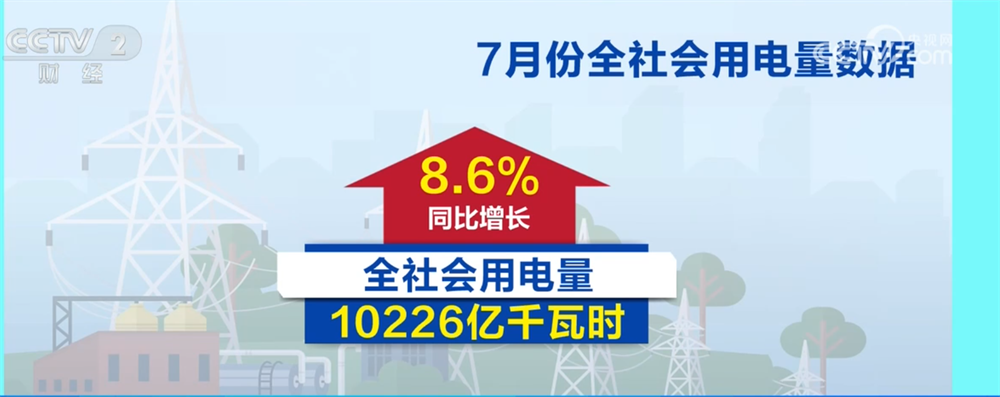
Core Insights - In July, China's total electricity consumption reached 1.0226 trillion kilowatt-hours, marking the first time it surpassed the trillion-kilowatt-hour threshold in a month [1][3] - The total electricity consumption in July increased by 8.6% year-on-year, with significant growth in various sectors [3] Sector Analysis - The primary industry consumed 17 billion kilowatt-hours, up 20.2% year-on-year [3] - The secondary industry consumed 5,936 billion kilowatt-hours, with a year-on-year growth of 4.7%, an increase of 1.5 percentage points from the previous month [3][5] - The tertiary industry consumed 2,081 billion kilowatt-hours, growing by 10.7% year-on-year [3] Factors Driving Growth - High temperatures in July contributed to a rapid increase in electricity consumption, with urban and rural residential electricity usage rising by 18.0% [5] - The internet and related services sector saw a remarkable year-on-year growth of 28.2% from January to July, driven by advancements in mobile internet, big data, and cloud computing [7] - The electric vehicle charging service sector experienced a significant year-on-year growth of 42.6% [7] Regional Developments - In Zhejiang, a steel plant transformed into a cloud manufacturing industrial park, establishing a data center and achieving a 38% year-on-year increase in electricity consumption in July [8] - Shenzhen became the first city in China where the number of electric vehicle charging stations surpassed that of gas stations, with the third industry electricity consumption reaching 25.905 billion kilowatt-hours, up 6.4% year-on-year [11] - In Jiangsu, the local football league and "night economy" led to a more than 25% year-on-year increase in electricity consumption in the restaurant sector [13]
我国月度用电量规模首次突破万亿千瓦时
Ren Min Ri Bao· 2025-08-21 08:21
Core Insights - In July, China's total electricity consumption reached 10,226 billion kilowatt-hours, marking the first time it surpassed the trillion-kilowatt-hour threshold in a month, with a year-on-year growth of 8.6% [1] Industry Analysis - By sector, electricity consumption in the primary industry was 17 billion kilowatt-hours, up 20.2% year-on-year; the secondary industry consumed 5,936 billion kilowatt-hours, growing by 4.7%; and the tertiary industry used 2,081 billion kilowatt-hours, with a growth of 10.7% [1] - Urban and rural residential electricity consumption was 2,039 billion kilowatt-hours, reflecting an 18% year-on-year increase [1] Cumulative Data - From January to July, total electricity consumption accumulated to 58,633 billion kilowatt-hours, with a year-on-year growth of 4.5% [1] - The secondary industry's electricity consumption showed a continuous recovery, with high-tech and equipment manufacturing sectors collectively increasing by 4.6%, outpacing the average manufacturing growth rate by 2.3 percentage points [1] - The new energy vehicle manufacturing sector maintained rapid growth, with electricity consumption rising by 25.7% year-on-year [1] Tertiary Sector Growth - The tertiary industry's electricity consumption continued to grow rapidly, with the information transmission/software and IT services sector increasing by 15.5% year-on-year, driven by the rapid development of mobile internet, big data, and cloud computing [1] - The internet and related services sector saw a significant increase in electricity consumption, growing by 28.2% year-on-year [1] Weather Impact - July experienced multiple rounds of high temperatures across various regions, leading to a rapid increase in urban and rural residential electricity consumption, with provinces like Henan, Shaanxi, Shandong, Sichuan, Anhui, and Hubei reporting year-on-year growth exceeding 30% [1]
从流量积累到商业变现,AI 互联网时代下的新一轮巨头之争开始了吗?
机器之心· 2025-08-16 01:30
Core Viewpoint - The release of GPT-5 with its Router dynamic switching mechanism is seen as a pivotal tool for OpenAI to commercialize advertising, posing significant challenges to traditional internet giants reliant on traffic for revenue generation [1]. Group 1: AI Companies Breaking the Traffic Monopoly - AI applications are rapidly growing their user base, positioning themselves to compete with traditional mobile internet Super Apps [5]. - In China, DeepSeek is projected to reach 194 million monthly active users by March 2025, surpassing Doubao and Tencent Yuanbao [5]. - Globally, ChatGPT has surpassed 700 million weekly active users, while Gemini has over 450 million monthly active users [5][6]. - The user traffic of AI applications is driven by the benefits of large model technologies, which create a new paradigm of value generation [6][7]. Group 2: AI Companies' Commercial Foundations - The introduction of AI as a platform capability raises questions about the necessity of multiple apps for users [3]. - AI applications can directly create tangible value from user interactions, unlike traditional mobile internet applications that primarily rely on traffic and information distribution [7][8]. Group 3: Competition Between Chinese and American Internet Giants - The differing investment attitudes of Chinese and American internet giants in AI may impact their future competitiveness [4]. - Traditional internet giants like Meta, Google, and Tencent heavily rely on advertising revenue, with Meta generating 98% of its revenue from ads [9].






上证移动互联网指数下跌1.65%,前十大权重包含兆易创新等
Jin Rong Jie· 2025-08-08 16:26
Group 1 - The Shanghai Composite Index opened lower with the Shanghai Mobile Internet Index (H50053) declining by 1.65% to 2553.98 points, with a trading volume of 39.362 billion yuan [1] - The Shanghai Mobile Internet Index has increased by 11.12% over the past month, 12.56% over the past three months, and 16.55% year-to-date [1] - The index is composed of securities from mobile terminal providers, mobile internet platform operators, and other companies benefiting from mobile internet, reflecting the overall performance of listed companies in the mobile internet industry [1] Group 2 - The Shanghai Mobile Internet Index is entirely composed of stocks listed on the Shanghai Stock Exchange, with 100% representation [2] - The industry composition of the index shows that Information Technology accounts for 85.63%, Communication Services for 13.49%, and Consumer Discretionary for 0.88% [2] - The index samples are adjusted quarterly, with adjustments occurring in the second Friday of March, June, September, and December, and weights are fixed until the next scheduled adjustment [2]
